EDAMAME Introduces Runtime Verification for Coding and Self-Improving AI Agents
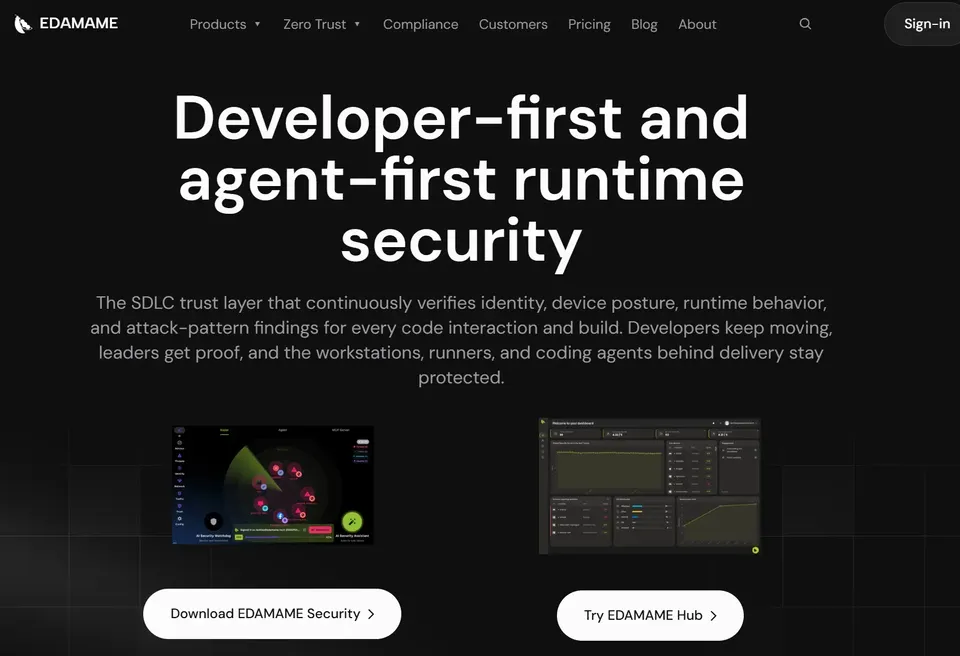
New developer-first evidence layer detects intent divergence and attack patterns across developer workstations, CI/CD runners and cloud environments.
EDAMAME Technologies today announced runtime verification and deterministic guardrails for coding and self-improving AI agents, giving security and platform teams a way to detect when agent behaviour diverges from declared intent and when host telemetry shows attack patterns across developer workstations, CI/CD runners and cloud environments.
As software teams adopt agentic development, agents increasingly operate with access to source code, local files, shells, package managers, credentials, internal services and external network destinations. Traditional controls typically observe outputs, scan code after the fact or monitor processes from the outside. EDAMAME uses host telemetry to compare each agent’s declared intent with observed process, file, network, credential and posture activity.
The new capability produces two immediate signals: runtime-verification divergence evidence when behaviour drifts from declared intent, and attack-pattern findings such as credential harvest, token exfiltration and sensitive-file access. It can run in reporting-only mode for developer adoption and can provide continuous evidence for security, platform and compliance teams. The same trust model applies from the workstation to the runner to the cloud, and the evidence is produced at the host boundary rather than inside the model prompt.
“Coding agents are becoming the execution layer for software delivery,” said Frank Lyonnet, founder and CEO of EDAMAME Technologies. “That changes the security question from ‘is this developer trusted?’ to ‘did the agent stay inside the operator’s intent, on this host, under this posture?’ EDAMAME measures that divergence from host telemetry, and alerts immediately when the evidence shows intent drift or concrete attack patterns.”
A product demo is available at https://youtu.be/zAN4u7ImWrU
EDAMAME Technologies is a French software company building a developer-first trust layer for secure software delivery, founded by Frank Lyonnet, PhD — a former researcher at INRIA, France’s national institute for research in digital science and technology. Its products help developers, security teams and platform teams enforce identity, device posture, code and runtime-policy checks across developer workstations, CI/CD and cloud workflows. The runtime-verification primitive underpinning this announcement is protected by French patent FR3146742, granted by INPI in April 2026. EDAMAME Technologies is a member of France DeepTech, the French network of startups commercialising disruptive science, and works with academic collaborators including Kave Salamatian, Professor of Computer Science at the University of Savoie, on verifiable behaviour of autonomous software agents. EDAMAME Technologies is backed by individual investors who are executives at Netskope, UiPath, and Sonar. Headquartered in Paris with operations in San Francisco. More information is available at