'I'm His Mother. I'm Exhausted. Is He Dead, or Alive?': The Palestinians Israel Disappeared, and the Smiling Soldiers Who Photographed Them
A schizophrenic man led off after evening prayer. An elderly woman torn from her son's arms. Two years on, their families still don't know if they are alive. Their captors do — and they posted the pictures.
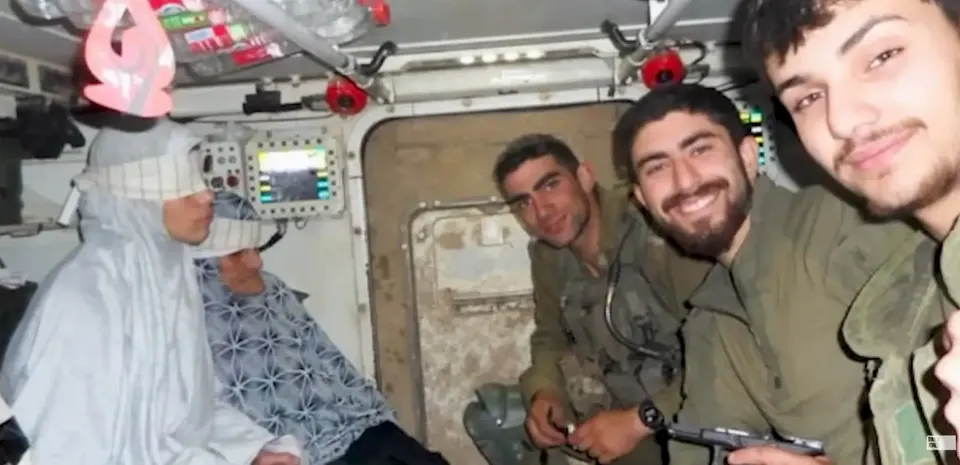
The picture surfaced online in early 2026. Two women, blindfolded, slumped in the back of an Israeli military vehicle. Three Israeli soldiers in the frame, grinning at the camera.
For the al-Akkad family of Khan Younis, the photograph was the first sign in more than two years that their mother and sister might still be alive. The last time they had seen Aisha and Huda al-Akkad was in December 2023, when Israeli soldiers entered the house where the family had taken shelter and tore Aisha — an elderly grandmother — from her son Zacharia's arms.
They were never heard from again. Until, that is, an image of two blindfolded women appeared online, posed for the entertainment of their captors.
When the Global Legal Action Network (GLAN), a UK-based legal non-profit, formally requested information from the Israeli military in early 2026, the response was a sentence that closed the file rather than opened it. The women, the military said, had been "released in Gaza." No date. No location. No further detail.
"That's as far as they're willing to go," Dearbhla Minogue, a Senior Lawyer at GLAN, tells me.
The al-Akkads are two names among many. According to the Palestinian Centre for Human Rights and corroborated by Sky News special correspondent Alex Crawford — whose recent investigation traced the last known movements of the same family — at least 800 Palestinians were last seen alive in Israeli military custody before vanishing. The true figure of those forcibly disappeared since October 2023 runs into the thousands. Gaza, sealed to international journalists, has become what Minogue calls "a black hole" — a 25-mile strip the size of east London where the worst crimes of the war are taking place beyond the gaze of independent witnesses.
This is the story of two of those vanishings, and of a pattern that the Israeli military's own soldiers, in their own social-media posts, in their own admissions to Israeli newspapers, have now made undeniable.
The grandfather in the courtyard
The al-Akkads were a family rooted in their home in Khan Younis, in southern Gaza. When Israeli forces issued an evacuation order in December 2023 and the tanks began their advance, the family argued about whether to leave. The grandparents, Muhammad and Aisha, refused. They were elderly. The house was theirs. Their three adult children — Zacharia, Iyad and Huda — stayed behind to look after them.
The first death came almost immediately. Muhammad, the grandfather, was shot by Israeli forces in the courtyard of the family home. His relatives could not reach him to give him first aid or carry him to a hospital. He bled to death where he fell.
The next day, the family moved to a nearby house they thought might be sturdier. It was there, Minogue says, that Israeli soldiers stormed in and separated the men from the women in what she describes as "incredibly traumatic circumstances" — the moment Aisha was wrenched from her son.
Iyad al-Akkad ended up in Israeli detention, which is how his account of the raid eventually reached his family and GLAN's investigators. Aisha and Huda simply disappeared. Nothing — no notification, no record, no remains — for almost two years.
Then the photograph.
The Israeli military's answer, when GLAN finally extracted one, amounts to an institutional shrug. "Released in Gaza." Released to whom? Released where? Released alive, or released as bodies? The family does not know. The two women have not returned.
"He needs to take tablets every day"
Mohammed Sharab was 41 years old and lived with his mother Zahra in Khan Younis. He had schizophrenia and required, by every account of those who knew him, near-constant care. Family members escorted him from the mosque, from water collection points, from one relative's house to the next. "This is not somebody who's an independent person," Minogue says. "He needed constant care."
On the evening of 20 August 2024, Mohammed went to the evening prayer at a nearby mosque. He did not come home. After the night prayer passed and he still had not returned, his family began to worry. A message arrived from relatives who said he had been found wandering in al-Mawasi, the strip of coastline in southern Gaza that Israel had designated a "humanitarian zone." They would walk him to al-Aqsa University, where his mother and brothers could collect him.
He never made it. The family searched through the night. By morning they were printing posters and posting his photograph on Facebook. A vulnerable man with a serious mental illness, last seen wearing the clothes he had on for prayer. Has anyone seen him?
Eighteen months of silence followed. Then, in February 2026, an Israeli soldier nearing the end of his service posted what Minogue describes as a "cheerful" album of farewell-to-Gaza pictures on social media. The kind of nostalgic montage a young man might assemble at the end of any deployment — friends made, sights seen.
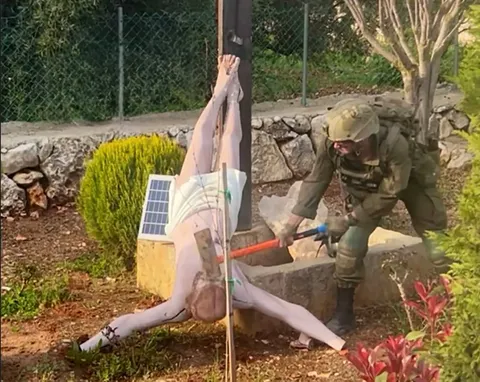
One of the images showed a Palestinian man in a white hazmat suit, his hands cable-tied, a blindfold across his eyes. The soldier had added a Hebrew caption: for sale.
Palestinian researchers spotted the image and circulated it online. Zahra Sharab recognised her son immediately. He was blindfolded. She had not seen him in 18 months. She knew him anyway. She is, as she put it in an interview later, his mother.
GLAN filed a request for information with the Israeli military. The reply this time was even shorter than for the al-Akkads. There was no record of Mohammed Sharab. He was not in their files.
"And that's the end of the conversation, as far as they're concerned," Minogue says.
"We operate a sub-army of slaves"
The two cases are not isolated incidents. They sit inside a pattern that the Israeli military's own soldiers have now described, in Israeli newspapers, in their own words.
In a series of investigations published from late 2024 onwards by Haaretz, the Associated Press, +972 Magazine, CNN and CBS, Israeli soldiers detailed a practice they call the mosquito protocol — sometimes shortened in IDF slang to "shawishes" or "wasps," the names given to the Palestinian civilians forced into the role. An anonymous Israeli officer, writing in Haaretz in March 2025, described the practice as "a sub-army of slaves."
The mechanics are these. Israeli units — often platoons, the smallest tactical formation — grab a Palestinian civilian. Often deliberately the most vulnerable available: the elderly, the disabled, the mentally unwell, the very young. They force the captive, under threat of summary execution, to enter buildings the unit suspects may be booby-trapped, to clear tunnels, to walk into rooms ahead of soldiers. The official military euphemism is "operational necessity." The actual reason, the same officer wrote in Haaretz, is speed: drones and sniffer dogs work, but Palestinians work faster, and Israeli commanders preferred not to risk the dogs.
According to the Haaretz officer, by the end of his nine-month deployment "almost every platoon" in the infantry kept a shawish. That puts roughly 36 Palestinian human shields in every brigade. Used at least six times a day.
The captives are routinely tortured during their period of usefulness. Minogue's team at GLAN has interviewed survivors. They describe being forced to sleep on stairwells, having food thrown on the floor in front of them as their captors mocked them, being beaten and humiliated for the entertainment of bored young soldiers. The victims include amputees and wheelchair users.
And then, when the unit is finished with them, a particular cruelty.
"We've observed it more than once now," Minogue says. "The person is told, okay, you can walk now, we're done with you — and they're released into an area the IDF has designated a free-fire zone. They're shot down while they're walking to safety."
In one of the most widely reported cases, documented by +972 Magazine and Israeli investigative outlets, soldiers tied an explosive cord around the neck of an 80-year-old Palestinian man and threatened to detonate it if he refused to enter buildings ahead of them. He limped through their search operation for around eight hours. When the soldiers had finished with him, they released him and told him to flee with his wife. A different Israeli battalion, spotting two elderly Palestinians on the street, shot both of them dead and left their bodies where they fell.
The pictures are the evidence
What makes these cases unusual is not the cruelty. It is the documentation. The soldiers, in case after case, have photographed their victims.
In a war that Palestinian journalists — at the cost of more than 240 of their own lives, the highest journalist death toll of any modern conflict — have been forced to livestream from inside, a second, parallel livestream has come from the perpetrators themselves. Israeli soldiers have posted videos of themselves burning Palestinian family homes, looting jewellery, urinating on belongings, parading detained Palestinians in their underwear, mocking the dead. The smiling-soldier-with-blindfolded-captive image has become a recognisable genre.
In legal terms, this matters. Photographing a detained civilian or combatant to humiliate them is not a peripheral act, Minogue points out. It is, in itself, a war crime.
"Anybody who is a protected person — civilians, vulnerable people, but also fighters who've been detained — they have to be treated humanely. They can't be mocked, humiliated, abused. These pictures, in and of themselves, are evidence of war crimes. And the fact that we've identified the soldiers who took them is significant. There are police forces around the world now looking at Israeli war crimes. This is a particularly clear-cut category."
GLAN, working with the Hind Rajab Foundation, has already secured one such breakthrough — in July 2025, Belgian federal police arrested and interrogated two Israeli soldiers at the Tomorrowland music festival after a complaint based on their own posts. The case is open.
What Israel could end tomorrow
The cruelty of enforced disappearance, in the technical legal sense, lies in the not-knowing. The state has the answer. It withholds the answer. The family lives, indefinitely, with the gap.
In an interview earlier this year, Zahra Sharab — Mohammed's mother — described what that gap feels like. She is exhausted, she said. She just wants to know whether her son is dead or alive.
Israel, Minogue points out, could answer her question tomorrow. GLAN has identified the soldier who posted the photograph of Mohammed. Sky News has identified the unit that detained Aisha and Huda al-Akkad. The records exist. The chain of custody exists. The decision not to tell these families what happened to their relatives is precisely that — a decision, made and re-made every day at every level of the Israeli military and political establishment.
The question of what changes that is, at this stage, almost entirely a question about Israel's Western backers. The UK government, having suspended around 30 of 350 arms-export licences to Israel in September 2024 but kept open the critical F-35 component pipeline, lost a legal challenge brought by Al-Haq and GLAN at the High Court last summer. The case continues at the Court of Appeal. Other European governments have moved further; most have not moved at all. The Trump administration in Washington has, since taking office, accelerated rather than constrained the flow of weapons.
"Israel's remaining allies have let this go on as far as they have," Minogue says. "They are beneath contempt. If they have a shred of humanity left, what they need to do is force Israel to allow forensic investigators — independent ones — into Gaza. Because Gaza is a massive crime scene. These families need answers, and the only people who can give them those answers are refusing."
She pauses.
"And the West is treating Gaza as a place where there's no reliable information coming out. They're using that as cover for doing nothing. It suits them."
The al-Akkad family is still waiting for a body to bury, or a phone call. Zahra Sharab is still waiting for her son. The Israeli soldiers who posed for the photographs are mostly home now, posting end-of-service nostalgia, getting on with their lives.
A Palestinian mother in Khan Younis, an Irish lawyer in London, and somewhere — in a database, in a record book, in a chain of military command that knows exactly what it did and exactly to whom — the answer.