Gaza’s Two Million Survivors Face a New Front in Israel's Illegal Siege: Water Deprivation in a Shrinking Territory
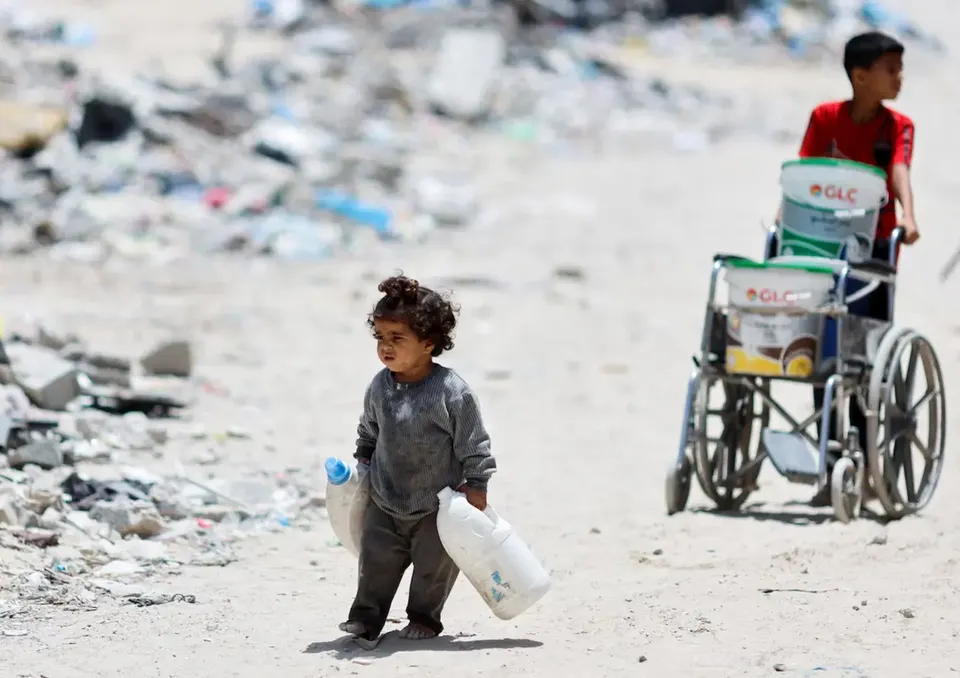
For Gaza’s more than two million Palestinians, survival has become a daily calculation measured not in hope for peace, but in litres of water, fragments of shelter, collapsing sanitation, and the narrowing possibility of escape.
After years of repeated Israeli military assaults, mass displacement, imprisonment behind sealed borders, and the destruction of homes, hospitals, roads, wells, pumping stations, sewage networks, and desalination plants, Palestinians in Gaza now face another escalating crisis: the denial of clean water.
For many residents and humanitarian observers, the catastrophe is not understood as a conventional war between two equal sides. It is experienced as a prolonged campaign of siege, bombardment, territorial confinement, deprivation, and forced survival imposed on a civilian population that has nowhere safe to go.
Gaza’s population, overwhelmingly civilian and including vast numbers of women and children, has already been pushed from neighbourhoods, homes, farms, and cities into an ever decreasing space. Large areas have been flattened, rendered inaccessible, or brought under Israeli military control, while the remaining population is forced into overcrowded shelters, tent camps, damaged schools, and broken urban districts where even the minimum conditions for life are disappearing.
Now, in what Palestinians and humanitarian workers describe as one of the most basic assaults on human survival, access to water is being choked off.
The Wider Human Cost of Collapse
The struggle for water is unfolding against a background of immense human loss.
Across Gaza, tens of thousands of Palestinians have been reported killed since the beginning of the assault, with women and children forming a large proportion of the dead. Entire families have been erased from civil registries, while many survivors continue searching for missing relatives beneath rubble or inside damaged neighbourhoods.
The injury toll has climbed into the tens of thousands as well. Hospitals already operating under severe shortages of electricity, medicine, anaesthetics, and surgical equipment have struggled to treat patients suffering from amputations, burns, shrapnel wounds, crush injuries, fractures, spinal trauma, and untreated infections.
Doctors working in Gaza have repeatedly warned that injuries which might otherwise be survivable become life threatening when hospitals cannot access sufficient supplies, clean water, sterilisation equipment, or reliable electricity.
At the same time, hunger and malnutrition have spread across the territory.
Aid organisations have documented rising levels of acute malnutrition among children under five, especially in overcrowded displacement camps where access to food, infant formula, sanitation, and clean water remains limited. Pregnant women, nursing mothers, newborn babies, and elderly people are among the groups considered most vulnerable.
Medical experts warn that malnutrition weakens immune systems, slows wound healing, increases vulnerability to disease, and makes contaminated water even more dangerous. A child weakened by hunger is less able to survive dehydration, diarrhoeal illness, or infection.
For many families, survival no longer depends on overcoming a single crisis. It requires navigating overlapping emergencies involving injury, displacement, hunger, contaminated water, sewage exposure, and collapsing healthcare.
Water as the New Front of Survival
The latest reports from Gaza describe a civilian water system near collapse. Israeli attacks have destroyed or damaged much of the infrastructure that once supplied clean water and removed sewage. Wells, pipelines, pumping stations, desalination plants, power lines, water trucks, septic systems, and municipal repair networks have all been hit by the cumulative devastation of the assault.
In recent weeks, Israeli forces killed a water engineer and two drivers transporting water to displaced families, according to reporting from Gaza. The deaths came as scarcity of clean water was already fuelling the spread of preventable disease among a population crowded into camps and temporary shelters.
Omar Shatat, the deputy director of Gaza’s coastal municipalities water utility, said the losses among workers responsible for maintaining the water system had become part of the daily reality of operating under fire.
“Since the beginning of the war, we have lost about 19 workers from water facilities who were carrying out repair and distribution work,” he said. “Targeting has become part of the operational reality.”
The most recent reported attack took place at al Zein well in northern Gaza, where water engineers were working inside the site. One engineer was killed, four others were injured, and the strike caused extensive structural damage to what was described in an incident report as “a critical water source serving the surrounding population.” The same report warned that disruption to the well would affect thousands of people.
Four days before that attack, Israeli forces shot dead two drivers working for UNICEF at the main water collection point for northern Gaza. Two others were injured. UNICEF said the attack threatened humanitarian networks bringing clean water to hundreds of thousands of people.
These are not abstract losses. In a territory where water infrastructure has already been shattered, every engineer, driver, pump, pipe, power line, and tanker truck matters.
Far Below the Minimum Needed for Life
The United Nations recognises access to clean water as a basic human right. International standards set a normal daily requirement of 50 to 100 litres per person, except in emergency situations.
In Gaza, the supply is nowhere near that level.
UNICEF has estimated that the average daily supply is only seven litres of drinking water and 16 litres of domestic water per person. Many people do not have access to even the minimum six litres a day of clean drinking water.
Humanitarian agencies say these shortages are unfolding alongside a worsening nutritional emergency. Acute malnutrition has risen among children living in overcrowded camps and shelters, where access to safe food preparation, clean water, and basic hygiene is limited.
Children weakened by malnutrition face a heightened risk of dehydration, diarrhoeal disease, and infection, creating a cycle in which hunger and water scarcity reinforce one another.
That means families are being forced to survive on quantities of water that are not enough for safe drinking, cooking, washing, cleaning wounds, bathing children, washing clothes, maintaining menstrual hygiene, preparing infant formula, or preventing the spread of disease.
For Palestinians in Gaza, the numbers translate into humiliating and dangerous choices repeated every day. Parents must decide whether water should be saved for a child to drink, used to wash contaminated clothes, poured over a baby, kept for cooking, or used to clean a wound before infection sets in.
The Daily Race for Water
Across Gaza, families wake before sunrise to queue beside water trucks, communal taps, or makeshift collection points. In many areas, supplies arrive irregularly, and when they do arrive, there is not enough for everyone.
Omar Saada, a 38 year old displaced father of four in Khan Younis, said one water truck served more than 50 families in his area. That was not enough to meet even the reduced allowance of 20 litres per person, turning each morning into a race to fill the family’s containers.
“We wake up as early as 6am to be able to collect water from the trucks,” he said. “Before, it was available from early morning until after noon, but now it is usually just for two hours.”
Saada said his family had cut back on bathing and washing clothes, leaving his children suffering from skin infections. Even the water they do receive does not always appear safe.
“It sometimes causes intestinal infections and stomach pain due to contamination, but we are forced to drink it because it is the only water available,” he said.
In al Qarara, water trucks reportedly come only once a week to the area where Nesma Rashwan, a 31 year old mother of five, is living in a tent. She said the water smells and tastes unsafe, but her family has no alternative.
“For about a year now, we have not had clean drinking water that truly quenches thirst,” she said. “I bought fresh drinking water once when my son was sick, but I cannot afford it regularly; a gallon costs five shekels. So we make do with what is available.”
Rashwan said she struggles to find enough water to wash dishes and clothes. Her children bathe in the sea, after which she pours only a minimal amount of stored fresh water over them.
This is what water deprivation looks like in daily life: children sent to the sea because a family cannot spare clean water for washing, mothers rationing every container, and displaced families drinking water they know may make them sick.
Disease Spreading Through Scarcity
The collapse of water access is directly worsening public health. Médecins Sans Frontières has warned that people are getting sick because they cannot access clean water or basic sanitation.
Laureline Lasserre, MSF’s emergency humanitarian affairs manager for Gaza, described the crisis in stark terms.
“No clean water, no soap, overcrowded living conditions; this is the root cause of a huge proportion of what we treat every day,” she said.
The consequences are visible across clinics, shelters, and camps. Many Palestinians must choose between drinking, cooking, and washing. Women report infections because they are unable to wash while menstruating or after giving birth. Babies repeatedly become ill because there is no clean water for formula. Wounds become infested with larvae because people cannot wash them.
MSF doctors have also reported psychological problems, including suicidal ideation, linked to extreme water shortages.
Lasserre directly blamed Israeli authorities for both creating the crisis and obstructing solutions.
“The Israeli authorities have destroyed water infrastructure and are blocking humanitarians from providing alternatives,” she said. “They are causing the water crisis and preventing the solution.”
Soap, Hygiene, and the Cost of Staying Alive
The water crisis is being compounded by a shortage of hygiene products. Israeli limits on the shipment of soap, washing powder, and other basic cleaning supplies into Gaza have pushed prices sharply higher, making it even harder for displaced families to protect themselves from infection.
The price of soap and cleaning supplies has doubled over the last month, according to local accounts. Anwar al Maghribi, a shopkeeper in Deir al Balah, described the shortage as a “major crisis.”
“A 7kg pack of laundry detergent has risen from 50 shekels to 100 shekels or more, and other cleaning products have also seen similar increases,” he said.
For families who have lost homes, income, possessions, and access to regular aid, the doubling of detergent prices is not a minor economic detail. It means clothes go unwashed, babies are cleaned less often, bedding remains contaminated, infections spread more easily, and people are forced to live in conditions that strip away dignity as well as health.
Infrastructure Destroyed, Repairs Blocked
The destruction of Gaza’s water system has been compounded by restrictions on the entry of fuel, spare parts, cement, basic equipment, and vehicles needed to keep water and sewage systems functioning.
Shatat, the deputy director of the coastal municipalities water utility, said workers have been forced to improvise by recycling and assembling parts from destroyed facilities.
“We have been forced to improvise by recycling and assembling parts from destroyed facilities to create a single functioning unit, what I describe as ‘assembling fragments,’” he said.
“For example, we collect usable spare parts from multiple destroyed wells to operate one functional well, or combine parts from several damaged pumping stations to build one working station.”
Earlier this month, shrapnel from an Israeli airstrike damaged the power line to the Deir al Balah desalination plant, which provides water for up to 400,000 people. Because spare parts were unavailable, repairs were delayed for a week. During that time, the plant could operate at only 20 percent capacity using backup generators.
Saada said water deliveries to his area stopped during that period.
The crisis is therefore not only about physical destruction. It is also about the inability to repair what has been destroyed because the parts, fuel, cement, vehicles, and secure access needed for reconstruction remain restricted or unavailable.
Sewage, Camps, and the Threat of Disease
The water emergency is inseparable from Gaza’s sewage crisis.
Large numbers of Palestinians now live in camps without proper sewage networks, relying instead on absorption pits that frequently overflow. Shatat said approximately 1.1 million people live in such conditions.
“The greatest tragedy is in the camps, where approximately 1.1 million people live without sewage networks, relying instead on absorption pits that frequently overflow, creating a severe health and environmental disaster,” he said.
In schools now used as shelters, septic tanks regularly overflow, causing sewage to leak into classrooms and spread between rooms. Families displaced by bombardment are therefore forced to live beside, and sometimes inside, contamination.
There is no cement for repairs. The fleet of trucks that once emptied septic tanks has been decimated. Gaza needs 100 such trucks, but only 15 remain, and those are worn out from intense use.
This means that even where water is available, sanitation may be collapsing around it. Contaminated water, untreated sewage, overcrowding, rising temperatures, and shortages of soap combine into a public health disaster that humanitarian workers fear will intensify during the summer.
Israel’s Denial and the Reality on the Ground
Israel denies that it is restricting equipment or fuel needed to run water and sanitation systems in Gaza. COGAT, the Israeli body that oversees aid in the occupied Palestinian territories, has said that Israel provides clean water through three pipelines and allows passage of water from Egypt through a fourth.
A COGAT spokesperson said these pipelines contribute to an estimated supply in Gaza of 70,000 cubic metres a day, or approximately 30 litres per person.
“There are four active water pipes supplying the Gaza Strip. There are operational desalination plants and there are dozens of water wells that receive regular fuel to power pumps,” the spokesperson said.
Yet the lived experience described by Palestinians, municipal officials, and humanitarian organisations is sharply different. UNICEF reports far lower average access. MSF says lack of water and hygiene is driving disease. Local families describe queues, contamination, unaffordable clean water, collapsing sanitation, and trucks that arrive too rarely or not at all.
Asked about the shooting of truck drivers near a humanitarian supply point, the Israel Defense Forces said troops who opened fire had “perceived a threat,” without providing further details. Asked about the water engineer killed at al Zein well, the IDF declined to comment.
For Palestinians, these responses do not answer the central question: how can a population survive when those repairing wells, driving water trucks, and maintaining desalination systems are being killed, injured, obstructed, or forced to operate under fire?
A Besieged Population Left Waiting
The crisis is unfolding in full view of the world. Neighbouring states issue statements. International organisations publish warnings. Governments debate ceasefire proposals and humanitarian access. Legal experts discuss obligations under international law. Yet inside Gaza, the material conditions of life continue to deteriorate.
Families remain trapped in shrinking areas of land, surrounded by destroyed infrastructure and dependent on aid systems that cannot meet the scale of need. Water deliveries are irregular. Sanitation systems are collapsing. Medical workers report diseases that could be prevented if clean water and soap were available.
For Palestinians standing in queues with empty containers, the language of international concern has become painfully detached from daily survival.
The absence of decisive action from nearby governments and the wider international community has deepened the sense among Gaza’s civilians that they have been abandoned to a slow emergency, one in which death does not always come from bombs but also from thirst, infection, sewage, hunger, untreated wounds, and the steady removal of the systems needed to sustain life.
A Slow Emergency Designed by Deprivation
The destruction of Gaza’s water system is not simply a technical failure. It is part of the wider unravelling of civilian life in a territory under siege.
When water engineers are killed, wells are damaged, drivers transporting water are shot, desalination plants are reduced to partial capacity, soap becomes unaffordable, sewage trucks disappear, and spare parts cannot enter, the result is not merely inconvenience. It is the deliberate or foreseeable production of conditions in which civilian survival becomes harder by the day.
For Gaza’s brutalised population, already forced into smaller and smaller spaces after years of siege and repeated Israeli attacks, water deprivation now stands as one of the clearest measures of the catastrophe.
A population of more than two million people cannot live on seven litres of drinking water a day. Children cannot remain healthy in camps where sewage overflows into classrooms. Mothers cannot safely care for newborn babies without clean water. Wounded people cannot heal when they cannot wash their injuries. Families cannot maintain dignity when soap is unaffordable and drinking water itself tastes contaminated.
This is the reality now facing Gaza’s surviving population: a people confined, displaced, impoverished, and deprived, while the infrastructure of life is dismantled around them.
For many Palestinians, the question is no longer only when the attacks will stop. It is whether enough of Gaza’s water, sanitation, health, and shelter systems will remain intact for the population to survive at all.