“Torture and Sexual Violence with Dogs”: New Report Alleges Inhuman Abuse in Depraved Israeli Detention Centres
A newly released report published by Euro-Med Human Rights Monitor in April 2026 has reignited scrutiny of Israeli detention practices during the Gaza war, alleging that Palestinian detainees were subjected to sexual violence, torture, humiliation, and attacks involving military dogs inside prisons and military-run detention compounds.
The report, titled Another Genocide Behind Walls: Sexual Violence in Israeli Prisons and Detention Centres and Engineered Impunity (October 2023 – October 2025), presents what the organisation describes as a large body of survivor testimony gathered over a two-year period.
Published amid growing legal and diplomatic pressure surrounding Israel’s conduct during the Gaza war, the report alleges that sexual violence and degrading treatment were not isolated incidents but formed part of a broader system of detention operating under wartime secrecy and limited external oversight.
According to Euro-Med Monitor, former detainees described patterns of abuse that extended beyond beatings and physical coercion into acts of humiliation, forced nudity, intimidation involving military dogs, threats of rape, and alleged assaults targeting prisoners’ bodies in ways intended to inflict psychological domination.
The organisation argues that these practices may represent more than individual misconduct, instead reflecting a detention environment shaped by what it calls “engineered impunity” — a system in which accountability is weakened by secrecy, restricted access, and wartime emergency powers.
The report’s publication follows a growing body of reporting from journalists, human rights organisations, medical experts, and even Israeli military sources who have raised questions about conditions inside detention facilities holding Palestinians arrested during and after military operations in Gaza.
Together, these accounts increasingly suggest that detention facilities may become a central battleground in future legal scrutiny surrounding the war.
A Hidden Dimension of the Gaza War
Since the escalation of war in October 2023, thousands of Palestinians from Gaza and the occupied West Bank have reportedly been detained by Israeli forces.
Many have been held without charge under emergency security powers.
Human rights organisations have repeatedly warned that access to detainees has become increasingly restricted, with lawyers, family members, and independent observers often unable to verify conditions inside military-run detention compounds.
Euro-Med Monitor’s report places particular emphasis on facilities such as Sde Teiman, a military detention site that has increasingly become associated with allegations of abuse.
Former detainees interviewed by journalists and rights groups have described overcrowding, blindfolding, prolonged shackling, sleep deprivation, beatings, denial of medical treatment, humiliation, and prolonged exposure to degrading conditions.
The new report expands these allegations by arguing that sexual violence formed a recurring feature rather than an isolated occurrence.
According to testimony cited by researchers, detainees described guards forcing prisoners to remain naked for extended periods, conducting invasive searches, threatening rape against detainees or family members, and using sexual humiliation during interrogation.
Euro-Med Monitor argues that many survivors may never publicly disclose their experiences because of trauma, shame, fear of retaliation, or cultural stigma.
Testimonies From Palestinian Detainees
Among the report’s most disturbing allegations are claims involving military dogs.
Euro-Med Monitor alleges that detainees described dogs being used not merely as security tools but as instruments of fear, humiliation, and in some cases alleged sexual torture.
One of the report’s central testimonies came from a 35-year-old Palestinian detainee identified as Amir, who described being held at Sde Teiman detention camp.
According to the testimony, he and other detainees were taken to a corridor between detention sections and ordered to strip naked.
Amir alleged that soldiers brought military dogs into the corridor while prisoners remained restrained.
He stated:
“I was detained in Sde Teiman. They took a group of detainees and me to a corridor between the sections and forced us to strip completely naked. The soldiers brought in several dogs. One of them urinated on me.”
He further alleged that he was assaulted while restrained and beaten.
Another former detainee described being held inside a metal cage while dogs were repeatedly brought near prisoners.
According to his testimony:
“We heard dogs barking in the area and from time to time the dogs would urinate on us while we were detained in the metal cages.”
The witness said he realised what was occurring only after understanding he could not move or resist while restrained.
The Palestinian Centre for Human Rights published additional testimony in November 2024 describing allegations of torture, humiliation, forced stripping, and sexual violence during detention.
One former detainee, identified only by initials, described being detained for 19 months.
He alleged he was transferred to an isolated section of Sde Teiman where detainees were allegedly moved away from surveillance cameras.
According to his testimony:
“During the first weeks there, amid repeated suppression operations, I was taken with a group of detainees in a degrading manner to a place far from the cameras of passage between sections.”
The witness alleged he was beaten, pepper sprayed, humiliated, and later treated for injuries including fractures and head wounds.
He claimed he received stitches without anesthesia.
Several testimonies included in the Euro-Med report describe humiliation as central to detention.
Some detainees alleged they were photographed while naked, mocked by guards, or forced into degrading positions.
Others described threats of further violence if they disclosed what occurred inside detention facilities.
Euro-Med Monitor argues that consistency across accounts gathered from different detainees and different facilities suggests a recurring pattern.
The Weaponisation of Military Dogs
The allegations concerning dogs extend beyond detention compounds.
A major investigation published by The Guardian in partnership with Arab Reporters for Investigative Journalism (ARIJ) on 12 June 2025 examined how military dogs used by Israeli forces may have been sourced from European suppliers and later deployed during operations involving Palestinian civilians.
The investigation documented cases in which Palestinians alleged they were attacked by dogs during raids.
One of the most widely reported incidents involved the Hashash family in Balata refugee camp in the occupied West Bank.
According to testimony, Amani Hashash gathered her four children inside a bedroom during a military raid in February 2023.
She said that shortly after soldiers entered the home, a large unmuzzled dog entered the room and attacked her three-year-old son Ibrahim while he slept in her lap.
Hashash described trying to pull the animal away as it bit and dragged the child.
She stated:
“It was such a big dog, not like any other dog I have seen. It kept biting and pulling my son away from me. I screamed and hit it, but it kept pulling at him.”
Medical evidence cited in the investigation indicated that Ibrahim sustained extensive injuries requiring surgery.
His wounds reportedly included deep lacerations measuring six and a half centimetres and four centimetres.
He required 42 stitches and 21 injections to treat infection resulting from the bites.
More than a year later, his mother said he continued to suffer nightmares.
The investigation suggested the animal involved was likely a Belgian Malinois, a breed widely used by Israel’s elite Oketz canine unit.
According to reporting, commanders within Oketz reportedly told urban warfare researcher John Spencer that approximately 99% of the unit’s roughly 70 annual dog purchases come from European suppliers.
Human rights groups argue that use of dogs against civilians has intensified since October 2023.
Euro-Med Human Rights Monitor says it documented at least 146 incidents involving military dogs being used against civilians after the start of the Gaza war.
Among the most widely reported cases was Muhammed Bhar, a young Palestinian man with Down’s syndrome and autism.
In July 2024, Bhar was reportedly attacked by a military dog inside his home in Gaza City’s Shejaiya neighbourhood.
His family later alleged that soldiers forced relatives to leave while he remained behind, badly injured.
He later died.
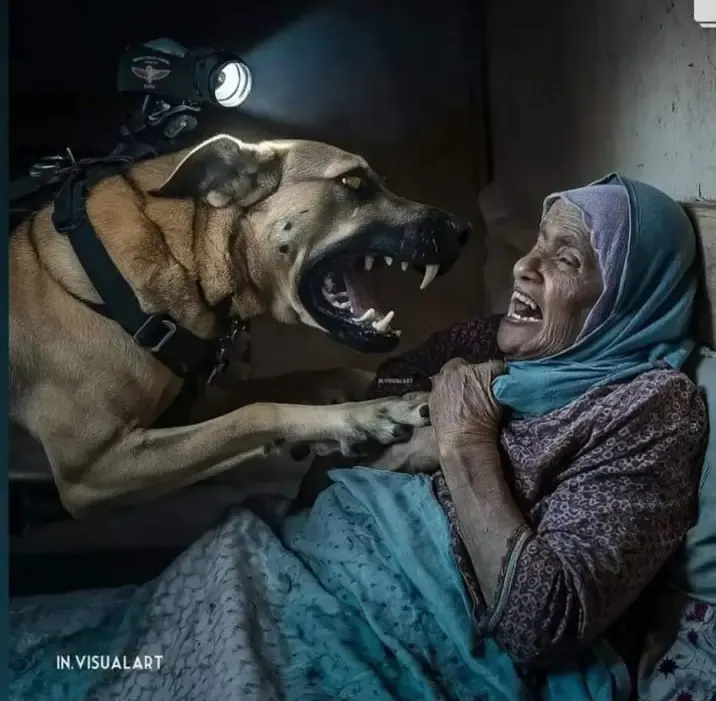
Another case involved Dawlat Al Tanani, a 68-year-old woman in Jabalia refugee camp.
Video footage published in June 2024 appeared to show a dog attacking her inside her home, leaving her injured.
Tahrir Husni, a Palestinian woman from Khan Younis, alleged that soldiers released a dog inside her home during a raid in 2023.
She described an attack lasting more than ten minutes.
According to her testimony:
“When it was attacking me, I lost all feeling in my leg. When it was over, I sat down on the couch and then I could see my blood and flesh all over the floor.”
Husni later said she miscarried.
Animal welfare experts have criticised the militarisation of dogs.
Dr Jonathan Balcombe, an animal behaviour specialist, stated:
“It is unethical to turn dogs, which are naturally social creatures, into instruments of aggression to be used in wars that are solely caused by humans.”
The investigation also raised questions about European supply chains.
Documents reportedly showed Dutch authorities issued 110 veterinary export certificates for dogs sent to Israel between October 2023 and February 2025.
One company, Four Winds K9, reportedly accounted for 100 certificates.
German company Diensthunde.eu acknowledged exporting Belgian Malinois and German shepherds to Israel between 2020 and 2024.
Under current EU regulations, military dogs are not classified as controlled weapons or dual-use items.
As a result, exports frequently occur without licensing requirements or detailed tracking.
Former UN special rapporteur Richard Falk argued that exporters risk complicity.
He stated:
“From the perspective of general international law, I have no doubt whatsoever that companies exporting these dogs are complicit, because they know exactly how they are used.”
Israeli Soldier Testimony Raises New Questions
Some of the most consequential reporting has emerged from Israeli soldiers themselves.
An article published by the Israeli newspaper Haaretz included anonymous testimonies from soldiers describing experiences that left them morally shaken.
Several soldiers recounted incidents involving the killing of unarmed Palestinians, destruction of civilian property, humiliation of detainees, and battlefield conduct they later questioned.
One soldier described participating in an operation in which a drone identified what troops considered suspicious figures.
According to the testimony, soldiers opened fire during an advance.
Only afterward did he realise those killed included an elderly man and several teenage boys.
The witness described bodies torn apart by gunfire and recalled a commander allegedly spitting on corpses.
Another reservist described witnessing overwhelming fire used against Palestinians crossing a restricted area despite uncertainty over whether they posed any threat.
According to the testimony, four Palestinians were killed and later buried by bulldozers.
One surviving detainee was allegedly restrained and humiliated overnight.
Other soldiers described looting, destruction of personal property, humiliation of family photographs, and language framing Palestinians as less than human.
These testimonies contribute to wider debate over whether battlefield practices reflected individual breakdowns or broader institutional attitudes.
Allegations of Engineered Impunity
A central argument of the Euro-Med report is that abuse became possible because of limited oversight.
The organisation claims that wartime secrecy, restricted legal access, and delayed external monitoring created conditions in which detainees could be mistreated without accountability.
According to the report, detainees often lacked immediate access to lawyers, independent doctors, or outside observers.
Human rights lawyers argue that such conditions create severe evidentiary challenges.
By the time detainees are released, injuries may have healed, witnesses dispersed, and documentation lost.
The report further argues that survivors of sexual abuse face especially severe barriers to disclosure.
Fear, trauma, shame, and social stigma may discourage victims from speaking publicly.
As a result, rights groups caution that documented cases may represent only a fraction of incidents.
International Legal Implications
The allegations arrive amid growing international scrutiny of Israel’s conduct during the Gaza war.
International law prohibits torture, sexual violence, degrading treatment, and unlawful detention practices.
The Fourth Geneva Convention and the Convention Against Torture establish legal protections for detainees held during conflict.
Human rights lawyers argue that sexual violence committed by state actors during detention may constitute a war crime or crime against humanity if shown to be systematic.
A 2025 report by the UN-backed Independent International Commission of Inquiry on the Occupied Palestinian Territory concluded that allegations of forced stripping, humiliation, and gender-based abuse appeared across multiple detention environments.
The commission suggested recurring allegations raised questions about institutional responsibility.
The Euro-Med report goes further, arguing that legal structures and wartime secrecy contributed to what it describes as “engineered impunity.”
Legal analysts say accountability will depend not only on documenting individual cases but on establishing whether abuses followed a consistent institutional pattern.
Israeli Response and Official Position
Israeli authorities have consistently denied allegations of systematic abuse.
Israeli prison officials and military representatives maintain that detainees are held according to domestic law and security procedures.
The Israeli military has stated that its use of dogs occurs only when operationally necessary.
In a statement responding to allegations surrounding military dogs, the Israeli military said its canine units operate under international law and ethical standards.
The military stated that dogs are not used for punitive purposes and that welfare standards for the animals are maintained.
Israeli officials have argued that wartime allegations must be independently verified and caution that politically motivated narratives may emerge during conflict.
Supporters of Israel’s position argue that the state faces exceptional security threats following the October 2023 attacks.
Critics counter that security concerns do not remove legal obligations toward detainees.
Detention as an Extension of War
One of the strongest themes running through the Euro-Med report is the argument that detention became an extension of the wider conflict.
Rather than existing separately from military operations, incarceration itself became another arena of punishment.
This interpretation aligns with a growing body of reporting suggesting that wartime detention expanded dramatically after October 2023.
For Palestinians released from detention, allegations of abuse carry long-term psychological and physical consequences.
Lawyers representing former detainees say many remain unwilling to publicly describe their experiences.
Some fear retaliation.
Others struggle to revisit traumatic memories.
The report argues that silence itself may conceal the true scale of abuse.
A Growing International Debate
The release of Another Genocide Behind Walls is likely to intensify debate over Israeli detention practices.
Human rights organisations continue to call for independent investigations, unrestricted access for monitors, and external oversight of detention compounds.
Legal experts argue that detention facilities may become one of the most significant arenas of accountability surrounding the Gaza war.
If future investigations substantiate allegations of torture, sexual violence, or dog-assisted abuse, the issue could reshape international legal discussion surrounding wartime detention.
For campaigners, the report raises questions about transparency, oversight, and the obligations of states and allies.
For Israel, the allegations may deepen international scrutiny over wartime conduct.
For former detainees, the report attempts to document experiences many claim occurred beyond the reach of cameras, courts, or independent observers.
As scrutiny increasingly shifts from battlefield conduct to what happened inside prisons and interrogation compounds, detention may emerge as one of the conflict’s most contested and legally consequential dimensions.