“I Even Threw the Mirrors Out. I Can’t Bear to Look at Myself”: Israeli Soldiers Confront Moral Injury After Gaza War
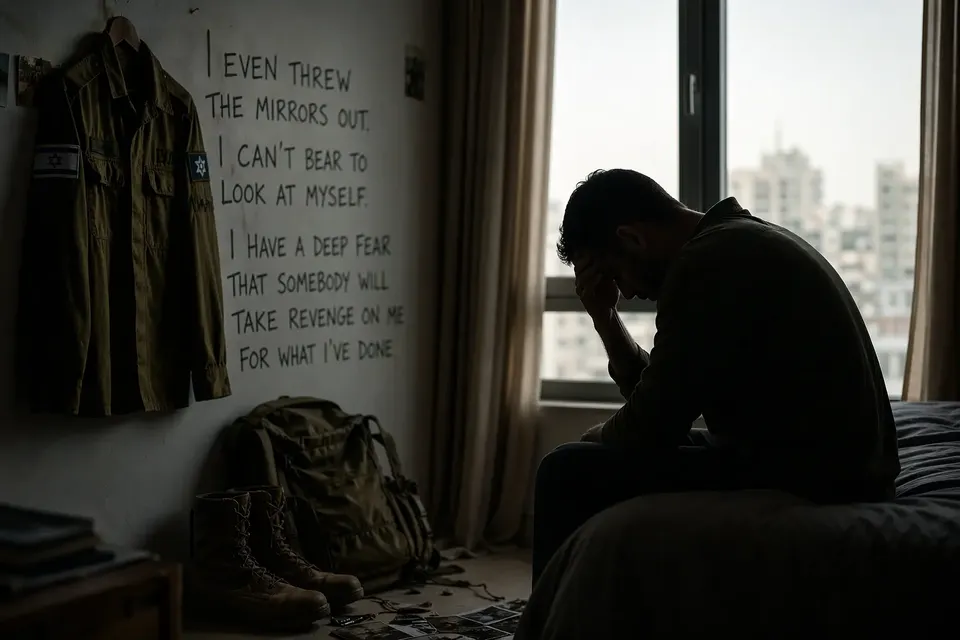
In a quiet apartment in Tel Aviv, a former Israeli soldier, speaking anonymously to a journalist at Haaretz in a report published on April 17, 2026, describes a torment that no battlefield training prepared him for. “I even threw the mirrors out. I can’t bear to look at myself. I have a deep fear that somebody will take revenge on me for what I’ve done,” he says, adding that although he knows such revenge is unlikely, the fear persists and reflects a deeper psychological collapse.
The man, referred to as Yuval, is not a career soldier but a 34-year-old former computer programmer from Ramat Hasharon who had been working at a major high-tech company before his deployment. Now, he sits anxiously in public spaces, scanning strangers, biting his nails, and struggling to function in daily life. “I was in hell, but I wasn’t aware of it,” he says of his time in Gaza.
There’s no forgiving what I’ve done
That “hell,” he explains, unfolded in Khan Yunis in December 2023, where constant airstrikes and heavy fighting created an atmosphere in which soldiers operated on instinct. “A one-ton bomb falls not far from you and makes your heart jump… You function on autopilot. You don’t ask questions,” he recalls.
The questions came later, and they have not left him. “I don’t have good answers; I don’t have any answers at all. There’s no forgiving what I’ve done. No atonement,” he says.
He describes a specific incident near Salah al-Din Road, Gaza’s main highway, where his unit advanced after identifying suspicious figures via drone. “I was firing like a madman, like they teach you in platoon drills in basic training,” he says. When the unit reached the site, the reality became clear. “These weren’t terrorists. It was an old guy and three boys, maybe teenagers. Not one of them was armed. But their bodies were riddled with bullets; their organs were pouring out.”
The reaction from his commanders compounded the trauma. “There was silence; nobody uttered a word. Then the battalion commander came over… spat on the bodies and yelled, ‘This is what happens to anybody who messes with Israel, you sons of bitches.’ I was in shock, but I kept quiet because I’m a loser, just a gutless coward.”
After his discharge three months later, Yuval returned briefly to civilian life, where he was celebrated as a hero. “They threw a party for me… applauded me and called me a hero,” he says. “But I felt I was a monster. I couldn’t bear the things they said to me. I felt they didn’t realize that I wasn’t a good person; just the opposite.”
His condition deteriorated rapidly. He stopped going to work, avoided leaving his home, and concealed his identity when he did. “I try not to leave the house, and if I do, I wear a hoodie so people can’t recognize me,” he says. He admits to suicidal thoughts. “Maybe in some way I want to die, to get it over with… I promised my mother, but I admit I don’t know how long I can keep it up.” Two days after speaking, he was hospitalized in a psychiatric ward.
An unarmed Palestinian who had raised his hands in surrender
“The officer… just fired—without asking questions … This is murder, just murder”
The incident was reported as the killing of a terrorist
Yuval’s experience is part of a broader phenomenon that Israeli mental health professionals say is growing in scale. According to Professor Gil Zalsman, head of Israel’s National Council for the Prevention of Suicide, “We’re seeing moral injuries of a much greater extent than ever before,” not only among soldiers but even among their children, who are affected by what they hear.
Experts distinguish moral injury from PTSD, describing it as the result of exposure to actions that violate fundamental ethical beliefs. Professor Yossi Levi-Belz explains that it involves “feelings of guilt, shame, rage, disgust, alienation, loss of faith and a breakdown in identity, meaning and a sense of humanity.”
Maya, a philosophy student and reservist officer, describes the psychological split between her civilian identity and her wartime role. “There’s no connection between my daily life and my reserve duty… it’s a little bit like Dr. Jekyll and Mr. Hyde,” she says.
She recounts an incident at an outpost where soldiers opened fire on five Palestinians crossing a restricted line. “The battalion commander gave an order to overwhelm them with fire… A tank started shooting… Hundreds of bullets.” Four were killed, buried by a bulldozer, and the survivor was detained.
What followed left a lasting mark. “One of the soldiers took out his penis and started pissing on him… ‘This is for Be’eri… this is for Nova.’ Nobody could stop laughing. I might have laughed too.”
The man was later released after being deemed uninvolved with Hamas, but Maya says the memory haunts her. “I felt like a hypocrite, dirty… how could I just stand there and do nothing?”
Yehuda, another reservist, describes witnessing the killing of an unarmed Palestinian who had raised his hands in surrender. “The officer… just fired—without asking questions,” he says. Reviewing drone footage later, one officer remarked, “This is murder, just murder,” yet no action was taken, and the incident was reported as the killing of a terrorist.
Months later, Yehuda broke down while viewing a Goya painting in Madrid. “It reminded me exactly of what had happened… I started to cry… I was shattered,” he recalls.
Other soldiers describe similar psychological fallout. A sniper who shot civilians seeking aid says, “You don’t forget the faces… whenever they close their eyes, see somebody taking a bullet in the forehead.”
Accounts also include looting, vandalism, and dehumanization. “People would just take pleasure in destruction… taking electric appliances, gold necklaces… burning photos… pee on them,” one soldier says, describing how others justified it by calling Palestinians “Nazis.”
Eitan, another soldier, recounts witnessing a brutal interrogation in which a detainee was tortured with cable ties. “He never stopped yelling, as if his soul were leaving his body… It shattered everything I thought about the army.”
Even those removed from direct combat describe moral injury. Ran, an air force reservist involved in planning strikes, says, “We would plan… strikes that we knew would involve the death of dozens of civilians… and that made no difference.”
He recalls a night of airstrikes that killed hundreds. “I couldn’t be part of this anymore… I felt that if I went on serving, I’d be betraying any of the good that was still in me.”
Since leaving, he has become obsessed with viewing images of casualties. “I keep trying to reconstruct whether I had something to do with it… I feel I have this coming,” he says.
Despite the growing number of cases, the Israeli Defense Ministry does not formally recognize moral injury, instead classifying affected soldiers under PTSD. Critics argue that this misdiagnosis obscures the nature of the condition and limits appropriate treatment.
Within the military, the term “injury of identity” has been adopted, a move some insiders say is politically motivated. “If we recognize that many soldiers are suffering from moral injuries, how does this fit with the cliché about the most moral army in the world?” one mental health officer asks.
The reluctance extends beyond institutions to society at large. Soldiers fear being labeled traitors or weak if they speak out. As Levi-Belz notes, many prefer silence to avoid rejection.
Guy, a special forces soldier, describes this internal conflict. “I’m carrying heavy blame… others channeled it into revenge,” he says, recalling how some soldiers reacted with excitement to killing operations, while he was reminded of historical atrocities.
After an operation at Al-Shifa Hospital, he says, “The entire area smelled of death… Ever since, I can’t bear the smell of burned meat. I became a vegetarian.”
For many, the question remains unresolved. “What have we become? What have I become?” Guy asks.
As the war recedes, the testimonies suggest that its psychological consequences are only beginning to emerge, raising difficult questions not only about individual responsibility but about the broader systems and narratives that shaped these experiences.