Will Trump’s Nevada Nuclear Test Revival Kill Off Burning Man?
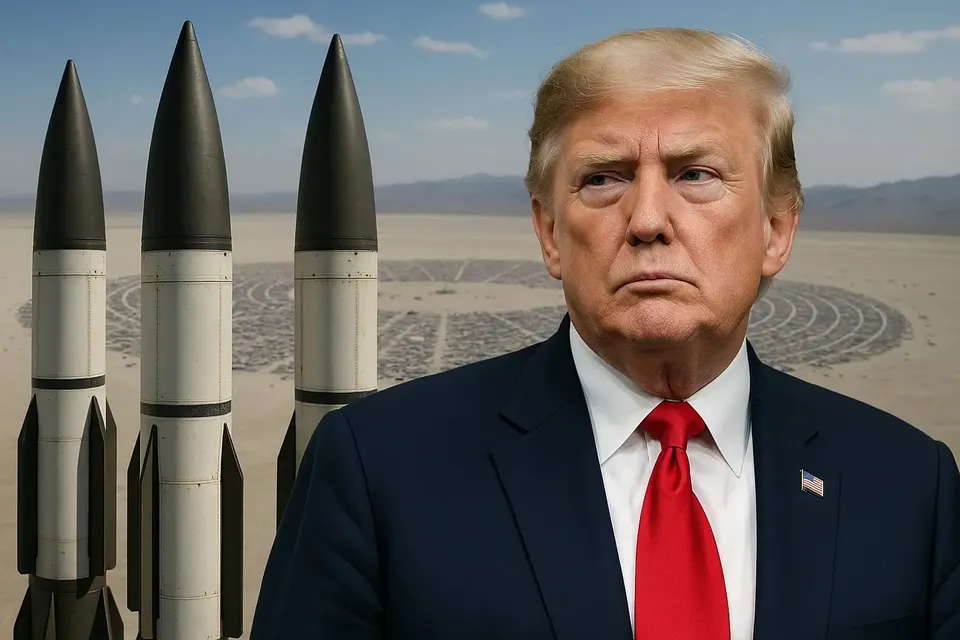
When Donald Trump announced that the United States would resume nuclear weapons testing “immediately” for the first time in over 30 years, the shockwaves reverberated far beyond diplomacy circles and arms-control think tanks. They landed squarely in the dusty, otherworldly expanse of the Black Rock Desert — the temporary home of Burning Man, a cultural phenomenon that draws 80,000 people each year to build a city of art, ritual, and radical self-expression.
Now, an unlikely question hangs in the desert air: Could renewed nuclear detonations in Nevada spell the end of Burning Man?
A festival in the shadow of the bomb
The proposed testing site — the Nevada National Security Site, formerly known as the Nevada Test Site — lies roughly 65 miles (105 km) north of Las Vegas. Black Rock City, by comparison, is about 100 miles north-northeast of Reno, more than 250 miles (400 km) from the test grounds in a straight line. That geographical buffer has long given festival organizers confidence that whatever radiation the federal government unleashes, it would stay far away.
But Trump’s abrupt reversal of a decades-long testing moratorium introduces a variable previously unthinkable: renewed nuclear explosions, potentially above ground, in an era of volatile geopolitics and eroding international treaties.
“This isn’t paranoia,” says one former nuclear-policy analyst. “Burning Man takes place downwind of Nevada’s historic fallout patterns. If atmospheric testing returns, the risk becomes very real.”
The legal taboo Trump could break
Atmospheric nuclear testing was banned in 1963’s Limited Test Ban Treaty — one of the foundational arms-control agreements of the nuclear age. Underground tests continued until 1992, when the United States unilaterally halted detonations under President George H. W. Bush.
Resuming underground tests would be controversial; resuming atmospheric tests would be explosive, both literally and diplomatically.
Trump’s social-media post was ambiguous. He did not clarify whether tests would be:
- Subcritical (no nuclear chain reaction)
- Underground full-yield
- Atmospheric detonations
Pentagon officials offered no immediate details.
“The process will begin immediately”
The timing of Trump’s remarks — made aboard Marine One en route to meet Chinese President Xi Jinping in South Korea — appeared to be a pointed message. With Russia expanding its exotic weapons programmes and China doubling its nuclear arsenal, the U.S. is increasingly anxious about slipping strategic parity.
Trump’s rhetoric framed the move as reluctant necessity: “I have no choice,” he said. “Other nations are testing.”
If the U.S. proceeds aggressively, the machinery at the Nevada site can be activated quickly. Officials at the National Museum of Nuclear Science & History have previously acknowledged that the facility could be authorized “if deemed necessary.”
Fallout fears return
For older Nevadans, Trump’s announcement unearthed painful memories.
Between 1951 and 1962, the Nevada Test Site hosted 100 atmospheric nuclear detonations. Radioactive clouds drifted across what would become known as “Downwinder Country,” blanketing parts of Nevada, Utah, and Arizona with fallout.
Communities suffered spikes in cancer rates. Ranchers watched livestock sicken. The government denied responsibility for decades.
“We’ve lived this nightmare before,” says a historian from Las Vegas. “To pretend it could never happen again is naïve.”
Black Rock City lies far northwest of the worst historical fallout paths. But a return to open-air detonations would redraw risk calculations overnight.
Burning Man caught in the blast zone of uncertainty
Burning Man organizers are not commenting publicly, but inside the community, anxiety is spreading faster than playa dust.
“If there’s even a small chance of radiation drifting over the festival, the event becomes uninsurable,” warns one veteran participant. “Attendance would collapse.”
Black Rock City LLC, the nonprofit behind Burning Man, already battles extreme weather, drug-safety incidents, and growing governmental scrutiny. A nuclear test threat adds catastrophic risk to a festival whose very survival depends on bureaucratic tolerances.
Realistically, environmental agencies would likely suspend the event if radiation dispersal could not be guaranteed safe.
Tourism, property, and Nevada’s economy at stake
Every year, Burning Man pumps tens of millions of dollars into rural Nevada — hotel bookings, gas stations, equipment rentals, service jobs. Towns from Reno to Gerlach depend on the pilgrimage.
State economic advisors expressed alarm privately. Publicly, silence reigns.
“If nuclear testing restarts, we face reputational damage,” says a Nevada business lobby official. “Who wants to vacation in a fallout state?”
Even the perception of risk can transform real-estate markets and tourism patterns.
A political earthquake before New START expires
Trump’s decision lands less than 100 days before the expiration of New START, the final arms-reduction treaty governing U.S.-Russian deployed warheads.
Its collapse would erase the last remaining guardrail on the world’s deadliest weapons — and normalize testing as a tool of geopolitical signaling.
Arms-control experts warn of cascading consequences:
- Russia matching American tests
- China accelerating development
- India and Pakistan following suit
- A global nuclear domino effect
Burning Man may not be the priority in Washington, but its existence becomes collateral to a shifting world order.
Underground tests: safe — until they aren’t
Supporters of resumed testing argue that modern detonations would be fully contained underground, posing no threat to civilians.
But containment failures have happened before.
In 1970, the “Baneberry” test cracked its underground chamber, venting radioactive dust into the atmosphere. Workers were exposed. Fallout drifted as far as Canada.
That accident occurred only 30 miles closer to Black Rock Desert than today’s test range.
Could Burning Man move?
Relocation sounds simple — but Burning Man is uniquely dependent on:
- A flat, ancient lakebed
- Permit agreements with the Bureau of Land Management
- Infrastructure relationships with Reno and Nevada counties
Finding a new site would take years. Legal battles could stretch a decade.
And to many Burners, the playa is sacred. Moving it would be like relocating Mecca.
Culture versus militarism
Burning Man represents:
- Radical creativity
- Non-commercial expression
- Temporary community
Nuclear testing represents:
- Annihilatory power
- National secrecy
- Militarized science
The contrast is stark: a culture festival built on communal trust, overshadowed by weapons whose purpose is absolute destruction.
A future written in dust and fallout
Will renewed nuclear testing kill off Burning Man?
Not immediately. No detonations are yet scheduled. No atmospheric tests have been authorized. And radiation does not spontaneously migrate across hundreds of miles.
But the danger is no longer theoretical.
If the U.S. crosses the once-unthinkable line back into mushroom-cloud testing, the desert wind patterns that once spread fallout east could, under unfortunate conditions, drift northwest toward the Black Rock Desert.
Burning Man’s survival would shift from artistic logistics to radiological physics — from engineering art cars to analyzing plume dispersal.
The horizon darkens
For now, thousands plan their pilgrimage as usual, building installations in warehouses and preparing costumes. But in tucked-away corners of the community, a quiet fear grows: what happens if the desert becomes a test zone again?
“A single nuclear blast could kill this culture,” says one long-time organizer. “Not because of radiation — because of fear.”
If Trump’s testing directive turns into detonations, Nevada’s most iconic cultural export may find itself living in borrowed time.
In a conflict between the state’s oldest monster and its strangest miracle, only one will survive the blast.