‘I Made Israel the Richest Country in the World’: Juval Aviv’s Account of Maxwell and the Missing Soviet Gold
Private investigator Juval Aviv alleges that Robert Maxwell moved Soviet bullion to Israel, stole from the shipments and revealed the secret during a birthday party in Morocco. His account places an extraordinary boast at the centre of a murder allegation, but parts of his explanation conflict with the historical record.
“I made Israel the richest country in the world.”
Robert Maxwell delivered that boast to an Israeli stranger at a lavish party in Morocco, according to private investigator Juval Aviv, who claims the newspaper tycoon was describing a secret operation to move Soviet gold into Israeli custody.
In Aviv’s telling, Maxwell had been drinking and did not realise that his companion was a Mossad representative stationed in Morocco. The man reported the conversation to Israel, raising alarm that a businessman entrusted with a sensitive operation had become dangerously indiscreet.
Aviv connects that alleged disclosure to Maxwell’s death in November 1991 and agrees when Jones suggests that Mossad was responsible. The publisher, he argues, had helped move immense quantities of bullion out of the Soviet Union, diverted some for himself and then exposed the arrangement through his own need to boast about it.
It is a sweeping allegation about a man whose public power was followed by financial disgrace. Maxwell’s body was recovered from the Atlantic off the Canary Islands on 5 November 1991 after he disappeared from his yacht, Lady Ghislaine. The subsequent collapse of his business empire exposed a devastating shortfall in employees’ pension funds. UPI Archives
Speaking to interviewer Danny Jones, Aviv presents the gold operation as the explanation for a death he believes was murder. The interview does not supply documentary evidence establishing the shipments or the killing, and the Spanish inquiry found no evidence of another person’s involvement. Several details Aviv uses to support his account, including his assertion that no autopsy was performed, are contradicted by contemporary reporting. UPI Archives
The alleged boast nevertheless gives his account its central theme: Maxwell, he claims, had become useful to powerful intelligence services because of what he could arrange, and dangerous because of what he knew.
The conversation in Morocco
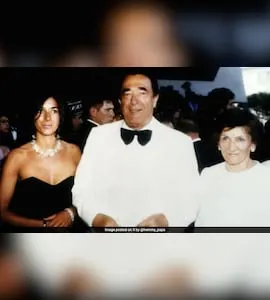
The setting was Malcolm Forbes’s extravagant 70th birthday celebration in Tangier on 19 August 1989. Maxwell’s attendance is documented in contemporary photographs and reporting, and Elizabeth Taylor was among the guests at an event staged around lavish tents, entertainment and displays of wealth. Getty Images
Aviv initially confuses the host with a member of the Hearst publishing family, before the identification is corrected to Forbes in the longer interview. The date places the alleged conversation within a period of Soviet upheaval, more than two years before Maxwell’s death. Juval Aviv Transcript and Discussion
He recalls Maxwell recognising another guest’s Israeli accent and telling him that Israel had become the richest country in the world through his efforts. Aviv presents the remark as a disclosure about Soviet gold, although he does not identify the guest by name or explain in the excerpt how he established the precise words exchanged.
Aviv identifies the listener as Mossad’s representative in Morocco. His account initially refers to the head of Mossad there before clarifying that he means its representative or attaché, rather than the national director of the intelligence service.
According to Aviv, the representative contacted Israel that night to report what Maxwell had said. Officials, in his reconstruction, became concerned that Maxwell was drinking heavily and talking about matters that depended on secrecy.
“This guy is blabbering now,” Aviv says, describing the reaction he believes followed. “He’s uncontrollable.”
He then links that alarm to Maxwell’s eventual death, without providing an operational account of an assassination, naming an individual assailant or presenting an instruction to carry one out. The conversation, the report to Israel and their alleged consequences remain elements of Aviv’s account; the documented existence of the party does not establish that they occurred.
A reserve for an endangered ruling party
Aviv places the origins of the alleged operation within the Soviet leadership’s fear that communist rule might end. Senior figures, he claims, wanted money outside the country in case they were forced into exile and needed to finance a return to power.
In this account, the gold was intended to preserve their political future. Aviv says they looked at the fate of displaced rulers and concluded that losing access to wealth could make exile permanent. He invokes the Shah of Iran as the example they supposedly had in mind.
He describes the proposed operation as moving the country’s entire gold reserve abroad, with cargoes large enough to require repeated movements by ship and aircraft. He says Maxwell was selected because he enjoyed the confidence of Soviet officials and possessed the international connections to arrange transport and secure storage.
Israel, Aviv alleges, became the proposed destination. He attributes to Maxwell the argument that the country’s military strength, including its nuclear capability, would protect the bullion from seizure. The excerpt does not identify the Soviet officials who supposedly approved this proposal, the Israeli officials who accepted it or the location where the gold was allegedly held.
Aviv also describes a purported political guarantee. He claims Soviet leaders believed their control over the emigration of Jews wishing to move to Israel would give them bargaining power if they later demanded the gold’s return.
Aviv presents this as part of the proposal, but offers no agreement or other documentation linking Soviet emigration policy to the alleged bullion transfers.
He says shipments travelled from Odessa, now generally rendered Odesa, to Haifa over seven or eight months. At another point he describes the destination as Tel Aviv, and he also refers to aircraft used in the operation. His account does not provide a calendar for the shipments or distinguish which consignments travelled by sea and which by air.
“I interviewed the captains,” he says, asserting that he established the dates and movements during his investigation. Those interviews and the underlying records are not presented in the excerpt.
Gold diverted at sea
Maxwell’s financial desperation, Aviv argues, turned him from an organiser of the operation into a thief within it.
The investigator describes ships interrupting their journeys through the Mediterranean, meeting another vessel and transferring part of their cargo. The diverted gold, he alleges, was then sold through banks and financial institutions in Switzerland, allowing Maxwell to obtain money from assets he had been trusted to move.
Aviv says the quantities entering the market were substantial enough to depress the gold price. He claims to have documented the relationship between the sales and market movements, but provides no transaction dates, quantities, buyers or price analysis in the supplied material.
His explanation depends on several parties having reasons to conceal what had happened. Soviet officials would have wanted to protect an arrangement made for their own future. Israel would have wanted to conceal its possession of the gold. Maxwell would have wanted to hide his diversions from the shipments.
Aviv further claims that later Russian authorities had an incentive to maintain the secrecy because they were seeking international loans and representing gold they no longer possessed as collateral. He does not identify a particular loan agreement or establish which authorities knew about the alleged arrangement at which date.
In his account, increasing Jewish emigration then removed the bargaining power on which Soviet officials had expected to rely. The bullion was beyond their control, the supposed guarantee had weakened and disclosure risked damaging their access to foreign finance.
This is the financial and political structure Aviv offers to explain why Maxwell’s alleged indiscretion mattered. It also leaves substantial questions about ownership. Gold placed in a country’s custody does not automatically become that country’s property, and the interview does not explain the legal or practical terms of the supposed transfer. Even within Aviv’s account, Maxwell’s claim to have made Israel the world’s richest country is a boast requiring proof.
How Ghislaine approached Aviv
Aviv says his involvement began when Ghislaine Maxwell entered an antique shop he maintained in London. The premises, he explains, served as a cover for work connected with his international investigations business, Interfor.
He describes a showroom beneath an office and apartment, together with access to a warehouse where concealed compartments in furniture could be used to store material. The antiques gave the operation an ordinary commercial appearance, although selling them was not its main purpose.
Ghislaine, he recalls, initially walked around as if browsing before asking to speak privately. Upstairs, she identified herself and said her father had told her about Aviv’s background.
She wanted two questions answered: who had killed her father, and where he had put the money missing from the pension funds of his publishing businesses. Aviv recounts her saying that she wanted the money recovered for the pensioners.
Aviv says he initially tried to put her off because he recognised the potential political complications. He wanted time to study the available information before accepting the assignment and told her he would take it only if he believed he could recover assets or clarify what had happened.
He then asked his research team to assemble the public record. As he describes it, the combination of Maxwell’s financial affairs, the circumstances of his death and the honours accorded to him in Israel persuaded him to investigate.
The pension scandal gave the search an immediate human consequence. In March 1995, Social Security Secretary Peter Lilley put the shortfall in scheme assets at about £440 million, affecting the pension rights of roughly 32,000 members. Thousands of existing pensioners had faced immediate cuts, while many future pensioners faced the prospect that their pensions would never enter payment. UK Parliament
The yacht and the autopsies
One of Aviv’s first reasons for rejecting an accidental fall was the shape of Lady Ghislaine. He describes Maxwell’s bedroom as being on a narrow upper level, with wider decks beneath it.
Looking at that configuration, he concluded that a man falling from the upper rail would strike a lower deck before reaching the sea. He says he later inspected the yacht, including the bedroom, and spoke to members of the crew and Maxwell’s household.
For Aviv, the arrangement of the decks made the familiar account of a fatal fall implausible. Yet the geometry of one part of the vessel cannot establish where Maxwell stood immediately before entering the water, and the excerpt contains no forensic reconstruction demonstrating that an accidental fall was impossible.
The death occurred in the Atlantic near the Canary Islands, although Aviv repeatedly describes the waters as the Mediterranean. More substantially, he says the body was taken to Israel without an autopsy in the Canary Islands and that no autopsy was performed in Israel either.
Contemporary accounts describe both a Spanish examination and a further autopsy in Israel on 9 November 1991. The latter lasted four hours and involved three Israeli and two British doctors, with Dr Iain West, head of forensic pathology at Guy’s Hospital in London, leading the team.
West subsequently rejected an interpretation of the Israeli examination suggesting that Maxwell had been badly beaten before death. He explained that injuries could have arisen after death or during recovery of the body. The existence of that examination directly contradicts the claim that Maxwell was buried without an Israeli autopsy. UPI Archives
The Spanish inquiry reached a different conclusion from Aviv. Judge Isabel Oliva’s December 1991 report identified an ischemic heart condition, followed by an additional contributing factor that could have included submersion, as the probable explanation. The pathologists considered an accidental plunge likely, while acknowledging that other possibilities could not be excluded completely.
The investigation found no external signs of violence, no traces of poison and no evidence of another party’s involvement. Its inability to reconstruct every final movement does not constitute a finding of murder. UPI Archives
The honours in Jerusalem
The funeral remains an important part of Aviv’s interpretation. He asks why a foreign newspaper proprietor received such prominent recognition from Israel’s political establishment, and argues that his public business interests could not adequately explain it.
Maxwell was buried on the Mount of Olives on 10 November 1991. Prime Minister Yitzhak Shamir and President Chaim Herzog attended the funeral, while Shimon Peres spoke at the graveside. The ceremony demonstrated Maxwell’s standing among senior Israeli figures. UPI Archives
Aviv sees those honours as a sign that Maxwell had performed services beyond his newspaper and other commercial investments. He also alleges extensive intelligence attendance, although the excerpt supplies no independently verifiable roster.
There was, however, a substantial public relationship to explain. Maxwell controlled Ma’ariv and had investments in Israeli publishing, pharmaceutical and computer businesses. Shamir publicly praised his interest in the economy and his willingness to make international contacts available to the state. Maxwell had also expressed a wish to be buried in Jerusalem.
Allegations of a Mossad connection were already circulating before his death, and Maxwell had denied them and begun libel proceedings. The funeral itself cannot establish a particular covert operation or a motive for killing him. UPI Archives
A businessman serving several agencies
Aviv’s portrait extends well beyond a single relationship with Israel. He claims that Maxwell worked with five intelligence services: Mossad, Britain’s MI6, the CIA, the KGB and German intelligence.
Initially, he says, the agencies did not know the extent of Maxwell’s other relationships. He alleges that Mossad eventually understood what he was doing and used him to pass false information to rival services.
These assertions help explain the central role Aviv assigns him in the gold story. A businessman trusted across political borders could, in theory, organise transactions that governments would struggle to undertake openly. The excerpt does not establish the five alleged relationships through intelligence records or testimony from identified handlers.
Aviv says he had personally met Maxwell two or three years before his death while representing a client who was owed money from a newspaper sale. He recalls a man of formidable charm who invited him to dinner and cultivated a friendly relationship while still resisting payment of the full debt.
The recollection gives a more intimate version of the character he describes elsewhere: someone able to secure confidence and affection while leaving others financially exposed. Aviv says Maxwell eventually sent some money to the client, although he did not settle the purchase price.
The Epstein allegation
The investigation, Aviv claims, also led him towards Jeffrey Epstein. He says patterns in the way Maxwell’s money had been concealed resembled techniques he had encountered while investigating Epstein for another client during the 1980s.
That earlier client, he alleges, had entrusted money to Epstein and then been unable to recover it. Aviv says the resemblance in the financial methods prompted him to ask Ghislaine directly whether her father had worked with Epstein.
In his recollection, she acknowledged a business relationship but instructed him not to investigate it. He says she also disclosed her own personal relationship with Epstein, giving him an additional reason for her resistance.
Aviv presents the exchange as a revealing limit on the assignment he had been offered. The excerpt, however, provides no independent confirmation of the conversation, records establishing the alleged financial relationship or evidence connecting it to the shipments of Soviet gold.
The missing dates and records
There were real uncertainties about Soviet gold reserves as the state approached its collapse. On 21 October 1991, Chancellor Norman Lamont told Parliament that Soviet economist Grigory Yavlinsky had publicly predicted reserves of 240 tonnes at the start of 1992. Lamont said the British Treasury had no independent estimate. UK Parliament
A study of the gold market published in 1991 described sharply conflicting assessments. Earlier industry estimates had placed Soviet reserves at about 2,300 tonnes at the end of 1989, while a former Soviet prime minister subsequently gave a figure of 784 tonnes for the same date. The study discussed sales, swaps and uncertainty about gold held outside the state bank.
Those discrepancies provide historical context for questions about Soviet assets. They do not establish that Maxwell transported the reserves to Israel. Aviv’s references to a hoard worth “trillions and trillions and trillions” are unsupported by a valuation in the interview, while his assertion that Soviet holdings were always the world’s largest conflicts with the study’s estimates, which put American official holdings far above the Soviet total. elibrary.imf.org
The chronology presents another difficulty. Aviv’s account moves through the fall of the Berlin Wall, the weakening of Soviet control and changes of government before arriving at the party where Maxwell allegedly spoke too freely. Forbes’s celebration took place in August 1989, almost three months before the Wall opened on 9 November. Getty Images
Gorbachev had already become Soviet leader in March 1985. The order in which Aviv recalls these events therefore cannot be treated as a reliable sequence for the alleged operation. The excerpt leaves unresolved when the shipments supposedly began, when they ended and which political developments preceded Maxwell’s alleged disclosure. Office of the Historian
Aviv repeatedly points to his book Max as a place where the story has already been told. Published in 2006, it was issued as fiction. In an interview that year, he explained that he had wanted to write a factual account of the investigation but had instead produced a fictionalised version.
“It is really a fiction book based on true events,” he said. He maintained his belief that Maxwell had been murdered, while declining to identify which details of the fictional killing corresponded to real events. robmcgibbon.com
That history makes the book evidence of Aviv’s longstanding position, rather than independent corroboration of the allegations. Establishing the gold operation would require access to the records and witnesses he says his investigation uncovered, with a chronology that could withstand comparison with documented events.
When Jones asks whether the gold is still in Israel, Aviv gives a much narrower answer than the certainty of the story might suggest: “I don’t know. Maybe.”
The boast he attributes to Maxwell remains the most striking line in his account. Whether it records an actual confession about Soviet bullion, and whether any such operation contributed to Maxwell’s death, are questions the interview does not resolve.
Sources and attributions
Danny Jones interview with Juval Aviv, full episode published 3 August 2026, and the supplied Danny Jones Clips excerpt, “Robert Maxwell Was Killed Over Russia’s Missing Gold,” dated 4 August 2026. The supplied transcript is the principal source for Aviv’s allegations and quotations. The full interview and its transcript record the correction from Hearst to Forbes at approximately 1:44. The lead uses the complete sentence “I made Israel the richest country in the world,” avoiding the preceding sentence’s apparent transcription error between “not” and “now.”
“Malcolm Forbes’ 70th Birthday Party, 1989”, photograph by Ron Galella, Getty Images, created 19 August 1989; and “1,000 Guests Attend Forbes’ Birthday Bash”, Deseret News, 20 August 1989. Establish the party, its date and Maxwell’s attendance. The contemporary report identifies Elizabeth Taylor with Forbes; the feature therefore does not repeat Aviv’s assertion that she was Maxwell’s guest.
“Maxwell Pensioners”, House of Commons, 17 March 1995, answer by Peter Lilley. Establishes the approximately £440 million scheme shortfall and the pension rights of about 32,000 members affected.
“Natural cause ruling in Maxwell death fails to dispel mystery”, United Press International, 14 December 1991. Contemporary account of Judge Isabel Oliva’s findings, the medical explanation, absence of evidence implicating another party and remaining uncertainty about the precise events.
“Pathologist says report report Maxwell beaten is wrong”, United Press International, 10 January 1992. Documents the Spanish and Israeli examinations and Dr Iain West’s rejection of claims that the Israeli autopsy established a beating. The duplicated word appears in the archive’s title.
“Maxwell buried on Mount of Olives”, Ben Lynfield, United Press International, 10 November 1991; and “Maxwell’s death raises questions in Israel”, Jonathan Ferziger, United Press International, 6 November 1991. Support the funeral details, political attendance, public investments and contemporary controversy over alleged Mossad connections.
“Soviet Gold Reserves”, House of Commons, 21 October 1991, answer by Norman Lamont; and The Structure and Operation of the World Gold Market, M. G. O’Callaghan, IMF Working Paper 91/120, December 1991. Provide contemporary reserve estimates and evidence of uncertainty about Soviet holdings. Neither establishes the alleged Israeli destination.
“Opening and fall of the Berlin Wall”, Berlin’s official website, undated; and “Gorbachev and Perestroika”, United States Department of State, Office of the Historian, undated. Establish the November 1989 opening of the Wall and Gorbachev’s emergence as Soviet leader in March 1985.
Interview with Juval Aviv, Rob McGibbon, Press Gazette, 21 July 2006, pages 20–21; and the Open British National Bibliography entry for Max, Century, 2006. Establish the book’s publication as fiction and Aviv’s explanation of its relationship to his claimed investigation.