Peace on Paper, Partition on the Ground: Hamas Disarmament Deal Collides With Israel’s Expanding Gaza Barrier
Donald Trump has hailed a new 15 point roadmap as a historic breakthrough for Gaza. Hamas has conditionally accepted the transfer and decommissioning of its weapons, but only alongside an end to Israeli attacks and a phased Israeli withdrawal. On the ground, Israel is building barriers, expanding military positions and pushing a supposedly temporary line deeper into the devastated territory.
Two sharply different visions of Gaza’s future emerged within the space of 48 hours.
In one, United States President Donald Trump announced what he called a historic agreement for the “complete disarmament” of Hamas and other armed Palestinian groups. A new Palestinian technocratic authority would take over Gaza’s civil administration and internal security, an international force would monitor the transition, Israeli troops would withdraw in phases and reconstruction would finally begin.
In the other, visible not in diplomatic language but in satellite images, bulldozer tracks and displaced families, Israel was deepening its physical hold over the Gaza Strip.
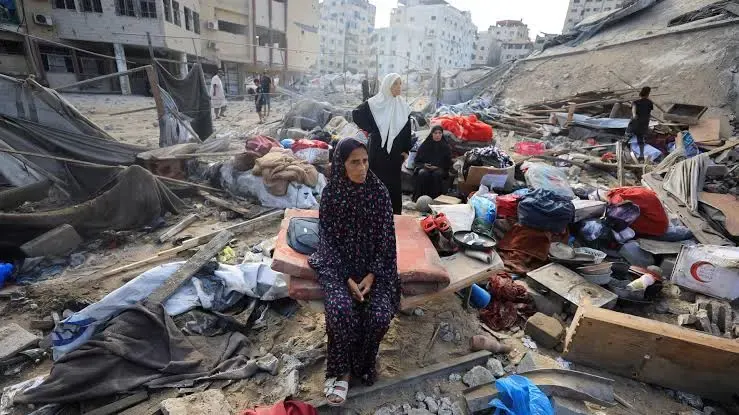
In al Tuffah, in northern Gaza, families awoke to find yellow concrete blocks marking the edge of Israeli military control moved westwards into Salah al Din Road, one of the territory’s main north to south routes. An Israeli flag flew above an earth bank about three metres high. Umm Mohammed al Shawish, whose family home had already been destroyed, was again searching for shelter after an Israeli warning forced the family from its tent and a subsequent strike tore it apart.
Elsewhere, satellite analysis documented scores of new demolitions, an expanding network of earthen ramparts and new Israeli military positions along the so called Yellow Line. What had been presented in the October 2025 ceasefire agreement as a temporary military demarcation increasingly resembled a fortified internal border.
This is the central contradiction confronting the latest Gaza initiative. For the first time, Hamas has formally accepted a framework that could end its independent military role in Gaza. Yet Israel has not publicly accepted the reciprocal withdrawal provisions on which Hamas says that commitment depends. Even as Trump celebrated a breakthrough, Israeli strikes continued and Israeli earthworks were reshaping the territory the agreement says the army must leave.
The result is not yet a peace settlement. It is a conditional framework whose success will depend on whether the political promises can reverse the physical reality being created on the ground.
What Hamas has actually agreed to
The distinction between an agreement to negotiate disarmament and the immediate surrender of weapons matters.
Trump announced on 30 July that his Board of Peace had reached an agreement for the complete disarmament of Hamas and other armed groups. The following day, Hamas confirmed that it had accepted a framework governing the transfer, storage and decommissioning of weapons, but it attached explicit conditions: Israel must stop its attacks, fulfil its obligations under the October 2025 Sharm el Sheikh agreement, withdraw its forces and permit an increased flow of humanitarian aid and goods.
The 15 point roadmap published by the Board of Peace supports a reciprocal process rather than a unilateral surrender.
First, Israel and the Palestinian factions are required to complete the cessation of military operations promised under the Sharm el Sheikh protocol. Within 14 days of all parties approving the new roadmap, negotiators are to prepare a detailed timetable and implementation mechanism. The 14 day deadline therefore applies to drafting the schedule, not to completing the removal of Hamas’s arsenal, tunnels or military infrastructure.
An International Verification Committee, comprising representatives of the guarantor states, the Board of Peace and an International Stabilisation Force, would certify compliance at each stage. Progress from one phase to the next would depend on verified completion of the previous phase.
The National Committee for the Administration of Gaza, or NCAG, would then enter the Strip and assume responsibility for civil government and security. Hamas and the other factions would be required to relinquish control of public administration and refrain from interfering in the committee’s work.
Police weapons would pass first to the NCAG. Existing police personnel would undergo vetting, while newly trained officers would be incorporated into the force. Personnel who failed the vetting process would be offered civilian roles or retirement under Palestinian law, rather than being stripped automatically of their livelihoods because of political affiliation.
The more difficult stage would begin only after Israel completed its remaining ceasefire commitments, the NCAG entered Gaza and the international force deployed. Heavy weapons, arms production sites, weapons depots and tunnels would then be catalogued, decommissioned or placed in storage through a gradual and time limited process administered by the Palestinian committee.
Crucially, the roadmap states that this process must be linked to a phased Israeli withdrawal from the areas it controls. No weapons are to be handed to Israel or to any other non Palestinian party. At the end of the transition, the NCAG alone would be permitted to possess, store or control weapons in Gaza under the principle of “One Authority, One Law, One Weapon.” Personal weapons would be licensed and regulated under Palestinian law, while militia arsenals would be placed under NCAG authority and militia members would not be absorbed into the police or security services.
The temporary international force would separate Israeli troops from areas controlled by the Palestinian committee, monitor the ceasefire, secure humanitarian deliveries and train Palestinian police. It would not conduct ordinary policing of Palestinian society. The roadmap also repeats that Israel must complete a phased withdrawal and that nobody is to be forced to leave Gaza.
This is much more extensive than Hamas’s previous willingness to step aside from day to day government. If implemented, it would dismantle the movement’s independent military infrastructure and end its control of Gaza’s security apparatus. It would also make an exclusively Palestinian technocratic body, rather than Israel or an international occupation authority, the custodian of weapons during the transition.
That difference helps explain why Hamas can present the agreement to its supporters as something other than capitulation. Ghazi Hamad, who participated in the negotiations, described the framework to Reuters as “difficult and painful,” but said Hamas was prepared to accept it if Israel first ended attacks, returned its forces to the positions agreed in October and expanded the flow of aid. Hamas also tied implementation to international protection and a credible route towards Palestinian self determination and statehood.
The agreement is not necessarily accepted by every armed group. Palestinian Islamic Jihad disputed reports that there was a complete consensus among the factions, leaving a serious enforcement question even if Hamas proceeds. Gaza contains smaller armed organisations, clan networks and personal weapons that cannot be brought under one authority by declaration alone.
A first mover dispute at the heart of the plan
The roadmap tries to solve a problem that has defeated previous negotiations: neither side trusts the other to move first.
Hamas argues that disarming while Israeli troops remain in Gaza would leave Palestinians defenceless under occupation and give Israel no incentive to withdraw. Israel argues that withdrawing before Hamas has been verifiably disarmed could allow the movement to rebuild its military capacity and attack again.
The new document attempts to bridge that divide through parallel, internationally verified steps. Nickolay Mladenov, the Board of Peace’s High Representative for Gaza, said withdrawal must proceed in lockstep with decommissioning. Yet public statements from the parties immediately exposed incompatible interpretations.
Trump said Israel was “very happy” with the plan and had helped his administration. Prime Minister Benjamin Netanyahu, however, had not publicly endorsed the roadmap by 1 August. An Israeli official told Reuters that the Israel Defense Forces would not withdraw from the current Yellow Line unless Hamas first underwent “genuine disarmament.”
That position reverses the sequence demanded by Hamas and sits uneasily with a roadmap that requires Israeli ceasefire obligations, the entry of the Palestinian committee and the deployment of the international force before the heavy weapons process begins.
Israel’s far right National Security Minister, Itamar Ben Gvir, rejected the draft outright. He argued that ending Israel’s assassination campaign would allow Hamas to regroup, called for continued attacks on the movement’s members and again advocated encouraging Palestinians to leave Gaza. His opposition matters because Netanyahu faces an Israeli election in October and is likely to depend on right wing allies.
The disagreement is therefore not a technical detail to be resolved later. It is the hinge on which the entire plan turns. If Israel insists on full disarmament before meaningful withdrawal, while Hamas refuses to place weapons in storage before Israel stops attacking and begins to leave, the process could fail before the 14 day scheduling period is complete.
International support, accompanied by basic questions
Foreign governments broadly welcomed the announcement, although their statements were more cautious than Trump’s.
European Union foreign policy chief Kaja Kallas called the roadmap a potentially constructive step, but stressed that success depended on full commitment from every party. She identified verification of Hamas’s compliance as a major challenge and said Israel would ultimately have to withdraw. The European Union, she added, was ready to help with the entry of the Palestinian committee and the international force.
German Foreign Minister Johann Wadephul welcomed what he called hopeful news and emphasised that Hamas must no longer threaten Israel. He also offered humanitarian support for Gaza. British cabinet minister Louise Haigh described progress on negotiations and disarmament as extremely welcome.
The statements showed the diplomatic appeal of the plan, but they did not resolve its practical gaps. Bader Al Saif, a professor at Kuwait University, asked the questions that now dominate the process: which party acts first, whether each step will be simultaneous, who physically receives and stores the arms, whether Palestinian Islamic Jihad is bound by the framework and when the international force will be capable of deploying.
Former Israeli legislator and special forces commander Doron Avital raised a different concern. Many Israelis, he said, would fear that weapons stored under Palestinian control could later be used again. He suggested that transferring them outside Gaza, perhaps to Egypt, would be viewed differently. The roadmap rejects that option by specifying that weapons will not be handed to a non Palestinian authority, exposing another potential conflict between its Palestinian ownership principle and Israeli security demands.
The Yellow Line is becoming a physical frontier
The dispute over sequencing is made more dangerous by the changing geography of Gaza.
Under the October 2025 agreement, Israeli troops withdrew to a mapped demarcation known as the Yellow Line. That first stage left Israel in temporary control of about 53 per cent of the Strip, pending further withdrawals. Netanyahu later said the military controlled more than 60 per cent, and in May he said his directive was to push that figure towards 70 per cent. Reuters reported that Israel controlled roughly two thirds of Gaza by late April.
The line was never consistently marked on the ground. Israeli forces placed yellow concrete blocks at intervals, but Palestinians and independent analysts reported that some markers were moved westwards, deeper into Gaza. In several areas the physical blocks, earthworks and troop positions no longer corresponded with the boundary shown on ceasefire maps.
The scale of construction now suggests something more durable than temporary battlefield management.
An Associated Press satellite investigation published in late July identified more than 23 kilometres of earthen barriers constructed through areas demolished by the Israeli military. The AP found that one southern section grew from roughly 500 metres to 2.4 kilometres in the first half of July, while the longest near continuous section stretched for about 17 kilometres from the Khan Younis area towards Gaza City.
A later and broader BBC Verify analysis mapped a network extending more than 42 kilometres and covering about 85 per cent of the Yellow Line. Its longest section measured 13.8 kilometres under the BBC’s methodology. Near al Mawasi, one part of the embankment was more than 1.5 kilometres beyond the line drawn on the ceasefire map. In Khan Younis, another section lay more than 500 metres beyond it. Intelligence analyst Tony Reeves estimated from satellite imagery that one barrier could be as high as seven metres.
The measurements differ because the investigations examined the network at different dates and counted sections differently, but their overall finding is consistent: construction has expanded rapidly, cuts through destroyed Palestinian communities and in some places lies beyond the agreed demarcation.
Israel has also established 14 military positions near the line since the ceasefire, including two still under construction, while seven earlier positions have been paved or enlarged. Roads, staging areas, trenches and security infrastructure reinforce the earth banks. Retired Israeli Brigadier General Assaf Orion told the BBC that the pattern suggested the army was preparing for a long stay. Andreas Krieg of King’s College London described the Yellow Line as being transformed from a temporary withdrawal boundary into a de facto internal border.
The Israeli military says the construction is defensive. It told news organisations that the barrier, surveillance systems, technology and troop deployments are intended to prevent infiltration, protect Israeli communities and stop Hamas rebuilding its armed forces. It has denied moving the Yellow Line and says clearer marking is meant to reduce friction and prevent civilians being harmed. For operational security reasons, it has declined to disclose the complete route or intended extent of the barrier.
The physical evidence nevertheless raises an unavoidable question. If the new peace roadmap requires Israel to withdraw from “areas under its control,” which line will be used as the starting point: the boundary agreed in October, the later position of the yellow blocks, or the new earthworks that have pushed further west?
Without an authoritative map, fixed coordinates and independent monitoring, a phased withdrawal could legitimise territorial gains made during the ceasefire rather than reverse them.
Independent scrutiny is particularly important because Israel has barred international journalists from entering Gaza independently since the war began in 2023. Palestinian reporters, witness testimony, verified video and commercial satellite imagery therefore remain essential to documenting changes that cannot be observed freely on the ground by the international press.
Families displaced by a moving boundary
For Palestinians, this cartographic dispute has immediate human consequences.
More than two million people are being compressed into an ever smaller area west of the line, much of it filled with tents and lacking adequate water, sanitation, medical care and shelter. Much of the Israel controlled zone to the east has been depopulated and extensively demolished. Satellite images examined by the AP showed the vast majority of buildings levelled in many locations, with new roads and military bases built across the ruins. Rafah, once home to more than a quarter of a million people, has been largely erased.
On 18 July, families in Zeitoun, east of Gaza City, loaded mattresses and possessions onto motorcycles after receiving an evacuation order. Residents reported fire from military vehicles, artillery and drones as Israeli forces approached. Some fled without belongings. The United Nations humanitarian office said about 30 families lost their tents, while satellite imagery showed scores of temporary shelters disappearing during July.
In al Tuffah, the movement of yellow blocks into Salah al Din Road again forced people who had already lost their homes to search for somewhere to go. Mohammed al Shawish, whose family’s tent was destroyed after an evacuation warning, said, “We are going to die here.”
East of Deir al Balah, families on farmland said the Israeli military gave them two days to leave before structures were razed. Satellite imagery showed tank tracks, damaged buildings and an olive grove apparently destroyed more than 500 metres beyond the mapped line. Newly placed yellow blocks extended hundreds of metres into the same area.
Near al Mawasi, one of the largest zones of displacement, Palestinians described recurring gunfire, daily tank movements and the construction of tall sand embankments closer to their camps. In July alone, satellite imagery indicated that scores of additional buildings were destroyed beyond the mapped Yellow Line in Khan Younis, Deir al Balah, Zeitoun, Jabalia and Beit Lahia. Greenhouses, orchards and roads were also cleared for barriers or military access.
The line is dangerous even where it has not moved. Israeli forces have killed Palestinians who approached or crossed it, including civilians and children who may not have known its precise location. The military says it fires on people assessed to be militants or threats to troops. Some Israeli soldiers, however, have told the AP that the boundary is not always clear to them and that orders have permitted firing on anyone crossing it.
On 22 July, the United Nations human rights office said the population was trapped in a shrinking area and warned that routine fire at Palestinians merely for being near the line would violate international human rights and humanitarian law. It recorded at least 57 Palestinians killed between 13 and 20 July, including six children and eight women. Thirty four were killed far from the Yellow Line, undermining any suggestion that danger was confined to the immediate military boundary.
Abu Kamel Hamami, displaced in Gaza City, described the practical effect in a few words: “The Yellow Line keeps moving day by day.”
A ceasefire in name, but not an end to killing
The announcement of the disarmament roadmap did not stop Israeli attacks.
On 1 August, Reuters reported that an Israeli strike killed two Palestinians in Gaza City’s Sheikh Radwan area. The Israeli military said they were Hamas members but provided no further details.
In a separate attack, two warehouses holding medicine for Al Aqsa Martyrs Hospital in Deir al Balah were destroyed. Two other medical stores and the hospital’s outpatient clinic were damaged. Hospital officials said the warehouses contained supplies for dialysis patients as well as dressings and routine treatment materials. Witnesses said an evacuation warning had been issued before the strike, and no casualties were immediately reported there. The Israeli military had not commented on the warehouse attack at the time of publication.
Palestinian health officials said Israeli attacks had killed 1,222 Palestinians in the nine months since the October ceasefire, most of them civilians. The AP, using an earlier cut off date, reported that militant attacks had killed five Israeli soldiers during the same period.
The continuing death toll explains why people in Gaza greeted Trump’s declaration with exhausted scepticism. Tala, an 18 year old university student living in a tent after her home was destroyed, told the BBC that repeated promises of ceasefires had produced more fear when they failed. Her priority was not the diplomatic terminology but an end to attacks, protection for civilians and the beginning of reconstruction.
Mohamed Ali Abed, displaced with his wife and two children, offered a more pragmatic view. If storing weapons could unlock withdrawal, reconstruction and an end to the siege, he said, then it should be done. Armed tools could be surrendered, he suggested, without extinguishing the political idea of resistance among an occupied people.
These views reveal the pressure on Hamas from within Gaza. After years of mass death, hunger, repeated displacement and ruin, many Palestinians may accept far reaching concessions if they produce genuine safety and freedom. That pressure can help implementation, but it also means that another failed agreement would deepen despair and destroy what remains of public trust.
Who would govern Gaza after Hamas?
The roadmap’s proposed alternative is the National Committee for the Administration of Gaza, led by Ali Shaath, a civil engineer and former Palestinian Authority official.
According to the committee’s official description, it is a transitional, technocratic and politically independent body composed exclusively of qualified Palestinians from Gaza. It has portfolios covering public services, finance, health, education, agriculture, justice, housing, social security, internal administration and other government functions. It would manage day to day civil affairs but would not represent Palestinians internationally.
The committee says its mandate is temporary and should end when reforms within the Palestinian Authority create conditions for a credible path to Palestinian self determination and statehood. The new roadmap would substantially enlarge its responsibilities by giving it authority over police, internal security, weapons licensing, militia decommissioning, public assets and Gaza’s administrative finances.
The proposal attempts to avoid two politically explosive outcomes: the return of direct Israeli rule and the installation of a wholly foreign administration. Yet the NCAG would operate under the supervision of Trump’s Board of Peace, an arrangement that has itself attracted criticism.
The Board includes the United States, Israel, Saudi Arabia, Qatar, Egypt, Turkey and more than 20 other states. Trump is its chairman, while its executive figures include Secretary of State Marco Rubio, Steve Witkoff, Jared Kushner and former British prime minister Tony Blair. Its charter offers states permanent membership in return for a contribution of $1 billion. Britain, France, Germany, China, Russia and several other major powers have not joined.
The United Nations Security Council recognised the Board in Resolution 2803 and authorised a temporary stabilisation force, but limited that mandate to Gaza and to the end of 2027. China and Russia abstained, arguing that the United Nations had not been given a sufficiently clear role. Critics have also objected that Palestinians are represented in the subordinate administrative committee but not on the international Board that supervises it.
Those legitimacy concerns will matter if the Board must adjudicate alleged breaches by Israel, which is itself a member, or compel either side to comply with withdrawal and disarmament schedules. Verification is useful only if violations produce consequences.
Reconstruction cannot wait for political perfection
The physical and social destruction of Gaza makes the timetable more than a diplomatic exercise.
An April 2026 United Nations and World Bank assessment estimated that more than 71,000 Palestinians had been killed and over 171,000 injured by that stage, with many more missing. By late July, the Gaza Health Ministry’s cumulative death toll had passed 73,000. The October 2023 Hamas led attack on Israel killed about 1,200 people, mostly civilians, and 251 people were taken hostage.
The UN assessment found that 1.9 million Palestinians had been displaced, often repeatedly, and more than 371,000 housing units had been damaged or destroyed. Gaza’s economy had contracted by 84 per cent, human development had been set back by an estimated 77 years and recovery and reconstruction would require about $71.4 billion over a decade. The Board of Peace said member states had contributed or pledged about $7 billion by February, illustrating the scale of the financing gap.
Even the limited humanitarian gains achieved since the ceasefire remain precarious. A July assessment by United Nations agencies found that 1.4 million people, about 67 per cent of Gaza’s population, were still experiencing crisis level hunger or worse. Some 212,000 remained in emergency conditions. More than 70 per cent of cropland was inaccessible and only three per cent was usable.
The Yellow Line is central to that crisis. It separates families not only from former homes but from farmland, water infrastructure, roads and sites needed for reconstruction. An earth barrier erected across agricultural land can continue causing hunger long after the last air strike. A military zone covering most of Gaza’s productive territory makes meaningful economic recovery impossible even if aid trucks increase.
This is why reconstruction cannot be treated merely as a reward to be released after every political and security dispute has been resolved. Early recovery, debris clearance, shelter, water, health care and access to farmland must proceed alongside the security transition. Otherwise, civilian misery becomes leverage in negotiations over weapons and withdrawal.
The five tests that will show whether the agreement is real
The latest framework contains the most detailed public formula yet for linking Hamas’s disarmament to an Israeli withdrawal. It also contains language on Palestinian government, protection from forced removal, reconstruction, self determination and statehood that was absent or ambiguous in earlier declarations. Those are meaningful developments.
Five practical tests will determine whether they amount to more than another announcement.
The first is formal Israeli acceptance, including an immediate end to strikes and assassinations covered by the cessation of military operations. Trump’s assertion that Israel is satisfied cannot substitute for a clear decision by Netanyahu’s government.
The second is an agreed map. The original Yellow Line, every subsequent movement of its concrete markers and the route of the new barriers must be independently documented. Demolitions and construction beyond the ceasefire line should stop while the verification mechanism determines the baseline for withdrawal.
The third is the actual entry of the Palestinian technocratic committee and deployment of a credible international force. Hamas cannot transfer administration and weapons to institutions that are not present, functioning and protected inside Gaza.
The fourth is a single reciprocal schedule that pairs each verified stage of weapons decommissioning with a specified Israeli withdrawal. Ambiguous sequencing will recreate the old demand that the other side move first.
The fifth is visible improvement in civilian life: sustained humanitarian access, restored medical services, freedom of movement, emergency housing and the beginning of Palestinian led reconstruction. If ordinary people continue to face air strikes, displacement and expanding military zones, no verification committee will be able to manufacture confidence in the process.
A historic possibility, surrounded by warning signs
It would be wrong to dismiss the agreement simply because Trump described it in superlatives. Hamas’s acceptance of a process that would remove heavy weapons, tunnels and militia control from its hands is a major political shift. The commitment to link that process to an Israeli withdrawal offers a possible route out of the first mover trap that has paralysed negotiations.
It would be equally wrong to call the war over.
Netanyahu has not publicly accepted the roadmap. Senior Israeli figures say the army will not leave its present line before Hamas disarms. Ben Gvir wants attacks and assassinations to continue. Palestinian Islamic Jihad has questioned whether all factions are committed. The international force and verification machinery are not yet fully deployed. Israeli strikes are still killing Palestinians, while earth barriers and new bases continue to harden a temporary military line into a territorial reality.
For people in Gaza, the decisive evidence will not be found in Trump’s announcement or in the careful phrasing of the roadmap. It will be seen in whether the bombing stops, whether the yellow blocks move east rather than west, whether the new embankments are removed, whether Israeli soldiers withdraw and whether Palestinian institutions can begin rebuilding a society pushed to the edge of physical survival.
If disarmament and withdrawal genuinely proceed together, the agreement could become the opening to a different political future. If Hamas is required to surrender its last leverage while Israel consolidates control over most of Gaza, the plan will look less like peace than the formalisation of partition.
The coming weeks will reveal which version is being built: the future described on paper, or the border already rising from Gaza’s ruins.