While the World Watched the World Cup, Gaza Burned: The Massacre the Cameras Missed
While viewers watched the World Cup, the Gaza 'ceasefire' kept killing civilians
On Wednesday night, in a heaving stadium in Atlanta, the second semi-final of the 2026 World Cup produced the kind of finish the tournament's sponsors dream about. Anthony Gordon had put England ahead; Argentina, the defending champions, answered with two late goals to win 2–1 and take their place in Sunday's final against Spain. Buenos Aires celebrated into the small hours, and on the pitch Giovani Lo Celso unfurled a banner declaring the Malvinas Argentine – a forty-year-old grievance waved in front of a billion viewers, and nobody thought politics out of place.
In the same hour, under a clear north London sky, I was one of the 60,000 packed into Tottenham Hotspur Stadium for the second of System of a Down's two sold-out nights – the band's first London shows in nearly a decade. Daron Malakian ran the football commentary himself from the stage, relaying England's goal mid-set, leading the chants, telling the crowd that if England lost he would blame Oasis. Even here, the old Anglo-Argentine wound was entertainment. Then came Tentative – the song whose whole engine is the question of where people are meant to go when the bombs start falling out of the sky – and the entertainment stopped. Malakian altered the line as he sang it, aiming the song's question at Gaza by name, asking where its people are supposed to go during Israel's unrelenting and illegal genocidal attacks. The crowd did not hesitate; 60,000 voices roared their backing. And as the song crashed towards its close, he snarled, 'Screw you, Benjamin Netanyahu', and the stadium erupted. It was a ritual, not an aberration: the band has dedicated the song to Gaza and Lebanon night after night on this tour, from Mexico City to Milan – where Malakian followed the dedication with a blunt condemnation of Netanyahu – and at an earlier show in France this month he told the crowd, 'I'd like to dedicate this song to the children of Gaza.'
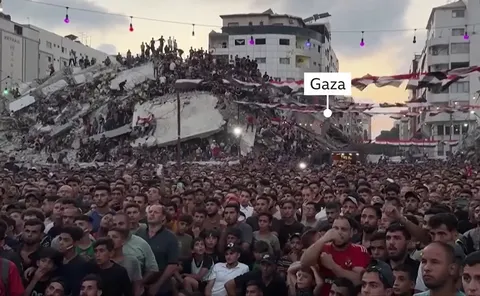
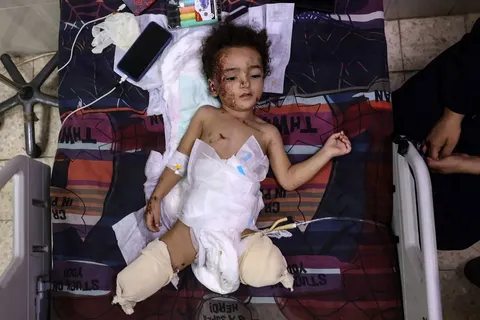
And in Gaza, across the same 48 hours, under a ceasefire now in its tenth month, the killing proceeded at its routine tempo. On Tuesday an airstrike on the police station in the Jabaliya refugee camp killed a woman and six police officers, among them Colonel Mohamad Marwan Salem, head of the station; the Israeli military said four of the dead officers were Hamas operatives, and published nothing to show how. The same day a man was killed when a tent camp in Khan Younis was bombed, and Israeli forces shot dead a child in the al-Mawasi area outside Rafah. On Wednesday – as the teams warmed up in Atlanta and the queues formed in N17 – a strike on a flat near the al-Baraka roundabout in Deir al-Balah killed Omar Abu Qassem, 33, his wife Asma and their six-year-old daughter Habiba, and started a fire that Civil Defence crews had to extinguish before they could bring out the couple's three-year-old son Sami, injured and alone; the Israeli army confirmed the attack, saying it had targeted a Hamas fighter. Local health officials counted at least a dozen dead across the Strip in two days. Not a massacre, by this war's standards. Just the tempo. Every single day.
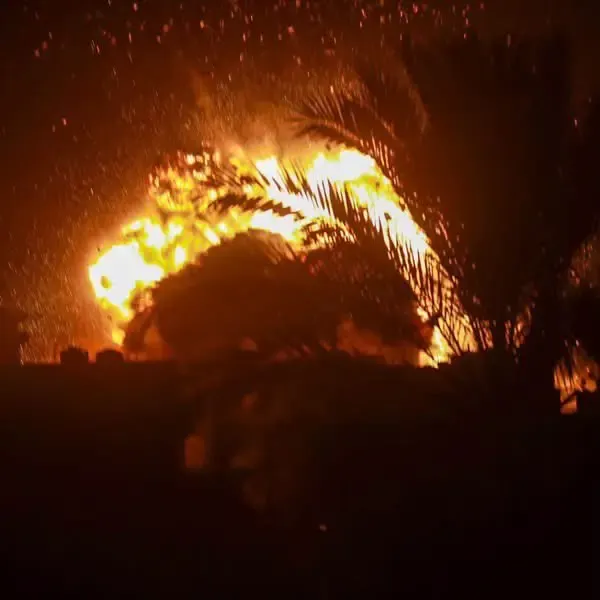
Nor did the tempo pause for the morning after. Overnight into Thursday, the Israeli military announced it had struck what it called four Hamas weapons depots in the central Strip – rifles, rocket-propelled grenades and explosives, it said, destroyed to 'remove the threat' – while residents in the Bureij refugee camp pulled their belongings from the wreckage. By Thursday the medics were counting again: two killed near the Tuffah neighbourhood in the north, one by tank shelling in Zeitoun in eastern Gaza City, one in an airstrike on a tent encampment for the displaced in western Gaza City, one in a strike on a vehicle in Khan Younis. Early counts said at least five dead; by evening the day's toll was being reported at nine, three women among them.
A ceasefire only in name
The ceasefire took effect on 10 October 2025 under the first phase of Donald Trump's plan. The hostages came home. The Security Council blessed the framework the following month with resolution 2803. Since that date, according to Gaza's Health Ministry – whose casualty records United Nations agencies and independent experts treat as broadly dependable – at least 1,123 Palestinians have been killed in Israeli military operations, and the ministry says women and children make up most of the dead – at least 275 of them children, by Al Jazeera's accounting of the same toll data. In the same nine months, five Israeli soldiers have been killed; Israel says its strikes answer shooting attacks and other violations by militants. Those are the two columns of the ledger: 1,123 against five. Set them side by side and the word 'ceasefire' does the rest of the work on its own.
And the tempo is rising, not falling. The conflict monitor ACLED recorded more than forty Israeli air and drone strikes in June – the highest monthly total since the truce took effect – and its own Middle East analysts link the surge to a prime minister trailing in the polls ahead of Israel's October election, under mounting domestic pressure to be seen taking a harder line against Hamas. The dead of Gaza, on this reading, are not even the point; they are a campaign backdrop.
The signature repeats. In the first days of June, in the same escalation ACLED measured, a dawn strike on a flat in Gaza City's Tel al-Hawa killed five members of the Labad family as they slept and set the apartment ablaze; the young daughter pulled from the fire, Hala, spent June in al-Shifa hospital, badly burned, asking where her parents had gone. Israel alleged her father, a policeman, was a senior figure in Hamas's security service. Six weeks later came Sami. Two children in two months, each carried out of a burning family home in which everyone else was dead – this is what the ceasefire's routine tempo produces, over and over, at a rate no single night's coverage can convey.
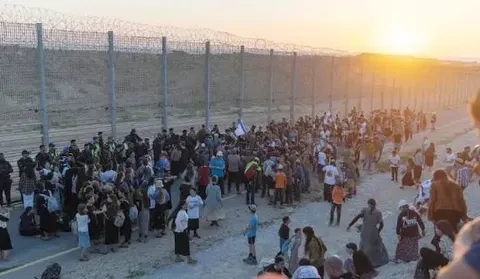
The pattern is not disputed by the UN's own machinery – only unpunished by it. The UN human rights office said on 3 June that Israeli forces had attacked Gaza's police at least a dozen times this year, including while officers directed traffic and patrolled markets, and warned that the pattern suggested no distinction was being drawn between police and fighters. Volker Türk, the human rights commissioner, said in April – when the post-truce toll stood at 738 – that it was 'hard to square this with a ceasefire', and that Palestinians had been left with no formula for staying alive: nothing they can do, nowhere they can go, that guarantees they will not be hit. UNRWA has called it a ceasefire only in name. On 29 June the UN's Middle East envoy told the Security Council that the toll since the truce had passed a thousand, and that Israel now says it controls roughly 70 per cent of the Strip, squeezing two million people into a shrinking remainder of it. Early this month Gaza marked 1,000 days of war; its media office says more than 90 per cent of the territory has been destroyed.
And the architecture of the killing keeps evolving. The Palestinian Centre for Human Rights has documented 23 military cranes inside Gaza fitted with remotely operated machine guns and surveillance cameras. The Gaza journalist Tamer Nahed – one of the few reporters there still alive and still transmitting – has described them firing near-continuously into tent camps and open streets, and has recorded their victims, a five-year-old girl among them. Days before the semi-final, the water station on which Nahed's volunteer group depended was struck, killing people at the site and ending the last clean-water deliveries his project could make in Gaza City.
The football did not stay on its side of the world
The World Cup likes to present itself as a sealed universe of joy. Gaza kept puncturing it. On the eve of Argentina's round-of-16 tie against Egypt – the match the champions survived only through a stoppage-time winner – an Israeli strike killed Mohammed al-Wahidi, an official of the Egyptian sporting committee, together with three others; days earlier a Palestinian goalkeeper had been killed. The tournament mourned neither on its broadcasts. It aired the unity commercials, permitted the Malvinas banner, and moved on towards the final.
The song that asks the question
Tentative was written two decades ago; on Wednesday night I heard its author sing its question at Gaza by name, and 60,000 people answered him with a deafening cry. In the tenth month of the ceasefire, the actual answer is a matter of public record. There is nowhere. More than 90 per cent of the Strip is destroyed. The 'yellow line' behind which Israeli forces sit is shifting and poorly marked, and people are shot for straying near it. The tents are within range of the crane guns. The UN's reproductive-health agency reports that 96 per cent of Gaza's children feel that death is imminent. Serj Tankian, System's frontman, put the band's position beyond doubt at the end of June, in a video responding to the Netanyahu cabinet's sudden recognition of the Armenian genocide: he accused a government 'already committing genocide in Gaza and Lebanon' of weaponising his grandparents' history to political advantage, and signed off with an obscenity aimed squarely at the cabinet. Sixty thousand people in a north London stadium did not merely stand adjacent to that message on Wednesday; they roared it back at the stage. The bombs fell anyway.
The machinery of impunity
There will be no emergency session over this week's dead. There is no mechanism anywhere in the system that treats 1,123 bodies in nine months as a breach worth convening for. The Security Council resolution that endorsed the ceasefire installed as its guarantor a 'Board of Peace' chaired by the American president who brokered the deal – and the Board's first report to the Council, in May, listed the ceasefire itself among its achievements. On Wednesday, the day the Abu Qassem family was buried, Morocco signed an agreement in Rabat to join the International Stabilisation Force that is meant, eventually, to police a truce whose ground rules Israel's prime minister has already rewritten, declaring that the army 'will not withdraw' from the territory it holds. Hamas, for its part, dissolved its government on 6 July to hand power to the UN-backed technocratic committee the plan requires; that committee has not yet been able to enter Gaza. Nine months. 1,123 dead. And the sum of the world's institutional response is a stabilisation force still collecting signatures, and a peace board that reports the peace a success.
That is the true shape of the night of 15 July 2026. In Atlanta, a comeback for the ages. In north London, a band that has spent a summer begging its audiences to look at Gaza gave 60,000 of us the night of the year, tracked the football from the stage, and sang its question about people with nowhere to run straight at the man ordering the bombs. In Deir al-Balah, a man, his wife and their little girl were carried to al-Aqsa hospital and buried – mourned by a three-year-old boy who now joins the more than 58,000 children the UN counted, even before this year, as having lost one or both parents in Gaza. The three scenes do not contradict one another; they are the same world, and the distance between them is the whole story. The word 'ceasefire' has not been broken so much as redefined: it now names an arrangement under which the strikes continue almost daily, the ledger reads 1,123 to five, and the institutions charged with enforcement mark their own homework. The crowd in Atlanta roared. The crowd in London roared. And Gaza buried its dead to the only sound the world reliably sends it – the jets.