'Every Day, a Child Dies': Surgeon and Witnesses Detail Ongoing Israeli Attacks on Gaza's Children Despite Ceasefire
As UN report accuses Israel of deliberate targeting of Palestinian children, a British surgeon who first described drone attacks on wounded children to UK MPs in 2024 says the pattern continues—while families in beachfront tent camps recount the latest deadly airstrikes
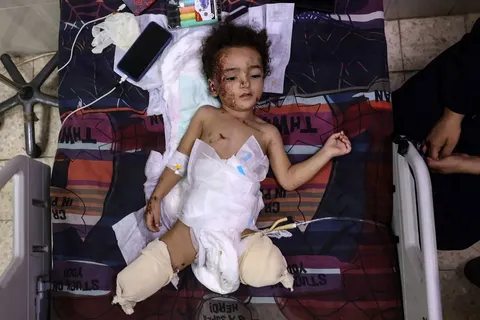
Eleven-year-old Ahmed Al-Raqab was playing outside his family's tent on Gaza's sandy coastline in Al-Mawasi when the Israeli missile struck. He had been carrying a watermelon.
"What was this child's crime?" his father, Sabri Al-Raqab, sobbed as he knelt on the floor of Nasser Hospital, his arms wrapped around his son's bloodied body in a final embrace. "He picked up a watermelon and they fired at him. Is he a fighter? He's not a fighter. He's a child."
The attack on June 24, 2026, which killed Ahmed and severely wounded several others, came just one day after a UN Independent International Commission of Inquiry released a devastating report concluding that "Israeli authorities and security forces have deliberately targeted Palestinian children, resulting in genocide, crimes against humanity and war crimes in the Gaza Strip."
The findings echo testimony given more than a year and a half earlier—proving that despite international outrage, nothing has fundamentally changed.
A Pattern Documented Since 2024
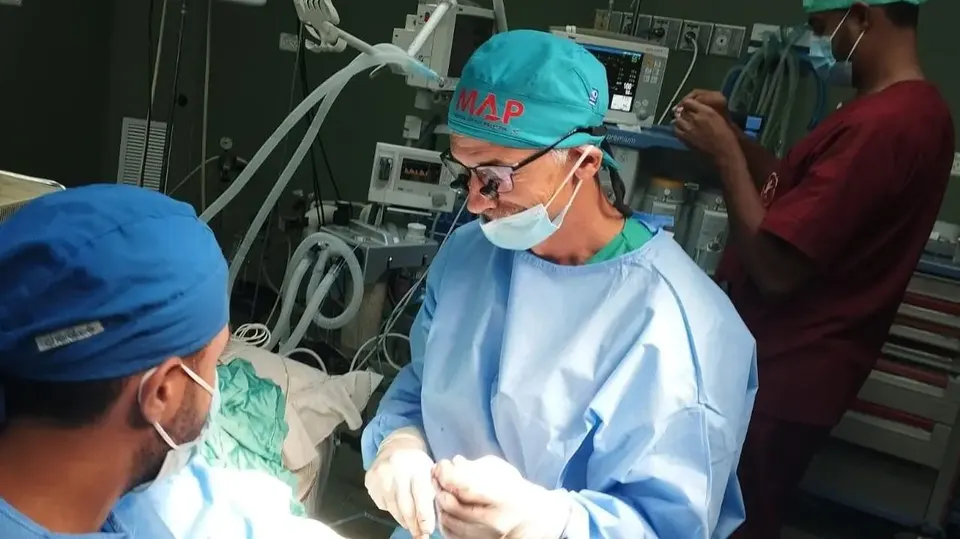
In November 2024, Prof Nizam Mamode, a retired surgeon from Brockenhurst, Hampshire, who had volunteered at Nasser Hospital in Gaza, gave evidence to the UK Parliament's International Development Committee. His testimony that day was described by committee chair Sarah Champion as "profound and deeply chilling."
Breaking down with emotion, the 62-year-old surgeon told MPs: "What I found particularly disturbing was that a bomb would drop, maybe on a crowded, tented area and then the drones would come down."
His face shook as he paused to compose himself before continuing: "The drones would come down and pick off civilians—children. We [were] operating on children who would say: 'I was lying on the ground after a bomb had dropped and this quadcopter came down and hovered over me and shot me.' That's clearly a deliberate act and it was a persistent act—persistent targeting of civilians day after day."
Now, in June 2026, Dr. Mamode has returned from yet another stint in Gaza—and the story remains unchanged. Operating at Al-Shifa Hospital, he continues to treat children with the same wounds, from the same drones, in the same targeting pattern.
"I've personally operated on a number of children who have described very clearly being targeted by quadcopters or drones," Dr. Mamode told the BBC this week. "These drones fire on people. They drop explosives, they fire bullets, and they fire small pellets, which cause a huge amount of damage, particularly in children, and in fact are illegal under international law."
He recalled one child from his latest deployment: seven-year-old Amir, who described being in a group of tents when a bomb was dropped. "He was knocked over by the blast, and then he heard a drone above him, turned around, and then it fired on him."
Two years on from the start of the war, the tactics are identical. The victims are still children. And the international community, Dr. Mamode says, is still watching without acting.
The Toll, By the Numbers
The UN inquiry found that during the first two years of the Israeli assault, over 20,000 children were killed and more than 44,000 injured. Since the so-called ceasefire went into effect in October 2025, Israel has killed at least 265 children and wounded hundreds more, according to findings released last week by UNICEF.
"During a period supposedly defined by restraint and protection, a child has been killed, on average, every single day for more than eight months," UNICEF spokesperson James Elder said. "That is an absurd and devastating figure."
Israel's Foreign Ministry has responded to the UN report, saying it "utterly rejects" the commission's findings, calling it "a libellous sham" and "a propaganda piece as outrageous as its previous ones."
But for those on the ground, the numbers are not propaganda—they are bodies. They are Ahmed, carrying a watermelon. They are Amir, lying wounded as a drone hovers overhead. They are the children Dr. Mamode has operated on, over and over, for two years.
Tents by the Sea, Under Fire
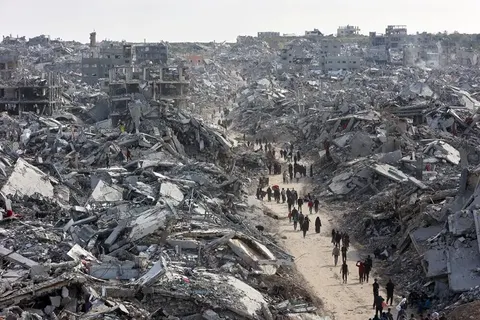
Israel's latest attacks targeted several areas of Gaza's coastline where thousands of displaced Palestinians live in dilapidated tent encampments—positioned as far as possible from the "yellow line" where Israeli troops are stationed and steadily encroaching westward.
One airstrike hit a tent encampment west of Gaza City. Israel warned of the strike minutes before, prompting families to flee toward the sea before the missile struck, destroying several tents and leaving a massive crater in the sand.
"We were sleeping, it was night. We heard sounds of commotion and disturbance so we went outside to see what was happening, and we found that everyone, in the whole quarter, the whole encampment, was evacuating," said Ahmed Yassin, who lived with his wife, five children, and other relatives in two tents on the sandy dunes. "We took our children, they were sleeping. My mother is elderly and disabled. She's ill. We barely managed to get out in the final moments."
Behind him, children picked through the ruins, trying to salvage whatever they could.
"We have no place, no shelter, nothing. Where are we supposed to go? We have no idea," Yassin continued. "From the beginning of the war until today, the attacks have never stopped. It didn't stop. A truce, a ceasefire—where is the ceasefire? What are they talking about? Bombing, destruction, shelling. The war is ongoing."
The Yassin family was displaced from their five-story home in Al-Zeitoun neighborhood of Gaza City early in the war. They went south, where they were displaced several times again before returning north after the "ceasefire" went into effect.
"Al-Zeitoun is a dangerous area, today there is no one there. The area we used to live in is basically nothing but a demolition zone," Yassin's wife, Rana, said. "This area here was made up of tents sheltering civilians—displaced people, people who lived through oppression, humiliation, famine, war and siege. And the whole place was bombed, the entire area was destroyed."
The Same Grim Reality in the Operating Room
Dr. Mamode described the impossible conditions faced by medical staff in Gaza's shattered healthcare system—conditions that have only deteriorated since his first visit.
"None of the hospitals—there were 36 hospitals in Gaza—none of them are functioning properly at the moment," he said. "Shifa was really the jewel for Palestinian healthcare. It had 700 beds before the war. It's been attacked twice. It's been completely destroyed. One building has left and that's been refurbished. That was the gynecology building. That's now used for all the surgical patients. The medical patients are still in tents in the courtyard."
He described operating without basic equipment. "There's no CT scanner, there's no basic equipment. We were doing major surgery and the only painkiller we had post-operatively was paracetamol, which was awful really."
"What is it like as a surgeon to operate on a young child who has injuries like this?" the BBC interviewer asked.
"Well, it's terrible, and indeed it's not just one child—it's over and over and over again," Dr. Mamode replied. "When I was there two years ago, we had maybe 30 or 40 serious injuries every day. There are less now, but despite the so-called ceasefire, we still see about 10 people a day killed in Gaza."
Even bringing in basic medical equipment was a struggle—a problem he first encountered in 2024 and which persists today. Dr. Mamode said he had to argue with Israeli border police to bring in his stethoscope.
"Anything that is not for personal use is not allowed in. So you can't bring in medication for other people. You can't bring in bandages, anything like that," he said. "I had a stethoscope, I had my surgical magnifying loops, and I had a small selection of instruments to do vascular surgery. They told me couldn't bring any of those in. I had to argue with the guards in order to get that in."
Water, Heat, and Survival
In the coastal tent encampments, the struggle for basic necessities continues unabated. Israel has targeted water pipelines, sewage systems, and desalination plants, damaging or destroying nearly 90 percent of water infrastructure in Gaza, according to Doctors Without Borders (MSF).
"Palestinians in Gaza face engineered water scarcity," MSF said in a report. "Families often prioritize drinking over cooking or washing, limit personal hygiene, and rely on unsafe or saline sources when humanitarian deliveries are interrupted."
Mohammed Zayed, displaced from Beit Lahia to a tent on the beach west of Gaza City, dug a makeshift well outside his tent using simple tools.
"We suffered tremendously, an indescribable hardship, due to the lack of water. We had to wait for water trucks, walk long distances and spend hours under the sun, just to sometimes get a single gallon of water," Zayed told Drop Site. "Other times, we would return empty-handed—unable to meet our daily needs and with no water. We were forced to go to the sea. The seawater is salty, but we would collect and use it despite the great difficulty."
Thankfully, his well struck fresh water. "It has eased my hardship and the hardship of those around me. Displaced people from the surrounding tents come here to fill up with fresh water."
With soaring food prices, Zayed also used the water to irrigate a small vegetable garden growing eggplants and zucchini beside his tent.
"We live in tents and in these tents we face so many hardships: Heat, cold, insects, rodents and sand. The sand itself causes us suffering. It gets into our bedding, our clothes, and affects our children. They develop itching and pimples on their bodies from the sand, the sea and the heat. May God ease our suffering."
Psychological Toll and Resignation
Dr. Mamode described the profound psychological impact on his Palestinian colleagues—a weight that has only grown heavier over two years of relentless violence.
One colleague had the car ahead of him targeted by a missile on three separate occasions during Dr. Mamode's latest visit.
"He was quite shaken on the first occasion because he said 20 meters—that could have been me killed," Dr. Mamode recounted. "By the third occasion, he'd become resigned to it and said, 'Well, if it's my time, it's my time.' This is the kind of thing that people are facing on a daily basis even though they're supposed to be in a ceasefire."
His colleagues, he said, are struggling. "They have no significant income. They're paid a minimum amount, rarely. Some of them are working entirely voluntarily. They have survived the worst of the famine and the bombing, but many of them see no future for themselves. What do they go home to? Many of them go home to tents."
"And when I say tents," he added, "these are not proper tents, many of them. They're really shacks with bits of carpet stuck to poles. No electricity, no sanitation, no running water."
A Call to Bear Witness
Dr. Mamode expressed anger that the international community, particularly the UK, has not done more—despite his testimony to Parliament in 2024, despite the UN reports, despite the mounting evidence.
"This country, which stood up for the oppressed, has an international reputation for doing that, is letting this genocide go by and doing nothing about it," he said.
That is why he felt compelled to speak publicly again. "No journalists are being allowed in. Many of the journalists—local journalists—have been killed. They're immensely brave people who still try and do their job. We are the only people really who can bring back firsthand accounts of what it's like, so it's vital for us to come and do this."
But as his testimony from 2024 and his words from 2026 make painfully clear, bearing witness has not yet translated into change. The drones still hover. The bombs still fall. The children still die.
"As this recent report has shown," Dr. Mamode said, referring to the UN inquiry, "the wealth of evidence is absolutely overwhelming. There is absolutely no way anyone cannot read that report and be upset by it and be convinced that the evidence is there and that these things have happened and are happening."
Two years on, the pattern is undeniable. The question remains: when will the world act?