Gaza’s Displaced Face a Deadly Winter as Storms Rip Through Tent Cities
The storm arrived before dawn, roaring in from the Mediterranean with sheets of freezing rain and winds strong enough to lift the flimsy tarpaulins many Palestinians in southern Gaza now call home. In the vast tent city of al-Mawasi, 62-year-old Sabah al-Breem huddled with her daughters and grandchildren, praying their makeshift shelter would hold. It didn’t.
“Everything collapsed,” she said, standing beside a mound of soaked bedding and warped wooden poles that had served as her home. “We repaired our shelter, and in the night it fell down again. All our belongings were soaked. The day the winds blew was a black day for us.”
For more than half a million displaced Palestinians like Breem, crammed along Gaza’s southern coastline in ad-hoc camps that stretch across the dunes, the storm marked the start of a winter many fear they will not survive. It is the third winter of displacement since October 2023, and aid groups warn it could be the harshest yet.
A Territory Held Together by Canvas and Hope
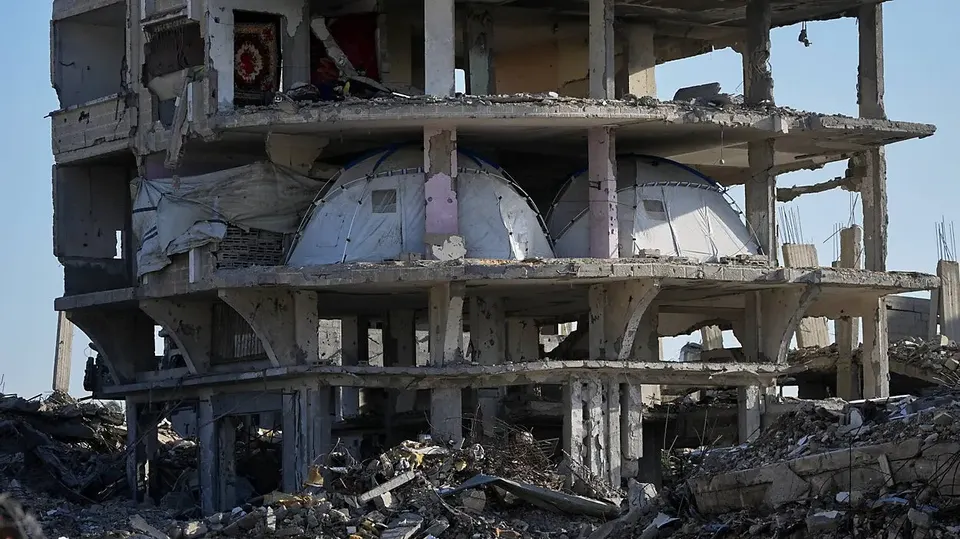
The war may have entered a fragile ceasefire phase, but Gaza’s humanitarian catastrophe has not paused. Nearly two million people now live in tents or improvised shacks, many pieced together from scavenged plastic, timber and scraps of corrugated metal. Entire neighbourhoods have vanished; homes destroyed in successive Israeli offensives or left inaccessible behind military-controlled zones.
Al-Mawasi, once a sleepy agricultural stretch on the southern coast, has become one of the largest displacement zones on earth. The overflow is so extreme that families pitch tents directly on the shoreline.
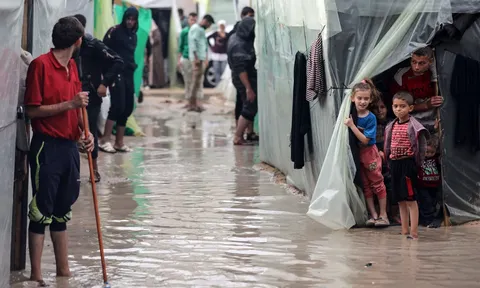
When the storm hit, waves smashed into the front rows of tents, sending seawater seeping under canvas walls and turning walkways into mud canals. Residents describe nights spent half-awake, listening for the next gust strong enough to lift a roof or sweep away a child.
“The sound of the waves prevents us from sleeping,” said 53-year-old Naama Arafat, now sheltering with her family in a single tarpaulin tent. “We lack all winter essentials—no blankets, no rugs, no bedding. Diseases have spread among us: colds, coughs, aches. And this is just the start of winter.”
‘A Storm on Top of a Ruin’
The storm’s impact was severe. Local officials and aid groups estimate more than 22,000 tents were destroyed or badly damaged, with thousands of families displaced yet again in a single night. The cost of the damage—food, medicines, tents, sanitation points—runs into the millions. But the larger cost is human.
“People are living between water and garbage heaps,” said a medical volunteer in central Gaza. “Children walk barefoot in freezing pools of rain mixed with sewage.”
The destruction of basic infrastructure—already skeletal after two years of bombardment—has worsened the spread of illness. Clinics report spikes in respiratory infections, gastric diseases, skin conditions and asthma attacks. With rainwater flooding latrines and mixing with overflowing cesspits, doctors warn of potential outbreaks of hepatitis, diarrhoeal disease and, in the worst case, cholera.
“We’re already seeing respiratory illnesses soar,” said Mohammed Madhoun, a community healthcare worker. “Overcrowding and limited access to clean water make everything worse.”
Aid Trapped Behind Barriers
Though the ceasefire has allowed some increase in aid, the volume remains catastrophically short of what is needed. Israeli authorities have reopened a handful of smaller crossings, but the main entry point at Rafah remains closed to UN agencies, and strict security procedures slow the movement of goods.
Humanitarian officials say vast stockpiles of winter tents, tarpaulins and shelter kits are sitting just outside Gaza, unable to pass through clearance procedures. Some items—like tent poles—are blocked entirely as “dual-use.”
“We could be handing out 10,000 tents a day,” said a senior NGO official. “Instead we’re giving out a fraction of that, because materials are stuck in warehouses or on trucks that can’t enter.”
COGAT, the Israeli defence body overseeing access, disputes claims of obstruction and says it has facilitated 140,000 tarpaulins in recent months. But aid workers say many tents that are allowed in are designed for summer use, not coastal storms, and barely last one night in the wind.
In the markets—where traders resell what little manages to slip through—one basic tent now costs $800, an impossible sum for families who have had no income for two years.
Even food is out of reach. Many families live on tinned beans and peas; community kitchens provide a hot meal “every three days if we are lucky,” said 29-year-old Maher Abu Jerad from Beit Lahiya. Water is a daily struggle. “We have three containers. We fill them from far away, and they never last the whole day.”
A Ceasefire Without Safety
The political landscape offers little reassurance. The first stage of the Trump-brokered ceasefire—partial Israeli withdrawal and hostage exchanges—is nearing completion. But the next phase, involving a Palestinian technocratic committee and an international stabilisation force, is uncertain. The central question—what to do with Hamas, and who governs Gaza—remains unresolved. So does the fate of Gaza’s displaced.
The separation of Gaza into the so-called “yellow line”—an area under Israeli military control—and a western zone overseen by Hamas’ civil authorities has created a fractured geography that complicates the relocation of camps. With entire neighbourhoods blocked off or levelled, even temporary resettlement options are limited.
“The war may have paused,” said one UN official, “but the humanitarian emergency is accelerating.”
‘We Had a Beautiful Life’
The tragedy beneath the statistics is the memory of normalcy. Many of today’s displaced once lived in sturdy homes, with warm blankets, stocked kitchens and winter clothing. They cooked on gas hobs, sheltered behind solid doors, and slept without fearing that a gust of wind would rip their roof into the night.
“We had a beautiful life,” Arafat recalled. “A small, warm house. Now we cannot even make a fire to cook because the winds are too strong and we have no wood or supplies.”
For the elderly, the psychological burden is enormous. For children, it is formative.
In al-Mawasi, mothers wrap their sons and daughters in wet sweaters and plastic bags to keep them warm. Families prop up tents with broken broom handles. Little boys collect torn sheets from the sand, trying to patch holes in the canvas.
“We barely sleep an hour,” Breem said. “When the waves crash, the sea reaches our tent.”
A Plea to the World
As winter deepens, aid agencies warn that without a massive and immediate influx of winter-grade shelters, blankets, clothing, heaters and sanitation support, mortality will rise—not from bombs, but from cold, infection and structural neglect.
“People survived the war,” said a senior field officer. “They may not survive the winter.”
In her battered tent on the shoreline, Arafat sends a message outward, across borders and political divides.
“I pray to God that our lives will be eased. To the world, I say: look at us with mercy. Help us. We are entering a very harsh winter.”