Israel’s Phantom Frontiers: Netanyahu’s Expanding War Rhetoric Spans Iraq to Lebanon Amid Domestic Crisis
As Israel fights across multiple theatres—from the rubble of Gaza and the mountains of southern Lebanon to the airspace of Syria and the maritime choke points near Yemen—a new front has suddenly been forecast by the country’s security establishment: Iraq. According to anonymous officials cited by the newspaper Maariv on 24 October, the Israel Defense Forces (IDF) and Mossad are preparing for a “developing threat to the Israeli home front” through Iranian-backed militias based in Baghdad.
There is, however, a notable omission from the reporting. Iraq has not attacked Israel once. Not its government. Not its army. Not its militias. The few claims of solidarity drone launches from disparate factions have not produced any independently verified damage inside Israel. The only confirmed attacks between the two countries run the other way: Israeli airstrikes on Iraqi soil, first in 2019 against Popular Mobilisation Forces depots and again earlier this year in an operation shrouded in deliberately ambiguous reporting.
Yet the narrative persists. Hypothetical enemies are, after all, politically priceless.
Inventing Threats, Cashing Budgets
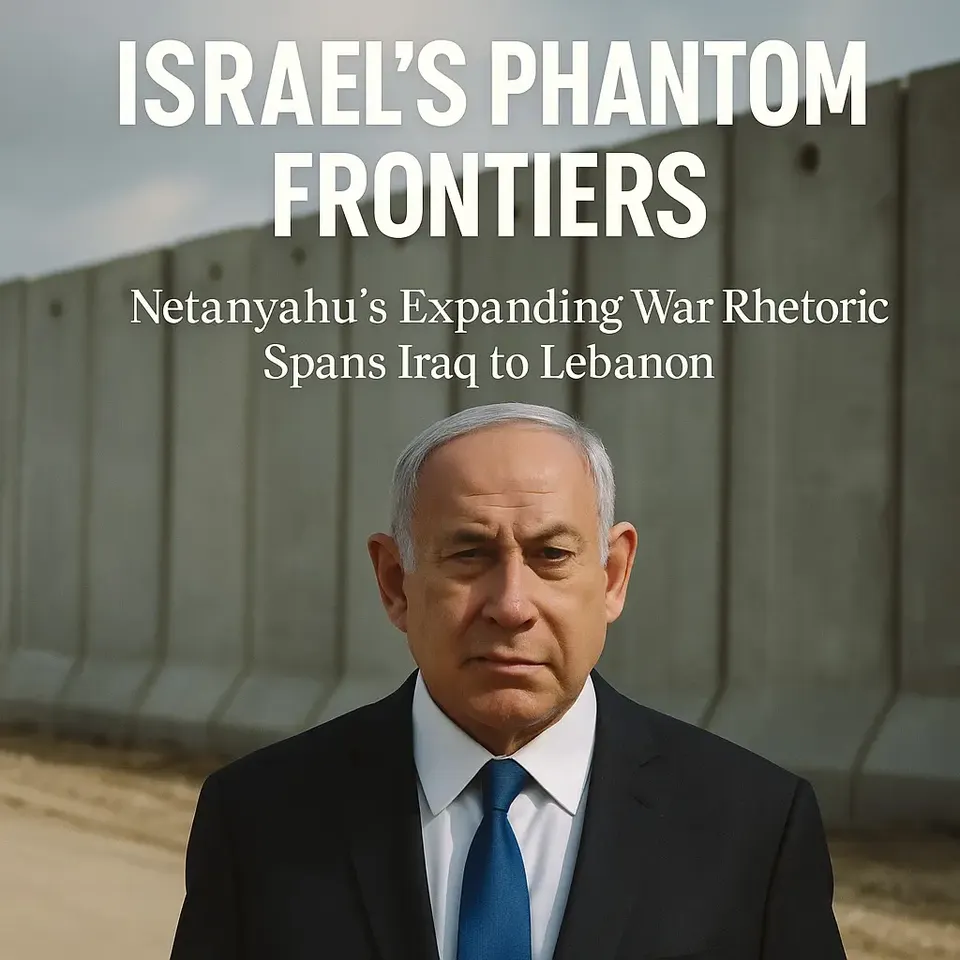
In the same column warning of “emerging threats,” Israel’s Ministry of Defense quietly announced something far more concrete: a 5.5 billion shekel, 425-kilometre multi-layered barrier along Israel’s eastern frontier from the Golan Heights to the sands north of Eilat. Tenders are issued. Contractors chosen. The bureaucratic phrasing is familiar—“strategic grip on the eastern border”—but the fine print describes integrated settlements, roads, and industrial growth engines.
This is not a wall. It is an annexation corridor with a security budget.
Israel’s wars increasingly begin not with evidence, but with tenders. The cycle is predictable: anonymous officials warn of imminent threats; government threatens pre-emption; Western allies nod along; taxpayers underwrite it.
A Campaign Between Wars
There is a term in Israeli strategic doctrine known as mabam—the “campaign between wars.” Historically, it meant keeping adversaries off balance. Today, critics argue, it functions more like anticipatory theatre: security by press release, deterrence by public relations.
Israel forecasts conflict like the weather, manufactures justification, and builds infrastructure to cash in the fear. War creates panic; panic delivers funding; funding sustains war. And as long as the enemy is hypothetical, defeat is impossible.
Domestic Exhaustion, Foreign Projection
Behind the wall building and rhetorical escalation sits a grim admission. The IDF recently told the Knesset Finance Committee it cannot fund new wars without an emergency budget. Defence spending has swallowed more than nine percent of GDP. Since 2023, simultaneous operations have cost roughly 80 billion shekels. Reservists are on their third call-up. Generals warn of manpower exhaustion.
Israel is running on fumes. Yet the government authorises new fronts anyway.
Stopping the wars would collapse the coalition. Continuing them buys time.
Lebanon: The Crisis That Never Ends
As Israel conjures threats from Iraq, another front continues to smoulder to the north. On 2 November, Defence Minister Israel Katz threatened to intensify attacks against Hezbollah in southern Lebanon, accusing Beirut of dragging its feet on disarmament despite the U.S.-brokered November 2024 ceasefire.
Katz’s warning came a day after an Israeli airstrike on the town of Kfar Reman killed four members of Hezbollah’s elite Radwan Force, identified by Lebanese media as Jawad Jaber, Hadi Hamid, Abdullah Kahil and Muhammad Kahil. Israel claims the men were involved in rebuilding “terror infrastructure.” Lebanon’s health ministry reports civilian deaths. The ambiguity is strategic.
Israel has maintained troops in five areas of southern Lebanon despite the ceasefire, launching regular airstrikes and ground incursions. Hezbollah, weakened by last year’s war that killed thousands of its fighters and its longtime leader Hassan Nasrallah, has largely refrained from retaliation. But it insists the disarmament clause applies only to the south.
Israel interprets it as national disarmament. That difference is the width of a future conflict.
Disarmament by Tightrope
Under the ceasefire, Lebanon agreed that only state security forces would bear arms—effectively mandating the dismantlement of Hezbollah. Washington, Riyadh, and domestic rivals have pushed Beirut to enforce compliance. According to Lebanese army sources cited by Reuters, security forces have detonated so many weapons caches that they have run out of explosives.
The army now faces an impossible balance: uphold the truce without collapsing the sectarian equilibrium that prevents civil war. Every seizure risks internal unrest. Every hesitation risks foreign sanction.
Hezbollah watches, silent—but armed.
The Legal Ballet of Violation
On Thursday, Israeli ground troops carried out another deadly raid into southern Lebanon, prompting President Joseph Aoun to order his military to confront incursions. Aoun had previously requested talks with Israel in mid-October, after former U.S. President Donald Trump helped broker a Gaza ceasefire. Instead, he claims, Israel escalated strikes.
Israel says Hezbollah’s caches violate the deal. Hezbollah says Israel’s raids do. The legal argument matters less than the perpetual utility of crisis.
Jordan: A Quiet Buffer Colony
Israel cannot strike Iraq without crossing Jordanian or Syrian airspace. Jordan depends heavily on Israeli water, gas, and intelligence. Its monarchy is protected by Western patronage and deeply fearful of domestic upheaval. Syria, bombed weekly, is treated as a ready-made war theatre.
The eastern barrier risks transforming Jordan into a buffer colony—a corridor for overflights, intelligence exchange, and border policing. The engineering outpaces the diplomacy.
You don’t redraw maps anymore. You redraw infrastructure tenders.
Economy in Decline, Fear on the Rise
Israel’s economic situation is worsening. Investors are pulling capital. Draft dodging is rising. Diplomatic partners privately describe Israel not as indispensable but as unpredictable. The Gaza genocide has shredded its moral capital abroad.
The government’s foreign policy is no longer aimed at creating security. It is aimed at delaying accountability.
In this context, the phantom threat from Iraq is not about geography. It is about domestic terror of political extinction.
The Collapsing Arc of Credibility
When a state this overstretched begins inventing new enemies, it is not projecting strength. It is confessing collapse. The numbers do not lie: five active fronts, near double-digit defence deficits, and war-crimes scrutiny at the International Court of Justice.
Maariv’s policy-manufacturing process is textbook:
- Cite an Iranian commander.
- Invoke militias—Hamas, Kata’ib Hezbollah, Harakat al-Nujaba.
- Mention long-range drones.
- Admit none of this has happened.
- Build a multi-billion-shekel barrier “just in case.”
It is deterrence by public relations. Storytelling for contractors. Theatre for taxpayers.
Walling Out Reality
The eastern barrier will rise. Headlines will fade. The desert will fill with concrete. But the fear it is meant to contain is inside the country, not outside it.
Israel, much as it did to Gaza, is walling itself against consequence—and against the day its own citizens stop believing the next threat briefing.
Netanyahu’s last enemy is not Hezbollah, nor the Houthis, nor phantom militias in Baghdad.
His last enemy is the truth.
And that is the one battlefield where walls offer no defence.