‘Who Among You Would Accept These Terms?’ Palestine Confronts UN Over Gaza’s Dead and the Demand for Endless Submission
Majed Bamya challenges the Security Council over unequal treatment of Palestinian lives, a ceasefire that has continued to claim children, and an independence process in which the occupying power sets the conditions.
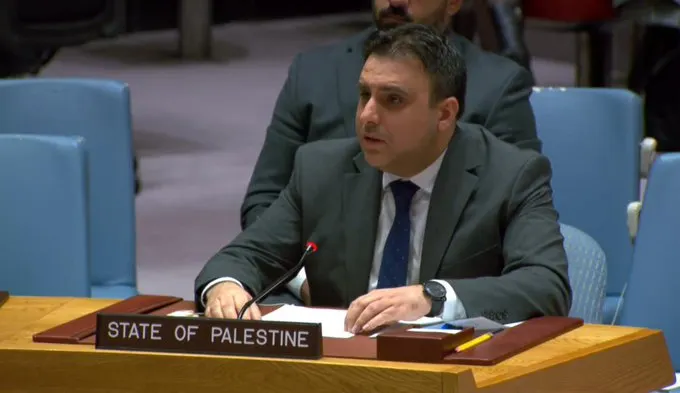
Palestine’s deputy representative to the United Nations has challenged governments to explain why Palestinians should accept conditions no other nation would tolerate: their children killed, their homes destroyed, their independence indefinitely deferred, and their commitment to peace repeatedly placed on trial.
Addressing the UN Security Council on 15 October, Majed Bamya accused Israel of pursuing permanent domination while demanding that the people living under its occupation continually prove their suitability for freedom. His speech combined an account of Palestinian suffering with a sustained challenge to the international diplomacy surrounding it.
“Are we to accept that we have no right to defend ourselves? No right to seek protection. No right to pursue justice. That dying is the only right left to us,” he asked.
“And if possible, could we do it silently?
“Who among you would accept these terms for your own people?”
The question ran through an address that moved between Gaza’s devastated families, Palestinian prisoners, violence in the occupied West Bank and the conditions attached to Palestinian statehood. Bamya’s argument was that international demands for peace had become detached from the protection, equality and freedom that would make peace possible.
“We have been reasonable beyond reason, but we cannot surrender our humanity, our rights, or our future to the power occupying and oppressing us,” he said.
“That is not how peace is achieved. That is how we go extinct.”
Bamya began with words he attributed to the Palestinian poet Mahmoud Darwish: “We suffer from an incurable disease called hope. Hope for liberation and independence. Hope for a normal life in which we will be neither heroes nor victims.”
That desire for ordinary life framed his account of what had followed the Hamas-led attacks of 7 October 2023. He recalled the condemnations, the recognition of Israeli suffering and the sympathy expressed for Israeli victims. He also recalled what colleagues, including people he regarded as friends, had told him.
“Israel has to defend itself. Israel will do whatever is necessary. And unfortunately, many innocent Palestinians would have to die, be killed.”
He asked whether Palestinians had ever received comparable permission to treat another population’s civilian deaths as an unavoidable price.
“I searched my memory. Had anyone ever told us, following a massacre of Palestinians, that we had the right to do whatever is necessary? That Israeli civilian death would be an inevitable and acceptable consequence?
“Never. Not once before October 7. Not once since. Not when 10,000 Palestinians were killed. Not when 20,000. Not when 50,000. Not when 70,000 Palestinians were killed.”
His criticism was directed at the unequal application of the principle that violence cannot resolve the conflict.
“If violence is an impasse, as we are often told, and we believe it is, how can Israeli militarism and brutal violence be justified while Palestinian pacifism is demanded?”
For Bamya, this amounted to placing one population’s security above another’s existence, then asking the population under occupation to endorse that hierarchy as evidence of peaceful intentions.
He described a similar disparity in the treatment of the dead.
“When Israelis were killed, their humanity was never in question. When Palestinians were killed, we saw debates over numbers. Their innocence was questioned. The characterization of their death became a subject of endless controversy.”
He accused some governments of investing more effort in defending Israel against the accusation of genocide than in preventing the destruction unfolding in Gaza.
“Instead of mobilizing to prevent genocide, some devoted their energies to arguing that Israel could never be accused of genocide, regardless how many Palestinians it killed.”
The accusation has also been examined beyond Palestinian diplomacy. In September 2025, the UN Independent International Commission of Inquiry concluded that Israel had committed genocide in Gaza. That was a finding by a UN investigative commission, distinct from a judgment by an international court.
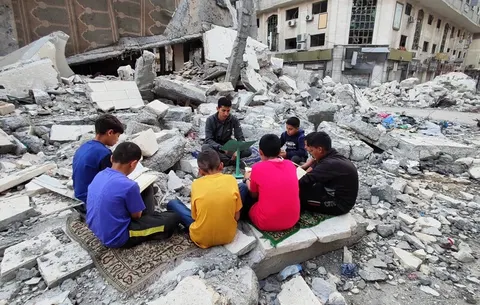
Bamya told the council that at least 74,000 Palestinians had been killed directly in Gaza, including 22,000 children and more than 1,000 babies. He said 600 babies had been born and died during the Israeli onslaught.
“It is the only thing they experienced.”
He described families erased across generations and survivors unable even to stop and grieve.
“Entire multi-generational families were wiped from the face of the earth. Others were forced to keep running for their lives with no time to mourn their loss, searching for food, water, and shelter amid the ruins of their homes.
“And still to this day, they are not given the right to mourn and recover.”
He said 92 per cent of Gaza’s homes had been destroyed or damaged. Yet the diplomatic response, he argued, continued to require the Palestinian leadership to demonstrate its commitment to peace while Israel destroyed the conditions necessary for a Palestinian state.
“We sought protection, not justification of violence, whether legitimate or illegitimate. We sought justice, not vengeance. We sought recognition of our state, not the erasure of another. We sought a ceasefire, not weapons.
“Yet we are the ones asked to prove our commitment to peace.”
Bamya welcomed the ceasefire agreement and explicitly credited Donald Trump with making it possible.
“Without President Trump, there would have been no ceasefire agreement,” he said.
He acknowledged the work of mediators and the Board of Peace, saying the Palestinian leadership had no intention of diminishing those efforts. But appreciation for diplomacy, he insisted, could not require silence about what continued to happen on the ground.
According to the figures he presented, more than 1,400 Palestinians had been killed since the ceasefire, including more than 300 children.
“Would anyone consider a ceasefire respected if 1,400 Israelis had been killed? 140? 14? If Israeli children were being killed every day?”
He followed the question with an explicit rejection of unequal treatment.
“We will not accept to be treated as a lesser people, and no one should demand us to do so.”
The UN’s acting Middle East peace coordinator, Ramiz Alakbarov, also described continuing deaths and severe deprivation in his briefing to the meeting. Citing Gaza’s health ministry, he reported approximately 1,500 Palestinian fatalities since the ceasefire, including more than 320 children, and warned that families remained in damaged buildings, overcrowded displacement sites and inadequate tents as winter approached.
Bamya acknowledged that the reduction in killing had saved lives. But he asked the council to consider what that statistical improvement meant to a mother whose child had survived the bombardment only to be killed after she believed the danger had passed.
“What comfort is that to a mother who managed by some miracle to keep her child alive under the bombs for so long, and when she thought he was finally safe, she had to bury that child?”
Survival among ruins, he argued, could not become the international community’s measure of an acceptable Palestinian future. Nor could mourning depend on whether Israel permitted the equipment needed to recover bodies.
“Our people deserve more than survival amid ruins, amid the remains of their loved ones that they continue being prevented from retrieving,” he said.
His account extended to Palestinians held in Israeli custody. Bamya said more than 10,000 remained in Israeli jails, approximately half without charge, and described a military justice system in which Palestinians faced abuse, torture and impunity for crimes committed against them.
He also raised the killing of Palestinian journalists while international media access to Gaza remained restricted.
“It’s easier for Israel to attack Palestinian journalists than international journalists,” he said.
These examples formed part of his wider contention that Palestinians were denied protection and then penalised for pursuing accountability.
“No people should be expected to live with their occupier holding the power of life and death over them,” he told the council.
“International protection is long overdue.”
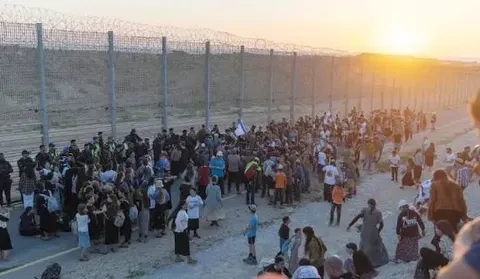
Turning to the West Bank, including East Jerusalem, Bamya said more than 1,000 Palestinians had been killed over three years and approximately 6,000 settler attacks had occurred since the beginning of 2026.
He rejected the portrayal of settler violence as the misconduct of a small fringe.
“Then why does Israel not stop them? Who armed them? Who protects them? Who ensures their impunity for their crimes?”
In his account, the violence served a political objective.
“This is not an isolated aberration. It is a policy of displacement and replacement, consolidating control and entrenching annexation.”
He welcomed sanctions and other measures already adopted, but said their value had to be judged by whether they actually deterred violations and reversed annexation.
“What we ask is simple. These are obligations. No arms to kill us. No trade that fuels plunder. No impunity for crimes against us. No money sustaining illegal occupation. No businesses and banks contributing to it. No embassy moves covering annexation.”
His argument about occupation rests within an established legal context. In its July 2024 advisory opinion, the International Court of Justice found Israel’s continued presence in the occupied Palestinian territory unlawful and said it must end as rapidly as possible. The court linked that unlawfulness to annexation, permanent control and the obstruction of Palestinian self-determination.
Bamya said the Palestinian leadership had supported the ceasefire plan and the Security Council resolution endorsing it because they contained essential commitments: an end to bloodshed, occupation, annexation and forcible displacement; the reunification of Gaza and the West Bank under the Palestinian Authority; and a credible route to self-determination.
He accused Israel of treating disarmament and Palestinian institutional reform as conditions that could be extended indefinitely, ensuring that independence remained permanently out of reach.
“It seeks to exploit disarmament and Palestinian Authority reforms as indefinite conditions for obstruction to explain why the plan will never be implemented and we will never get to Palestinian self-determination and statehood.”
He described the political difficulty of changing social protection arrangements for families that had suffered profound losses, or prioritising curriculum reform while children were studying in tents because their schools had been destroyed.
“And yet, these reforms were conducted in an effort to move forward, in an effort to find a way out.”
At the same time, he said, Israel was weakening the institutions it demanded should reform. He cited withheld tax revenues and said most Palestinian Authority employees were owed the equivalent of 15 months’ salaries.
“You tell me which of your countries would have a standing government today without paying the equivalent of 15 months of salaries to people.”
Alongside destroyed livelihoods, uprooted olive trees, military raids and prisoner abuse, he argued, that financial pressure increased the danger of institutional collapse.
“These are conditions for collapse and chaos, not reform, stability, or peace.”
Israel’s representative presented a sharply different account at the same meeting, insisting that Hamas’s continued weapons, tunnels and alleged ceasefire violations were the central obstacle to progress. He also challenged the Palestinian Authority’s ability to confront extremism. The US representative similarly made Hamas’s disarmament and Palestinian Authority reforms central to implementation of the peace plan.
Bamya’s objection was that Palestinian freedom could not depend on satisfying an occupying power that continued to undermine it.
“No nations represented here would accept an examination designed and graded by its colonizer as a condition for independence.”
He set out the contradictions as he saw them.
“Israel demands reforms while obstructing them. Disarmament while its occupation forces continue killing and while it continues arming settlers. Security while denying ours. Guarantees for its state while destroying our state. Assurances for itself from the people it is devastating.
“This is not peace. It is permanent subjugation.”
He then asked what political future remained if Israel rejected both a Palestinian state and a single state with equal rights.
“So, what are the alternatives? Kill Palestinians? Genocide? Remove them forcefully? Ethnic cleansing? Subjugate them forever? Apartheid?”
Invoking security to justify annexation, he warned, carried consequences far beyond Palestine.
“Annexation cannot be justified by the need for security. Not in Palestine, not in Lebanon, not in Syria, not anywhere. Our borders would be meaningless and wars would be permanent.”
Bamya also challenged the idea that regional peace could be secured through successive military campaigns while Palestinian rights remained unresolved.
“Israel always claims that the region is one war away from peace before moving to the next war.”
The alternative he described was a region of sovereign states with equal rights and responsibilities, sharing security and prosperity. He warned against turning a political conflict that could be resolved into an enduring religious confrontation.
“The followers of any faith cannot be held responsible for the actions of a state or a group. Nor can their faith be used by perpetrators of crimes to shield themselves from accountability.”
Responsibility towards future generations, he said, required a conscious refusal to reproduce inherited wounds.
“Our responsibility is not to pass on our wounds or exploit them to perpetuate hatred, but to heal them. So, future generations need not endure them.”
Bamya thanked the governments, diplomatic initiatives and millions of people around the world mobilising for Palestinian freedom. He argued that changes in public opinion, including in the United States, had altered the political landscape.
“People will not unsee what they have seen.”
But he closed by returning to the lives behind those campaigns: people rebuilding homes, educating children and sustaining communities after repeated destruction. Palestinian resilience, he suggested, had too often become something others admired while failing to end the conditions that made it necessary.
“But no people should be expected to rebuild everything only to see it destroyed again, generation after generation.”
He invoked sumud, Palestinian steadfastness, while rejecting the expectation that endurance should be limitless.
“We pride ourselves on Palestinian sumud, resilience, but it is unfair to demand endless resilience from our people who have suffered so greatly instead of finally allowing them to simply live.”
The hope with which he had opened was, he argued, essential to any peaceful future: the belief that Palestinians could obtain freedom without surrendering their country, and could eventually live ordinary lives beyond the roles of victim or hero.
“Palestinian existence and freedom are not a threat to peace,” he concluded.
“Denying them is.”
Quotations are drawn from the supplied speech transcript. Figures and allegations presented by Bamya are attributed to him; additional context comes from the UN meeting transcript, the International Court of Justice and the UN Commission of Inquiry.