


Creator behind a YouTube channel with 216,000 subscribers says alleged suppression, content restrictions and the threat of sudden removal have forced him to establish an independent home for his work
Content creator Mahmood OD, whose Arabic name appears as محمود عودة, has launched an independent, members only streaming platform after claiming that years of restrictions on YouTube have made it increasingly difficult to reach his audience and publish material without censorship.
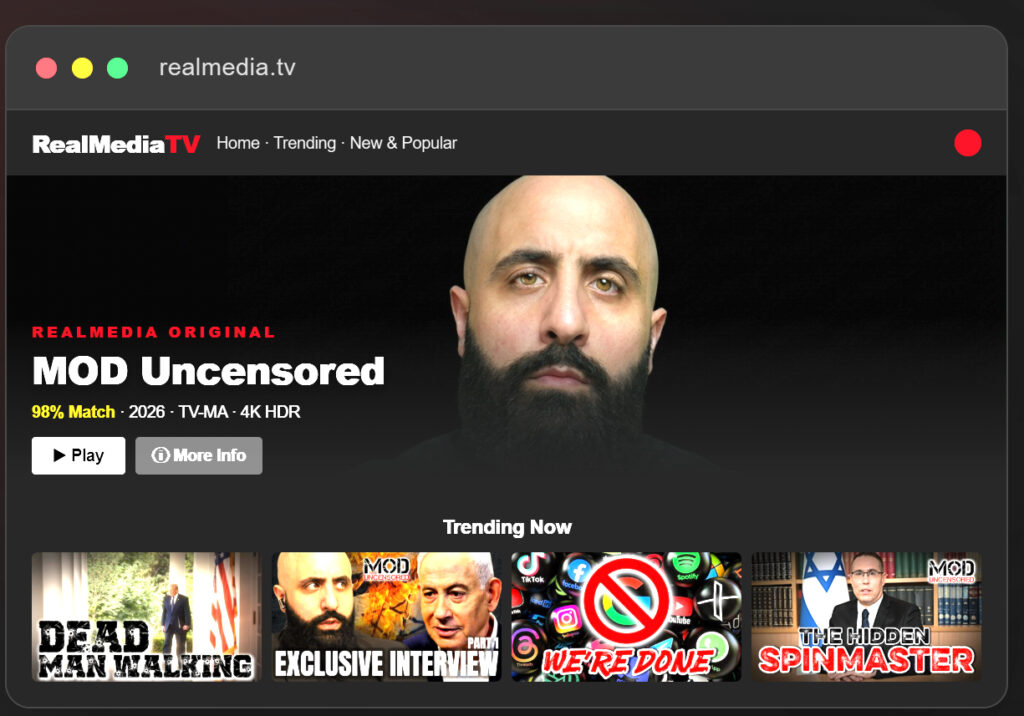
Mahmood, who has built an audience of approximately 216,000 YouTube subscribers, announced the launch of Real Media TV during a livestream devoted to the past, present and future of his channel.
Rather than addressing a breaking international story, as his broadcasts frequently do, Mahmood used the programme to explain why he believes creators producing political commentary outside the corporate media system can no longer rely entirely on the world’s largest social media platforms.
He said his new programme, MOD Uncensored, would be available exclusively through RealMedia.tv, offering news, political analysis, interviews, comedy and satire that he believes cannot be published safely or in full on YouTube.
“This will be from now on our new home,” Mahmood told his audience. “This will be the place where we post every single thing without any boundaries, any limits.”
The launch represents both a business expansion and an attempt to protect the relationship Mahmood has developed with his audience. He warned that a creator who is suddenly removed from a major platform can lose not only access to their archive, but also the ability to contact the people who followed and financially supported their work.
Filling a gap left by corporate media
Mahmood said he originally launched his YouTube channel because he believed there was a growing public demand for interpretations of world events that differed from those presented by established broadcasters.
He described an audience searching for facts, analysis and what he called “unfiltered information”, particularly on subjects involving war, Western foreign policy, Israel and Palestine.
“There was a real public hunger to listen to the different story, the different side of the story,” he said.
His criticism of mainstream media is uncompromising. Mahmood accused large news organisations of feeding viewers a continuous mixture of manipulation and propaganda, arguing that independent creators emerged partly because public confidence in corporate broadcasting had deteriorated.
His channel’s growth suggests that this alternative media audience is substantial. Reaching 216,000 subscribers places Mahmood among a class of independent political commentators capable of attracting audiences comparable to those of some established news programmes.
He maintains, however, that the visible size of his channel does not reflect its full potential. According to Mahmood, the channel grew despite what he described as persistent suppression by YouTube’s recommendation and moderation systems.
The claims presented during the livestream were Mahmood’s account of his experience. No detailed response from YouTube was included in the material, and the alleged manipulation of his channel’s reach could not be independently established from the information he presented.
From moderation to “shadow cancellation”
Mahmood divided the difficulties he says he has experienced into three categories: reduced visibility, algorithmic manipulation and the direct blocking or removal of content.
He described the first category as “shadow banning”, although he said “shadow cancellation” was a more accurate description.
Unlike the public deletion of a channel, shadow cancellation allows an account and its published material to remain technically accessible while allegedly preventing much of the intended audience from encountering it.
“You’re there. I’m here, but you’re not really there,” Mahmood said while explaining the effect.
He claimed that some subscribers had been removed from his channel without requesting it, while others reported that his videos had disappeared from their recommendations. Some followers, he said, were unable to interact with his posts or were forced to use different accounts after their original accounts were restricted.
Mahmood also claimed that his channel achieves a click through rate around five times the overall YouTube average. He argued that such a response would ordinarily encourage an algorithm to recommend the material more widely, yet said many of his videos were not consistently shown even to existing subscribers.
He presented messages and comments from viewers as evidence of a recurring pattern, with followers reportedly telling him that they had been unsubscribed, could no longer find his content or were unable to register likes.
Mahmood acknowledged that social media companies publicly reject allegations of indiscriminate shadow banning. His own complaints to platforms, he said, had produced little meaningful response.
Working around restricted language
The creator said restrictions had influenced not only how his work was distributed, but also how it was produced.
Certain terminology, images or pieces of footage could allegedly trigger reduced visibility, warning notices or the removal of a video. Mahmood said this forced him to alter language, remove footage or exclude evidence that might otherwise have been included in a programme.
The result, he argued, is a system in which creators begin censoring themselves before publication because they cannot predict which combination of words or images will provoke enforcement.
Some videos have also received information panels when Mahmood questioned accepted accounts of historical or political events. While platforms present such notices as a way of directing users towards established sources, critics argue that they can implicitly discredit independent material before a viewer has considered its arguments.
Mahmood accepted that platforms require rules governing graphic footage, harassment and other harmful material. His objection concerned what he described as vague or inconsistently applied standards.
“We understand that there are rules and regulations,” he said. “But violate what?”
He said even material employing satire or comedy could result in warnings if particular political terms were used. In some instances, he claimed, creators could temporarily lose the ability to communicate through community pages, separating them from their own subscribers without having their channels formally removed.
Mahmood described this environment as unsafe and unstable for both creators and viewers, including those paying for premium subscriptions or channel memberships.
Algorithms as instruments of editorial control
The second element of Mahmood’s criticism concerned the power of recommendation algorithms.
Social media companies explain that these systems help viewers discover material related to their interests. Someone watching football, boxing or international news will generally be offered more videos concerning those subjects.
Mahmood argued that this apparently neutral process gives platform owners enormous editorial power. By adjusting which channels are recommended, deprioritised or excluded, a company can influence public discussion without formally banning anyone.
He also questioned why viewers of his criticism of Israel were frequently shown advertising supporting Israel, while his own videos allegedly received limited organic distribution.
In Mahmood’s assessment, the algorithm is not simply a technical mechanism designed to predict viewer interest. It is a system controlled by private companies that can be changed according to their commercial, political or regulatory priorities.
He warned that proposed government measures could place further pressure on online platforms to favour established corporate news organisations. Mahmood did not identify a particular law during this portion of the livestream, but predicted that viewers attempting to escape conventional broadcasting could eventually find their online feeds dominated by CNN, Fox News, the BBC and Sky News.
That, he argued, would reproduce the existing media hierarchy within digital spaces that originally promised a more open and decentralised exchange of information.
A private home for MOD Uncensored
Mahmood concluded that maintaining backup accounts on other major social media services would not solve the underlying problem. Although the platforms might have different names and branding, he said, creators would remain dependent upon similar moderation policies, algorithms and corporate structures.
His proposed answer is Real Media TV, a private, members only streaming service that gives MOD Uncensored a permanent home outside YouTube.
The platform is intended to carry exclusive videos, interviews, political commentary, uncensored news and comedy. It also includes a community section where members can comment, interact with Mahmood and discuss programmes privately.
Mahmood said the service would operate without advertising and without an algorithm deciding which members were permitted to see his work. All new material would be available directly to subscribers, with notifications informing them when programmes were published.
Only four videos were available at the time of the announcement, but Mahmood promised a substantial expansion of the archive. One of the first productions was a satirical interview involving Israeli Prime Minister Benjamin Netanyahu, which Mahmood jokingly introduced as an encounter with “the most hated individual on Earth”.
The platform can be accessed through desktop and mobile browsers. Mahmood said a dedicated application and livestreaming facilities were also under development.
The cost of independence
Unlike advertising supported social media, Real Media TV requires a monthly subscription.
Mahmood announced a founding membership priced at $9.99 per month, with the offer scheduled to expire on July 31. Those joining during the founding period would retain that price for life, he said, while receiving a permanent founding member badge and access to the platform’s exclusive programmes and community facilities.
He acknowledged that a paid service would not be affordable or appropriate for everyone, but argued that independent video distribution carries unavoidable costs.
Hosting high quality video requires large quantities of storage, bandwidth, software integration and infrastructure capable of serving viewers in different countries. Without corporate advertising, wealthy backers or paid political promotion, Mahmood said membership income was necessary to keep the service functioning.
“We’re not a massive corporation with some huge funders or backers,” he told viewers.
The creator contrasted his subscription model with reports of political campaigns paying influencers thousands of dollars for individual posts. His new platform, he said, would instead be funded directly by the people consuming and supporting the work.
Existing YouTube memberships will remain available for viewers wishing to support both channels. Mahmood nevertheless advised anyone choosing between the two to subscribe to Real Media TV because it offers the independent infrastructure and exclusive material at the heart of his new project.
YouTube channel will continue within restrictions
The launch does not mean Mahmood is immediately abandoning YouTube.
He intends to continue publishing there for as long as the platform permits, although future videos will remain within what he called YouTube’s available “scope”. Material regarded as unsuitable or too vulnerable to restriction will instead appear through MOD Uncensored.
Mahmood said the separate platform provides a safety net if his YouTube account is suspended or permanently removed. He pointed to other creators who had built audiences of hundreds of thousands, or even millions, before suddenly losing their channels.
The danger, he suggested, becomes more serious as an alternative media channel grows. A small creator might attract limited scrutiny, while a commentator capable of influencing a large audience may face increasingly aggressive moderation.
“You can get banned in one given moment,” he warned. “Then you can’t really speak with your followers. You can’t speak with your subscribers.”
Drawing a line between Judaism and Zionism
During the audience discussion, Mahmood also addressed a message from an American Jewish viewer who said that many Jewish Americans opposed the Israeli government and were appalled by its actions.
Mahmood welcomed the intervention and emphasised the distinction between criticism of Israel, opposition to Zionism and hostility towards Jewish people.
He said anti Zionist Jewish campaigners had appeared on his channel since its early years and described them as comrades in a humanitarian struggle. The political and moral dispute, he argued, concerns the conduct of a state and its government, rather than Judaism or Jewish identity.
The remarks were significant because political coverage of Israel and Palestine is among the most heavily contested forms of online speech. Platforms face pressure both to prevent antisemitism and to avoid silencing legitimate reporting or criticism of Israeli government policy.
Mahmood acknowledged that toxic voices existed within online discussions and said they should be rejected. His own comment section asks participants to remain respectful and avoid offensive language.
He framed his work as part of a wider human struggle between genuine civilisation and what he described as forces seeking to return the world to “the dark ages”.
An attempt to escape platform dependency
Real Media TV will not immediately offer the reach of YouTube, nor can an independent service entirely escape dependence on hosting providers, payment systems and national laws. Its success will depend on whether a sufficient portion of Mahmood’s audience is prepared to become paying members.
The project nevertheless reflects a larger shift in the alternative media landscape.
Independent journalists and commentators increasingly recognise that large subscriber numbers do not necessarily provide security. Their archives, revenues and contact with audiences remain subject to rules written and enforced by technology companies.
Mahmood’s response is to maintain his public presence on YouTube while gradually building an audience that can be reached outside it.
The new platform is therefore more than a location for exclusive programmes. It is intended to ensure that the community surrounding Mahmood OD survives even if his access to mainstream social media does not.
For Mahmood, the decision followed years of adapting his language and presentation to an environment he believes has become progressively more restrictive.
“So far, we just have four videos there,” he said. “But that’s going to be flooded. You’re going to see heaps of content there.”
Whether the new service can develop into a sustainable independent media platform remains to be seen. Its launch, however, demonstrates how distrust of corporate media has become intertwined with distrust of the technology companies now controlling access to alternative voices.