1,000 Days of Blood and Rubble: A Generation Lost in Gaza as Ceasefire Fails to Halt the Carnage
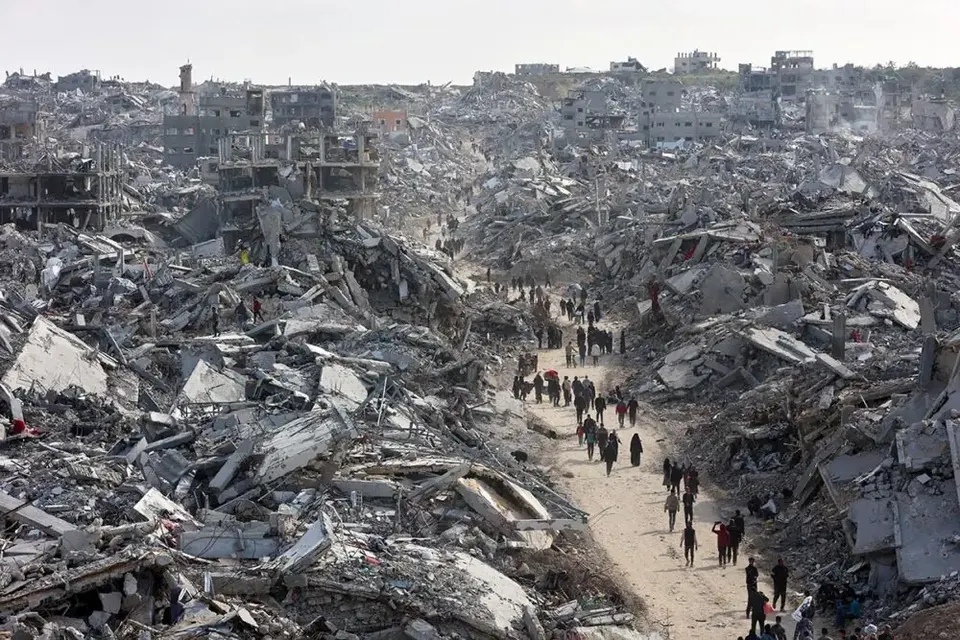
It has been 1,000 days since the first bombs shattered the predawn silence of Gaza. But for the roughly two million Palestinians trapped inside the strip, the passage of time has lost its meaning—measured only in the ceaseless drone of aircraft, the rattle of gunfire, and the gut-wrenching silence that follows a family home collapsing into dust.
July 2, 2026, marked a grim, gruesome milestone in modern warfare. According to Gaza’s Government Media Office, 73,066 Palestinians are now dead, and 173,514 have been wounded since October 7, 2023. Of the dead, more than half—55%—are women, children, or the elderly. As the world looked away, the enclave has been systematically reduced to a wasteland; and a tenuous "ceasefire," hailed as a diplomatic victory last October, has proven to be nothing more than a pause in the violence.
As one Gazan father, digging through the rubble of the Sheikh Radhwan neighborhood after an Israeli airstrike on Wednesday, told Palestine Online: "They are killing us slowly, day by day. There is no ceasefire for us. There is only death, waiting for the next missile."
A Civilization Reduced to Ashes
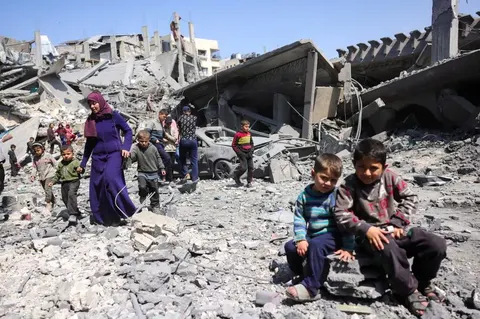
The statistics issued by the media office paint a picture of annihilation that is almost incomprehensible. Over the past 1,000 days, Israel has dropped an estimated 223,000 tonnes of explosives on the tiny, densely populated coastal territory—a payload roughly equivalent to sixteen times the atomic bomb dropped on Hiroshima. This relentless bombardment has destroyed over 90% of Gaza, rendering 410,000 homes and buildings uninhabitable.
The human fabric of Palestinian society is tearing irreparably. Some 58,800 children have now been orphaned, left with either one parent or none at all, wandering through tent cities with hollow eyes. More than 2,700 extended families have been entirely erased from the Palestinian civil registry—their names, histories, and futures wiped out in a flash of white phosphorus and high explosives.
Dr. Marwan Al-Hams, a surgeon at the now-crippled Al-Shifa Medical Complex, described the toll on healthcare as "medical genocide." The Government Media Office reports that 1,700 medical workers have been killed, 38 hospitals have been damaged or destroyed, and 197 ambulances have been directly targeted. Amid the rubble, infectious diseases are rampant; the authorities have logged more than 2.1 million cases of infectious disease, while over 22,000 critically ill patients remain trapped—unable to access life-saving treatment abroad due to stringent Israeli restrictions on medical evacuations.
The "Ceasefire" Mirage
International mediators heralded the October 10, 2025, ceasefire as a breakthrough. But since the first full day of that deal, the violence has never truly stopped.
Despite the ink being dry on the agreement, Israeli attacks have continued with disturbing regularity. In the first half of 2026 alone, Israel has killed at least 1,059 Palestinians and wounded 3,429 in Gaza, according to the media office. Meanwhile, local civil defense crews have painstakingly extracted 788 bodies from beneath the rubble—victims of previous strikes whose remains were only discovered during the supposed "peace" period.
Just this Wednesday, the pattern of violation continued. Israeli aircraft struck a gathering of civilians in the Sheikh Radhwan neighborhood of Gaza City, killing two and wounding several others. In the south, armored vehicles opened fire directly at displacement tents and residential homes in the Qizan Rashwan area, south of Khan Younis. The Palestinian Red Crescent rushed to evacuate two wounded civilians from Omar al-Mukhtar Street in central Gaza City, one of whom was described as being in critical condition.
In a tragic closure of a year-long wait, a Rafah resident succumbed to wounds he had sustained more than 12 months ago, becoming another grim statistic in the long tail of the war.
Famine Returns to the Strip
Alongside the bombs, a silent killer is returning to Gaza: famine.
On Wednesday, Gaza’s Social Development Ministry issued a stark warning that only 25% of the population's food needs are currently entering the Strip. Deputy Minister Riyad al-Bitar blamed the crisis on severe restrictions imposed by the Israeli military, noting that Israel is currently permitting only 120 to 150 aid and commercial trucks to cross daily. This is a far cry from the 600 trucks per day that were explicitly agreed upon under the October ceasefire framework.
"We are witnessing a total collapse of the economy," Al-Bitar stated. "Families are surviving on one meal a day. The bakeries are empty, and the markets are barren. Israel is using starvation as a weapon of war."
The international community has largely remained silent as the specter of acute malnutrition—particularly among children—once again looms over the enclave, threatening to compound the death toll far beyond the numbers of those killed by airstrikes.
A Nation Mourns its Athletes
In a poignant symbol of the conflict’s indiscriminate nature, the Palestinian Football Association (PFA) confirmed the killing of yet another sportsman this week. Saleem Al-Ashqar, 32, a celebrated goalkeeper for Khadamat Khan Younis who also played for Al-Aqsa and Al-Musaddar clubs, was shot by Israeli forces on Monday in Al-Qarara, northeast of Khan Younis.
Al-Ashqar had recently been married, and his wife was awaiting the birth of their first child. He was reportedly cycling to exchange a gas cylinder for his family when he was fatally struck. He bled to death in a hospital two hours later due to severe internal trauma.
He is now the 1,009th Palestinian sports figure killed since the genocide began, with 567 of those being footballers. The PFA has since escalated its battle against Israel’s international standing, filing a formal complaint with FIFA that seeks to have the Israeli Football Association expelled from the global governing body.
East Jerusalem: Land Grabs and Settler Violence
The war has not been confined to the Gaza Strip. In occupied East Jerusalem, the situation has reached a boiling point. The Jerusalem Governorate reported on Thursday that Israeli forces and settlers have killed at least 11 Palestinians in the holy city during the first half of 2026. Among the dead, eight were shot by the Israeli military, while three were lynched or shot by armed Jewish settlers.
The Governorate highlighted a near-total closure of the Al-Aqsa Mosque compound, Islam’s third holiest site, imposed from February 28 onward. This unprecedented lockdown has prevented thousands of Palestinian worshippers from accessing their sacred space during the holy month of Ramadan and beyond, while facilitating a surge in extremist settler incursions—totaling 269 separate attacks.
The report also documented 866 arrests, 288 home demolitions or land-leveling operations (including 66 forced self-demolitions), and 89 new settlement plans. Authorities described this as "a systematic policy aimed at expanding settlements and forcibly displacing Palestinians from Jerusalem."
The U.S. Digs In: A Permanent Embassy on Contested Land
Amid the carnage, the United States has moved to solidify the geopolitical reality on the ground. On July 1, the U.S. and Israel signed a historic—and highly contentious—agreement to build a permanent U.S. Embassy compound on the 13-acre Allenby Barracks site in southern Jerusalem. The lease is set for 99 years at the symbolic rate of just $1 per year.
The move is a direct consolidation of President Donald Trump’s 2017 decision to recognize Jerusalem as Israel’s capital. However, the plot of land at the center of the deal is claimed by Palestinian families who hold pre-1948 land deeds, making the transfer a flashpoint for international law.
At the signing ceremony, U.S. Ambassador Mike Huckabee, a fervent evangelical Zionist, delivered a defiant message: "We will plant our flag in Jerusalem—the eternal, indigenous, and forever capital of the Jewish people."
The move flies directly in the face of the Oslo Accords, which stipulated that Jerusalem's final status must be resolved through bilateral negotiations. It also violates UN Security Council Resolution 478, which declared Israel's claim to a "complete and united" Jerusalem as "null and void" and urged member states to withdraw their diplomatic missions.
With the U.S. officially entrenching its presence in East Jerusalem, Palestinian officials argue that any hope for a viable two-state solution—the bedrock of international consensus for decades—has been essentially buried.
The Outlook: A Long Dark Tunnel
As Gaza crosses this horrendous 1,000-day threshold, there is little sign of light. The International Court of Justice has declared Israel’s presence in the occupied territories unlawful, and FIFA is under pressure to act. But on the ground, the mechanisms of international law seem powerless.
$80 billion in direct losses across 15 sectors mark a sum that Gaza cannot recover from without decades of international investment—but with the border crossings locked and the occupation entrenched, reconstruction remains an impossible dream.
For the 350,000 families now living in shelters or tents, and for the 58,800 orphaned children, the war is not over. They have survived 1,000 days. But in Gaza, survival is no longer a blessing; it is a daily struggle against hunger, disease, and the ever-present threat of the next airstrike.
As the sun sets over the rubble of Gaza City this evening, the only certainty is that the 1,001st day will bring more of the same.