
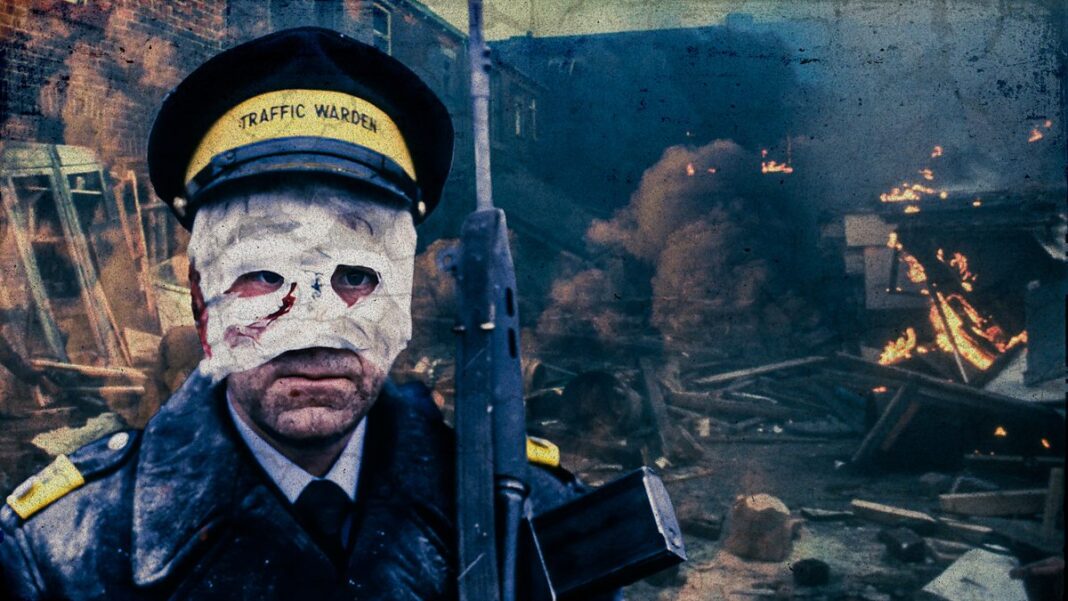

When the BBC broadcast Threads in 1984, the film did not begin with explosions or dramatic warnings of global catastrophe. Instead, it opened quietly in the city of Sheffield, where ordinary life unfolded while television and radio carried background news reports about escalating tensions involving Iran. Those bulletins described military movements, diplomatic confrontations and growing anxiety about the stability of the Middle East. At first the reports sounded routine, just another sequence of geopolitical developments unfolding somewhere far away.
That understated opening was deliberate. The creators of Threads understood that the most frightening crises rarely begin with obvious catastrophe. They begin with ordinary news that seems distant and manageable.
In the film, one of the early bulletins announces:
“The United States has accused the Soviet Union of moving nuclear warheads into their new base at Mashhad in northern Iran.”
Other reports describe diplomatic efforts breaking down and tensions rising between the superpowers. None of it seems immediately connected to the lives of the people in Sheffield. Yet the audience eventually learns that those fragments of news were the first signs of a chain reaction that would end in nuclear war.
Four decades later, the headlines emerging from the Middle East are beginning to echo that structure in ways that feel uncomfortably familiar.
The Strategic Fault Line of the Gulf
For decades, analysts have understood that the Gulf region contains one of the most dangerous geopolitical fault lines in the world. At the center of that fault line lies the Strait of Hormuz, a narrow waterway that connects the Persian Gulf to the open ocean and carries a vast portion of the planet’s energy supply.
The vulnerability of the strait has long been recognized. During the early years of the Iran–Iraq War, television reports from the region warned that the conflict could escalate dramatically if oil shipments through the Gulf were disrupted. One report explained the stakes with remarkable clarity:
“If the Iranians did try to control the straits and stop oil shipments from all the Gulf states, America might feel sufficiently nervous to send in her Indian Ocean task force to open the waterway again.”
The analysis did not stop there. The report continued with an even more ominous possibility:
“If the Americans became involved, the Iranians could well turn to the Russians for help and the conflict could escalate dramatically.”
In other words, the strategic concern was that a regional war could draw the superpowers into direct confrontation through the narrow gateway of the Gulf.
A Passage That Feeds the World
The physical geography of the Strait of Hormuz explains why it has always been viewed as a potential trigger point for global crisis. Reporters who visited the region during the Iran–Iraq War described the passage in stark terms:
“A passage twenty-four miles wide through which one oil tanker passes every nineteen minutes.”
Through this corridor flows a substantial portion of the world’s oil supply. The shipping lanes themselves pass through both Iranian and Omani territorial waters, leaving only a narrow corridor of international passage between them. The strait is therefore not simply a maritime route but the central artery of the global energy system.
Despite its narrow reputation, naval experts have long pointed out that physically blocking the strait would be extremely difficult. One analyst summarized the situation bluntly:
“There are misconceptions about the strait. It may be narrow, but not so narrow you can block it. You’d need to pile tankers three high and twelve metres across to do that.”
Yet the strait has another vulnerability that is far more realistic.
“The strait could be mined.”
Even a relatively small number of naval mines could disrupt tanker traffic and send shockwaves through global markets.
When Insurance Markets Panic
During the Iran–Iraq War, the threat of disruption was enough to send immediate tremors through the global shipping industry. Lloyd’s of London declared the Gulf a war zone and tripled insurance rates for vessels operating in the region.
Tanker owners began reconsidering whether it was safe to send their ships into the upper Gulf. Dozens of supertankers dropped anchor off the coast of Oman while their captains waited for instructions from their companies.
Within days, the number of idle vessels waiting offshore had multiplied.
The sight of giant tankers sitting motionless in the water illustrated how quickly military conflict in the Gulf could ripple outward into the global economy. Oil shipments slowed, insurance premiums surged and shipping companies began calculating the risks of continuing their operations in a region that had suddenly become unpredictable.
The Fear of Superpower Escalation
At the time, diplomats and regional governments repeatedly insisted that the conflict would remain limited. Arab states feared that superpower intervention could devastate the region and transform a local war into a geopolitical catastrophe.
One analyst summarized the concern with striking simplicity:
“They don’t want the superpowers to get drawn in and possibly reduce their region to chaos. It’s a war that nobody wants.”
The United States, still dealing with the fallout of the Iranian hostage crisis, was anxious to avoid becoming entangled in another Middle Eastern war. The Soviet Union, meanwhile, maintained relationships with both Iraq and Iran and had little interest in being dragged into a confrontation that could destabilize the entire region.
Yet the strategic dilemma remained unresolved. If Iran attempted to halt international shipping through Hormuz, Washington would almost certainly feel compelled to intervene in order to protect global energy supplies. Such an intervention could easily trigger a wider confrontation between the major powers.
The Present Crisis
Today’s confrontation between the United States, Israel and Iran is unfolding against that same strategic backdrop. What began as military strikes has already expanded into attacks on the infrastructure that underpins global energy markets.
Israel’s strike on Iran’s South Pars gas field — the largest natural gas field on the planet — marked a significant escalation by demonstrating that energy infrastructure itself had become a target. Iranian retaliation against energy facilities elsewhere in the Gulf has reinforced the sense that the conflict could spread beyond conventional military installations.
The Strait of Hormuz therefore once again becomes the central pressure point.
Roughly one fifth of the world’s oil passes through this narrow corridor. Any disruption to the flow of tankers would reverberate through global markets within hours, driving energy prices upward and threatening supply chains across multiple continents.
Shipping companies, insurers and energy traders are already reacting to the possibility that the region could once again become a war zone.
The Escalation Pattern
Cold War strategists spent decades analyzing how regional conflicts could escalate into global crises. The pattern they feared was deceptively simple.
First comes a regional conflict between neighboring states.
Then outside powers intervene to protect strategic interests.
Then infrastructure — oil facilities, shipping routes and energy systems — becomes entangled in the fighting.
Each stage appears manageable when viewed in isolation. Yet together they form a chain reaction that becomes progressively more difficult to control.
This is precisely the dynamic dramatized in Threads. In the film, the crisis begins with unrest in Iran and gradually expands into a confrontation between global powers. At every stage political leaders believe they are acting rationally in order to manage events. Yet each decision narrows the available options until escalation becomes unavoidable.
When Fiction Mirrors Reality
The enduring power of Threads lies in its recognition that catastrophic events rarely announce themselves dramatically at the beginning. Instead they appear first as ordinary news reports describing developments that seem distant and manageable.
A military strike.
A naval deployment.
A warning about shipping lanes.
A dispute between rival powers.
Only later does it become clear that these fragments were the early stages of a much larger transformation.
Today’s headlines from the Gulf carry that same unsettling quality. Iran once again sits at the center of a widening geopolitical confrontation, while the Strait of Hormuz remains the most sensitive pressure point in the global energy system. Military escalation, economic disruption and diplomatic maneuvering are unfolding simultaneously across the region.
None of this guarantees that the worst outcomes will occur. Yet the structure of the crisis now emerging in the Middle East follows a pattern that analysts have recognized for decades.
The warning rarely arrives with the explosion.
It arrives first as the news.