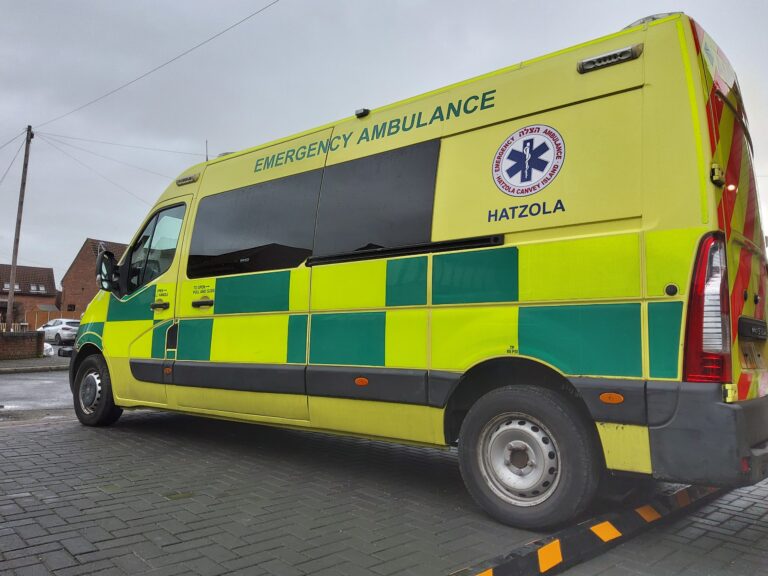
Public funds are set to help replace ambulances destroyed in a suspected antisemitic attack in North London, following a pledge by Health Secretary Wes Streeting. The intervention comes alongside major private donations, including from a foundation chaired by a businessman convicted in one of Britain’s most notorious financial scandals, raising questions about accountability, oversight, and the role of private influence in essential services.
UK taxpayers will contribute to the replacement of ambulances destroyed in a suspected arson attack on Hatzola UK, a privately run, volunteer-led emergency service operating predominantly within Jewish communities. Wes Streeting said the government would ensure the ambulances were replaced following what he described as a “horrific antisemitic attack.”
In the immediate aftermath, reports indicated that ambulances were loaned to Hatzola to maintain operational capacity. While this suggests short-term use of publicly sourced emergency vehicles, there is no evidence that frontline NHS ambulances were removed from general service. The support is most likely drawn from reserve capacity, contingency planning, or non-frontline resources rather than active 999 fleet vehicles.
The intervention, made alongside significant private donations including £200,000 from a foundation chaired by convicted financier Gerald Ronson, marks a rare instance of public money being directed toward a non-state ambulance provider.
The attack in March 2026 saw four Hatzola ambulances set ablaze in Golders Green, with explosions triggered by onboard oxygen tanks damaging nearby property. Counter-terrorism police are investigating the incident as a potential extremist-linked hate crime. Within hours, more than £500,000 had been raised through private donations, reflecting the organisation’s deep support within the community it serves. The government’s involvement has shifted the issue from one of solidarity to a broader public policy question.
A Parallel Emergency System Under Scrutiny
Hatzola, Hebrew for “rescue,” operates as a volunteer-led emergency medical service in areas such as Golders Green and Stamford Hill in London, as well as parts of Greater Manchester. It is regulated by the Care Quality Commission but functions outside the NHS 999 dispatch system, effectively creating a parallel emergency response network.
Supporters argue that the model delivers rapid response times, provides culturally sensitive care, and reduces pressure on overstretched NHS services. Critics question whether operating outside the formal system risks fragmentation, duplication, or delays in accessing advanced care.
The tension between Hatzola’s function and its legal status has surfaced before. In 2014, the High Court of England and Wales ruled that two Hatzola volunteers in Manchester had breached traffic laws by using blue lights and sirens while responding to an emergency. Although the judges described them as medically trained citizens seeking only to do good, they made clear that the law at the time did not grant volunteer responders the same exemptions as official emergency services.
Regulatory inspections have also raised concerns. In 2022, the Care Quality Commission rated Hatzola Northwest in Manchester as “Requires Improvement,” citing infection control lapses, inconsistent staff competency tracking, inadequate clinical waste handling, and incomplete staff records. A separate inspection of Hatzola Ambulance Service Ltd in London identified weaknesses in dispatch procedures, including unclear prioritisation of life-threatening calls and the absence of a formal rota system. Inspectors also warned that reliance on Hatzola instead of NHS services could delay access to higher-level care.
Who It Serves and How It Is Funded
There are no official UK statistics breaking down Hatzola’s patients by religion, and such data is not collected by the NHS, the Charity Commission, the Care Quality Commission, or Hatzola itself. The most authoritative description from regulators is that the service is “not exclusively but, predominantly” for the local Jewish community.
In practice, this reflects geography. Hatzola operates in areas with large Orthodox Jewish populations, meaning most patients are drawn from those communities. At the same time, there is no formal restriction on treating non-Jewish patients, and the organisation’s policy is explicitly non-discriminatory.
Public debate often extends beyond the available evidence. Online forums frequently feature claims that Hatzola serves only its own community, countered by arguments that emergency responders cannot and do not screen patients by religion. These discussions are largely anecdotal and unsupported by data. No credible UK dataset provides a breakdown of Jewish versus non-Jewish patients.
Hatzola’s model is unusual in the wider UK context. Private ambulance services are overwhelmingly commercial or NHS-contracted providers that serve any patient regardless of background. No equivalent ambulance service catering primarily to another ethnic or religious group appears to exist within the UK system, making Hatzola a distinctive example of a community-rooted emergency service.
Financially, Hatzola operates through a network of independent charities and companies limited by guarantee rather than a single national organisation. Individual entities report relatively modest incomes. One London-based service recorded annual income of just over £376,000, with expenditure closely matching income and no high salaries or trustee pay.
Training a Hatzola volunteer costs around £2,500 per responder and clinical training is delivered by NHS professionals from hospitals including Homerton, the Royal London, and Whittington. These doctors, nurses, and psychiatric liaison staff are paid by their NHS trusts and contribute their time as part of their existing roles. This represents an in-kind partnership rather than a direct funding stream, illustrating how public healthcare expertise intersects with privately funded emergency provision.
Public Money, Private Networks, and Political Support
The current situation represents a departure from Hatzola’s usual funding model. The government’s pledge to replace destroyed ambulances is a rare example of taxpayer involvement in a service otherwise funded by donations. The temporary loaning of vehicles further demonstrates how public emergency resources can be mobilised in response to targeted attacks, even where services sit outside the NHS framework.
Such interventions are not unprecedented. Public funds have previously been used to repair community infrastructure, including religious buildings, following hate crimes. However, they remain exceptional rather than systemic.
The fundraising response has also highlighted the role of major donors. Among the largest contributions was £200,000 from the Gerald and Gail Ronson Family Foundation. The foundation is chaired by Gerald Ronson, a prominent property developer.
Ronson was convicted in 1990 in connection with the Guinness share-trading scandal, a major corporate fraud involving share price manipulation. He was found guilty of false accounting, theft, and conspiracy, receiving a 12-month prison sentence and a £5 million fine, and serving approximately six months in Ford Open Prison.
Despite this conviction, he later re-established himself as a leading businessman and philanthropist and was awarded a Commander of the Order of the British Empire in the 2012 New Year Honours. The award was approved in the name of Elizabeth II and presented at Buckingham Palace by Princess Anne. While the honours system allows for recognition of individuals with historic convictions, such cases remain controversial and raise broader questions about rehabilitation, influence, and the role of philanthropy.
Hatzola is part of an international network of similar organisations operating in the United States and Israel. However, there is no evidence of direct Israeli funding for its UK operations or training.
Senior politicians have also engaged with the organisation. Boris Johnson visited its London base while in office. Following the 2026 attack, Keir Starmer and Kemi Badenoch publicly condemned the incident and expressed support for the community. Despite this, there is no evidence of political involvement in Hatzola’s governance.
Hatzola UK occupies a distinctive position within Britain’s emergency response landscape. It is a privately funded, volunteer-driven service delivering rapid care within specific communities, operating alongside but outside the NHS system.
Its strengths lie in speed, trust, and community integration. Its challenges lie in regulation, coordination, and transparency. The events of 2026 have added a new dimension, bringing direct government support into a model historically sustained by private funding.
The destruction of the ambulances prompted both solidarity and scrutiny. As taxpayer funds and private philanthropy converge to rebuild the service, the broader question remains unresolved. How should the UK balance community autonomy with public accountability when essential services operate beyond the state?