
Thirty years after it was written, the King of Pop’s haunting lyrics for “Palestine, Don’t Cry” have resurfaced amid renewed global attention to Gaza, alongside troubling questions about why the song was never released and what happened to Jackson shortly after he wrote it.
A Confession: We Were All Part of the Problem
“I’m guilty of this. I’m the first to admit I am guilty of making fun of Michael Jackson. I did. It’s done tongue in cheek. It’s for laughs. It’s for fun. But I never questioned whether Michael Jackson was an abused child and whether or not there were many layers to why he ended up where he did. I never for a moment stopped to think, well, maybe, just maybe, there’s more to this than meets the eye…”
These words, spoken by a commentator reflecting on his own complicity in the public mockery of Michael Jackson, capture a growing sentiment in the wake of the Epstein files and the rediscovery of Jackson’s unpublished work. For decades, the King of Pop was a punchline — a figure of weirdness, plastic surgery and scandal. But as new evidence emerges and old testimonies are re-examined, a different picture is coming into focus: that of a deeply traumatized man who may have been silenced for speaking truth to power.
The Manuscript That Survived
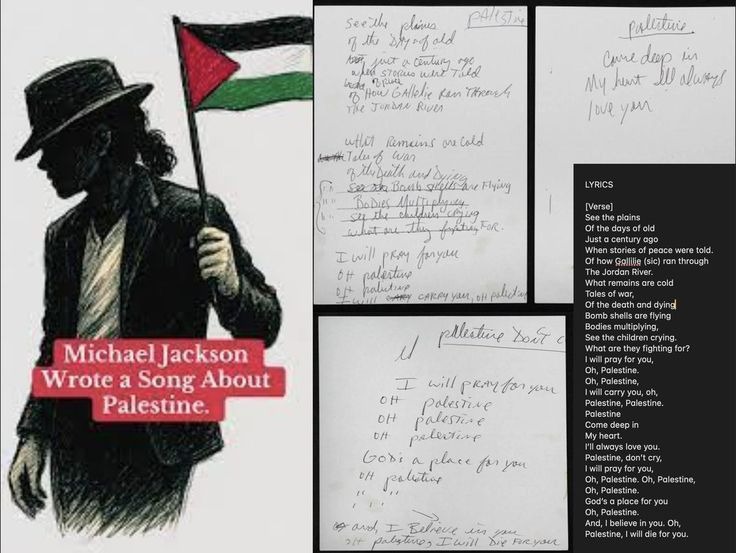
In June 2010, nearly a year after Michael Jackson’s death, Julien’s Auctions in Los Angeles placed a remarkable item on the block: a two-page handwritten manuscript of working lyrics for an unreleased song. Written in black pen on British Airways Concorde stationery, the document bore Jackson’s unmistakable handwriting and a title that would later spark intense debate: “Palestine.”
The auction house estimated the lot at just $600 to $800, a modest sum for a piece of pop culture history that would eventually be recognized as one of Jackson’s most politically charged compositions. But at the time, few understood what they were looking at.
The lyrics, dated 1993, revealed a deeply empathetic meditation on Palestinian suffering…
The Complete Lyrics of “Palestine, Don’t Cry” (As transcribed from Michael Jackson’s original handwritten manuscript)
[Verse 1]
See the plains
Of the days of old
Just a century ago
When stories of peace were told
Of how Galilee ran through
The Jordan River
[Pre-Chorus]
What remains are cold
Tales of war
Of the death and dying
Bomb shells are flying
Bodies multiplying
See the children crying
What are they fighting for?
[Chorus]
I will pray for you
Oh, Palestine
Oh, Palestine
I will carry you, oh
Palestine, Palestine
[Verse 2]
Palestine
Come deep in
My heart
I’ll always love you
[Pre-Chorus]
Palestine, don’t cry
I will pray for you
Oh, Palestine. Oh, Palestine
Oh, Palestine
God has a place for you
Oh, Palestine
And, I believe in you, oh
Palestine, I will die for you
[Final Chorus]
I will pray for you
Oh, Palestine
Oh, Palestine
I will carry you, oh
Palestine, Palestine
The Geography of Conscience: Jackson’s 1993 Visit
Just months after writing these words, Michael Jackson traveled to the region. In September 1993, he arrived in Tel Aviv as part of his Dangerous World Tour, performing two concerts at Yarkon Park for crowds estimated between 70,000 and 100,000 fans.
During his five-day visit, Jackson toured several iconic sites: the Western Wall in Jerusalem, the ancient fortress of Masada and an Israel Defense Forces army base, where he abruptly left after encountering photographers. He also visited a hospital, spending time with both Arab and Jewish children and bringing them gifts; a gesture consistent with his lifelong humanitarian impulses.
But contemporary reporting from United Press International, dated September 22, 1993, noted a significant detail: Jackson did not visit the occupied territories. His itinerary was limited to locations within ‘Israel’ proper – that is, the lands taken from Palestine from the 1948 Nakba onwards.
This geographical distinction carries weight under international law. According to the United Nations and other international bodies, the term Occupied Palestinian Territory officially refers to the West Bank including East Jerusalem and the Gaza Strip — territories occupied by Israel since 1967. The UN Office for the Coordination of Humanitarian Affairs confirms that this military occupation is a key driver of humanitarian needs in these areas. The Organization of Islamic Cooperation has further affirmed that the occupied Palestinian territory, including Gaza and the West Bank, constitutes a single geographical unit over which Israel has no sovereignty under international law.
Jackson, whether by design or circumstance, did not cross that line. His empathy for Palestine remained, in 1993, a matter of private conscience rather than public action.
The 1993 Visit: A Week in the Holy Land
Just months after penning his heartfelt plea for Palestine, Michael Jackson arrived in Israel in September 1993 for what would be his first and only visit to the region. His week-long trip was a mix of massive public performances, quiet humanitarian gestures and the intense media scrutiny that had begun to follow him following the child molestation allegations filed earlier that year.
Jackson performed two sold-out concerts at Tel Aviv’s HaYarkon Park as part of his Dangerous World Tour, performing for a combined audience of over 170,000 people. The concerts were a spectacle of his greatest hits, from Billie Jean to Black or White and featured a finale where he brought Israeli children on stage to sing Heal the World.
Away from the stage, Jackson dedicated his time to humanitarian visits. Between shows, he spent his free time at the Schneider Children’s Medical Center and other hospitals in the Tel Aviv area, where he cheered up cancer and transplant patients, distributing gifts and spending time with young children. Reports from the time note he visited both Arab and Jewish children, with one source identifying a child he met as Mohammed of Gaza.
His sightseeing itinerary included some of the region’s most significant historical locations. He visited the ancient mountain fortress of Masada and traveled to Jerusalem. However, his attempt to visit the Western Wall was met with hostility when a group of fervently Orthodox Jews, deeming the commotion on the Sabbath inappropriate, overturned tables and chairs to block his path, prompting Jackson to leave to avoid a confrontation.
The visit was also marked by tension with the media. Jackson faced what was described as intense harassment from photographers. This culminated in him abruptly cutting short a planned visit to an Israel Defense Forces army base after newspaper photographers interrupted his cameramen and he subsequently left the country for Turkey.
A Song Silenced: The Timeline That Matters
The lyrics for Palestine, Don’t Cry were completed in early 1993. Jackson reportedly intended the song for his 1995 double album HIStory: Past, Present and Future, Book I—a project that would ultimately address themes of persecution, media manipulation and global injustice.
But Palestine, Don’t Cry never made it past the writing stage. No demos were recorded. No studio sessions were scheduled. The song simply disappeared.
According to multiple sources, Sony Records refused to release the song. Some have pointed to powerful industry figures with ties to Israel who allegedly blocked its distribution.
Then, something cataclysmic for him happened… Just two months later, the first claims of child abuse against Michael Jackson began.
The timing has fueled decades of speculation. Michael would have recorded this song in early 1993, says a source familiar with Jackson’s creative process during that period. By late summer, the Chandler allegations had exploded and everything changed.
The Chandler Connection: A Father’s Admission
Evan Chandler, the father of Jackson’s first accuser Jordan Chandler, was recorded in a July 1993 phone conversation making chilling statements about his intentions. “If I go through with this, I win big time”, Chandler said. “I will get everything I want. I will get everything I want and they will be destroyed forever. Michael’s career will be over.”
Jackson settled the civil case with the Chandler family for a reported $23 million in 1994, though he continued to maintain his innocence. Evan Chandler died by suicide in 2009, months after Jackson’s own death. Jordan Chandler has never publicly recanted, but has also never spoken publicly about the case.
But it was Chandler’s next comment that has intrigued conspiracy theorists for decades: “There are other people involved who are waiting for my call and will intentionally occupy certain positions. Everything is going according to a certain plan that isn’t just mine.”
Chandler was Jewish, as were several key figures involved in the subsequent legal proceedings against Jackson. While critics warn against drawing simplistic conclusions, some researchers have noted that Jackson’s 1995 song They Don’t Care About Us contained controversial lyrics — later partially censored — that included the phrases ‘Jew me’ and ‘kike me’ alongside ‘sue me’, suggesting Jackson himself connected his legal persecution to his conflicts with the music industry establishment.
The La Toya Revelation: A Sister Forced to Betray
Perhaps the darkest twist in this story involves Jackson’s own sister, La Toya Jackson.
In the midst of the 1993 scandal, La Toya held a press conference in Tel Aviv, Israel, where she publicly stated that she believed her brother was a pedophile who had committed crimes against children. The statement made international headlines and seemed to confirm the worst suspicions about the King of Pop.
But years later, in 2011, La Toya revealed a very different truth. She confessed that her then-husband and manager, Jack Gordon, had been physically abusive and had forced her to make those statements against her will. Gordon, she said, controlled her every move and compelled her to betray her brother as part of a coordinated attack.
Gordon, who died in 2005, was never able to be questioned about these allegations. But La Toya’s recantation adds another layer to the narrative of a carefully orchestrated campaign to destroy Michael Jackson’s reputation.
It is worth noting that Jack Gordon was born to Jewish parents. His father, Abraham Gordon, was a Jewish immigrant from Russia and his mother, Faye Stein, was an Illinois native of Jewish heritage. Gordon, who also used the aliases Samuel Isaac Gordon and Clifford William Johnson, had a criminal record including a bribery conviction and documented associations with organized crime figures. According to La Toya, Gordon threatened to have Michael and Janet killed if she did not follow his orders during the 1993 press conference.
The Rabbi and the Spiritual Adviser
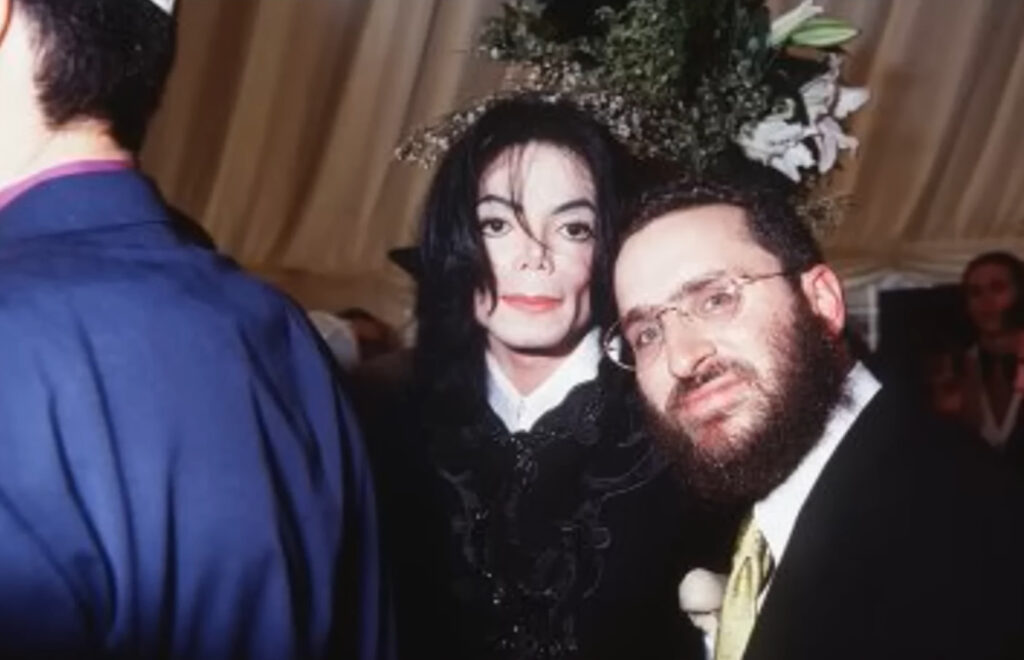
Following the 1993 allegations and the subsequent damage to his career, Jackson’s public rehabilitation took a peculiar turn. He began appearing with Rabbi Shmuley Boteach, who became his spiritual adviser.
For those who believe Jackson was targeted by powerful industry interests, this relationship represented something more sinister than spiritual guidance. “When you see somebody of incredible prominence, who’s been taken down several pegs and has now been placed in the position where they have to do everything they can to salvage their reputation — especially if you insult the wrong community — this is the person that they’re going to stick you with,” one commentator observed.
The implication is clear: Jackson, having crossed a line with his pro-Palestinian lyrics, was forced to make amends by associating with figures who could demonstrate his rehabilitation to the very interests he had offended.
The Phone Call: They Could Frame Me and Say I Overdosed
Another chilling piece of evidence in the Jackson saga is a phone call from the night before his death on June 25, 2009.
In the recording, Jackson can be heard saying: “Maybe a group of people don’t want to get rid of me. They could frame me and say I overdosed on drugs. They could frame me and say I overdosed on drugs.”
The words, spoken just hours before his death from a lethal dose of propofol administered by Dr Conrad Murray, have taken on a prophetic quality. For those who believe Jackson was silenced, the call is proof that he knew he was in danger and that his death was no accident.
Dr Murray was convicted of involuntary manslaughter and served two years in prison. But questions have never fully subsided about whether others were involved in ensuring that Michael Jackson, who had become a liability to powerful interests, would no longer be a problem.
The Children Who Spoke Up—and Were Ignored
Throughout his life and after his death, a chorus of child stars who knew Jackson intimately have maintained his innocence.
Macaulay Culkin, perhaps Jackson’s most famous young friend, has been unwavering in his defense for over 20 years. In multiple interviews, he has described their relationship as a normal friendship between two people who bonded over the trauma of childhood fame. “He never did anything to me,” Culkin has repeatedly stated. I never saw him do anything. He has described Jackson’s bedroom at Neverland as a two-story space where they simply played video games, clarifying that the sleepovers were innocent gatherings of friends.
In a 2023 podcast appearance, Culkin elaborated on their bond: “He reached out to me because a lot of things were happening big and fast with me. And I think he identified with that. It’s almost easy to try to say, oh, it was like weird or whatever. But it wasn’t. He was a kind of person who’d been through the exact same freaking thing and wanted to make sure that I wasn’t alone.”
Corey Feldman has gone further, alleging that law enforcement was more interested in building a case against Jackson than in investigating actual abusers. “I told them he is not that guy,” Feldman said of his 1993 interview with the Santa Barbara Police Department. He claims he gave them the names of the men who had molested him and his friend Corey Haim. “All they cared about was trying to find something on Michael Jackson—who was innocent.”
Feldman’s frustration has only grown over the decades. “There were four FBI agents waiting for me,” he recalled. “They asked all these super sexually exploited, backsided questions. I looked at all four of them and said, Are y’all crazy?”
Perhaps most heartbreaking is the testimony of the late Aaron Carter. In a 2019 interview, Carter recounted being confronted by FBI agents and his own mother, who pressured him to say Jackson had abused him. His response was defiant: “What you think I’m going to do? Tell you that Michael did something bad so that we can sue him for money? That man did nothing but be hospitable, kind, loving, giving, everything you can think of.”
Carter, who later named his son Prince after Jackson, was found dead in 2022. His testimony stands as a final, powerful defense of the man he considered a friend.
The Epstein Files: A Reckoning and a Revelation
When the Department of Justice released over 300,000 pages of documents related to Jeffrey Epstein in December 2025, Jackson’s name appeared, but not in the way his detractors might have expected.
Multiple news outlets confirmed that while Jackson’s name was mentioned in the files, there was no evidence that he engaged in any wrongdoing. In fact, a detail emerged that painted a very different picture. According to reports, during a visit to Epstein’s Palm Beach home, a minor was offered to give Jackson a massage. Jackson reportedly refused, preventing the child from being subjected to what would likely have been abuse.
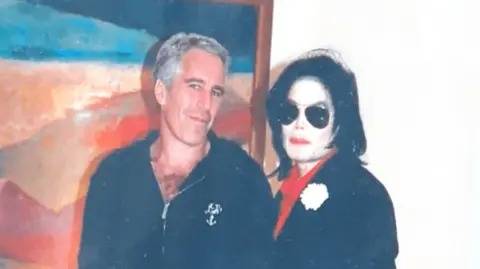
This detail has fueled the theory that Jackson was not only innocent of the charges against him, but actively worked to shield children from the very predators who would later be exposed. A photo of Jackson with Epstein, long held up as evidence of a connection, was explained by Jackson’s former bodyguard Matt Fiddes as an innocent encounter during a 2002 to 2003 house-hunting trip, at a time when Epstein’s crimes were not yet public knowledge.
“We never even knew who Epstein was,” Fiddes stated. “He was not famous then. He, like the other house owners we viewed that week, wanted a picture with Michael. Michael would always be polite to everyone he meets.”
Another photo, which showed Jackson with Bill Clinton and Diana Ross with three faces redacted, sparked immediate speculation that the blacked-out individuals were Epstein victims. The truth, quickly uncovered, was that the redacted faces belonged to Jackson’s children, Prince and Paris and Diana Ross’s son, Evan Ross—all photographed at a public 2002 Democratic fundraiser at the Apollo Theater.
The incident sparked criticism of how the document release was handled, with some accusing officials of deliberately creating misleading impressions.
The Sony Connection: Tommy Mottola and the Price of Speaking Out
Central to the narrative of Jackson’s persecution is his bitter feud with Tommy Mottola, the powerful head of Sony Music. In a 2002 speech, Jackson publicly labeled Mottola “a racist” and “very, very, very devilish”, accusing him of exploiting Black artists.
‘You don’t really care about us’, Jackson sang in his 1995 track They Don’t Care About Us — a line that defenders now interpret as a direct warning about the industry’s indifference to artists’ welfare. The song’s original lyrics, which included the controversial couplet ‘Jew me, sue me, everybody do me / Kick me, kike me, don’t you black-or-white me’, sparked accusations of antisemitism. Jackson defended himself by saying, “I am the voice of the accused and the attacked. I am the skinhead, I am the Jew, I am the black man, I am the white man. I am not the one who was attacking.”
Mottola’s own connections to Epstein have since come under scrutiny. Documents released in the Epstein files show direct communication between the two men, including an email where Epstein allegedly offered Mottola an extra massage room… in bulletproof glass, on his island. For Jackson’s defenders, this association confirms that his accusations against Mottola were not paranoid fantasies, but accurate assessments of a man embedded in a corrupt network.
At the time of his 2002 speech, Jackson also revealed his business acumen, noting that he owned half of Sony’s catalog and was preparing to leave the label. “I’ve generated several billion dollars for Sony,” he said. “They never thought that this performer would out-think them. They’re very angry at me because of it. But I just did good business.”
That anger, some believe, had consequences.
The Leaked Rant: Frustration Boils Over
At some point during his later years, a leaked phone recording captured Jackson expressing deep frustration with those he believed were targeting him.
“So tired of it. They start out the most popular person in the world, make a lot of money and everything end up with meaningless conspiracy. The Jews do it on purpose.”
The comments, which surfaced without context, were quickly labeled antisemitic. But for those familiar with the full scope of Jackson’s battles — with Sony, with the accusers and their families, with an industry he believed was controlled by a small group of powerful figures — the rant represented a man at the end of his rope, lashing out at those he felt had destroyed him.
Jackson never publicly addressed the recording, but its existence has been used by both sides of the debate: by critics as proof of bigotry and by defenders as evidence of a man driven to desperation by a coordinated attack.
Palestine: The Final Provocation
It is within this context — Jackson’s industry war, his defense by child stars, the La Toya recantation, the Rabbi Shmuley connection and the revelations of the Epstein files — that the Palestine, Don’t Cry manuscript takes on new significance.
Written in 1993, the same year the first allegations against him emerged, the lyrics express explicit solidarity with the Palestinian people. I will die for you, Palestine, Jackson wrote. In an industry with powerful financial and political ties to Israel, such a statement would have been controversial. Coming from the world’s biggest pop star, it may have been untenable.
The manuscript, authenticated by Julien’s Auctions and written on British Airways Concorde stationery, stands as material evidence of Jackson’s sympathies. Whether it was suppressed by Sony, as some have alleged, or simply abandoned during the chaos of the 1993 allegations, its existence challenges the sanitized, apolitical image often imposed on Jackson’s legacy.
“You’re telling me that this song that he wanted to release as part of his greatest hits album that ultimately came out in 1995,” one commentator asked, “you’re telling me that this song was shelved by Tommy Mottola at the beginning of 1993 and the next thing you know he has child sex crimes brought against him? You couldn’t make it more obvious that this was a hit job.”
A Stolen Childhood: Understanding the Man
To understand Michael Jackson — his quirks, his pain, his desperate love for children — one must understand what was taken from him.
In a rare moment of vulnerability, Jackson himself explained it best:
“Read all the things written about me. I wasn’t aware that the world thought I was so weird and bizarre. But when you grow up as I did in front of 100 million people since the age of five, you’re automatically different. My childhood was completely taken away from me. There was no Christmas. There was no birthdays. It was not a normal childhood. No normal pleasures of childhood. Those were exchanged for hard work, struggle and pain. And that’s why I love children and learn so much from being around them. I realized that many of our world’s problems today, from the inner city crime to large-scale wars and terrorism and our overcrowded prisons, are a result of the fact that children have had their childhood stolen from them.”
His father, Joe Jackson, was notoriously abusive — physically and emotionally — driving his children to fame while robbing them of any semblance of normal life. It is perhaps no coincidence that Jackson’s closest friendships were with child stars like Macaulay Culkin, who endured similar pressures. “They basically had the same father,” one observer noted.
The Song’s Second Life
Palestine, Don’t Cry remained largely unknown until the 2010 auction brought it to public attention. For years afterward, it circulated primarily among dedicated fan communities. A 2012 post on the Michael Jackson Chinese Fan Club forum featured the complete lyrics alongside emotional responses from fans moved by Jackson’s empathy.
The song gained renewed prominence in October 2023, following Hamas’s attack on Israel and the subsequent Israeli genocide in Gaza. Social media users began sharing screenshots of the lyrics, framing Jackson’s 30-year-old words as prophetic commentary on ongoing events.
In 2025, French creator Stéphane Desmoulin used artificial intelligence to imagine what the song might have sounded like had it been recorded, explicitly noting that his creation was entirely fictional and unofficial while paying tribute to Jackson’s deep sensitivity to humanitarian issues.
Legacy of an Unheard Plea
What remains most striking about Palestine, Don’t Cry is its directness. Unlike Jackson’s more general humanitarian anthems like Heal the World or Earth Song, this composition names a specific place and people. I will die for you, Palestine, Jackson wrote — words that would have been controversial in 1993 and remain so today.
Whether the song’s suppression was deliberate or simply the result of creative decisions during the HIStory album’s production may never be known. Sony has never commented on the matter and Jackson’s estate has not addressed the speculation.
But for those who have followed the threads — from the Chandler allegations to the Epstein files, from La Toya’s forced confession to Aaron Carter’s defiant defense, from the Rabbi Shmuley years to the leaked death-bed phone call — a pattern emerges. Michael Jackson, a deeply troubled man who never had a childhood, may have been destroyed because he threatened powerful interests.
He wrote a song for Palestine. He refused to play along with Epstein’s network. He tried to leave Sony and take his catalog with him. He spoke truth about an industry that exploits its artists and abandons its children… and for that, they came after him.
“I ask all of you to wait and hear the truth before you label or condemn me,” Jackson said during his 2005 trial. “Throughout my life, I have only tried to help thousands and thousands of children to live happy lives.”
Decades later, with new evidence and shifting perspectives, some are finally listening.
The song remains unheard. But its words, preserved on Concorde stationery and scattered across the internet, continue to speak… “Palestine, I will pray for you. God has a place for you.”