From ‘God Mode’ to Normal Life: Some IDF Soldiers Return From Gaza Depressed by Lost Power
*As Israeli officials target the makers of NAZA, Palestinian writer Muhammad Shehada argues that some soldiers’ accounts reveal excitement at the power they wielded over Gaza — and asks why testimony about mass killing has brought such fury upon those exposing it.*
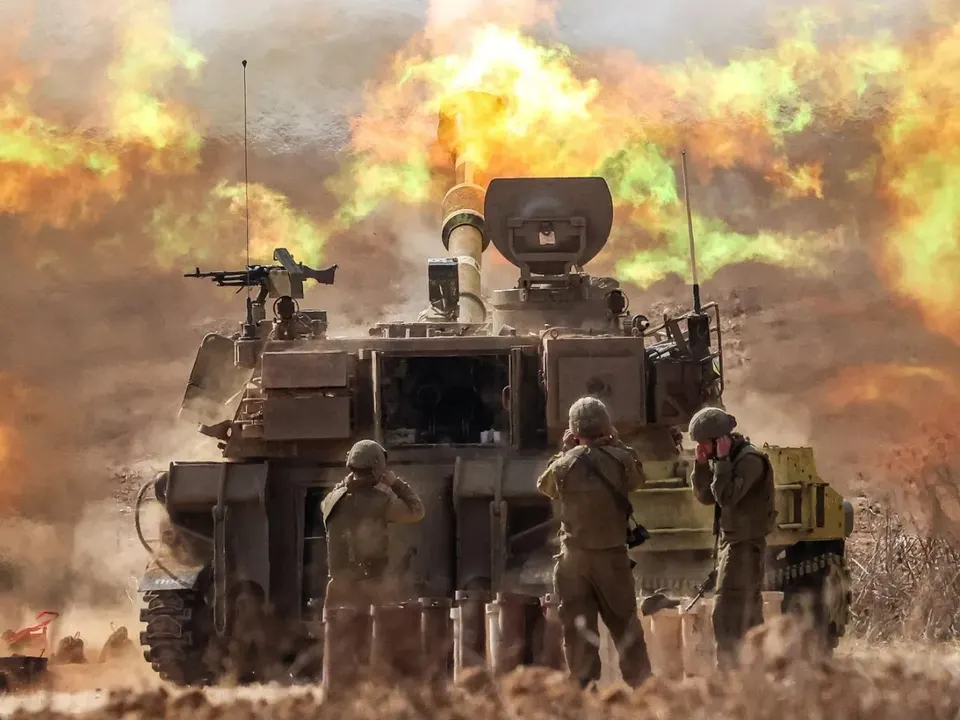
The Israeli soldiers speaking about Gaza did not sound, to Muhammad Shehada, like people struggling to confess. Some sounded eager to describe what they had been able to do.
“They were providing it out of excitement,” the Palestinian writer and political analyst told Useful Idiots. “They were very eager to brag about the formidable force that was at their disposal.”
His comments, in an interview excerpt published on 14 October, concern NAZA, the documentary by Israeli filmmakers Yuval Abraham and Rachel Szor. But the argument he develops reaches beyond the film: into the exhilaration of exercising power over another population, the destruction of civilian life, and the responsibility of governments that continued supporting Israel while receiving accounts of what its military was doing.
“The most striking thing in that movie was how casually soldiers describe the atrocities they unleashed in Gaza,” he said.
For Shehada, the apparent ease of the telling is central. These accounts, he argues, demand scrutiny not only for what they disclose about military operations, but for what they suggest about the people who carried them out.
NAZA takes its title from an Israeli military abbreviation for collateral damage. Filmed on Tel Aviv rooftops, it examines the systems behind the bombing of Gaza, building on investigations by +972 Magazine, Local Call and the Guardian. Abraham and Szor are also among the directors of No Other Land.
Shehada was particularly struck by the social backgrounds of the people discussing those systems.
“It’s not Israeli extremists,” he said. “It’s actually liberal, left-wing, or centre-left, upper-middle-class Tel Avivians.”
“They are working in the high-tech,” he continued, describing people with prestigious, well-paid civilian careers who could speak with apparent detachment about mass killing.
His point was that the violence could not simply be assigned to a political fringe. In his reading of the film, it also involved educated professionals whose civilian identities sat comfortably within Israel’s liberal mainstream.
That is Shehada’s interpretation of the interviewees’ demeanour and motivations. An apparent lack of emotion on camera cannot, by itself, establish what any individual feels. But his challenge is directed at the assumption that testimony about atrocities necessarily arrives as an expression of remorse.
“They were bragging,” he said. “They were excited.”
One of the technologies he discussed was Lavender, the system exposed in an April 2024 investigation by +972 Magazine and Local Call. Drawing on six Israeli intelligence officers, that report described the use of automated assessments to identify suspected militants, with limited human scrutiny and attacks often conducted at family homes.
Shehada called it an “AI killing machine”. He also referred to testimony about authorising an attack despite the prospect of hundreds of civilian deaths.
The Israeli military disputes the film’s account. In its published response, it denied approving a strike with 500 anticipated civilian deaths, described Lavender as an intelligence database rather than an authorised target list, and said commanders must assess individual attacks. It also accused the documentary of presenting an incomplete and misleading account of targeting procedures.
The dispute goes to the heart of the film: whether the safeguards described by the military meaningfully constrained the killing, or whether the people operating its systems experienced something very different.
Shehada then turned to an account he recalled reading in the Israeli press, possibly on the news website Walla, about soldiers struggling after returning from Gaza.
According to his recollection, a psychiatrist interviewed for the article attributed some soldiers’ distress to the loss of the extraordinary power and status they had experienced during deployment.
“He didn’t say it’s because the soldiers feel guilt or shame,” Shehada said. “He said it’s because the soldiers in Gaza felt like gods. They were superhumans. They decided who lives and who dies.”
“They felt an extreme inflated sense of ego,” he continued. “They felt like they are in charge of life and death of two million people there.”
In his retelling, the return to civilian anonymity was experienced as a collapse.
“Nobody knows them. Nobody recognises them. Nobody opens the door for them. Nobody greets them. There’s no military salute. There’s no prestige. There’s no honour.”
“You’re just walking anonymously as a nobody in a crowd of nobodies,” he said. “And that’s what tears them down the most.”
Shehada did not name the psychiatrist or provide the article’s date, and the particular account could not be independently verified. It remains his recollection of a commentary, rather than an established clinical explanation for depression among returning soldiers.
His broader argument was that distress after deployment should not automatically be read as evidence of guilt about what happened to Palestinians.
“That’s why a lot of people go back to serve in Gaza,” he said, describing the explanation he remembered: “because of the adrenaline, because of the excitement, because of the euphoria of feeling like a god, feeling like a superhuman.”
That recollection informed his response to NAZA.
“It seems to me that some of those soldiers in Gaza were basically craving that sensation again,” he said.
He also challenged the language used to discuss soldiers’ moral distress, alleging that it was reframed as an “identity crisis”.
“Because moral injury means you’ve done something wrong,” he argued. “Identity crisis shames you. It means that you’re the problem.”
He did not identify a written military policy establishing that terminology. His criticism was of an institutional culture that, in his view, protects the legitimacy of the mission by locating the problem in the person who questions it.
The interview then moved from the soldiers’ motivations to the conduct Shehada said three Israeli servicemen had described directly to him.
Their accounts, he said, concerned three recurring practices: killing people who entered designated areas, destroying the built environment, and forcing Palestinians into dangerous locations ahead of troops.
“The soldiers came with a very clear testimony,” he said. “They said, ‘We were given orders to do three things.’”
The first, in his account, was to “kill everyone” within areas whose boundaries might be invisible to the people walking into them.
He described an “annihilation zone” or “extermination zone” in which soldiers treated Palestinian presence itself as sufficient grounds to fire.
“You’re allowed to kill any Palestinian that walks through that invisible circle,” he said.
Shehada also alleged that, in the accounts he received, soldiers observed more restrictive conditions for shooting animals than for shooting Palestinians.
“But for humans, you can shoot freely,” he said.
These were his descriptions of what soldiers had told him, rather than quotations from published rules of engagement. The broader allegation of lethal zones, however, predates the interview: Haaretz reported in March 2024 on areas defined by commanders in which Palestinians entering them could be shot.
The second practice Shehada described was destruction intended to make civilian return impossible.
“The other thing those soldiers described is the commands, the orders to destroy everything,” he said. “Leave nothing standing.”
He recounted what he said commanders had told their troops:
“This is the only way we teach the Arabs a lesson. When they come back and find no homes left. When they find their villages gone.”
The allegation is that destroying homes was itself part of the objective: a means of punishing a population and eliminating the places to which it might return.
Shehada connected this to conversations he said he had held with European and American officials over the course of the war.
“They were describing to us vividly that Israel was destroying everything in Gaza, leaving nothing standing,” he said, accusing Israeli forces of “deliberately wiping out all of the urban space so that people would have nothing left to live in and then they would leave”.
He also recalled a conversation, which he placed in February 2024, with an unnamed former American general who had served in NATO.
Asked how Gaza compared with other wars he had experienced or studied, the general had said the scale of force was beyond anything he would have authorised, according to Shehada.
The official was not identified, so the exchange remains Shehada’s account of a private conversation. Its significance to his argument was that people with military expertise and political access understood the scale of the destruction early on.
“So they knew,” he said. “The point is that for those people, they didn’t care.”
The third practice the soldiers described, Shehada said, was the systematic use of Palestinians as human shields.
“One of those soldiers said, ‘We were using people in Gaza like dogs.’ That was the verbatim quote.”
He described civilians being captured, dressed in military clothing and sent ahead into buildings or other dangerous areas, exposing them to gunfire and explosives that might otherwise threaten Israeli troops.
“The IDF was using them as slaves and bait,” he said.
He referred to the practice as the “mosquito protocol”.
“You come too close to danger, you get zapped,” he said, explaining his understanding of the term. “Your life is disposable. That’s it.”
Separate reporting supports the allegation that Palestinians were repeatedly forced into such roles. An Associated Press investigation published in May 2025 described soldiers compelling detainees to enter buildings and tunnels ahead of them. An officer said commanders knew about the practice. The military told AP it prohibited using civilians as human shields and was examining allegations.
Shehada went further, alleging that Palestinians could be killed even after surviving the dangerous work imposed upon them.
“They would let them go and then hand them over to another unit that would shoot them dead or bomb them on the spot,” he said.
One reported case illustrates that danger, without establishing that every person used as a human shield met the same fate. In February 2025, +972 and The Hottest Place in Hell reported that soldiers had forced an 80-year-old man to scout buildings with an explosive cord around his neck. After he and his wife were ordered to leave, another battalion shot them dead, according to soldiers’ testimony.
These allegations form the wider context of the controversy surrounding NAZA. The film brings accounts of military conduct to an audience that may never have encountered the investigations on which it builds.
The response has included threats against the filmmakers and pressure on their families.
The International Documentary Association has documented official moves to strip Abraham and Szor of citizenship, accusations of treason, and protests outside the home of Szor’s parents. It has called for the intimidation to end.
Netanyahu has also demanded that NAZA’s military interviewees be identified and prosecuted.
The Committee to Protect Journalists and ten other press freedom organisations have urged Israeli authorities to protect the filmmakers and their families, and to allow journalists to investigate government and military conduct.
For Shehada, the discussion ultimately returns to the people subjected to that military power.
In the interview material, he recalled a conversation with his late friend Ali, whom he described as his closest friend, living in a refugee camp in central Gaza.
Asked how he was coping, Ali had imagined what he would request if there were a final judgement.
“I would ask him to force those Israeli soldiers to go on the same adventure that I have to take every single day to find water and food,” Shehada recalled him saying. “Nothing more. That is enough punishment for them.”
“The idea of going every day, out in the open under airstrikes, under constant gunfire, and walking around desperately from one place to another, ten hours just to find water, that is enough punishment.”
The demand he remembered was to make the soldiers experience the daily conditions imposed on the people beneath their power: the exposed walk, the search for food, the hours spent trying to find water.
For Ali, as Shehada told it, that would have been punishment enough.
Sources and attribution
Interview source: Muhammad Shehada speaking to Useful Idiots, hosted by Katie Halper and Aaron Maté; supplied transcript and programme description for the excerpt “IDF Soldiers Return DEPRESSED After Gaza. Here’s the Sickening Reason Why”, dated 14 October 2026. Quotations have been lightly edited for repetition, punctuation and obvious transcription errors; substantive wording and attribution have been retained.