Iran’s Strikes Force a Reckoning for America’s Gulf AI Ambitions
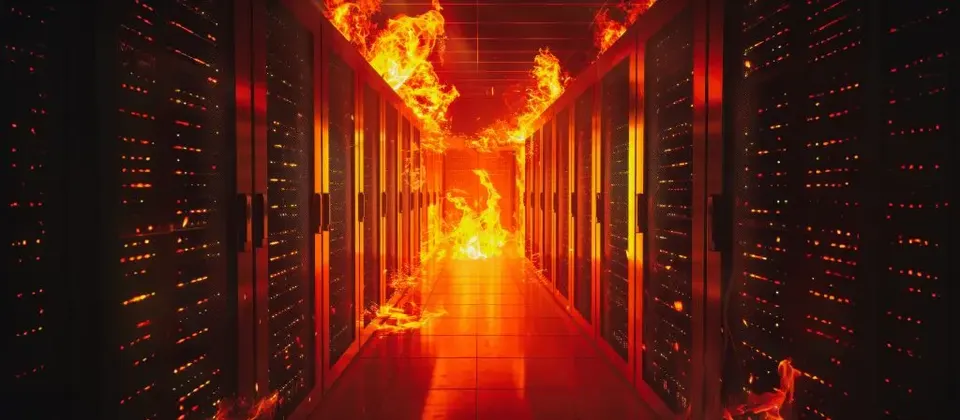
Iran’s attacks on Amazon’s Gulf data centres have exposed a weakness at the heart of America’s ambitions for artificial intelligence: some of the infrastructure intended to extend its technological dominance is within reach of a regional war.
On 15 September, Amazon Web Services said it had been unable to restore access to its Bahrain cloud region and one of its three UAE availability zones following wartime damage. It had exhausted restoration options for affected Bahrain data that customers had not moved elsewhere, and further updates were expected in early 2027.
For businesses that entrusted their systems to those facilities, the consequences extend beyond an interrupted connection. An outage can force an emergency move to another country’s servers; unrecoverable data can undermine the business itself. For governments seeking to turn the Gulf into a centre of the digital economy, that distinction carries an uncomfortable lesson about the security of the investment they are attracting.
The promise had been expansive. On 15 May 2025, Donald Trump and UAE President Sheikh Mohamed bin Zayed Al Nahyan attended the unveiling of a planned five-gigawatt AI campus in Abu Dhabi, billed as the largest outside the United States. Its promoters described a platform from which American technology companies could serve nearly half the world’s population, including markets across the Global South.
“American companies will operate the data centres and offer American-managed cloud services throughout the region,” US Commerce Secretary Howard Lutnick said. He presented the agreement as a milestone towards “US AI dominance”.
The development’s scale matched that language. The full campus was planned to cover ten square miles. Within it, Stargate UAE would begin as a one-gigawatt computing cluster built by G42 and operated by OpenAI and Oracle, with Nvidia, Cisco and SoftBank also participating. The first 200 megawatts were scheduled to become available in 2026.
Other commitments reinforced the impression of an accelerating investment boom. Microsoft set out a $15.2 billion UAE programme covering 2023–2029, including both spending already undertaken and future investment. Separately, AWS committed more than $5.3 billion to a cloud region in Saudi Arabia. These were distinct projects across different countries, but together they demonstrated how central the Gulf had become to American technology companies’ expansion plans.
The commercial stakes are particularly high for Amazon. AWS generated $45.6 billion of operating profit in 2025, against $80 billion for the group as a whole: about 57 per cent. Its contribution exceeded those of Amazon’s North American and international segments combined. Cloud computing may be less visible than parcels and warehouses, but it is fundamental to the company’s profitability.
The deals also carried strategic conditions. G42 had divested investments in China and begun removing Chinese hardware as it sought closer relationships with American companies. Access to advanced US technology came with security requirements intended to restrict its diversion and use by Washington’s competitors.
The resulting bargain tied Gulf capital and development ambitions more closely to American chips, software and political priorities. Its attraction depended in part on confidence that those relationships would sustain a stable environment in which expensive infrastructure could operate for years.
Washington’s public language encouraged that confidence. Trump’s introduction to the 2025 National Security Strategy said Operation Midnight Hammer had “obliterated Iran’s nuclear enrichment capacity” and declared that America was “making peace all over the world”. Those assertions described an administration presenting regional conflict as something it had successfully contained.
By March 2026, the damage to cloud infrastructure told a different story. Two AWS facilities in the UAE were directly struck by drones, while a nearby strike affected infrastructure at a Bahrain site. Amazon described structural damage, interruptions to electricity and water damage caused during firefighting. Customers were urged to move workloads and protect their data.
Further drone activity disrupted AWS operations in Bahrain later that month. The repeated interruptions made the commercial danger clearer: customers could not assume that recovery from one incident would end their exposure to the conflict.
The military role of commercial AI sharpened the problem. Anthropic’s technology was used during US operations against Iran, while its models had reached American defence and intelligence users through an arrangement involving Amazon’s cloud. Such relationships connect some of the same corporate providers to civilian commerce and military operations. They do not establish which workloads were running at the particular Gulf facilities that were attacked.
Nor does a company’s military business automatically make every building it owns a lawful target. The legal assessment depends on the particular infrastructure and its contribution to military action. Rules protecting civilians, prohibiting disproportionate attacks and requiring precautions continue to apply. For civilian customers, however, the practical danger can exist regardless of whether an attacker’s justification would survive legal scrutiny.
Iran made its threats against the wider technology sector explicit. In an April video, its armed forces singled out Stargate UAE with satellite imagery and threatened American and Israeli technology and energy facilities if Iranian power infrastructure was attacked. A flagship investment had become an object of public military intimidation.
The UAE is reportedly considering dispersing its planned five-gigawatt campus across several sites, with underground construction, air defences and stronger protection for buildings, power and cooling systems. The first, $30 billion Stargate phase is expected to continue with modifications. The revised masterplan, final costs and timetable remain unconfirmed. G42 says work is progressing as planned: “The project’s specifics are subject to continuous review.”
The proposals point to a more demanding investment calculation. A site chosen for available land, energy supplies and proximity to customers must also be assessed for its ability to keep functioning during attacks. Protecting equipment, securing access for staff and maintaining services through repeated disruption all become part of the cost of delivering computing power.
The financial pressure is clear even without a revised public budget: additional protection absorbs capital, construction delays postpone revenue, and uncertainty makes a promise of uninterrupted service harder to sell.
The asymmetry is commercially significant. An attacker does not need to destroy every server to damage an operator’s prospects. A sustained risk of outages can cause customers to move, require more spending on protection and weaken confidence in future projects. The economic consequences can therefore extend well beyond the immediate repair bill.
That creates a potential opening for competitors, including Chinese providers, if customers seek computing capacity elsewhere. But the scale of any resulting shift in business has yet to be established. The broader implication is that Washington’s effort to bind markets to American technology can be weakened if the infrastructure supporting that strategy becomes associated with avoidable disruption.
For Gulf governments, the dilemma reaches into the purpose of the investment itself. Digital infrastructure was meant to support economic diversification and attract businesses seeking dependable services. If hosting that infrastructure brings additional exposure to regional conflict, the benefits have to be weighed against risks borne by local companies, workers and public services.
The projects retain powerful financial and political backers. Their credibility will now depend on demonstrating that they can deliver what customers ultimately purchase from a cloud provider: secure data, reliable access and continuity when conditions deteriorate. The war has made the cost of that promise impossible to leave outside the business plan.
Sources and attribution
Reuters — proposed revisions to the UAE AI campus, 11 September 2026
Reuters — AWS unable to restore access to Bahrain and one UAE cloud zone, 15 September 2026
UAE Embassy — announcement of the five-gigawatt UAE–US AI campus, 15 May 2025
G42 — Global Tech Alliance Launches Stargate UAE
Microsoft — details of its $15.2 billion UAE investment programme, 3 November 2025
Reuters — Big Tech’s investments in the Middle East, 2 March 2026
Amazon — fourth-quarter and full-year 2025 financial results, 5 February 2026
Reuters — Microsoft’s investment in G42 and restrictions on Chinese technology, 16 April 2024
White House — 2025 National Security Strategy; text reproduced by the World and Japan database
Reuters — drone damage to AWS facilities in the UAE and Bahrain, 2 March 2026
Reuters — further disruption to AWS in Bahrain, 24 March 2026
Reuters — US use of Anthropic AI during operations against Iran, 1 March 2026
ICRC — protections for civilian digital infrastructure in armed conflict, 23 April 2026
Tom’s Hardware — Iran’s video threat against Stargate UAE, 5 April 2026