Trump’s “Rescue Mission” in Iran Was a Catastrophic Military Failure Masked by Propaganda and a Cover for a Far Larger Operation
The narrative presented to the public was crafted with precision and emotional clarity, centering on a single compelling image of a downed American pilot rescued in a daring operation deep inside hostile territory. It was framed as a triumph of American resolve, a mission that demonstrated capability, loyalty, and the principle that no serviceman would be left behind.
President Donald Trump reinforced that narrative in unequivocal terms, describing what he called a “daring search and rescue operation” and presenting it as a success worthy of celebration.
However, Trump’s own later remarks have fundamentally undermined that version of events.
“We had 155 aircraft,” Trump said. “The second rescue mission involved 155 aircraft including four bombers, 64 fighters, 48 refueling tankers, 13 rescue aircraft and more… a lot of it was subterfuge.”
The scale of that admission is impossible to reconcile with the claim that this was a limited operation to recover a single individual.
A Deployment That Exposes the Truth
The use of 155 aircraft, including bombers, fighters, refueling tankers, and specialized rescue units, represents not a tactical extraction but a major coordinated military operation. Such a deployment carries enormous logistical complexity, requires extensive planning, and exposes large numbers of personnel to risk.
Even at the most basic level, the numbers do not align with the official story. A single pilot extraction does not require dozens of fighters, nearly fifty aerial refueling tankers, and strategic bombers. The scale alone indicates that the mission had a far broader objective.
This is precisely the point raised by Larry C. Johnson, who rejected the official narrative outright.
“The story we’ve been given, it’s a lie,” Johnson said. “On several fronts.”
The Operation on the Ground
Johnson’s account provides critical detail that helps explain what the scale of the deployment actually means in operational terms.
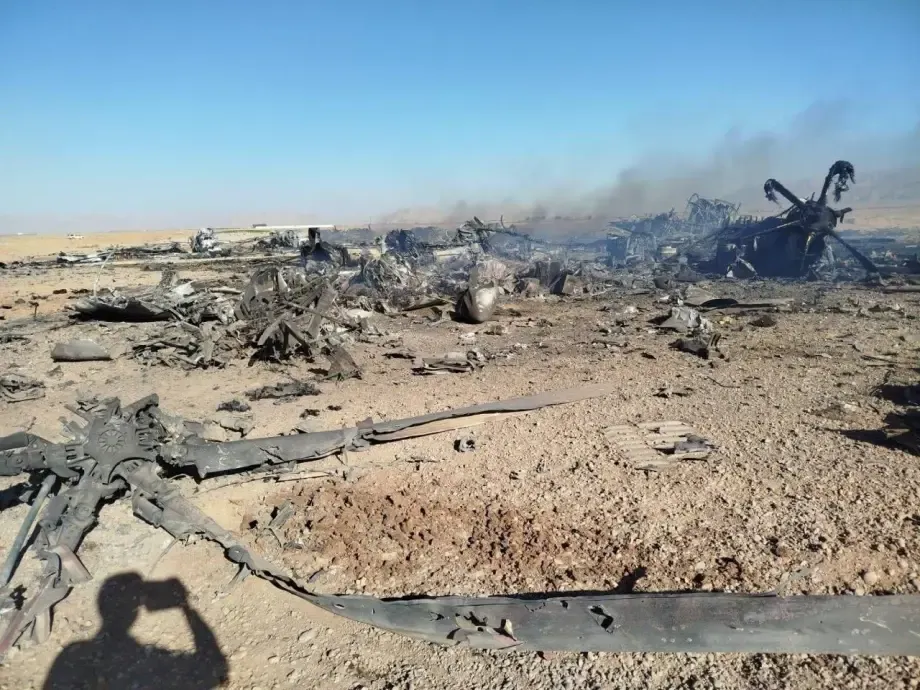
“At that site there were two C-130 aircraft,” he said, along with multiple MH-6 Little Bird helicopters and other assets. “Why did they send out four Little Birds? There must have been some sort of firefight.”
The presence of two Lockheed C-130 Hercules aircraft is particularly significant. These platforms are not used for simple extraction missions. They are designed to transport large numbers of troops, heavy equipment, or fuel required to sustain extended operations.
A single C-130 can carry close to or over 100 fully equipped personnel. Two of them represent the capacity to insert a substantial force into hostile territory. When placed alongside Trump’s admission of a 155-aircraft operation, the implication becomes unavoidable. This was not a rescue mission but a large-scale military deployment with the capability to support a ground operation.
The Missing Explanation
Trump’s statement that “a lot of it was subterfuge” introduces a critical element that has not been addressed in official reporting. If the operation involved deception, then the publicly presented narrative may itself be part of that deception.
This aligns with claims emerging from Iranian officials that the rescue mission may have been a cover for a much larger objective. According to statements from Iran’s foreign ministry, the operation could have been intended to seize enriched uranium from within Iranian territory.
While such claims cannot be independently verified in full, they are supported by reporting that a plan had been presented within U.S. military circles to extract approximately 1,000 pounds of highly enriched uranium from Iran. That plan, reportedly developed at Trump’s request, involved transporting drilling equipment by air, constructing a runway for cargo aircraft, and deploying large numbers of personnel deep inside Iranian territory.
Such an operation would require precisely the kind of assets that were observed, including heavy transport aircraft, extensive air support, and a large logistical footprint.
It would also explain the otherwise inexplicable scale of the deployment.
A Plan Requiring Hundreds or Thousands of Troops
According to the same reporting, executing such a mission would have required hundreds or even thousands of personnel, along with heavy equipment and sustained logistical support. It would not have been a short operation but one that could extend over weeks or months under highly dangerous conditions.
When this is compared to Trump’s admission of 155 aircraft, the numbers begin to align. Even a conservative estimate suggests that such a fleet would involve hundreds of crew members, with additional personnel transported within aircraft capable of carrying dozens of troops.
This brings the focus back to the central unanswered question. If this was merely a rescue mission, why deploy forces on a scale consistent with a complex ground operation?
“We Lost a Lot More Than They’re Saying”
Johnson’s description of the losses further reinforces the conclusion that the operation was far larger than acknowledged.
“In addition to losing the F-15, we lost an additional two Black Hawk helicopters,” he said. “We’ve got the two C-130s… an additional four MH-6 Little Birds… an A-10 Warthog went down.”
He then summarized the scale of the losses in stark terms.
“When you total it up, you’re looking at about $400 million worth of aircraft that got shot down yesterday just ostensibly to save one person.”
He also highlighted what has not been disclosed.
“We have no information actually about the number of actual casualties.”
When viewed in the context of a 155-aircraft operation, that absence becomes even more significant. The number of personnel involved would have been substantial, and any losses sustained during such an operation are unlikely to be minimal.
A Failed Operation Reframed as Success
Trump’s earlier claims further deepen the contradiction. Just days before the incident, he asserted that Iranian air defenses had been neutralized.
“There was no more air defense in Iran,” Johnson recalled. “That didn’t age too well.”
The losses described in the operation suggest the opposite, indicating that Iranian forces were capable of inflicting serious damage on U.S. assets.
Johnson also pointed to advanced Iranian capabilities.
“They have a loitering system… a rocket that acts like a glider… and then boom, can hit it,” he said.
The Strategic Objective Behind the Narrative
Johnson’s assessment of the mission’s purpose provides a crucial link between the scale of the operation and the uranium extraction theory.
“I think it was involved in preparation for a ground attack on the Natanz nuclear reactor,” he said.
He added that if the operation had not collapsed, “it’s very likely we might have seen troops on the ground already.”
When combined with reports of a plan to extract enriched uranium and Trump’s own admission of a massive, multi-layered deployment involving “subterfuge,” the conclusion becomes increasingly difficult to avoid. The rescue narrative appears to be a simplified cover for a far more ambitious and risky operation.
Civilian Impact and the Erasure of Context
While the focus of public attention has been directed toward the rescued pilot, the broader context of U.S. military activity inside Iran has been largely ignored. The F-15 involved in the incident was conducting active combat operations, and those operations inevitably involved strikes on Iranian territory.
The absence of reporting on civilian casualties or damage to infrastructure reflects a selective framing that prioritizes a single narrative while excluding its consequences.
Echoes of Operation Eagle Claw
Johnson drew a direct comparison to the failed 1980 rescue mission in Iran, which ended in disaster.
“There’s always a problem in the desert,” he said, recalling how that operation resulted in a fatal collision and multiple deaths.
The similarities are striking, particularly in the combination of logistical complexity, hostile conditions, and the rapid escalation of risk.
“We’re Getting a Lot of Happy Talk”
Johnson summarized the situation in blunt terms.
“We’re getting a lot of happy talk surrounding this,” he said, “without actually knowing what was the case.”
That “happy talk” has been reinforced by media coverage that presents the operation as a success while failing to address the scale, contradictions, and unanswered questions.
The Reality Behind the Narrative
When Trump’s own statements are examined alongside Johnson’s analysis and the available evidence, the official narrative collapses.
A mission involving 155 aircraft, large transport planes capable of inserting troops, and the destruction of multiple assets cannot be credibly described as a simple rescue operation. It is the profile of a major military action, one that appears to have failed and was subsequently reframed.
The introduction of “subterfuge” into Trump’s own description only strengthens the conclusion that the story presented to the public is not the full story.
What has been portrayed as a moment of triumph is, in reality, a large-scale operation with a far more ambitious objective, one that resulted in significant losses and has been repackaged as a success.
The gap between reality and narrative is not a matter of interpretation.
It is the story itself.