Israel Accused of Systematic Ceasefire Violations as Gaza Destruction Expands, Resistance Groups Release New Statements
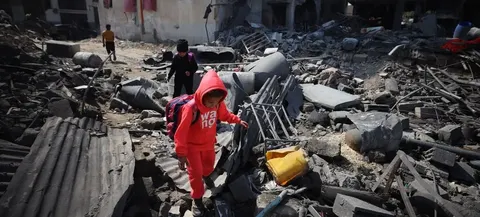
New reports from Gaza indicate that Israel has carried out more than 400 violations of the 42-day-old ceasefire agreement, killing and wounding more than 1,000 Palestinians during the pause in hostilities, including over 30 overnight—most of them children.
In a detailed field report, journalist John Elmer documented large-scale demolitions, continued military incursions, and heavy equipment operations across eastern Gaza, all conducted inside the so-called “yellow line”—the delineated zone Israel agreed to withdraw from under the terms of the first phase of the ceasefire.
Meanwhile, Palestinian resistance factions have continued to abide by the agreement, completing 26 of the 28 required returns of Israeli bodies and captives. The two remaining bodies are expected to conclude the first phase of the deal.
Shadow Unit Recovers Israeli Bodies as Palestinians Denied Equipment to Recover Their Own Dead
Elmer’s report focused initially on the Qassam Brigades’ “Shadow Unit,” tasked with recovering the bodies of fallen Israeli soldiers and security personnel.
Footage from Shuja’iyya, Zeitoun, Khan Yunis and Rafah shows resistance fighters using excavators and other heavy machinery—equipment supplied specifically for the recovery of Israelis but reportedly not permitted for use in locating the estimated 10,000 Palestinians still buried under rubble.
Egyptian-flagged machinery was visible at recovery sites, but Palestinian officials say Israel is blocking the full entry of agreed-upon equipment and aid, constituting additional violations of the ceasefire terms.
Former U.S. President Donald Trump, whose 20-point plan underpins the ceasefire, recently stated that “many believed [Hamas] could not do it,” referring to the body-recovery operation. Qassam units, however, appear to have fulfilled their obligations despite Israeli restrictions.
Israel Expands Yellow Line, Demolishes Entire Neighborhoods
A significant portion of Elmer’s report examined Israel’s activities along and beyond the “yellow line.”
Assam al-Nabha, an engineer with Gaza Municipality now reporting for Al Arabi, conducted an on-the-ground assessment and found:
- Israel has expanded its control zone by nearly 10%,
- exerts effective control over 62% of Gaza,
- and has occupied 33 additional square kilometers beyond agreed boundaries.
Hamas issued a statement accusing Israel of “daily and systematic demolition of homes” within the expanded area, calling it a “clear, explicit breach” of the ceasefire.
Satellite imagery obtained by BBC Verify corroborates these claims. Between Oct. 10 and Nov. 8—entirely during the ceasefire—Israel destroyed more than 1,500 buildings inside areas it continued to control. Analysts believe the true number is far higher due to gaps in satellite coverage.
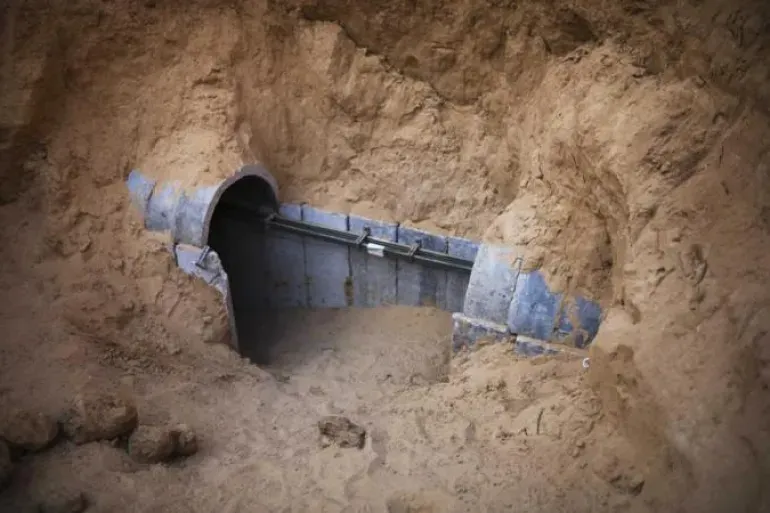
Massive armored bulldozers, augers and tunnel-drilling rigs have been deployed—machinery that could not safely operate during active combat. Elmer notes that this indicates Israel is using the ceasefire to carry out operations it failed to achieve during 23 months of war, particularly the destruction of underground resistance infrastructure.
US Central Command Map Reveals Even Larger Israeli Control Zone
An image taken inside the US-run Civil-Military Coordination Center in Kiryat Gat shows a wall-mounted operational map displaying a much larger Israeli control zone than previously acknowledged publicly.
The facility houses more than 200 U.S. troops and foreign personnel and was initially described as supervising humanitarian aid flows.
After a Washington Post profile suggested the U.S. was monitoring aid deliveries, Israeli officials immediately contradicted the report. IDF sources told Army Radio:
“The political echelon in Israel will continue to make exclusive decisions about the types of materials allowed or forbidden to enter the Strip.”
Aid organizations say Israel has permitted less than one-quarter of the agreed-upon aid shipments to enter Gaza.
Israel Uses Ceasefire to Target Tunnel Sites Linked to Battlefield Losses
Footage released by the IDF in recent days shows troops demolishing tunnel routes in areas where Israel suffered significant losses during the war—including the December 2024 “snake hunting” ambush in Beit Hanoun, where Qassam fighters detonated multiple IEDs against Israeli units that believed the area had been secured.
Elmer notes that Israel is now using the ceasefire to enter and destroy these locations—something it was unable to do while resistance fighters remained active.
In Shuja’iyya, one of Gaza’s largest neighborhoods, satellite and field footage show nearly total destruction. The Shuja’iyya battalion, Elmer says, was never defeated during the war, and Israeli operations of this scale would not have been possible under resistance fire.
IDF Boasts of “Weapons Depots” Showing Only Minimal Arms
The IDF recently released photos claiming to have seized Hamas “weapons depots.”
Elmer argues the images reveal the opposite:
- at most three mortar rounds,
- one disassembled rifle,
- three RPG rounds,
- a small number of explosives.
“These are weapons from a single fighter’s position, not a depot,” he said, adding that throughout the war, Israel never produced evidence of overrunning major Hamas armories or capturing large stockpiles of weapons.
Rafah Fighters Remain Trapped in Yellow Zone; Negotiations Stall
Negotiations have been ongoing for weeks to extract a group of 150–200 resistance fighters trapped within the yellow zone in eastern Rafah.
Hamas says it is prepared to remove them, but that Israel refuses, allegedly seeking to use the situation to justify renewed military assaults.
Qassam Brigades stated:
“The principle of surrender does not exist in our lexicon… the mediators must act to ensure the continuation of the ceasefire.”
No progress has been reported.
Resistance Movements Release New Videos Saluting Civilian Steadfastness
Three Palestinian factions—Hamas’ Qassam Brigades, Islamic Jihad’s Saraya al-Quds, and the Popular Front for the Liberation of Palestine—released new messages honoring Gaza’s civilian population and reiterating their rejection of the Trump ceasefire framework presented to the UN.
Qassam Brigades
Qassam’s new video includes:
- scenes of wartime operations,
- statements by Ismail al-Hadad, Qassam’s new chief of staff,
- an excerpt from a 2025 speech by the elusive spokesman Abu Obeida.
Al-Hadad praised “the unparalleled steadfastness of our people,” while Abu Obeida said:
“Victory comes with patience… this night will surely have an end.”
The resistance has not commented publicly on Abu Obeida’s current status.
Saraya al-Quds
Islamic Jihad’s video includes training footage and scenes from Oct. 7.
Its spokesperson Abu Hamza warned Israel that Gaza would be “an expanse of hell” for invading forces.
Ziad al-Nakhala told the Arab National Congress:
“We emerged from this battle with our weapons still in our hands… Israel is attempting through negotiation what it failed to achieve through war.”
Popular Front for the Liberation of Palestine
The PFLP’s Abu Ali Mustafa Brigades released a video titled “We Will Fight You Until Liberation,” featuring deputy secretary-general Jamil Mazhar:
“The answer to genocide is not surrender but more steadfastness… We reject the American colonial plan to liquidate the Palestinian cause.”
All resistance factions said they agreed only to phase one of the ceasefire as originally negotiated. Any further stages, they insist, must be bilaterally negotiated—not imposed through a UN resolution.
On day 776 of the war and day 42 of the ceasefire, evidence continues to mount that Israel has used the pause in fighting to expand territorial control, accelerate demolitions, and conduct previously impossible military operations. Palestinian resistance factions, meanwhile, have largely fulfilled the ceasefire’s first-phase requirements, including the return of Israeli bodies and captives.
The next phase of the agreement, meant to begin once the final two bodies are returned, appears increasingly uncertain as Israel’s actions diverge sharply from the terms it originally accepted.
Elmer concluded:
“The resistance is upholding the ceasefire. Israel is not.”