
From the “Hummus Trail” in India and confrontations in Southeast Asia to Israeli communities emerging in Italy, Greece and Cyprus, a provocative new film argues that the habits of occupation are travelling far beyond Palestine. The evidence reveals genuine tensions and a striking inequality of movement, but it also raises a difficult question: where does legitimate criticism of a political ideology end and collective accusation begin?
On the Philippine island of Siargao, a dispute outside a small restaurant became a symbol of a much larger argument.
On 11 May 2026, two Israeli visitors were reported to have attacked the owners of the Cartoon Resto Cafe, allegedly after objecting to a Palestinian flag displayed at the premises. Witnesses said closed circuit television cameras were damaged, objects inside the cafe were destroyed and the owners were injured. The suspects had not been found when local business owners spoke to reporters in June.
The alleged assault brought years of local frustration into the open. Residents and Filipino social media figures described complaints of verbal abuse, reckless driving, disregard for curfews and the treatment of local people as servants. They demanded firmer enforcement of immigration rules and local ordinances, while carefully stressing that the allegations concerned the behaviour of particular visitors rather than Jewish people as a whole. Reporting from Siargao presented the controversy as a test of whether a tourist economy could defend the dignity of the community on which it depended.
The episode is one of several assembled in a film by the media channel Uncivilized titled How Israelis Are Colonizing the World. Its thesis is deliberately confrontational. Israeli backpackers fresh from military service, affluent secular families leaving Israel for Europe, property investors in Greece and Cyprus, and tourists accused of breaking local rules are presented as different manifestations of the same political culture.
The film argues that Zionism produces a particular relationship with land, law and other people: boundaries are tested, local resistance is treated as an obstacle and the freedom of the settler is placed above the rights of those already present. In this telling, the behaviour associated with Israel’s occupation of Palestinian territory does not remain behind when Israelis cross an international border.
It is a powerful frame, but it needs careful handling. A soldier accused on evidence of destroying civilian property is not the same as a family lawfully buying an abandoned house in an Italian village. A tourist who assaults a cafe owner is not representative of an entire nationality. Migration, even when undertaken by people with money and passports, is not automatically colonisation.
Yet dismissing every comparison as prejudice would obscure a real and increasingly visible story. Israel’s military system, its prolonged occupation of Palestinian territory, its culture of security and its widening internal political crisis are shaping how large numbers of its citizens encounter the world. Those encounters are producing economic benefits in some places and anger in others, while exposing the extraordinary contrast between the mobility available to Israelis and the confinement imposed on Palestinians.
The “big trip” after military service
For decades, South and Southeast Asia have formed part of a recognised Israeli rite of passage known as the tiyul hagadol, or “big trip”. After completing compulsory military service, tens of thousands of young Israelis travel for months before entering university or beginning a career. India, Nepal, Thailand, Vietnam and parts of Latin America have become familiar destinations.
In India, the route is often called the “Hummus Trail”. It runs through places including Goa, Pushkar, Old Manali, Dharamkot and Kasol, where Hebrew signs, falafel shops, Israeli dishes, specialist hostels and Chabad centres have developed around the market created by Israeli travellers. Kasol has frequently been described as “Mini Israel”, while Dharamkot has been called the “Tel Aviv of the hills”. Estimates of the annual number of Israeli visitors to India vary, although several reports place it between 30,000 and 80,000.
This is partly a story of adaptation and exchange. Local hotel owners, guides, restaurateurs and shopkeepers have learned Hebrew and built businesses around repeat visitors. A 2024 account from Kasol and Dharamkot described an economy badly affected when the Gaza war and the call up of Israeli reservists caused visitor numbers to fall. The report depicted relationships formed over decades and Indian communities waiting for familiar customers to return.
There is another side to the story. Critics have documented Israeli military stickers in cafes, allegations that Indian customers were excluded from particular venues, and complaints about foreigners working or operating businesses without the required permission. Chabad houses give Jewish travellers religious services and practical support, but in places where Israelis dominate the tourist economy they can also contribute to the impression of a self contained enclave.
The military background of the travellers has become much more politically charged during the destruction of Gaza. Most young Jewish Israelis are liable for military service, although not all serve in combat and service alone does not make someone responsible for a crime. Nevertheless, organisations seeking accountability for alleged war crimes have used soldiers’ own social media posts to identify individuals travelling abroad and have asked national authorities to investigate them. That has transformed the “big trip” from a private period of decompression into a potential arena of legal scrutiny.
The moral discomfort is difficult to avoid. Young veterans may travel thousands of miles to recover from military service, seek spiritual renewal or escape the pressure of Israeli life. Palestinians living under the system in which those soldiers served may struggle to travel between neighbouring towns. Gaza’s population has endured siege, mass displacement and the destruction of the infrastructure required for ordinary movement, while Palestinians in the occupied West Bank pass through checkpoints, road closures and a permit regime that fragments daily life.
Travel is therefore not politically neutral in this context. The freedom to “find oneself” after enforcing a system that denies another people freedom of movement becomes part of the story, even though the personal motives and conduct of individual travellers differ.
A culture of testing the boundary
Uncivilized’s film looks to Israeli language for an explanation of the confrontations recorded abroad. One term is freier, usually translated as “sucker”. The fear of being the person who waits patiently while others push ahead has long been discussed inside Israel itself. A related expression, shitat matzliach, or the “successful method”, describes trying to obtain an advantage and retreating only when someone firmly objects.
These phrases cannot provide a national diagnosis. Every society has idioms about cunning, directness and rule breaking, while the loudest tourist in a viral video is rarely a reliable representative of millions of people. Cultural explanation can easily become ethnic caricature.
Even so, the language is relevant because Israelis themselves use it to debate the line between admired boldness and unacceptable conduct. What is celebrated at home as chutzpah, initiative or refusal to be a “sucker” can be experienced elsewhere as queue jumping, aggression or contempt for local rules. When economic privilege is added, a mundane clash can acquire the structure of domination: the visitor has money, mobility and consular protection, while the local worker depends on tourism and may fear the cost of objecting.
The comparison with Palestine is strongest at the institutional level. Israel’s settlement project in the occupied West Bank has advanced through a repeated process of establishing facts on the ground, legalising outposts after their construction, seizing land, expanding roads and testing the limits of international opposition. Around 700,000 Israeli settlers live in the West Bank, including East Jerusalem, according to the United Nations human rights office. The settlements are considered illegal under international law by the United Nations and most governments, a position Israel disputes.
That political method does not prove that an Israeli tourist who ignores a sign or an Israeli emigrant who buys a European house is reproducing the occupation. It does, however, explain why apparently small arguments about permission, property and whose objections matter now carry such a heavy charge.
Siargao and Thailand push back
In Siargao, the alleged cafe assault intensified calls for authorities to protect local businesses. One resident told reporters that the assailants destroyed a visible camera but were still recorded by another device. The owners reportedly went to hospital and filed a police complaint. Filipino commentators argued that hospitality must not become submission and that visitors who harass residents or violate local laws should face prosecution or deportation.
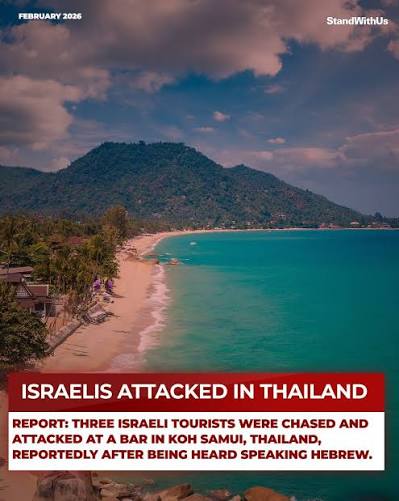
Thailand has faced a related debate. Koh Phangan, long associated with backpackers and full moon parties, has attracted a sizeable Israeli community alongside visitors of many other nationalities. During 2025, Thai authorities carried out raids and arrests as part of a wider investigation into foreign controlled businesses using Thai nominees to evade ownership restrictions. Israeli nationals were among those arrested in cases involving allegedly illegal tourism operations, although the national crackdown was not limited to Israelis. Thai reporting in October 2025 described arrests connected to suspected nominee companies and unauthorised work.
A separate confrontation became notorious after an Israeli tourist, asked to remove her shoes at a cafe, was filmed saying that her money built Thailand. She later apologised and said the clip did not show the aggression she had experienced. The exchange nevertheless resonated because it condensed the fear present in many tourist destinations: that communities have become economically dependent on visitors who then speak as though payment has purchased authority over the host society.
Badly behaved tourists come from every continent, and Thailand’s more recent tightening of visa rules has been justified by officials as a response to crimes and illegal work by foreign nationals generally, not one nationality. The distinction matters. Collective bans on Israelis, exclusion from businesses solely because of nationality, or threats against Jewish institutions would replace enforcement with discrimination.
The legitimate demand is simpler and stronger: the same law must apply to the visitor as to the resident, regardless of the visitor’s passport, religion, military history or purchasing power.
Liberal Israelis seek another home
The second form of outward movement examined by the film is quieter and more affluent. It involves secular, educated Israelis who believe their country is becoming authoritarian and are building lives elsewhere.
The movement accelerated during the 2023 campaign against Benjamin Netanyahu’s judicial overhaul. Hundreds of thousands of Israelis joined demonstrations, warning that government plans to weaken the judiciary threatened the separation of powers. After the Hamas led attacks of 7 October 2023, which killed about 1,200 people in Israel and led to the capture of 251 hostages, war and insecurity added new reasons to leave. The devastation subsequently inflicted on Gaza, the expansion of far right power and the deepening religious and secular divide have further fractured Israeli society.
An October 2025 Knesset discussion warned of a “tsunami” of departures. According to figures cited by the committee, approximately 82,800 Israelis left for extended periods in 2023, an increase of 44 per cent on the previous year, while the number returning after long stays declined. The emigrants are disproportionately likely to be educated, secular professionals whose departure raises fears of economic and democratic decline.
The Valsesia valley in Italy’s Piedmont region has become a symbol of this exodus. Surrounded by forested Alpine slopes and communities affected by ageing and depopulation, the valley offered what many Israeli families wanted: quiet, affordable property, schools for their children and distance from permanent war.
Progetto Baita was established in 2022 by Ugo Luzzati, an Italian born Israeli who had lived in Israel for 38 years before returning to the area. The initiative helps families relocate and integrate in towns including Varallo and Borgosesia. Reports published at different stages have counted between 50 and more than 80 families, with hundreds of additional people expressing interest. Some newcomers have bought and restored empty stone houses, enrolled their children in local schools and learned Italian. Local supporters say the arrivals have revived communities threatened by population loss.
On those facts, “colony” is an inaccurate legal and political description. The families entered Italy through its immigration system, purchased property from willing owners and moved with the support of local authorities. They did not arrive behind an army, expel the existing population or establish a separate sovereign authority. Those distinctions separate migration from colonial settlement and should not be blurred.
Yet the language surrounding the project exposes a political contradiction. Luzzati has spoken of “good people” leaving Israel as its democracy collapses. Several emigrants portrayed themselves as guardians of a liberal Zionist ideal betrayed by Netanyahu and the religious right. Their account begins with the crisis of 2023, rather than with the decades during which Palestinians lived without equal political rights under occupation.
For Palestinians, the idea that Israeli democracy has only recently begun to fail is difficult to accept. A state can provide elections, courts and civil liberties for one population while maintaining military rule, land seizure and unequal legal systems over another. Liberal Israelis may sincerely oppose Netanyahu while leaving the structure that privileged them largely unexamined. They are not transplanting a West Bank settlement by moving to Italy, but they may carry with them a political narrative in which their own loss of comfort marks the beginning of the crisis.
The Valsesia story also demonstrates the danger of turning that critique against people. In June 2026, Varallo mayor Pietro Bondetti received an anonymous letter containing a bullet. It threatened him, Luzzati and officials who supported Progetto Baita, and warned against the arrival of more Israeli families. Italian authorities opened an investigation. Nothing about opposition to Zionism, Israel’s conduct in Gaza or selective migration can justify a death threat. Political criticism loses its legitimacy when it treats civilians as targets because of national or Jewish identity.
Property, power and the eastern Mediterranean
Greece and Cyprus occupy a more complicated position because private movement is accompanied by deepening state and military relationships.
Israeli buyers have become prominent in sections of the Greek property market, particularly in Athens and Thessaloniki. Greece offers proximity, lower property prices than Israel and routes to residence for qualifying investors. Cyprus has likewise attracted Israeli residents, businesses and property purchases, provoking debate about affordability, sovereignty and the emergence of socially separate enclaves.
Property purchases by foreigners are not unique to Israelis and are not automatically a territorial project. London, Lisbon, Athens and coastal communities across Europe have all been reshaped by international capital. The central issues are familiar: whether local people are priced out, whether planning laws are enforced, whether investment benefits the wider community and whether new residents integrate.
What makes the eastern Mediterranean politically distinctive is the strategic alliance surrounding the money. Israel, Greece and Cyprus have expanded cooperation in energy, defence procurement and military training. Their 2026 joint action plan includes exercises, training and strategic dialogue, while Reuters reported that air and naval drills would increase during the year. Private property flows therefore sit beside a state relationship that gives Israel growing military reach and diplomatic depth in the region.
It is this combination, rather than the nationality of an individual homebuyer, that deserves scrutiny. Capital can alter a town without formal conquest. Defence agreements can change sovereignty without moving a border. A wealthy mobile population can build institutions designed around itself while poorer residents bear rising costs. None of those outcomes is inevitable, but each requires transparent regulation and democratic consent.
The border Palestinians cannot cross
The most revealing comparison is ultimately not between one rude tourist and one violent settler. It is between two radically unequal systems of movement.
An Israeli citizen can complete military service, fly to India, open a business if the law permits, seek another passport, buy a house in Italy or invest in Greece. If Israel becomes too dangerous, too religious or too authoritarian, those with money and foreign connections can construct a “Plan B”. Their mobility is treated as an individual choice and often welcomed as investment.
A Palestinian displaced from a village now occupied by an Israeli settlement may be unable to return to the land from which the family was expelled. A resident of the West Bank can be prevented from using roads built through the territory. A person in Gaza may be unable to leave a devastated enclave even for urgent medical treatment. Palestinian refugees scattered across the region remain denied the return claimed as an inherited right by Jewish people from anywhere in the world.
This is the asymmetry that gives Uncivilized’s film its force. The people most able to leave the consequences of Zionism are often those who benefited from the state it built, while the people dispossessed by that project remain enclosed by it.
The film goes too far when it turns that structural indictment into a description of Israelis as a single type of person. No ideology is carried in blood or “DNA”, and no passport proves an intention to dominate. Israelis include anti occupation activists, conscientious objectors, Palestinian citizens, refugees, dissidents and people whose views have changed through experience. Jewish identity cannot be made a synonym for the policies of the Israeli state.
The sharper conclusion is that political systems train habits, distribute privileges and shape what their citizens imagine to be normal. A society organised around prolonged military occupation may normalise force, securitisation and the testing of limits. A state founded on preferential immigration for one people may make the portability of belonging appear natural to those it privileges. A global economy eager for tourists and capital may then reproduce that inequality far from its point of origin.
Settler politics can travel through money, institutions, military agreements and assumptions about whose movement matters. That is a legitimate subject for investigation. The answer is not collective hostility, but equal law, local democratic control and a refusal to let wealth or geopolitical protection place any visitor above the community receiving them.
The central question is therefore not whether every Israeli abroad remains a settler. It is whether the international system will continue to protect the mobility of those shaped by occupation while denying mobility, property and political rights to the people living beneath it. Until that inequality is confronted, disputes in a Himalayan village, a Thai cafe, a Philippine surf town or an Italian valley will continue to echo a conflict whose borders were never as contained as the map suggested.