
Two years after Gaza’s British-administered cemeteries were described as the burial grounds Israel had left alone, the official record now says around one-third of each site has suffered extensive structural damage. Poland’s Foreign Ministry says the whole Gaza War Cemetery was ultimately incorporated into the Israeli control zone. Beneath the churned soil, the fate of the dead remains unresolved. Beyond its walls, UNESCO has verified damage to 164 cultural sites spanning more than five millennia.
| ≈ one third of each Commonwealth cemetery estimated to have extensive structural damage | 164 cultural sites with damage verified by UNESCO through 24 March 2026 | 82% of all Gaza structures damaged in UNOSAT’s 16 June 2026 assessment |
|---|
A cemetery that once seemed untouchable
For almost a century, rows of pale Commonwealth headstones stood behind high walls in al-Tuffah, eastern Gaza City, in the care of a Palestinian family whose work survived revolt, occupation, repeated wars and long political estrangement. The cemetery belonged administratively to the Commonwealth War Graves Commission, but its daily guardians were Gazans. They watered the lawns, repaired shell damage and preserved the different religious symbols of soldiers who had arrived in Palestine from several continents and never left. [1, 2, 3, 5]
That history gave the site a peculiar moral force. On 26 June 2024, Middle East Eye described Gaza’s British cemeteries as “the only ones Israel isn’t destroying”. The headline captured a real and disturbing contrast at that moment: Palestinian burial grounds had already been bulldozed or excavated, while the two manicured Commonwealth sites appeared comparatively intact. The exception did not last. [1, 19, 25]
The CWGC’s live status page now says that “currently we estimate around a third of both Gaza War Cemetery and Deir El Balah War Cemetery have suffered extensive structural damage”. It also records significant structural impact at the adjoining Egyptian cemetery in Deir el-Balah. This is the clearest current official summary, and it changes the story’s central fact. The institution that maintains the graves no longer describes isolated wartime wear. It describes damage to a substantial part of all three commemorative landscapes. [2]
| “I feel a sorrow like that of a child who has lost his mother.” Essam Jaradah, long-serving Palestinian caretaker of Gaza War Cemetery [5] |
|---|
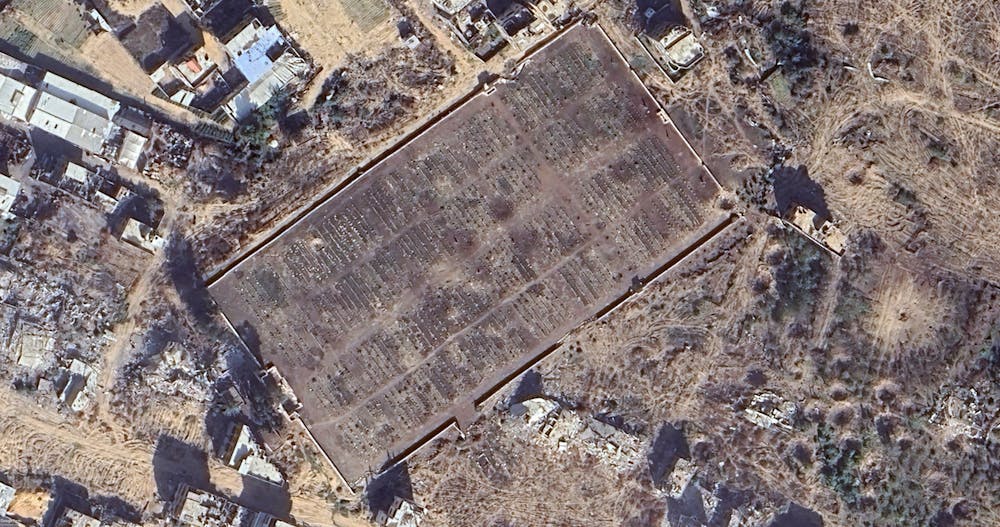
Jaradah told the Guardian that he had witnessed two phases of bulldozing. Satellite imagery showed that rows of headstones in the southern corner had disappeared, topsoil had been churned and a substantial earth berm had been raised across the affected ground. The earthworks were absent in March 2025, visible by 8 August and clearer by 13 December. The damaged area included more than 100 Second World War graves, predominantly Australian alongside British and Polish dead, as well as four First World War sections described as overwhelmingly British. [5]
A cemetery is more than the stones visible from above. Headstones can be replaced from registers and photographs. Once excavators cross a burial horizon, the central question becomes whether bones, coffins, identity markers and the spatial relationship between a named stone and a human body have survived. That answer is not available. There has been no forensic ground survey, no plot-by-plot register of displaced remains and no safe return for the custodial team. [2, 5, 6, 7]
Who lies beneath the damaged ground
Gaza War Cemetery was formed after the three Battles of Gaza in 1917 and completed by 1920. The official register records 3,217 Commonwealth burials from the First World War, including 781 unidentified dead; 210 Commonwealth burials from the Second World War; 30 post-war burials; and 234 graves of other nationalities. Together they make 3,691 burials. The stones compress the military and imperial history of the early twentieth century into a few acres beside the Salah al-Din road. [3]
The largest national group is British. The cemetery also contains Australians, Indians, New Zealanders, Canadians and South Africans, along with Polish, Ottoman Turkish, Greek, Egyptian, German, French and Yugoslav dead. Widely cited national breakdowns include 263 Australians, 50 Indians, 23 New Zealanders, 23 Canadians, 36 Poles and 184 Ottoman Turkish graves. Exact nationality totals should be read with the CWGC register because some summaries combine wars, burials and commemorations differently. [3, 6, 11, 24]
The cemetery is also multifaith. Christian dead include Anglican, Presbyterian and Roman Catholic service traditions, alongside other Protestant identities. Jewish personnel are marked by individual headstone symbolism. Indian sections and memorials represent Hindu, Sikh and Muslim service personnel, while Muslim dead also include Commonwealth soldiers and Ottoman troops. Nationality is not a substitute for religion: no British, Indian, Canadian or Ottoman grave should be assigned a denomination without its register entry, emblem or memorial record. [2, 3, 4]
The post-war layer is especially exposed. A separate plot commemorates 22 Canadian members of the United Nations Emergency Force who died between 1956 and 1967, while eight Indian personnel are commemorated in the Indian section. Images reviewed by CWGC in 2026 showed a new road cutting through or immediately affecting those areas outside the main southern wall. The commission dated the apparent new damage to between 5 and 16 April 2026 and said it could not determine from satellite imagery whether burials had been disturbed. [2, 9]
Australian officials told a Senate estimates hearing that 146 of the cemetery’s 263 Australian graves might have been affected, a provisional figure equal to about 56 per cent. A broader planning assessment reported in Australia put the number of graves affected across the two Commonwealth cemeteries at 818 and named dead from the United Kingdom, Australia, New Zealand, Poland, Canada, India, Greece and Germany. Neither figure is a final grave-by-grave count, because neither rests on a complete physical inspection. [6, 8]
| “It is not currently considered safe to access these cemeteries and this may remain the case for some time.” Australian Department of Veterans’ Affairs, 18 February 2026 [7] |
|---|
At Deir el-Balah, established in March 1917 and used through the First World War campaign, CWGC records 724 Commonwealth burials and a small group of other-nationality war graves. Its Indian section includes 64 casualties commemorated on panels. The current damage notice describes harm to boundary walls, trees, bushes and the staff base, damage to about ten per cent of the headstones, and damage to the Hindu, Sikh and Muslim memorials. The adjacent Egyptian cemetery, associated with Egyptian personnel of the First World War, has also sustained significant structural impact. CWGC educational records list 732 Egyptian war graves there, adding an Arab and North African commemorative population to the damaged sites. [2, 4, 27]
These percentages describe different categories. The commission’s estimate that roughly one-third of each cemetery has extensive structural damage does not mean that one-third of all graves is confirmed destroyed. At Deir el-Balah, the site-specific notice still gives approximately ten per cent of headstones as damaged. One figure concerns the structural footprint; the other concerns marked graves. Conflating them would exaggerate what is known while obscuring what remains dangerously unknown. [2]
What the satellite images establish
The evidence is strongest at the surface. Bomb craters surrounded the Gaza cemetery. Inside its southern corner, mechanical clearance removed ordered rows, displaced soil and formed a berm. Later imagery showed further damage along the southern border and a new road affecting the Canadian UN plot and Indian section. Damage to boundary walls, the staff house, the maintenance base, vegetation and several memorial areas had already been reported. The 54th East Anglian Division, Hindu, Muslim and Turkish commemorative areas were among those affected. [2, 5]
The evidence is weakest below the surface. Satellite sensors cannot identify bone fragments or determine whether a grave shaft remains intact beneath a road. Australian officials have said disturbance is possible; campaigners and some parliamentarians consider it likely in the most heavily excavated plots. The CWGC’s controlling position remains narrower: it cannot determine whether burials were disturbed until a competent team enters safely. [2, 6, 8]
Israel has offered several military explanations. The IDF told the Guardian that the area had been an active combat zone, that militants had taken cover near the cemetery and that underground infrastructure had been identified and dismantled. Israel’s ambassador in Warsaw later told Poland’s Foreign Ministry that the devastation was unintentional and an accidental effect of combat and bombardment. These are assertions, not a published evidentiary case. [5, 40]
For the avoidance of doubt, Israel has never provided publicly testable evidence for the cemetery-specific claims on which it relies. It has released no tunnel survey, coordinates, weapons recovery, imagery of fighters operating from the graves, engineering plan, target file, proportionality assessment or record of precautions taken to protect the dead. British ministers have repeated reports of Hamas military use, and one minister attributed damage to both Israeli operations and Hamas fighters, but neither answer supplied evidence. [31, 33]
There is, however, later visual evidence that Israeli forces conducted underground demolition at the cemetery. CBC’s visual investigations team geolocated an IDF video showing a chain of subsurface explosions at the site, including at the Canadian peacekeepers’ plot. An officer from the IDF’s 401st Brigade said troops excavated 20 to 30 metres below the cemetery to destroy a tunnel and that no precautions were taken to protect human remains. Dust rising along underground lines supports the presence of passages or blast paths. It proves excavation and detonation occurred; it does not establish who built or used every passage, when it was used, whether it created an imminent threat, why the chosen method was necessary, or whether the surface destruction was proportionate. [42]
The distinction matters legally and journalistically. The bulldozing, road construction and subsurface detonations were deliberate physical operations, even if Israel disputes any intention to desecrate graves. A military objective can lose the protection normally attached to civilian or cultural property while it is used militarily, but that does not remove the duties of distinction, proportionality and feasible precautions. A legal conclusion would require the operational records Israel has not released and the forensic access it continues to prevent. [20, 21, 22, 40, 42]
Is the cemetery inside the moving Yellow Line?
| THE PRESENT-DAY FINDING Poland’s Foreign Ministry reported in April 2026 that the entire Gaza War Cemetery had been incorporated into Israel’s control zone. Later imagery and the CWGC’s continuing exclusion are consistent with that official account. The precise mapped boundary may move, but the cemetery remained outside custodial and independent access at the cut-off. Deir el-Balah was also extensively damaged, although its relationship to the latest control boundary was not publicly fixed. [2, 14, 15, 40, 42] |
|---|
The strongest public official answer is now yes. In a formal reply to Polish MP Marta Stożek on 24 April 2026, Poland’s Foreign Ministry said the Yellow Line initially divided the cemetery between Hamas and Israeli control, but that “ultimately the entire cemetery area was incorporated into the Israeli control zone”. The ministry added that Israel still barred foreign nationals, including Polish diplomatic staff, from entering Gaza, making independent verification difficult. [40]
By 23 June 2026, after successive shifts, OCHA calculated that the Orange Line placed 64.9 per cent of Gaza under tighter and more direct Israeli control. Between 10 October 2025 and early April 2026, the UN human rights office verified the killing of 196 Palestinians in Israeli attacks reported near the Yellow Line, including 18 women and 43 children. The line is therefore not simply cartography. It is a lethal and movable access regime, marked imperfectly on the ground and capable of changing the condition of a site without notice to its owners or custodians. [14]
The Polish answer turns an earlier high-confidence inference into the clearest available government statement about the site’s control status. Later satellite imagery showed further road and berm construction at the Canadian and Indian plots between 5 and 16 April 2026. The CWGC’s 25 June update said it remained unable to enter or protect the site. OCHA’s August reporting recorded continuing military activity and further movement of access markers. Nothing in the latest public record shows that the cemetery returned to civilian, Palestinian custodial or CWGC control. [2, 15, 40, 42]
The phrase “inside the Yellow Line” still requires care because the line is mobile, loosely marked and supplemented by an Orange Line that imposes even broader coordination restrictions. The defensible present formulation is that the entire Gaza War Cemetery was officially reported inside Israel’s control zone in April 2026 and remained inaccessible to its custodians and international inspectors in the CWGC’s latest June update. Deir el-Balah’s precise relationship to the newest control boundary is not publicly fixed. [2, 14, 15, 40]
That enforced uncertainty is itself part of the current status. The CWGC says: “It is unlikely we will be able to enter Gaza for some time and are not able to protect the sites from further damage.” A restoration promise exists, but protection in the present tense does not. The longer the sites remain under armed control and beyond forensic access, the greater the risks from earthworks, explosives, weather, vegetation loss, theft and disappearance of the spatial evidence needed to identify disturbed graves. [2]
The Commonwealth sites were never the whole story
The original 2024 contrast was morally powerful because Palestinian cemeteries had already been damaged on a far wider scale. A CNN investigation published in January 2024 identified at least 16 cemeteries affected by Israeli military operations, with destroyed stones, upturned soil, armoured-vehicle tracks and, in some locations, exposed bodies. At Bani Suheila in Khan Younis, an Associated Press journalist saw a demolished Islamic cemetery and mosque and a pit approximately 140 metres wide leading to what the Israeli military described as a Hamas tunnel. Israel also said it had searched some cemeteries for the remains of hostages taken on 7 October 2023. [19, 25]
The comparison is no longer between Palestinian graves destroyed and foreign graves spared. It is between different stages and forms of damage: Palestinian family cemeteries excavated, crossed by military roads or converted into positions; Commonwealth plots bulldozed and structurally damaged; an Egyptian cemetery struck; and unidentified human remains still being recovered from the rubble of homes more than two years after the attacks that killed them. [2, 15, 19, 25]
On 4 August 2026, Gaza held a collective funeral for 112 bodies recovered from a residential block in al-Sabra that had been struck in November 2023. Palestinian Civil Defence said the dead included 40 children, 38 women and seven people with disabilities, while 157 other people believed killed in the same incident remained missing. The scene joined two kinds of uncertainty: graves whose bodies may have moved, and bodies that have not yet reached a grave. [15]
A five-thousand-year archive reduced to rubble
The war cemeteries now sit inside a much larger destruction of the built record. UNESCO’s most recent public assessment, updated on 25 March 2026, verifies damage to 164 cultural sites since 7 October 2023. The total comprises 14 religious sites, 128 buildings of historical or artistic interest, three repositories of movable cultural property, nine monuments, two museums and eight archaeological sites. Of the 164, 153 are in Gaza Governorate, five in North Gaza, one in Rafah, two in Deir al-Balah and three in Khan Younis. [13]
The figure is a minimum. UNESCO combines satellite monitoring with on-site assessment where security permits. Remote sensing can identify a collapsed roof or new crater more readily than scorched manuscripts, looted objects, vibration damage, mixed archaeological strata or the slow failure of an unsupported wall. The list also lags later events. At the same time, inclusion proves damage, not deliberate targeting, the identity of the attacker in every case or the legal absence of military necessity. [13]
The damaged record is not confined to one nationality or faith. It includes Sunni mosques and Sufi shrines, a Greek Orthodox compound, Gaza’s Roman Catholic parish, Byzantine Christian churches and mosaics, a bath whose name preserves Samaritan Jewish memory, Palestinian family houses, markets, cinemas, music institutes and museums, and archaeological sites shaped by Canaanite, Egyptian, Persian, Greek, Roman, Byzantine and early Islamic worlds. The Commonwealth cemeteries add British, Australian, Canadian, Indian, New Zealand, South African, Polish, Ottoman Turkish and other European or regional dead, marked in Christian, Jewish, Muslim, Hindu and Sikh traditions. [2, 3, 4, 13, 16, 23]
| “Every stone tells a story.” Hamuda al-Dahdar, Palestinian architect and heritage specialist [18] |
|---|
At the Great Omari Mosque, one building embodied much of that layering. A fifth-century Byzantine church preceded a seventh-century mosque; a Crusader cathedral was dedicated in 1149; Mamluk rebuilding reshaped the complex from the thirteenth century and was substantially complete by 1340; restoration followed the First World War. An Israeli strike on 7–8 December 2023 left the complex largely ruined and destroyed its minaret. Israel said a tunnel and militant infrastructure were associated with the site; Palestinians disputed that account. Workers later began sorting rubble and rescuing manuscripts with basic tools. [13, 18]
The Israeli military told Reuters that cultural sites were “treated with the utmost sensitivity by the IDF” and said strikes presenting a risk to such places underwent a rigorous approval process. The visible record is nevertheless one of exceptional loss. Pasha Palace, with a Mamluk core dating to about 1260–1277, was reduced to fragments; the 1661 As-Saqqa Palace was destroyed; the fourteenth-century al-Qissariya market was severely damaged; Hamam As-Sammara, restored in 1320, was almost entirely destroyed; and the Rashad Ash-Shawwa Cultural Centre, built between 1985 and 1988, was reported destroyed. [13, 18]
Christian heritage has also been struck. At Saint Porphyrios, where an earlier church was founded around 425 and much of the present fabric dates to the Crusader period, an Israeli strike on 19 October 2023 collapsed a building in the compound and killed civilians sheltering there. Gaza’s Holy Family Church, completed in 1965 and belonging to the Roman Catholic Latin Patriarchate, suffered compound and school damage before tank fire struck the church on 17 July 2025, killing three people. The Byzantine Church of Jabalia, established by 444, lost protective structures, though important mosaics were later reported to have survived. [13]
Some sites are valuable precisely because they resist a single modern identity. Anthedon Harbour preserves occupation from about 800 BCE to 1100 CE across Neo-Assyrian, Babylonian, Persian, Hellenistic, Roman, Byzantine and early Islamic phases. Tell es-Sakan reaches back to roughly 3300 BCE; Tell el-Ajjul to the second millennium BCE. Gaza’s Roman cemetery, rediscovered in 2022, yielded 135 graves and rare lead sarcophagi before war reached the area. Damage to such sites is not only the loss of stone. Earthmoving can destroy the relationships between layers that make archaeology intelligible. [13, 23]
One place requires a different description. Saint Hilarion/Tell Umm Amer, founded in the fourth century and associated with one of the earliest monastic communities in the Holy Land, was placed on both the World Heritage List and the List of World Heritage in Danger in July 2024. UNESCO said states were “committed to avoid taking any deliberate measures likely to cause direct or indirect damage” to it. The monastery is a threatened survivor rather than one of the 164 verified damaged sites. That distinction shows that protection is still possible, but only if access, monitoring and restraint are real. [16]
Selected historic sites: dates, identities and damage
| Site | Construction / use date | Nationality, faith or tradition | Best-supported status |
|---|---|---|---|
| Great Omari Mosque | Fifth-century Byzantine church; seventh-century mosque; Crusader cathedral dedicated 1149; Mamluk rebuilding largely complete by 1340 | Sunni Muslim sanctuary with Byzantine Christian, Latin Crusader, Mamluk and Ottoman layers | Largely ruined after the Israeli strike of 7–8 December 2023; minaret destroyed; salvage and stabilization begun |
| Saint Porphyrios complex | Earlier church c. 425; present fabric substantially c. 1150s–1160s; renovated 1856 | Greek Orthodox Palestinian Christian | Compound building collapsed in an Israeli strike on 19 October 2023; sanctuary reportedly survived; UNESCO verifies damage |
| Holy Family Church | Parish church completed 1965; school founded 1974 | Roman Catholic, Latin Patriarchate | Compound and school damaged; tank fire struck the church on 17 July 2025, killing three people |
| Ibn Othman Mosque | 1399–1400 to 1430–1431 | Sunni Muslim; Mamluk | Reported destroyed in an Israeli airstrike on 3 July 2024; UNESCO verifies damage |
| Ali Ibn Marwan mosque and shrine | Fourteenth century; minaret inscription 1370–1371 | Sunni Muslim and Sufi | Bombed in October 2023; UNESCO lists damage to mosque and shrine separately |
| Al-Mahkama minaret | c. 1455 | Sunni Muslim; Mamluk | UNESCO verifies damage; precise survival awaits survey |
| Pasha Palace Museum | Mamluk core c. 1260–1277 | Palestinian national museum; later secular institution | Only portions of wall and an arch remained after bombardment; heritage workers estimated roughly 70 per cent damage |
| As-Saqqa Palace | 1661 | Ottoman-period Palestinian merchant house | Destroyed in an Israeli airstrike on 9–10 November 2023 |
| Hamam As-Sammara | Mamluk restoration inscription dated 1320 | Public bath preserving Samaritan Jewish memory within later Muslim Palestinian urban life | Almost entirely destroyed in Israeli bombardment in December 2023 |
| Al-Qissariya gold market | Fourteenth century | Mamluk Palestinian civic and mercantile | Severely damaged in December 2023 and reportedly struck again in July 2024 |
| Rashad Ash-Shawwa Centre | Built 1985–1988 | Secular Palestinian library, theatre and civic forum | Reported destroyed by an Israeli strike on 25 November 2023 |
| Anthedon Harbour | Occupied c. 800 BCE–1100 CE | Neo-Assyrian, Babylonian, Persian, Hellenistic, Roman, Byzantine and early Islamic | UNESCO verifies damage; earthmoving and military use reported; subsurface survival unknown |
| Roman cemetery | First century BCE–second century CE; rediscovered 2022 | Roman-period funerary archaeology | Damaged early in the war; condition of the 135 excavated graves and deeper layers is uncertain |
| Tell es-Sakan | c. 3300–2200 BCE | Early Bronze Age Canaanite and Egyptian-connected | UNESCO verifies damage; no full ground survey |
| Tell el-Ajjul | c. 2000–1300 BCE | Middle and Late Bronze Age Canaanite and eastern Mediterranean | UNESCO verifies damage |
| Byzantine Church of Jabalia | Established by 444 CE; mosaics dated 548–549 and early eighth century | Byzantine Christian | Protective superstructure destroyed; important mosaics were later reported to have survived; UNESCO verifies damage |
| Qal’at Barquq | 1387–1388 | Mamluk fortified mosque and caravanserai | Historic Khan Younis centre devastated; surviving complex awaits survey |
| Saint Hilarion/Tell Umm Amer | Fourth century | Early Christian monastic | World Heritage in Danger; threatened survivor, not one of UNESCO’s 164 verified damaged sites at the March 2026 cutoff |
Status descriptions synthesize UNESCO’s verified inventory with reporting cited in the source list. “Damage verified” does not by itself establish intent or legal responsibility. [13, 16, 17, 18, 23]
The scale around the monuments
Heritage does not stand apart from the city around it. UNOSAT’s satellite assessment for 16 June 2026 found that 201,290 structures, an estimated 82 per cent of all structures in Gaza, had sustained damage. It classified 134,422 as destroyed, 13,848 as severely damaged, 28,096 as moderately damaged and 24,924 as possibly damaged. The assessment estimated 328,627 housing units affected. Compared with 11 October 2025, the total number of damaged structures had grown by 1.5 per cent and the number assessed as destroyed by nine per cent. [15]
The destruction continued after the ceasefire announcement. OCHA reported daily military activity through the end of July and early August. According to the Gaza Ministry of Health figures cited by OCHA, 1,254 Palestinians were killed, 4,121 injured and 804 bodies retrieved between the 10 October 2025 ceasefire announcement and 5 August 2026. These are attributed figures, not an independently reconstructed casualty database, but they establish that “ceasefire” did not mean an end to death, demolition or physical change. [15]
The named cultural sites are therefore the visible points in an overwhelmingly altered landscape. A mosque can be rebuilt in outline, a headstone recut and a façade reassembled. What cannot easily be restored is original material, archaeological context, a manuscript collection, the continuity of a neighbourhood or the confidence that the body beneath a marker is still the person named on it. [2, 13, 15]
Law, accountability and the word “impunity”
Cemeteries, churches, mosques, monasteries and historic buildings are protected under several overlapping bodies of international humanitarian law. The 1954 Hague Convention and its protocols protect cultural property. Customary IHL prohibits attacks on buildings dedicated to religion and historic monuments unless they have become military objectives, and requires special care around cultural property. The Rome Statute criminalises intentionally directing attacks against buildings dedicated to religion, art, science or charitable purposes and historic monuments when they are not military objectives. [20, 21, 22]
Those rules do not make every damaged monument an adjudicated war crime. Criminal responsibility depends on evidence of the object attacked, its use at the time, the attacker’s knowledge and intent, military advantage, proportionality and precautions. UNESCO’s 164-site inventory is a damage assessment, not a judicial finding. Israeli claims of Hamas use must be tested rather than presumed true or dismissed without evidence; Palestinian and independent accounts of destruction must likewise be attached to dates, imagery, witnesses and site records. [13, 18, 20, 21, 22]
The genocide context
The cemeteries were damaged within Israel’s wider military campaign against Gaza, which the UN Independent International Commission of Inquiry concluded in September 2025 constituted genocide against Palestinians in the Strip. Israel rejected that conclusion and continues to deny genocide. The International Court of Justice has issued binding provisional measures but, as of 12 August 2026, has not delivered a final judgment on the merits of South Africa’s genocide case. The distinction is important: there is a formal UN investigative finding of genocide, but no final ICJ merits judgment. [44]
Destruction of graves and heritage does not by itself prove genocidal intent, yet it belongs to the evidentiary context in which intent is assessed: the destruction of homes, life-sustaining infrastructure, cultural institutions, religious buildings, archives, archaeological strata and places where the dead are remembered. The damage to foreign soldiers’ graves is not the measure of Palestinian suffering. It is one internationally legible part of a far broader assault on Gaza’s people and physical memory. [13, 15, 25, 44]
The word “impunity” describes an accountability outcome, not simply the magnitude of damage. As of 12 August 2026, there is no published cemetery-specific criminal judgment, no completed independent forensic investigation, no public Israeli engineering dossier, no disclosed investigation promised by President Isaac Herzog and no final compensation settlement. Israel controls the ground while the CWGC, diplomats, independent journalists and forensic specialists remain excluded. That combination of deliberate physical action, withheld operational evidence, denied access and absent accountability is why the language of impunity is now difficult to avoid. [2, 36, 40, 42]
| “Brave servicemen laid to rest overseas should never have had their graves defiled in this way.” Hamish Falconer, UK Foreign Office minister, written parliamentary answer, 13 February 2026 [11] |
|---|
In the House of Commons on 16 March, Armed Forces Minister Al Carns said he was “absolutely dismayed” by reports of damage from Israeli operations and Hamas fighters and confirmed that concerns had been raised with the Israeli authorities. The government promised to support CWGC assessment and repair when safe. The statement condemned defilement, but it did not announce an independent investigation or a mechanism to compel access. [12]
Questions in Westminster, Canberra, Warsaw and Ottawa
The British government had been formally warned about the cemeteries long before the most dramatic satellite images became public. Labour MP James Naish asked on 4 February 2025 what Britain was doing with international partners to assess and protect Gaza War Cemetery and Deir el-Balah. Defence Minister Al Carns answered on 12 February that both had suffered extensive damage, including to about ten per cent of headstones, but that a detailed assessment could not be made. Naish asked again on 29 August; the 8 September answer repeated the same position. [28, 29]
On 5 February 2026, during a Commons debate on Britain’s obligation to assess genocide risk, Fleur Anderson told ministers that her grandfather had fought in Palestine and asked whether the government would condemn reports that the IDF had destroyed allied graves. Middle East minister Hamish Falconer replied, “I would,” adding that Private William Jordan and Private Wilfred Ogden from his Lincoln constituency had had their graves defaced. [30]
Independent MP Ayoub Khan then asked what discussions the Foreign Office had held with Israel, the CWGC and the Royal British Legion. Falconer’s written answer on 13 February named the United Kingdom, Australia, Canada, India, New Zealand, Poland and South Africa, described “justifiable distress”, and said foreign servicemen should never have had their graves defiled. The Lord Bishop of Southwark separately asked what representations had been made to Israel about repairs; the Lords answer reproduced Falconer’s response. [31, 32]
On 16 March, Labour MP Yuan Yang told the Commons that satellite imagery showed more than 100 allied graves destroyed with heavy machinery and asked what Britain would do to prevent further destruction. Carns said he was “absolutely dismayed” and that Britain had raised concerns with Israel. He attributed damage to both Israeli operations and Hamas fighters, but supplied no evidence for the Hamas attribution and announced no independent investigation or mechanism to compel access. [33]
Australia’s Parliament pursued the issue more aggressively. Senator David Pocock opened Senate estimates questioning on 12 February by referring to the “desecrated war graves in Gaza”. Foreign Minister Penny Wong said the graves were of great national importance, while Prime Minister Anthony Albanese raised them directly with Israeli President Isaac Herzog. Herzog promised to check with officials after returning to Israel; no public report of that investigation had appeared by 12 August. [35, 36]
The Australian Department of Veterans’ Affairs confirmed on 18 February that both cemeteries had suffered extensive damage, including Australian graves, and said the full extent could not be accurately assessed without safe access. Later Senate evidence put 146 of 263 Australian graves potentially within affected areas, about 56 per cent. Major General Wade Stothart, director of the Office of Australian War Graves, said it was “quite possible” that bodies had been disturbed, moved or damaged, while stressing that direct proof required an on-site survey. [34, 37]
Further Australian estimates hearings in June examined new imagery showing additional April 2026 damage to the Canadian and Indian plots. Senators asked who would pay, what Australia had demanded of Israel and why restoration was still only a future promise. Officials reiterated concern but could not provide access, a grave-by-grave account or a timetable for repair. [38]
Poland’s response is the most specific official intervention by another affected European state. MP Marta Stożek’s written question of 10 April asked whether Israel had been formally required to rebuild the cemetery, whether Poland had received explanations or an apology, and what action had been taken for 36 Polish Second World War graves. The Foreign Ministry’s 24 April answer confirmed that the Polish area had been levelled, probably with heavy equipment, alongside about 100 British and Australian graves, and that the Canadian UN plot had been completely destroyed. It also disclosed a meeting with Israel’s ambassador, who said the damage was accidental, and confirmed that the entire cemetery had entered Israel’s control zone. [39, 40]
Canada’s Global Affairs department said on 9 February that it was deeply concerned and in contact with the CWGC. A June CBC investigation then showed the 22-member Canadian peacekeepers’ plot destroyed by explosions, earthmoving and later road construction. Canadian officials declined to disclose what they had demanded from Israel. A search of Canada’s indexed parliamentary record found no post-destruction cemetery-specific question comparable to those in Britain, Australia or Poland by the evidence cut-off. [41, 42]
New Zealand’s official record is thinner. An April 2024 information release recorded 23 New Zealand First World War graves and said the NZDF had no management responsibility for CWGC cemeteries. No later indexed parliamentary question addressing the 2025–2026 destruction was found by the cut-off. Nor was a cemetery-specific parliamentary intervention located in the indexed national records of India or South Africa, despite their dead and memorial traditions being represented at the damaged sites. This is a statement about the searchable public record, not proof that no private diplomatic contact occurred. [43]
There is a historical precedent for state-to-state remedy. Israel paid compensation after earlier damage to Gaza War Cemetery in 2006, and hundreds of stones were repaired following shelling in 2008–2009. The present task is vastly larger. A 2024 estimate placed cemetery reconstruction at about £5 million before the later bulldozing and road works. For Gaza’s broader heritage, UNESCO had mobilised $5.7 million in emergency assistance by April 2026 and called for $116.5 million, while a Palestinian recovery plan reported by Reuters carried an initial price of about $133 million. [17, 18, 24]
What must happen before restoration can begin
The first requirement is not new stone. It is protection of the evidence that remains. The cemetery boundaries, road cuts, berms, disturbed soil and surviving markers should be frozen from further change, mapped at high resolution and compared with pre-war plot plans. Any excavation should be conducted by forensic archaeologists with CWGC, national war-grave authorities, Palestinian experts, religious representatives and the International Committee of the Red Cross able to observe. [2, 20, 21]
The second requirement is a transparent grave register. Every affected plot should be given a status: headstone intact, headstone moved, grave shaft apparently intact, grave shaft crossed by excavation, remains recovered, remains unidentified or condition unknown. Families should be told what is known and what is not. The same dignity and notification principles should apply to Palestinian families whose cemeteries were excavated or whose relatives remain under rubble. [2, 6, 7, 15]
The third is disclosure. Military engineering logs could establish when and where excavators entered, how deep they dug, whether remains were encountered and what happened to them. Target and legal reviews could test the asserted military necessity. Satellite providers and heritage organisations should preserve the highest-resolution imagery and metadata before commercial archives change or disappear. [2, 5, 10]
Finally comes reconstruction, which cannot be credible if it restores only foreign graves while leaving the Palestinian dead and Gaza’s own historic fabric outside the moral frame. The Commonwealth cemeteries are multinational sites tended by Palestinians. Their repair should recognise both facts: the dead came from Britain, Australia, Canada, India, New Zealand, South Africa, Poland, the Ottoman Empire and elsewhere, while the century of care that made the landscape possible was Gazan. [1, 2, 3, 4]
The status today
On the evidence available on 12 August 2026, neither Gaza War Cemetery nor Deir el-Balah War Cemetery has vanished in its entirety. Both survive in damaged form. Around one-third of each is estimated to have extensive structural damage. At Gaza, southern First and Second World War plots, the Polish area, Canadian UN section and Indian area have been bulldozed, blasted or crossed by later road works. At Deir el-Balah, about ten per cent of headstones and the Hindu, Sikh and Muslim memorials are reported damaged. The adjacent Egyptian cemetery has significant structural impact. [2, 37, 40, 42]
Gaza War Cemetery is not merely likely to have fallen east of a moving map line. Poland’s Foreign Ministry reported that the whole site was ultimately incorporated into Israel’s control zone. Later imagery and the CWGC’s continuing exclusion are consistent with that account. The exact August boundary may move again, but the practical status is unchanged: the custodians cannot return, independent inspectors cannot enter and Israel can physically alter the site without contemporaneous outside scrutiny. Deir el-Balah remains inaccessible and vulnerable, although its relationship to the latest control line is less certain. [2, 15, 40, 42]
No one can yet say, responsibly, how many bodies were displaced. Israel has never supplied the public evidence needed to test its claims about cemetery-specific military use, necessity or precautions. What can be said is already grave enough: the exception identified in 2024 is over; the physical acts of bulldozing and detonation are documented; foreign military and Palestinian family burial grounds have both been damaged; UNESCO has verified 164 cultural sites affected; 82 per cent of Gaza’s structures were damaged by mid-June; and the institutions promising repair still cannot enter the ground they are meant to protect. [1, 2, 13, 15, 25, 40, 42]
For generations, the order of Gaza War Cemetery depended on a simple covenant: each stone marked a person, each plot had a place, and the living would keep faith with the dead. The stones can eventually be cut again. The harder question is whether the world will establish what happened beneath them, and whether Gaza’s own dead and damaged memory will be granted the same determination to identify, protect and restore. [2, 5, 15]
Source and verification notes
This feature is current through 12 August 2026. Citation numbers refer to the linked sources below. Official bodies are used for present status and headline statistics; journalism and witness accounts supply detail where access is restricted. Israeli military statements are reported as claims where underlying operational evidence is not public. UNESCO verification establishes damage, not intent or legal responsibility. The phrase “no evidence” refers specifically to the absence of a public, independently testable cemetery-specific dossier supporting Israel’s claims of military use, necessity and precautions; it does not deny the later visual evidence that Israeli forces excavated and detonated underground passages. Quoted passages are brief and attributed.
8. News.com.au, report on Australian Senate estimates evidence concerning Gaza war graves, March 2026.
11. UK Parliament, written answer UIN 111058, 13 February 2026.
12. UK House of Commons Hansard, oral answers on Gaza war graves, 16 March 2026.
13. UNESCO, “Impact on cultural heritage” in Gaza, updated 25 March 2026.
14. UN OCHA oPt, Humanitarian Situation Report, 26 June 2026.
15. UN OCHA oPt, Humanitarian Situation Report, 7 August 2026.
17. UNESCO, Gaza emergency recovery assistance and appeal, 17 April 2026.
18. Reuters, “Gazans race to preserve cultural heritage damaged in war,” 3 December 2025.
22. International Criminal Court, Rome Statute, current English text, accessed 12 August 2026.
23. Associated Press, report on Gaza’s Roman cemetery and 135 excavated graves, 23 September 2023.
25. CNN, “At least 16 cemeteries in Gaza have been desecrated by Israeli forces,” 20 January 2024.
26. Los Angeles Times, investigation of the moving Yellow Line, 9 August 2026.
28. UK Parliament, written answer UIN 28574, tabled 4 February and answered 12 February 2025. https://questions-statements.parliament.uk/written-questions/detail/2025-02-04/28574
29. UK Parliament, written answer UIN 71586, tabled 29 August and answered 8 September 2025. https://questions-statements.parliament.uk/written-questions/detail/2025-08-29/71586
30. UK House of Commons Hansard, debate on genocide risk assessment, including Fleur Anderson and Hamish Falconer on Gaza War Cemetery, 5 February 2026. https://hansard.parliament.uk/Commons/2026-02-05/debates/FDBD7A6E-012C-4157-BD1F-52F9EF48C666/occupied-palestinian-territories-genocide-risk-assessment
31. UK Parliament, written answer UIN 111058, tabled 4 February and answered 13 February 2026. https://questions-statements.parliament.uk/written-questions/detail/2026-02-04/111058
32. UK Parliament, House of Lords written answer HL14373, tabled 6 February and answered 13 February 2026. https://questions-statements.parliament.uk/written-questions/detail/2026-02-06/HL14373/
33. UK House of Commons Hansard, Yuan Yang and Al Carns on more than 100 allied graves, 16 March 2026. https://hansard.parliament.uk/commons/2026-03-16/debates/4FA7DC36-159E-49DE-8696-FD978A4E0C39/UnitedNationsCharter
34. Australian Department of Veterans’ Affairs, statement on damaged Australian war graves in Gaza, 18 February 2026. https://www.dva.gov.au/news/latest-stories/dva-statement-on-damaged-australian-war-graves-in-gaza
35. Parliament of Australia, Senate estimates hearing, Foreign Affairs, Defence and Trade Legislation Committee, 12 February 2026. https://www.aph.gov.au/Parliamentary_Business/Hansard/Hansard_Display?bid=committees%2Festimate%2F29372%2F&sid=0002
36. The Guardian, report on Prime Minister Anthony Albanese raising the graves with Israeli President Isaac Herzog, 12 February 2026. https://www.theguardian.com/australia-news/2026/feb/12/anthony-albanese-isaac-herzog-bulldozed-australian-war-graves-gaza
37. The Guardian, report on Australian Senate evidence concerning 146 graves and possible disturbance of remains, 15 March 2026. https://www.theguardian.com/australia-news/2026/mar/16/australian-soldiers-bodies-very-likely-disturbed-by-israeli-bulldozing-at-gaza-cemetery-senator-says
38. Parliament of Australia, Senate estimates hearing, Foreign Affairs, Defence and Trade Legislation Committee, 2 June 2026. https://www.aph.gov.au/-/media/Estimates/fadt/bud2627/FADT_-_2_June_2026.pdf
39. Polish Sejm, MP Marta Stożek, written question no. 3379 on destruction of Gaza War Cemetery, received 10 April 2026. https://www.sejm.gov.pl/Sejm10.nsf/InterpelacjaTresc.xsp?key=DT6D49
40. Polish Ministry of Foreign Affairs, reply to written question no. 3379, 24 April 2026. https://www.sejm.gov.pl/Sejm10.nsf/InterpelacjaTresc.xsp?key=DTFGVS
41. The Canadian Press via CityNews Halifax, Global Affairs Canada response to reported destruction, 9 February 2026. https://halifax.citynews.ca/2026/02/09/ottawa-investigating-report-gaza-cemetery-where-canadians-were-buried-was-destroyed/
42. CBC News, republished by Yahoo News, visual investigation of the Canadian peacekeepers’ plot, 24 June 2026. https://nz.news.yahoo.com/canadian-peacekeepers-cemetery-gaza-completely-080000401.html
43. New Zealand Defence Force, OIA-2024-4932 on 23 New Zealand graves and CWGC responsibility, April 2024. https://www.nzdf.mil.nz/assets/Uploads/DocumentLibrary/OIA-2024-4932-Damage-to-Commonwealth-War-Graves.pdf
44. UN Human Rights Council, Independent International Commission of Inquiry finding on genocide in Gaza, September 2025, as recorded by OHCHR in November 2025. https://www.ohchr.org/en/press-releases/2025/11/human-rights-council-president-appoints-members-commission-inquiry-occupied