
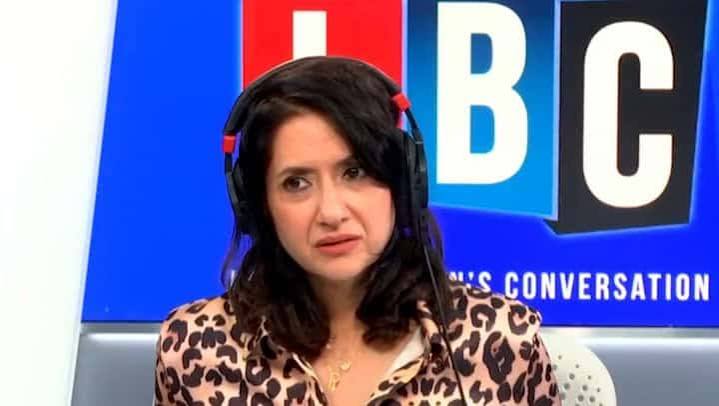

More than two years after she vanished from LBC’s airwaves following a combative interview with an Israeli government spokesman, the award winning broadcaster has given her fullest account yet of the lifetime confidentiality restrictions, legal pressure and professional isolation that followed. She cannot disclose why she was removed, but argues that her experience exposes a culture of fear reaching far beyond one radio station.
Sangita Myska had spent a quarter of a century learning how to remain composed on air, but when she began describing the aftermath of her departure from LBC, the discipline of a veteran broadcaster briefly gave way.
Speaking in a newly released Double Down News interview, Myska stopped, fought back tears and asked for a moment. More than two years had passed since her final programme, yet the experience was plainly still raw. What followed was not a complete explanation of her exit because, she said, her employment contract still prevents her from giving one. Instead, it was a carefully bounded account of what she is legally able to place on the record.
The chronology at the heart of the controversy is straightforward. On 14 April 2024, Myska conducted a robust live interview with Israeli government spokesman Avi Hyman. Within 48 hours, she said, she was informed that she would no longer be on air. She never returned to her weekend programme.
“I did an interview with an Israeli spokesperson and within 48 hours I was told I was no longer on air,” Myska said.
That sequence does not, by itself, prove that the interview caused her removal, and Myska repeatedly declined to tell viewers what conclusion they should draw. The distinction matters. LBC has never said she was taken off air because of her journalism on Israel and Gaza. Its public explanation was that she was leaving at the end of her contract as part of a “refreshed weekend schedule”. Sources at Global, LBC’s parent company, were reported at the time to have cited declining hourly audience figures, while presenter James O’Brien also argued that hosts ultimately stand or fall by their ratings.
Myska’s new testimony nevertheless raises a more disturbing question than the unresolved motive behind one employment decision. What happens to public interest journalism when a broadcaster can be removed without an on air farewell, forbidden indefinitely from discussing the circumstances and warned that even liking supportive social media posts may breach a contract?
For Myska, this is no longer simply a dispute about her career. She describes it as a warning about the condition of British journalism itself.
A programme that exceeded its target
Myska joined LBC’s weekend schedule in 2022 after a long career across BBC news, radio, current affairs, documentaries and factual television. Her record included thousands of hours of live broadcasting, presenting work on BBC Radio 4 and BBC One, and investigations into subjects including child trafficking, modern slavery, social care and the lives of unpaid carers.
In October 2023, only months before her LBC exit, she was named Radio Presenter of the Year at the Asian Media Awards.
In the Double Down News interview, Myska said she had been given an imposing audience target when she took over the weekend afternoon slot: to lift average weekly listening above half a million. Weekend afternoons are difficult territory for speech radio because listeners have families, sport, shopping and social lives competing for their attention. She said she nevertheless reached the target, crediting the audience that listened live and downloaded the programme.
Myska said contemporary audience data showed her average audience rising to 465,000, an increase of 12.5 per cent, and that later figures took the show beyond the half million mark. No detailed audience data was released by LBC when her contract ended, leaving the ratings explanation asserted by sources around the station but never publicly demonstrated in a way listeners could examine.
Her programme was also developing a distinctive editorial identity. Listeners urged her to watch The Labour Files, Al Jazeera’s investigation into the treatment of Jeremy Corbyn and the Labour Party’s internal battles over antisemitism. She eventually watched the complete series, describing it as excellent. Richard Sanders, who conducted the new interview with Myska, directed episodes of that investigation and has himself described losing mainstream work after it was broadcast.
When Hamas led the 7 October 2023 attacks in southern Israel, Myska said her position was unambiguous: attacks on civilians were wrong, whoever carried them out. Yet she also believed the British media had an obligation to scrutinise Israel’s response rather than treating the initial atrocity as a licence for collective punishment.
“To attack civilians is wrong. I don’t care who does it. It’s wrong.”
Within days, Israel had imposed what its own defence minister called a complete siege of Gaza, cutting electricity and restricting water, fuel and aid as the bombardment intensified. Myska said the implications were already unmistakable. On 28 October, she conducted her first interview with an Israeli official. Further encounters with Israeli government and military representatives followed, including several exchanges with spokesman Eylon Levy.
The interviews repeatedly went viral. Myska recalled the disconcerting experience of people sending her clips of her own programme because they were circulating so widely. Listeners contacted her to urge her to continue, largely because they believed she was subjecting official Israeli claims to a level of scrutiny that was then uncommon across British broadcasting.
Myska insists that she approached those interviews with meticulous care. Israeli representatives received a fair hearing, she said, but a fair hearing did not mean immunity from follow up questions, evidential challenge or the standards routinely applied to other governments.
“I was meticulous. I mean, I was absolutely meticulous,” she said. “I would ensure that the Israeli side had a fair hearing.”
The interview that became her last broadcast
The final exchange came after Iran launched drones and missiles at Israel in retaliation for the 1 April 2024 strike on an Iranian diplomatic compound in Damascus, widely attributed to Israel. Myska challenged Avi Hyman over the sequence of escalation, putting it to him that Israel’s earlier action against the Iranian site had predictably produced blowback in an already dangerous regional confrontation.
Hyman called her framing outrageous. Myska rejected that characterisation and said she had just spoken to a British diplomat with experience of Iran. Whether governments approved of Tehran or not, she argued, an attack on a diplomatic compound carried grave implications under established diplomatic norms.
“Sangita, that’s an outrageous framing of the reality,” Hyman told her.
“It’s not an outrageous framing,” Myska replied. “There was undoubtedly going to be a blowback.”
It was the last time her LBC audience heard her live.
In the new interview, she expressed the limit of what she can say with almost legalistic precision: she conducted the interview, and within 48 hours was told that she was no longer on air. She would not allege a causal connection because, she said, her contract prevents her from discussing the events leading to and following her dismissal.
Publicly, LBC confirmed on 1 May 2024 that she would leave at the end of her contract after almost two years at the station. Senior managing editor Tom Cheal thanked her for what he called a fantastic contribution and wished her success. Global presented the changes as a weekend schedule refresh. Former Conservative parliamentary candidate Ali Miraj took over much of her previous slot, while Vanessa Feltz joined the Saturday schedule in a different time period.
The sparse statement did little to answer why an award winning presenter had disappeared without warning, explanation or farewell. By 9 May, ITV News reported that more than 35,000 people had signed a petition demanding her reinstatement. The number later approached 40,000.
An open letter initially signed by more than 100 media figures, lawyers, politicians and campaigners expressed deep concern about her sudden disappearance. The list later grew beyond 170 and included broadcasters and journalists from major British news organisations. Signatories described Myska as fair, balanced and principled, while warning that an opaque departure of this kind risked further damaging public trust. ITV journalist James Mates, Sky correspondent Alex Crawford, BBC correspondent Lyse Doucet, Channel 4 News international editor Lindsey Hilsum, musician Charlotte Church and MP Zarah Sultana were among those publicly associated with the campaign.
The letter was organised independently of Myska. Its significance lay not in proving why she left, but in demonstrating how extraordinary her disappearance appeared to professional colleagues and listeners.
A contract that reaches into perpetuity
Myska says the greatest obstacle to explaining her story is not a settlement agreement signed after a private financial deal. She stressed that there was no settlement and that she accepted no settlement money. The restrictions, she said, were already embedded in her original employment contract.
“There has been no settlement. I have not taken a penny in settlement,” she said.
According to her account, the contract contained both a confidentiality provision and a broadly framed nondisparagement clause, with obligations continuing in perpetuity. She says she is therefore barred indefinitely from discussing the events that led to her removal or what happened afterwards. At one stage, she said, she was not even permitted to discuss the existence of the restriction with her own family. The nondisparagement language is so wide, she argued, that almost any critical comment about Global or LBC might be characterised as a breach.
“I’m not allowed to discuss what happened in the run up to the events of my dismissal or afterwards, forever.”
Myska described the reach of the second provision in equally stark terms.
“The terms of that disparagement clause are so wide that almost anything I say can be interpreted as disparaging Global and LBC.”
More remarkably, Myska alleged that solicitors acting for Global and LBC monitored her social media activity after she left. Her lawyers were shown examples of occasions on which she had liked posts from listeners saying that they missed and supported her. The implied warning, as Myska understood it, was that continuing such engagement could violate her contract.
“They had been monitoring my social media,” she said. The message conveyed to her lawyers was that continuing could constitute “a breach of contract”.
She described the effect as devastating. Already denied the ability to answer public questions, she now felt that even acknowledging solidarity could expose her to legal jeopardy. The combination of sudden unemployment, public speculation and private legal pressure caused her to “fall apart”, she said.
The allegation is Myska’s account, and the Double Down News programme did not include a fresh response from Global or LBC. Global’s previously published position remains that her contract ended during a schedule refresh. The company describes itself as Europe’s largest radio company, with brands including LBC, Heart, Capital, Classic FM and Smooth reaching more than 29 million people each week.
British employment guidance confirms that confidentiality clauses can be legally enforceable and that an alleged breach may lead to a contract claim and damages. They cannot lawfully prevent protected whistleblowing, reports of crime or certain other protected disclosures. Acas guidance updated in March 2026 also says such agreements should not be used routinely, to conceal misconduct, to avoid resolving workplace problems or where they create serious ethical concerns.
Myska’s assertion that British journalists have “zero” legal protection is best understood in the context she supplied: the United Kingdom has no direct equivalent of the United States First Amendment, while general freedom of expression protections do not automatically free a former employee from a valid contractual promise. Her proposal is therefore specific. She wants perpetual confidentiality and nondisparagement obligations restricted or prohibited in journalism, with legitimate confidentiality limited in subject and duration.
She contrasted her experience with parts of the financial sector, where she said similar restrictions are often time limited. The larger principle, in her view, is that a contract should not permanently prevent a journalist from discussing matters that bear upon editorial independence and democratic accountability.
James O’Brien and the accusation of conspiracy
The silence around Myska’s exit also produced an unusually bitter public clash within LBC’s own orbit.
When callers and online critics suggested that her treatment was connected to her questioning of Israeli officials, James O’Brien rejected the claim. In one heated exchange, he dismissed it as nonsense and accused people of allowing antisemitic conspiracy theories to develop. He also suggested that the one person capable of disproving the allegations had chosen to remain silent.
“That’s just bollocks, mate. That’s just crap,” O’Brien told one caller, before referring to “antisemitic conspiracy theories”.
The problem, Myska later said through her lawyers, was that her silence was not freely chosen. On 28 May 2025, law firm Bindmans published notice of her formal response, confirming that she was restricted in what she could disclose and was represented over the dispute.
In the Double Down News interview, Myska said attacks from presenters associated with the station continued online until June 2025. She alleged that she had retained screen captures and eventually instructed another legal team to warn LBC and Global that she would take action if the comments continued. She said the attacks then stopped.
This episode does not settle the question of why her contract ended, but it reveals the asymmetry that troubles her supporters. Colleagues were able to propose explanations for her departure, criticise those who doubted them and condemn speculation surrounding her, while the person at the centre of the story says she was contractually unable to offer her own account.
Private sympathy and public distance
Once outside LBC, Myska encountered a distinction familiar to many journalists who become professionally contentious: support delivered privately and distance maintained publicly.
“There was a lot of kind of, ‘We support you privately. We just won’t say anything publicly,’” she recalled.
One powerful industry figure embraced her, praised her journalism and assured her that colleagues knew she had done nothing wrong. When she explained that she would have to begin again by pitching documentaries, the advice was to wait until the controversy died down. This conversation took place in July 2024, while the destruction of Gaza was continuing. Myska replied that it would not die down because the underlying catastrophe would not disappear.
“It’s a genocide. It’s never going to die down,” Myska recalled telling him.
She is careful to place her own suffering in proportion. What happened to her, she said, was nothing beside the experience of Palestinians. Even so, the professional and emotional consequences were severe. She described falling off a cliff mentally and emotionally while trying to rebuild a career that had taken decades to establish.
“What happened to me is genuinely nothing compared to what’s happened to Palestinians,” she said. “Nothing.”
Some prominent journalists who considered themselves liberal or moderately left wing simply looked through her at industry events, she said. Two years later, some had repositioned themselves as though they had always challenged Israel’s conduct. The observation points to a recurring pattern in establishment life: once public opinion shifts, yesterday’s risk can become tomorrow’s consensus, and those who remained silent can quietly rewrite their own record.
“There are very high profile journalists who totally blanked me,” Myska said. Sanders replied: “One day everyone will always have been against this.”
Sanders offered a parallel, less visible example from freelance journalism. After directing the second episode of The Labour Files, which presented testimony from Jewish Labour members who opposed Israel and supported Corbyn, he said mainstream commissions disappeared. Al Jazeera told him there had not been a single Ofcom complaint about the programme, yet he later heard that it had “raised eyebrows” within the industry. For a freelancer, no dismissal letter is necessary. The telephone simply stops ringing.
“From one day to the next, the phone stopped ringing,” Sanders said. “The phone never rang again.”
Sanders said the exclusion ultimately pushed him towards work he regards as among the most important of his career, including a film on Gaza for Al Jazeera. Myska’s route has also moved towards independent outlets. She said she had worked with The Nerve and Middle East Eye without editorial interference, while her current public profile also includes presenting work for Zeteo UK.
Journalism that serves power
The interview broadens from one broadcaster’s story into a critique of the professional incentives shaping British news.
Myska rejects the romantic idea that everyone enters journalism to expose wrongdoing and hold power accountable. Broadcast news, like any large profession, contains careerists who want promotion, influence and six figure salaries. Many do not require an explicit order to avoid a dangerous subject. They understand where institutional pain lies and adapt accordingly.
“They want to keep climbing the greasy pole,” Myska said. “They don’t want to put that at risk.”
Sanders describes the result as “client journalism” — reporting that serves power instead of scrutinising it. In this model, official denials can be presented alongside overwhelming contrary evidence as though the two possess equal credibility. Israeli government assertions, he argued, have repeatedly been granted a fresh presumption of reliability even after earlier claims proved false or misleading.
Myska’s objection is not that Israeli officials should be excluded from British airwaves. She interviewed them repeatedly precisely because she believed their position should be heard. Her argument is that access is not the same as deference. Journalists have a duty to test official statements, assess the reliability of sources and give audiences the context required to judge competing claims.
Nor does impartiality require moral neutrality towards war crimes or crimes against humanity. Myska and Sanders argue that “both sides” reporting becomes a distortion when it gives an unsupported denial the same evidential weight as documented events. Proportionality, verification and framing are not breaches of impartiality; they are essential parts of it.
“There is nothing in any kind of journalistic handiwork that says crimes against humanity should be both sided,” Myska said.
Myska said the atmosphere after 7 October showed how rapidly those elementary principles could be weakened. She condemned attacks on Israeli civilians, but would not accept that doing so required silence about the mass killing and deprivation of Palestinians. Those positions are not contradictory. Her listeners, she believes, understood that before much of the political and media class did.
A warning extending beyond the newsroom
The messages Myska received after her removal suggested that the chilling effect was not confined to broadcasting. Nurses, teachers, doctors and other health workers contacted her to say they had faced disciplinary proceedings, lost contracts or seen employment opportunities disappear after expressing views considered supportive of Palestinian rights.
“This is happening to us,” Myska recalled them saying. “We are facing disciplinaries. We’re losing our contracts.”
Some doctors, she said, were pursuing tribunal cases that could begin to define the limits of lawful workplace discipline. She contrasted their treatment with the apparent tolerance sometimes shown towards colleagues who had served with the Israeli military in Gaza, an imbalance she described as one sided and oppressive.
Those claims require assessment case by case, because employment decisions can involve different contracts, professional rules and facts. Their broader significance lies in the pattern perceived by those contacting her: speech sympathetic to Palestinians was treated not merely as controversial, but as a professional risk.
That perception has consequences for public debate. Censorship does not always arrive as a government ban or an editor’s written instruction. It can operate through precedents, legal costs, reputational labels and the knowledge that a colleague who crosses an invisible line may abruptly disappear. One highly visible removal can discipline an entire workforce without anyone issuing a general prohibition.
The battle over trust
Myska believes mainstream media organisations are losing trust because audiences can see a gap between their lived moral response and the narrow language used by political and broadcasting institutions. She nevertheless resisted condemning every journalist inside those organisations, recalling excellent former BBC colleagues who continued trying to get difficult stories broadcast despite management constraints.
For years, viewers have watched images of dead, injured and traumatised Palestinian children while being told that the issue is too complicated for clear judgement, or that official Israeli claims must continue to be treated as presumptively credible. The dissonance reaches far beyond the traditional left, Sanders argued. Conservative voters and “middle England” can also look at the suffering of civilians and conclude that something is profoundly wrong.
Myska sees the public response to her own removal as evidence of a durable British instinct against unfairness. Some listeners told her they had often disagreed with her opinions, yet still believed she had been treated wrongly. They objected not only to her departure but to the denial of a farewell and the absence of a credible explanation.
“We didn’t really agree with all of your opinions, but what’s happened to you is unfair,” listeners told her. “It’s wrong.”
The same instinct, she argued, allows people to condemn the killing of civilians on 7 October while demanding an end to the devastation of Gaza and to British complicity in it. That is not an extreme position, however aggressively it may sometimes be portrayed.
Independent media have expanded into the space created by this collapse of confidence. Outlets such as Double Down News, Declassified UK, Middle East Eye, The Nerve and Zeteo have found audiences seeking reporting and argument they believe established broadcasters avoid. Individual journalists increasingly carry trust that once attached automatically to institutions.
That shift can produce its own problems. Independent outlets also require rigorous verification, transparent corrections and clear distinctions between reporting and opinion. Yet their growth reflects a failure that large broadcasters cannot dismiss simply by criticising alternative media. When audiences repeatedly find important questions explored elsewhere, institutional authority drains away.
The unanswered question
More than two years after Sangita Myska disappeared from LBC, the central factual question remains unresolved in public: why was a popular, award winning presenter removed from air so abruptly after her last interview with an Israeli government representative?
LBC’s answer has remained that her contract ended amid a refreshed schedule, with sources around the station pointing to ratings. Myska does not disclose the reason because she says she is legally forbidden from doing so. She asks audiences only to consider the chronology and the machinery that followed: permanent contractual silence, alleged monitoring of supportive social media activity, expensive legal correspondence and an industry in which private sympathy rarely became public solidarity.
The importance of her account does not depend upon proving a secret instruction from Israel or identifying a single decisive conversation inside Global. The more fundamental danger is visible without either. A journalist says she can be removed, prevented indefinitely from explaining what happened and then criticised for failing to correct public speculation. Her colleagues see the cost. Editors absorb the lesson. Other workers, already anxious about expressing solidarity with Palestinians, recognise the pattern.
Myska’s proposed first step is modest but consequential: end perpetual gagging clauses in journalism and ensure that confidentiality cannot be used to conceal decisions bearing upon editorial freedom. A democratic society cannot demand fearless scrutiny from reporters while allowing their employers to impose lifelong silence about how that scrutiny is managed.
“It is oppressive. It is one sided. And it completely goes against natural justice,” Myska said. “This is about the future of journalism and the future of the truth.”
Her own return through independent media demonstrates that a voice can be displaced without being extinguished. It also leaves Britain’s largest broadcasters with an uncomfortable challenge. If robust questioning of governments is the purpose of journalism, the public is entitled to know that the journalists who perform it will not disappear into a silence they are contractually forbidden to explain.