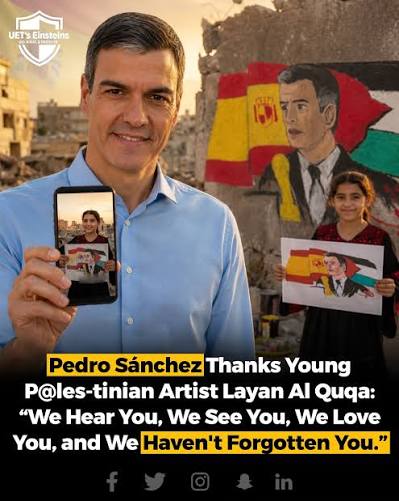

Young Palestinian Layan and Gaza artist Obay Kareem transformed the ruins of a destroyed building into a message of gratitude, prompting an emotional response from the Spanish leader.
A mural painted on the shattered wall of a building in Gaza has prompted a heartfelt exchange between a young Palestinian girl and Spanish Prime Minister Pedro Sánchez, becoming a powerful symbol of solidarity amid the destruction of the Palestinian territory.
The portrait, credited to Gaza artist Obay Kareem, depicts Sánchez on a wall surrounded by broken concrete and the unmistakable remains of war. Standing beside the mural in a video shared online, a girl named Layan addressed Spain directly and introduced herself with the words: “I am Layan, a girl from Gaza.”
She explained that the portrait had been created as a gesture of gratitude towards Sánchez and the Spanish people for their support for Palestine. The location gave the artwork an added significance, with the likeness of a European leader painted not inside a gallery or public building, but across a damaged structure in a territory devastated by years of bombardment, displacement and humanitarian crisis.
The video quickly circulated across social media and eventually reached Sánchez, who responded personally in a 53-second message posted on his official Instagram account.
Appearing visibly moved, the Spanish prime minister thanked Layan, the artists responsible for the mural and Palestinians who had expressed friendship towards Spain.
“Spain listens to you, sees you and does not forget you,” Sánchez said.
He expressed the hope that Gaza’s children would soon be able to return to their schools, paint without fear and live in peace. Sánchez concluded the message by sending what he described as an enormous embrace from Spain.
The response carried particular weight because it came directly from the head of a European government rather than through an official spokesperson or diplomatic statement. Sánchez addressed Layan by name, acknowledging the child behind the mural and the wider Palestinian population whose experiences she had come to represent.
A joyful reply from Gaza
Footage subsequently shared from Gaza showed Layan reacting with delight after learning that Sánchez had seen the mural and answered her message. Speaking from the street, she thanked the Spanish prime minister “from the heart” and said that his response had made her extremely happy.
Her reaction completed an exchange that crossed geographical, political and linguistic boundaries. A painting created among Gaza’s ruins had reached Madrid, while the response from the Moncloa Palace had travelled back to the child who helped present it.
The original mural video and Layan’s subsequent response were widely shared, with many social media users describing the encounter as a rare moment of warmth and human connection emerging from the devastation.
The image also demonstrated how Gaza’s artists have continued to use destroyed buildings as public canvases. In this case, the broken wall became both an artwork and a political message, thanking a government perceived by many Palestinians as having taken a stronger position on their rights than most other Western European states.
Spain’s recognition of Palestine
Layan’s tribute reflected Spain’s increasingly prominent diplomatic support for Palestinian statehood under Sánchez.
On 28 May 2024, Spain formally recognised the State of Palestine alongside Ireland and Norway. Announcing the decision, Sánchez said recognition was both a matter of historical justice and an urgent step towards peace.
The Spanish government said a viable Palestinian state should encompass Gaza and the West Bank, connected by a corridor, with East Jerusalem as its capital. Madrid said it would not recognise changes to the pre-1967 boundaries unless agreed by both Palestinians and Israelis.
Sánchez also stressed that the decision was not directed against Israel and reiterated Spain’s condemnation of the Hamas-led attacks of 7 October 2023. His government argued, however, that Palestinian statehood and an end to the occupation were essential to any credible and lasting peace.
Spain later filed a declaration of intervention in South Africa’s case against Israel at the International Court of Justice, addressing the interpretation of the Genocide Convention in relation to Gaza.
The Sánchez government has also supported demands for a ceasefire, unrestricted humanitarian access and continued international funding for Palestinian relief agencies. Measures announced by Madrid included a commitment to increase humanitarian and development assistance for Gaza to €150 million during 2026, together with additional funding for the United Nations Relief and Works Agency for Palestine Refugees.
During a March 2026 meeting with UNRWA Commissioner-General Philippe Lazzarini, Sánchez reaffirmed Spain’s support for the agency and warned that Gaza continued to face a grave humanitarian situation. Spain maintained that United Nations agencies and humanitarian organisations must be permitted to operate without restrictions and in accordance with international law.
Art amid destruction
For Layan and the artists who created the mural, Spain’s diplomatic decisions were translated into something deeply personal. The portrait was not simply an image of Sánchez, but an expression of gratitude from people who felt that their suffering had been acknowledged.
The setting remained inseparable from its message. The mural stood on a ruined wall because much of Gaza’s ordinary civic and cultural space has been damaged or destroyed. Art that might otherwise have appeared inside a school, studio or cultural centre was instead created among the wreckage.
Sánchez’s answer recognised that reality by focusing particularly on Gaza’s children and their right to return to classrooms without fear. His response turned a social media video into a direct conversation between political power and a child living amid the consequences of war.
For a brief moment, the mural connected Gaza and Spain through something other than diplomatic communiqués, casualty reports or scenes of destruction. Layan’s message travelled from a broken wall to the office of a European prime minister, and Sánchez’s reply returned to the streets of Gaza.
The exchange could not alter the political or humanitarian reality facing Palestinians, but it showed the continuing power of art to carry a message beyond borders. On a wall marked by destruction, Layan and Gaza’s artists created an image intended to say that they were still present, still speaking and still hoping to be heard.