
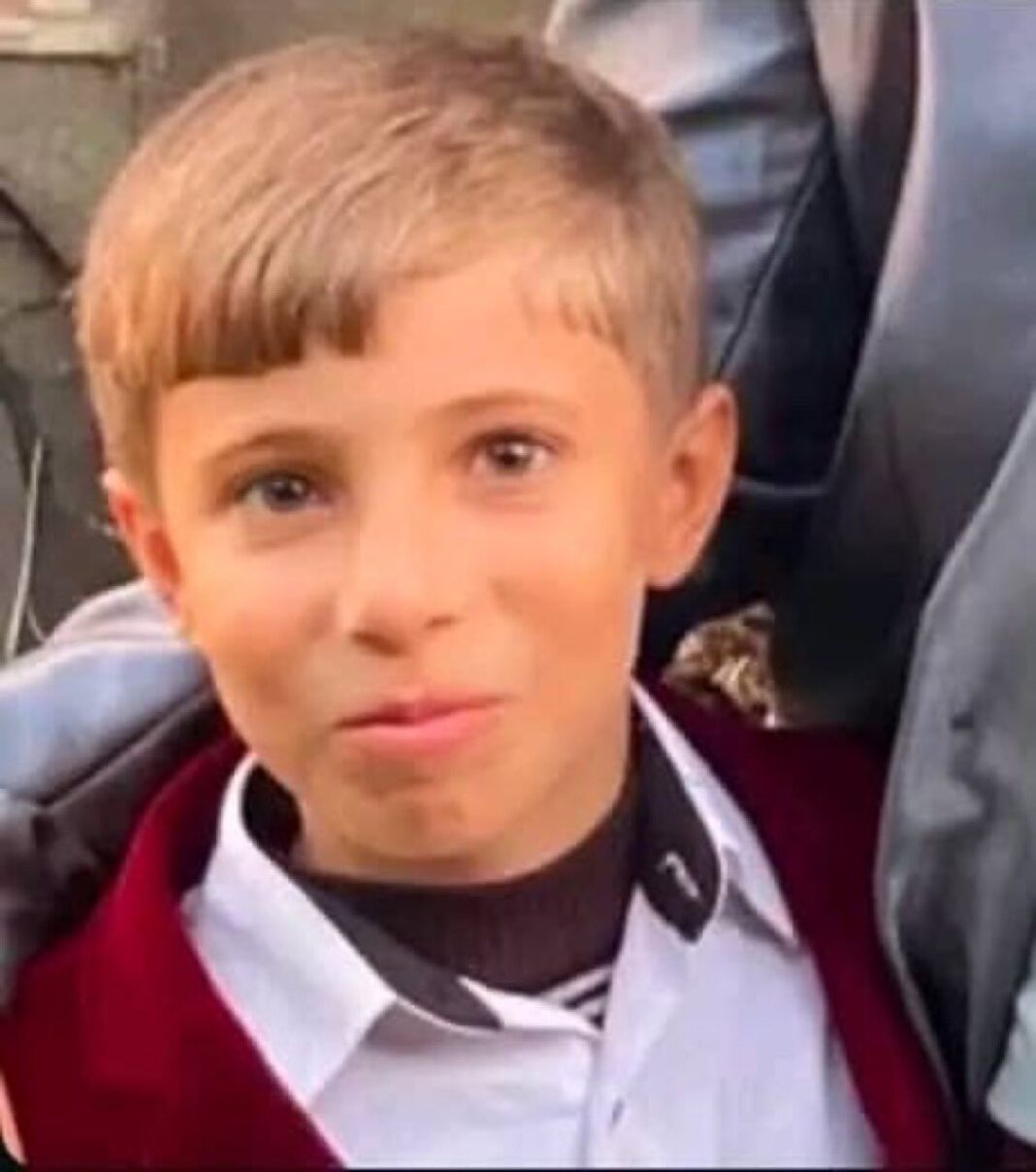

A Palestinian child and his father were among those killed when two missiles struck a café surrounded by displaced families. Israel says it targeted senior Hamas commanders but has not identified them or released evidence supporting its account.
Seven Palestinians, including a child, were killed when an Israeli airstrike hit a crowded café inside Gaza City’s fishermen’s harbour on Tuesday evening, less than a day after talks involving United States envoy Jared Kushner ended without a breakthrough on implementing a ceasefire and disarmament agreement.
Fourteen people were initially reported wounded in the attack on the café, which stood beside a sprawling encampment of displaced Palestinian families along Gaza City’s Mediterranean waterfront. Some of the injured were reported to be in a critical condition.
The death toll rose from six to seven on Wednesday, 19 August, when Musab Muhammad Madi died from serious injuries sustained in the strike, according to Palestinian medical and local media sources.
Among those killed were Muhammad Hamdi Ahmad al-Masri and his young son, Jihad Muhammad Hamdi al-Masri, who was reported to have been approximately 12 or 13 years old. Photographs and videos from al-Shifa Hospital showed grieving relatives saying farewell to the father and child before their funeral.
The Israeli military said the strike targeted a meeting of commanders from Hamas’s elite Nukhba Force, including a company commander, three platoon commanders and several other operatives. It also alleged that one person present had entered Israeli territory during the Hamas-led attack of 7 October 2023.
However, the Israel Defense Forces did not identify any of the alleged commanders, provide details of the attacks they were purportedly planning or release evidence connecting the named Palestinian casualties to the Nukhba Force.
Hamas condemned the bombing as a deliberate escalation intended to undermine ceasefire negotiations, but did not say whether any members of its armed wing were killed.
Two Missiles Strike Waterfront Café
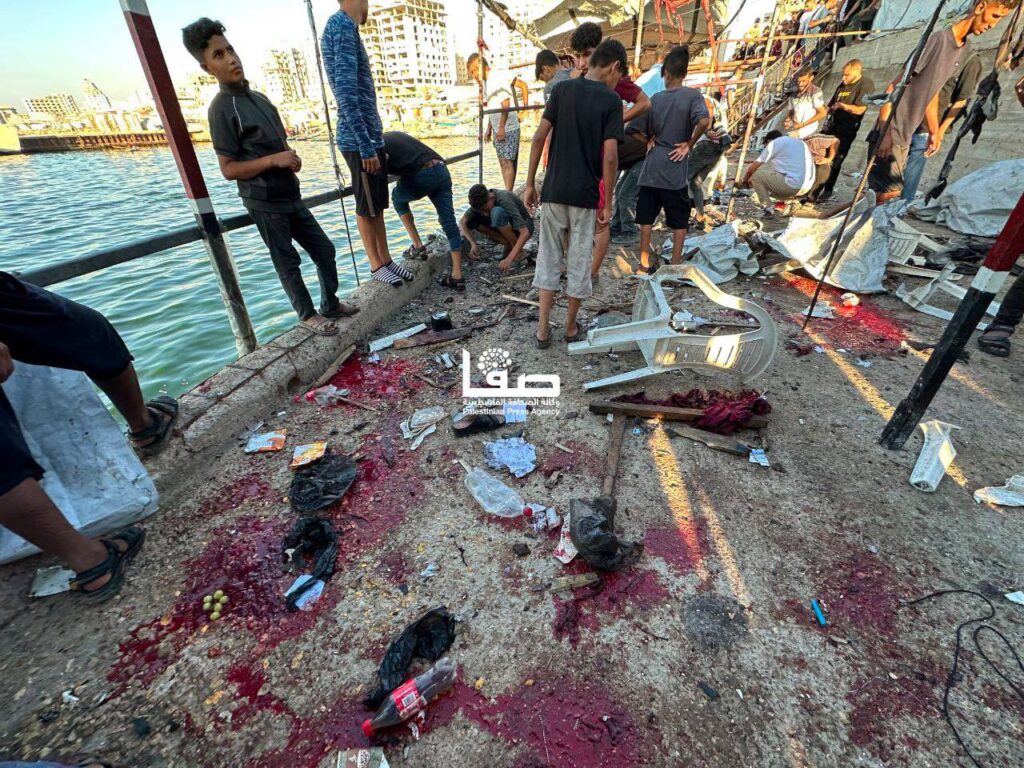
The attack occurred inside the fishermen’s harbour in western Gaza City, close to the al-Shati refugee camp and an extensive collection of tents and makeshift shelters occupied by families displaced during nearly three years of war.
Witness Mohammed Alghoul told Agence France-Presse that Israeli aircraft fired two missiles at a small establishment known as the “Sweet and Bitter” café, from the Arabic name Ala al-Hilwa wal-Murra.
Palestinian sources described the café as crowded when it was struck. Al Jazeera’s correspondent in Gaza reported that many residents had emerged from their tents and gathered near the waterfront in an attempt to escape the extreme summer heat.
The port, once an important centre for Gaza’s fishing industry, has gradually been transformed into a displacement camp as Israeli military operations destroyed residential areas and forced much of Gaza’s population into an increasingly restricted coastal zone.
Accounts differ over the aircraft used in the attack. Some Palestinian reports described a drone, while others referred to a warplane. The Israeli military has described the operation only as a “precise aerial strike.”
The immediate aftermath was documented by Palestinian journalists and international news agencies. Images showed blood covering the ground among shoes, broken chairs and café debris, while residents and emergency workers carried casualties towards waiting ambulances.
Some victims were reportedly thrown into the harbour basin by the force of the explosions. Videos showed people attempting to recover casualties from the water, although the precise number who fell or were thrown into the sea has not been independently established.
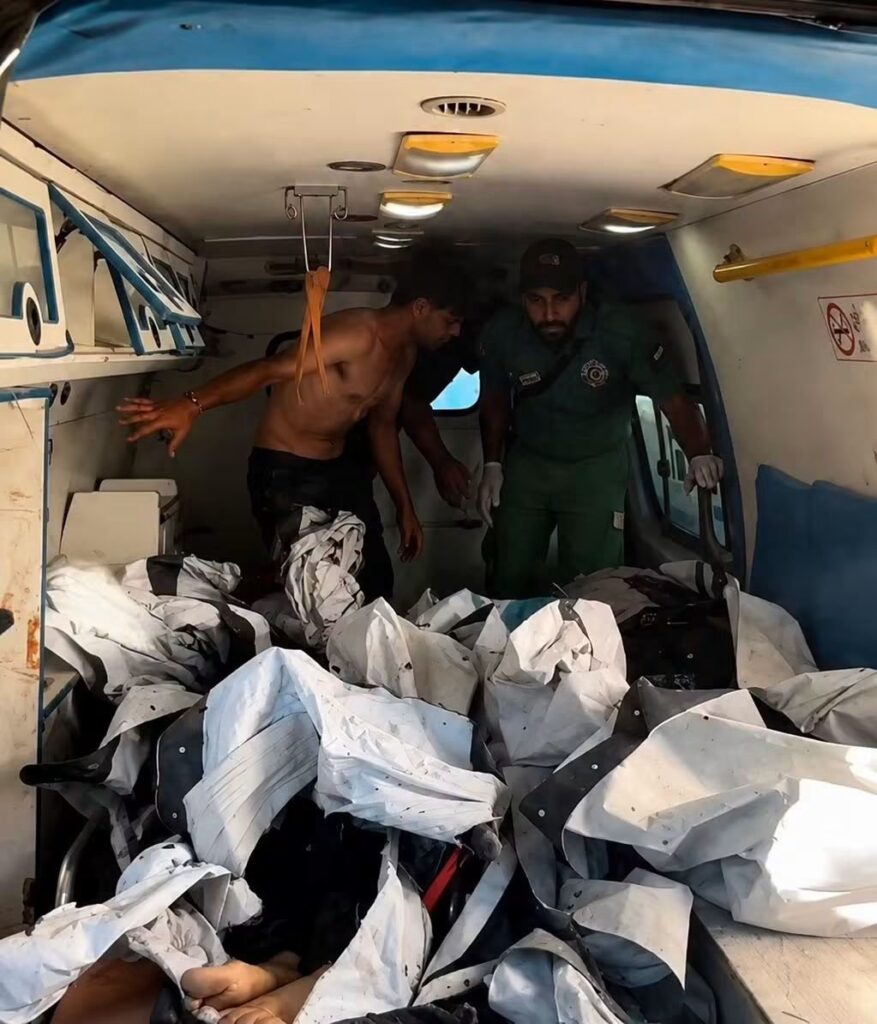
Palestinian Red Crescent crews transported bodies and wounded people to al-Shifa Hospital. The hospital initially reported receiving five bodies and approximately 13 injured people. One casualty subsequently died, bringing the first confirmed toll to six, while the Gaza Health Ministry reported a total of 14 injuries.
Madi’s death the following day raised the number killed to seven.
A Child and His Father Among the Dead
Later Palestinian reporting identified the seven victims as:
- Muhammad Najib al-Attar
- Jihad Muhammad Hamdi al-Masri
- Muhammad Hamdi Ahmad al-Masri
- Issam Muhammad Musa Murtaja
- Muhammad Fathi Hussein Nasser
- Samid Samir Harb Abu Habl
- Musab Muhammad Madi
Local casualty documentation reported Muhammad Hamdi al-Masri as 35, Murtaja as 31, Nasser as 29 and Abu Habl as 33. Jihad al-Masri was identified as the son of Muhammad Hamdi al-Masri.
There remains a discrepancy surrounding one of the names. Early casualty lists identified Izz al-Din Salem Deeb among the six people initially reported killed. Later seven-person lists included Muhammad Najib al-Attar instead of Deeb. Palestinian authorities and medical sources have not publicly explained whether this resulted from an initial misidentification, confusion caused by the condition of the bodies or an incorrect attribution.
Early social-media reports also claimed that a woman was among those killed. The later named list contains seven male names, although photographs and reports confirm that women were among the injured.
Israel Claims Four Nukhba Commanders Were Meeting
In its initial statement, the Israeli military said it had targeted Hamas commanders in the al-Shati area who were planning attacks against Israeli troops operating in Gaza.
“The terrorists were struck in a precise aerial strike to remove the threat,” the military said.
The IDF subsequently expanded its account, saying a meeting of Nukhba Force commanders had been under way at the location. It claimed that those present included a company commander, three platoon commanders and additional Hamas operatives.
One of the people targeted had allegedly participated in the 7 October attack and entered Israeli territory that day, according to the military.
An Israeli security official separately told Army Radio that four Hamas commanders had gathered at the café. Israeli reporting said the military used aerial surveillance and precision munitions in an effort to reduce civilian casualties.
Nevertheless, no images of the alleged commanders, names, intelligence summaries or evidence of the purported attack planning have been made public. The IDF said it would provide further information once the results of the operation were verified, but no detailed identification had been released at the time of publication.
Reuters, reporting on 18 August, noted that the Israeli military had provided no evidence substantiating its claims.
Claims circulating in Israeli and pro-Israel social-media accounts have described Muhammad Hamdi al-Masri as a senior Hamas commander. That identification has not been accompanied by a detailed official profile or independently verifiable evidence.
The Israeli military has also not explained whether the child, Jihad al-Masri, was inside the café with his father, elsewhere in the immediate blast area or among people gathered beside the displacement tents.
Hamas described those killed as civilians but did not specifically address Israel’s assertion that armed-wing commanders were present. The movement rarely provides immediate information about military casualties, meaning its silence cannot conclusively establish the status of every adult killed.
Katz Confirms Policy of Retribution
Israeli Defence Minister Israel Katz responded to the strike by setting it within a broader policy that includes both removing immediate threats and pursuing people accused of participating in the October 2023 attacks.
Katz said Israel’s policy was to eliminate threats and militants and to “settle the score” with everyone involved in 7 October. He said the military would continue operating from the Israeli-controlled security zone inside Gaza.
His statement is significant because it frames the bombing not only as an operation against an imminent threat but also as part of Israel’s continuing campaign of retribution and targeted killings.
Israel has repeatedly justified strikes conducted during the ceasefire by saying they targeted Hamas or Palestinian Islamic Jihad members planning attacks against Israeli troops. In numerous cases, civilians, family members, neighbours and bystanders have also been killed.
Strike Follows Kushner’s Failed Diplomatic Mission
The timing of the café bombing placed it at the centre of the deepening dispute over President Donald Trump’s 15-point roadmap for Gaza.
Kushner, Trump’s son-in-law and regional envoy, had spent two days meeting the parties. He held rare direct talks with Hamas political leader Khalil al-Hayya in Cairo before travelling to Jerusalem for a meeting of almost four hours with Israeli Prime Minister Benjamin Netanyahu.
Those talks ended without a breakthrough.
The proposed roadmap envisages Hamas and other Palestinian factions placing their weapons beyond use in phases while Israeli forces withdraw progressively from Gaza. Areas declared free of heavy weapons would be transferred to a new Palestinian technocratic administration, supported by an international stabilisation force.
Hamas says it accepted the roadmap in principle but insists that implementation must include an end to Israeli attacks and a phased military withdrawal. Netanyahu has rejected that sequencing and maintains that Israel will not withdraw, or permit Gaza’s reconstruction to begin, until Hamas has surrendered all weapons and its tunnel network has been dismantled.
Trump publicly said that Israel should not be striking Gaza while progress was being made towards Hamas surrendering its weapons. Netanyahu, however, reportedly told Kushner that Israel would continue targeting Palestinians accused of participating in the 7 October attacks.
Israeli officials also insisted that the military would retain freedom of action throughout Gaza and that no withdrawal from the current Israeli-controlled line had been agreed.
The café was struck less than 24 hours later.
Hamas accused Netanyahu of deliberately using the attack to derail negotiations and undermine the efforts of Egypt, Qatar, Turkey, the United States and other mediators.
The movement said the bombing demonstrated “blatant disregard” for ceasefire demands and called on Washington to compel Israel to implement the agreement.
The close timing establishes a clear connection between the attack and the political dispute over continued Israeli military operations. It does not, by itself, prove that the café strike was specifically ordered to sabotage the negotiations.
A Ceasefire That Has Not Stopped the Killing
The Gaza ceasefire came into force in October 2025, reducing the intensity of the war without ending Israeli airstrikes, artillery fire, demolitions or shootings.
According to the Gaza Health Ministry’s updated figures, Israeli attacks since the agreement have killed approximately 1,273 Palestinians and wounded more than 4,200. Four Israeli soldiers have reportedly been killed by Palestinian armed groups during the same period.
The Palestinian ministry does not distinguish between civilians and members of armed groups in its overall figures. Reuters has reported that most of those killed during the ceasefire period were civilians, while Hamas does not publish a comprehensive total for military casualties.
Israel currently controls approximately two-thirds of Gaza, including the territory behind what has become known as the “yellow line.” Israeli forces have demolished remaining structures, cleared land and destroyed tunnels in areas under their control.
Most of Gaza’s population has consequently been compressed into a narrow and devastated coastal area containing tents, damaged buildings and improvised shelters. The fishermen’s harbour and surrounding beach have become places where displaced families live, seek food and water and attempt to find relief from intense heat.
The Gaza Health Ministry reported that the overall Palestinian death toll since October 2023 had reached approximately 73,400 by the time of the café strike, with more than 174,000 people recorded as wounded. Thousands of additional victims are believed to remain beneath destroyed buildings.
Gaza’s Cafés Have Repeatedly Become Targets
The 18 August attack was not the first Israeli strike on a café near Gaza City’s waterfront.
On 30 June 2025, an Israeli airstrike devastated the popular al-Baqa café, killing dozens of Palestinians, including children, journalists, artists and athletes. The café had become one of the few surviving places where residents could obtain internet access, charge telephones, work or briefly escape the conditions of war.
Fragments examined after that attack were identified as parts of a United States-manufactured 500-pound Mark 82 bomb. The Israeli military said it had targeted Hamas operatives and had used aerial surveillance to reduce civilian harm.
On 31 May 2026, another Israeli strike hit a café at Gaza’s emergency seaport while it was crowded with people marking a public holiday and escaping the heat. At least two Palestinians were killed and approximately 12 wounded.
The latest attack was carried out in the same general port and waterfront environment, but there is no verified evidence that it struck the same café or employed the same type of weapon as the al-Baqa bombing.
The repeated targeting of waterfront cafés reflects the disappearance of any meaningful separation between Gaza’s shrinking civilian spaces and the battlefield. Restaurants, tents, schools, hospitals, markets and waterfront shelters have become places of refuge while simultaneously being treated by Israel as potential military targets.
Serious Questions Under International Law
Under international humanitarian law, members of an organised armed group performing continuous combat functions may be lawfully targeted. Civilians may also lose protection for the limited period during which they directly participate in hostilities.
A café or other civilian building can become a military objective if its use makes an effective contribution to military action and attacking it offers a definite military advantage.
However, the alleged presence of commanders does not remove the protection afforded to civilians gathered inside or around the building. An attacker must verify the target, take all feasible precautions, select weapons and timing intended to minimise civilian casualties and cancel an operation if the expected harm would be excessive compared with the anticipated military advantage.
Israel’s assertion that four Nukhba commanders were meeting at the café would, if supported by reliable intelligence, provide a potential military rationale for the operation. It would not automatically establish that firing two missiles into a café beside a displacement camp was proportionate or that sufficient precautions were taken.
The absence of publicly released evidence does not prove that Israel’s intelligence was false. It does, however, prevent independent scrutiny of who was targeted, how imminent the alleged threat was and whether the military knew a child and other civilians were present.
Israel has not disclosed the expected civilian-casualty assessment, the precise munition used, whether alternative weapons or timing were considered, or why an arrest or less destructive means was impossible.
The absence of an advance warning is not automatically unlawful when a warning would defeat a legitimate military operation. It nevertheless becomes relevant when assessing the precautions taken before striking a public venue surrounded by displaced families.
Palestinian factions have described the attack as a war crime and a massacre. Those descriptions reflect the scale and civilian circumstances of the strike, but a definitive legal finding would require an independent investigation examining Israel’s intelligence, targeting process and proportionality assessment.
A Father, a Child and an Unanswered Claim
For the families gathered at Gaza’s port, the official language of commanders, proportionality and precision offers little explanation for the scenes left behind.
The confirmed dead include a child and his father. Other victims were carried from a café that existed within one of the few remaining spaces where displaced Palestinians could gather beside the sea.
Israel says the location concealed a meeting of senior Nukhba commanders preparing attacks. Hamas and Palestinian officials say civilians were deliberately targeted. Neither side has provided a complete account capable of resolving the competing claims.
What is established is that two missiles struck a crowded café, seven Palestinians died and at least 14 people were wounded during a ceasefire that has already claimed more than a thousand Palestinian lives.
The attack occurred immediately after the United States president said Israel should not be bombing Gaza and immediately after his envoy failed to persuade Netanyahu to suspend the policy of targeted killings.
Until Israel identifies those it claims were commanders and releases evidence explaining the military necessity for attacking the café when and how it did, the most important questions surrounding the deaths of Jihad al-Masri, his father and the five other Palestinians will remain unanswered.