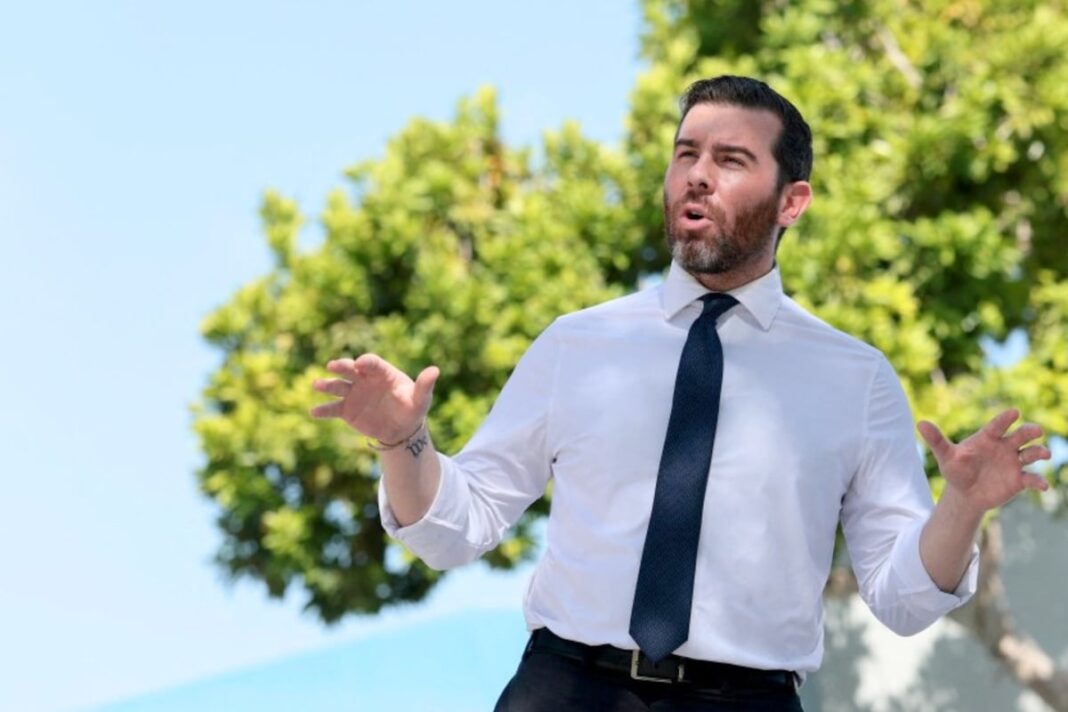

Congressional candidate Oliver Larkin cited a United Nations commission, Amnesty International and the Israeli human rights organisation B’Tselem. WPLG presenter Glenna Milberg repeatedly called him “factually incorrect”, but the public record shows that the evidence he invoked was real, extensive and far more substantial than viewers were told.
A routine television interview ahead of Florida’s Democratic congressional primary turned into an extraordinary dispute over Israel and Gaza after a local news presenter repeatedly interrupted a candidate, dismissed his statements as false and told viewers that the United Nations had rejected the application of the word genocide.
The exchange took place on Sunday, 16 August, when Oliver Larkin, a 34 year old union organiser and member of the Democratic Socialists of America, appeared on WPLG Local 10’s This Week in South Florida. Larkin is challenging incumbent congressman Jared Moskowitz for the Democratic nomination in Florida’s newly drawn 25th Congressional District.
Larkin grew up in Fort Lauderdale as the son of a retired United States Army officer. He worked in a restaurant kitchen after college, became involved in Bernie Sanders’ 2016 presidential campaign, later helped unionise his workplace and returned to South Florida in 2022. His campaign has combined support for universal healthcare, free public university tuition and affordable housing with calls to abolish Immigration and Customs Enforcement and end military support for Israel. The primary became a national test of whether the recent growth of democratic socialism could extend into an older, wealthier and politically competitive Florida district.
The interview was conducted by Glenna Milberg, an award winning WPLG journalist. It began with questions about democratic socialism, universal healthcare, education and immigration enforcement, but its tone changed dramatically when Milberg raised Larkin’s opposition to United States military support for Israel.
Milberg told Larkin that roughly one in four voters in the district was Jewish, then asked how he would explain a policy of “essentially” defunding Israel to voters who might believe it would place the country under existential threat. That framing immediately became part of the controversy because it appeared to treat a diverse Jewish electorate as politically synonymous with the Israeli state.
Larkin replied that the United States should apply democratic and human rights principles abroad as well as at home. He referred to Israel’s 2018 Nation State Law and attempted to discuss the Leahy laws, which prohibit United States assistance to foreign security force units when there is credible information implicating them in gross human rights violations. The United States State Department describes the two Leahy provisions as binding restrictions on assistance to implicated units.
Milberg interrupted him, saying his statement was factually incorrect because there had been no Palestinian state in 2018. Yet Larkin had not claimed that there was one. He was referring to the Basic Law adopted by the Knesset in July 2018, which states that “the right to national self determination in the State of Israel is unique to the Jewish People”. The law has been defended by supporters as a declaration of Israel’s Jewish national character, while critics say it constitutionally downgrades Palestinian citizens and entrenches unequal national rights. The Law Library of Congress records the provision and the controversy surrounding it.
The presenter then shifted to Iron Dome, describing much of the United States contribution as defensive funding and arguing that Israeli technology and related employment also benefit the American economy. She asked why Larkin would remove defensive protection from a country surrounded by groups that threaten its destruction. Her framing narrowed a much broader financial relationship to missile defence. Congressional Research Service figures cited by Miami New Times put cumulative United States bilateral assistance and missile defence funding for Israel at about $174 billion since 1948, before adjusting for inflation.
“Israel is committing a genocide,” Larkin replied.
Milberg immediately cut in. “That’s incorrect. That is factually incorrect,” she said, before Larkin cited the United Nations, Amnesty International and B’Tselem.
Milberg responded that the United Nations had said the definition of genocide did not apply to what some people regarded as disproportionate wartime action. She added that genocide was instead being committed against Jewish people, “not by Israel”, and told viewers that this was a fact.
Larkin tried again. He referred to findings that Israeli forces had deliberately targeted women and children, the restriction of humanitarian aid, famine conditions and attacks on hospitals, mosques and churches. Milberg interrupted for a third time, again saying his account was factually incorrect, before announcing that the interview had to end.
The segment rapidly went viral. Miami New Times reported that one social media post attracted more than one million views in less than a day. Larkin later wrote that whether he appeared on Fox News or local television, he would not stop saying that Israel was committing genocide. He told the newspaper that he initially regarded the exchange as a misunderstanding and would have offered more documentary evidence if he had been allowed to continue.
An email exchange posted online appeared to show Milberg acknowledging that a United Nations commission had used the term genocide, although the authenticity and full context of the correspondence could not be independently established. Miami New Times said neither Milberg nor WPLG responded to its requests for comment.
What the United Nations actually found
The legal position is more precise than either participant managed to explain during the tense exchange, but it does not support Milberg’s categorical dismissal.
In September 2025, the Independent International Commission of Inquiry on the Occupied Palestinian Territory, including East Jerusalem, and Israel concluded that Israeli authorities and security forces had committed genocide against Palestinians in Gaza. The commission was established by the United Nations Human Rights Council, although it operates as an independent investigative body rather than speaking for every United Nations institution or member state.
Its legal analysis found that four of the five genocidal acts listed in the 1948 Genocide Convention had been committed: killing members of the group, causing serious bodily or mental harm, deliberately inflicting conditions of life calculated to bring about the group’s physical destruction, and imposing measures intended to prevent births. It also concluded that genocidal intent could be inferred from statements by Israeli leaders and the pattern of conduct on the ground. The findings were published by the Office of the United Nations High Commissioner for Human Rights on 16 September 2025.
In June 2026, the same commission issued a further report saying Israeli authorities and security forces had deliberately targeted Palestinian children, including babies and toddlers, and that the conduct formed part of continuing genocide and other atrocity crimes. The commission’s report and findings directly contradict the suggestion that claims about the deliberate targeting of children had simply been invented.
There is an important institutional distinction. A finding by a United Nations appointed commission is not a final judgment by the International Court of Justice, nor does it automatically become the formal position of the General Assembly or Security Council. Larkin’s abbreviated reference to “the United Nations” therefore required clarification. It did not justify telling viewers that the United Nations had found the genocide definition inapplicable, because a major United Nations investigative body had reached precisely the opposite conclusion.
The International Court of Justice case brought by South Africa against Israel remains unresolved. At the provisional measures stage in January 2024, the court did not decide that Israel had committed genocide, or even that the genocide allegation itself had been proved plausible. It found that Palestinians in Gaza had a plausible right to protection from acts of genocide, that South Africa had a plausible right to seek Israel’s compliance with the convention, and that at least some of the alleged acts appeared capable of falling within its provisions. The court ordered Israel to prevent prohibited acts, punish direct and public incitement, permit humanitarian assistance and preserve evidence. The case remains active before the court.
That distinction matters because genocide is a specific legal crime requiring proof of intent to destroy, in whole or in part, a protected national, ethnic, racial or religious group. A final judicial decision can take years. The absence of that final ruling is not the same as an international finding that genocide is not occurring.
Human rights groups and scholars reached the same conclusion
Larkin’s other references were also grounded in published investigations.
In December 2024, Amnesty International concluded that Israel was committing genocide against Palestinians in Gaza. Its report examined civilian killings, mass displacement, destruction of essential infrastructure, restrictions on food, water and aid, and statements by senior Israeli political and military figures. Amnesty said the combined evidence demonstrated the prohibited acts and specific intent required by the convention.
In July 2025, B’Tselem, one of Israel’s best known human rights organisations, published a report titled Our Genocide. It said Israel was deliberately and systematically destroying Palestinian society in Gaza and had created conditions calculated to eliminate the group’s ability to continue existing there. The organisation described its conclusion that Israel was committing genocide as unequivocal. B’Tselem’s report is available in full.
The International Association of Genocide Scholars followed on 31 August 2025 with a resolution declaring that Israel’s policies and actions met the legal definition in Article II of the Genocide Convention. The measure was supported by 86 per cent of those who voted, although only 28 per cent of the association’s membership participated, a caveat that should accompany claims of an overwhelming scholarly consensus. The association published both the resolution and its voting figures.
Several prominent Israeli scholars of the Holocaust and genocide have reached similar conclusions. Israeli American historian Omer Bartov, a former Israeli soldier and professor of Holocaust and genocide studies at Brown University, wrote in July 2025 that his “inescapable conclusion” was that Israel was committing genocide. Hebrew University historian Amos Goldberg had reached that conclusion by April 2024, while Goldberg and fellow Holocaust historian Daniel Blatman later warned that the destruction of Gaza would leave a lasting stain on Jewish and Israeli history.
Israel rejects all accusations of genocide. Its government says the military campaign was launched in self defence after the Hamas led attacks of 7 October 2023, in which about 1,200 people were killed and 251 were taken hostage. It maintains that its target is Hamas rather than the Palestinian population, accuses the armed group of operating from civilian areas, and says it takes measures to reduce civilian casualties. Israeli officials have dismissed the United Nations commission and other genocide findings as distorted, politically motivated and reliant on information supplied by Hamas.
A responsible interview could have presented those competing claims, questioned the methodology of the investigations, examined the legal threshold for intent and asked Larkin how he would answer Israel’s defence. What happened instead was different: a contested but heavily documented conclusion was pronounced false before the candidate could explain the evidence behind it.
Jewish voters are not a political monolith
The opening premise of Milberg’s question also deserves scrutiny. The assumption that a policy directed at the Israeli government must be explained to Jewish voters as though they share one political position collapses the distinction between Jewish identity and the actions of a foreign state.
Polling shows that American Jewish opinion on Gaza is deeply divided. A Washington Post survey conducted by SSRS in September 2025 found that 61 per cent of Jewish Americans believed Israel had committed war crimes and 39 per cent believed it had committed genocide. Among Jewish adults under 35, support for the genocide description reached 50 per cent. At the same time, large majorities maintained a strong emotional commitment to Israel’s existence and regarded antisemitism in the United States as a serious threat. The poll therefore showed criticism of Israeli conduct coexisting with Jewish communal identity and concern for Jewish safety.
A separate AP and NORC survey published in July 2026 found that 30 per cent of Jewish adults believed Israel had committed genocide, 49 per cent said it had not and 21 per cent were unsure. The differing figures reflect methodology and timing, but both polls demonstrate that Jewish Americans cannot be treated as a single pro government voting bloc.
Larkin made the same distinction in a subsequent interview with Miami New Times. He said antisemitism was a genuine and growing threat, and that South Florida’s Jewish community must be able to practise its faith safely. His opposition, he said, was directed at the Israeli government and United States military support, not at Jewish people.
The physical record in Gaza
The argument over terminology cannot be separated from the scale of destruction.
By May 2026, a United Nations impact assessment reported that 74 per cent of Gaza’s road network had been destroyed, 88 per cent of above ground water, sanitation and hygiene assets had been damaged, as had 76 per cent of underground water networks. Ninety per cent of energy infrastructure had been destroyed, while 92 per cent of assessed commercial and industrial establishments had been destroyed or damaged. The United Nations impact snapshot brought together data from humanitarian agencies and satellite analysis.
The World Health Organization said in August 2026 that every hospital in Gaza had been damaged and only around half remained even partially functional. More than 43,000 people were estimated to be living with life changing injuries by May, a figure equivalent to roughly two per cent of the territory’s population before the war. Reuters reported that the occupied Palestinian territory was among the places worst affected by a worldwide surge in attacks on healthcare.
Agriculture, which supported the livelihoods of more than 560,000 people before October 2023, has also been devastated. On 18 August 2026, the Food and Agriculture Organization and the United Nations Satellite Centre reported that only three per cent of Gaza’s cropland remained both accessible and undamaged. Just 448 hectares could be reached and cultivated without rehabilitation, down from 601 hectares after the October 2025 ceasefire. The agencies said the decline was driven largely by the westward expansion of the line separating areas open to Palestinians from territory controlled by the Israeli military.
Gaza health authorities have recorded more than 73,000 Palestinian deaths since October 2023, although the complete toll remains uncertain because hospitals, civil registries and rescue services were themselves destroyed. A peer reviewed household survey published in The Lancet Global Health in February 2026 estimated 75,200 violent deaths by 5 January 2025 alone, alongside 8,540 excess deaths from non violent causes beyond the expected baseline. Women, children and older people accounted for an estimated 56.2 per cent of violent deaths. The study described the official health ministry figures for the same period as a substantial undercount.
Israel disputes many claims concerning intent, targeting and the civilian share of casualties. It says fighters are included in Gaza’s overall death toll and argues that the urban battlefield, Hamas tunnels and the group’s presence among civilians shaped the pattern of destruction. Those are relevant claims for investigation, but they do not erase the documented scale of death, displacement and damage that informed the genocide findings cited by Larkin.
Ben Gvir’s words intensify the argument over intent
The television dispute unfolded as a senior Israeli minister made statements that renewed scrutiny of genocidal intent.
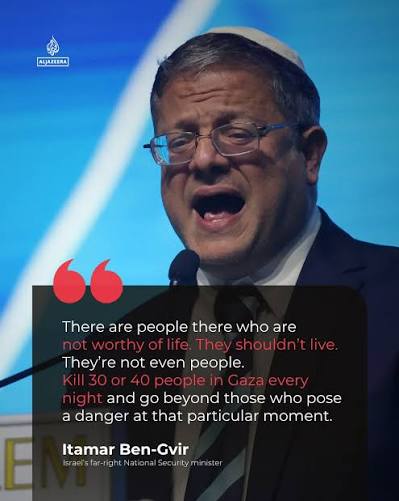
Itamar Ben Gvir, Israel’s far right national security minister, told a podcast hosted by former hostage Rom Braslavski that Israel should carry out targeted killings in Gaza and “take down 30 to 40 every night”. He explicitly said the policy should extend beyond people presenting an immediate threat, adding that there were people in Gaza who were “not worthy of life” and “not even people”.
Ben Gvir also advocated Israeli settlement throughout Gaza and mass Palestinian emigration. He has no direct authority over the military, but he controls the ministry responsible for Israel’s police and prison system, leads a party whose support has been important to Benjamin Netanyahu’s coalition, and holds one of the most senior security positions in government. The Associated Press reported that previous statements by Ben Gvir had already been cited in proceedings before the International Court of Justice as possible evidence of genocidal intent.
His comments do not by themselves determine the legal responsibility of the Israeli state, particularly because he does not command military operations. They nevertheless make it increasingly difficult to treat accusations of dehumanisation and destructive intent as propaganda unworthy of discussion.
Kushner makes reconstruction conditional on disarmament
The wider political context also shifted this week when Jared Kushner, President Donald Trump’s son in law and Middle East envoy, said Gaza would not be rebuilt until Hamas had disarmed.
Kushner had met Hamas officials in Egypt and Netanyahu in Israel in an attempt to revive a United States plan that links phased disarmament by Hamas to an Israeli withdrawal. The talks ended without a breakthrough because the two sides dispute the sequence. Hamas says Israel must stop attacking and begin withdrawing before the weapons process is completed, while Netanyahu says Israeli forces will not pull back until Hamas is fully disarmed.
In an interview with Fox News, Kushner said visible progress could begin within 30 days, with weapons removed and tunnels filled in over 60 to 90 days. If Hamas complied, he called the outcome an extraordinary security achievement for Israel. If it did not, he said Israel would gain greater United States and international support to “finish the job in the appropriate way”.
The phrase was especially charged after the destruction already inflicted on Gaza. It also placed civilian reconstruction behind a political and military condition that could take months or fail entirely. Reuters reported that Kushner and Netanyahu agreed reconstruction would not begin before disarmament, while more than 1,200 Palestinians and four Israeli soldiers had been killed since the October 2025 ceasefire, according to Gazan and Israeli authorities.
On 18 August, one day after Kushner left the region, an Israeli strike on a café at Gaza City’s fishing harbour killed at least six Palestinians and wounded 14, according to local health officials. The Israeli military said it had targeted Hamas commanders and other militants, including people involved in the 7 October attacks, but released no supporting evidence. Hamas accused Israel of trying to sabotage the peace plan. Reuters reported that the location had become a displacement camp for Palestinian families.
A similar controversy in Britain
The dispute over whether Jewish identity should be equated with support for Israel is not confined to Florida.
In Britain, The Economist promoted a profile of Green Party leader Zack Polanski, who is Jewish, by saying that many British Jews viewed him as “a traitor to his origins” rather than a disciple of Jewish ideas. The post said he had embraced the “anti Israel fervour” of the new left.
Polanski called the wording antisemitic. His critics have raised legitimate questions about antisemitic statements made by a small number of Green candidates, some of whom were suspended or arrested, and The Economist profile addressed those controversies. Yet the promotional language produced a different argument: that a Jewish politician’s opposition to Israel might make him a traitor to his own origins.
Critics also noted that The Economist had previously estimated that between 77,000 and 109,000 Palestinians may have been killed violently during the first 19 months of the assault, representing roughly four to five per cent of Gaza’s population before the war. That estimate excluded deaths from hunger, disease and the destruction of healthcare. The contrast was difficult to miss: a publication that had itself described a possible loss on that scale was presenting opposition to Israel’s actions as ideological fervour and questioning the Jewish authenticity of a politician who voiced it.
That implication mirrors the problem in Milberg’s opening question. Jewish people may support Israel, oppose its government, reject Zionism, defend Zionism while condemning the Gaza campaign, or hold combinations of those positions. Treating Jewish identity as a duty of political loyalty to Israel both erases that diversity and risks making Jewish communities collectively responsible for the decisions of the Israeli state.
The issue is not resolved by pretending antisemitism is imaginary. Antisemitic attacks and threats are real, have risen sharply and require serious action. The distinction that must be protected is between hostility towards Jewish people and criticism of a state, its army and the foreign governments that arm it.
A fact check that failed its own test
Milberg had every right to challenge Larkin. Candidates for Congress should expect demanding questions about military assistance, Israel’s security, Hamas, civilian casualties, antisemitism and the legal meaning of genocide. The problem was not that she questioned his conclusion. It was that she repeatedly presented her own contested and, in crucial respects, inaccurate account as settled fact while preventing him from giving the evidence behind his answer.
The record shows that Larkin correctly identified genocide findings by Amnesty International and B’Tselem. A United Nations appointed commission had also concluded that Israel committed genocide and later found that Palestinian children had been deliberately targeted. The International Court of Justice has not delivered a final judgment, but it has ordered provisional measures under the Genocide Convention and the case remains active. Major scholars agree with the genocide description, while Israel and other experts reject it.
That is the reality viewers should have been told. The legal debate is serious, contested and consequential. It cannot responsibly be reduced to a television presenter saying “factually incorrect” until the interview ends.
The viral clip became more than a difficult campaign interview because it exposed a broader failure in Western media coverage. The evidence from Gaza is often treated not as material to be investigated, but as an assertion to be suppressed whenever it threatens a long established political narrative. In this case, the attempted fact check did not settle the argument. It revealed how much of the argument the public had been denied.