
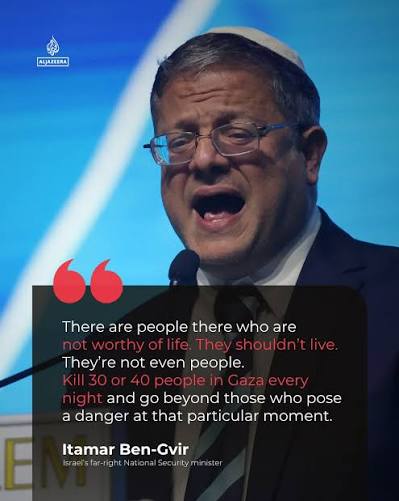

Itamar Ben-Gvir – sanctioned by Britain and four allied governments, convicted eight times by Israel’s own courts – tells the podcast of a former prisoner of war that Gazans ‘shouldn’t live… they’re not even people’.
The so-called Jewish State’s international pariah status – and its general disgrace not only within diplomatic circles but among the global population at large – appears complete thanks to the words of the previously convicted criminal Israeli national security minister, Itamar Ben-Gvir on Sunday.
Speaking on ‘October 8’, the podcast of the former Israeli prisoner of war Rom Braslavski, in its first episode, published at the weekend, Ben-Gvir said he disagreed with Benjamin Netanyahu’s reduction of attacks under the ceasefire and wanted Israel to conduct targeted killings in Gaza, eliminating 30 to 40 people every night. ‘Not just those who pose an immediate threat – there are people there who are not worthy of life. They shouldn’t live. They’re not even people,’ he said. Braslavski, a serving IDF soldier on leave from the army’s Logistics Corps when he was captured while working security at the Nova festival on 7 October 2023, was held by Palestinian Islamic Jihad for more than two years before his release under the October 2025 ceasefire.
He went further still. ‘I see all of Gaza as ours,’ Ben-Gvir told Braslavski, calling for Israeli settlements ‘not just in Gush Katif but throughout Gaza’, for ‘as much emigration as possible’ of Palestinians and, ‘for the terrorists, no emigration, nothing, just to kill them one by one’. Even Gazans whom some ‘might consider uninvolved’ should not be spared, he argued, describing a woman who brought Braslavski food during his captivity as ‘a terrorist for all intents and purposes’.
Braslavski had a request of his own. ‘I have a personal request,’ he told the minister, asking to be ‘the one who hangs them’ – the Palestinian prisoners held in Israel’s jails. ‘I don’t want a rope,’ Braslavski said. ‘With my own hands I will execute every terrorist in the State of Israel.’
‘I promise you I’ll try and turn the world upside down to make this happen,’ Ben-Gvir replied, adding that it was one of his dreams to see released Israeli prisoners of war executing Palestinians and that Braslavski was ‘the right person in the right place… to hang and execute them one by one’. ‘They don’t deserve to live,’ the minister said of the prisoners.
Ben-Gvir’s latest words may yet be his lowest, resembling as they do the Nazi term ‘Untermensch’, which translates literally from the German as ‘subhuman’ or ‘under-human’. The language echoes that of his cabinet colleague Yoav Gallant, then Israel’s defence minister, who announced the collective punishment of Gaza’s civilians when he initiated a total siege of the Strip following the 7 October 2023 Hamas attacks, declaring: ‘We are fighting human animals.’
Since the ceasefire took effect on 10 October 2025, Israeli forces have killed at least 1,260 Palestinians in Gaza, according to the territory’s health ministry. UNICEF reports that at least 300 of them were children – an average of one child killed every day for the 300 days of the ‘truce’.
Born near Jerusalem to a family of Iraqi Kurdish descent, Ben-Gvir has been convicted by Israel itself eight times, for offences including incitement to racism and supporting a terrorist organisation. As a teenager, his views were so extreme that the Israeli army barred him from compulsory military service. His mother, Shoshana Ben-Gvir, fought at the age of 14 in the Irgun – described in contemporary Pathé newsreels as a Jewish terrorist organisation, and later absorbed into the newly formed Israeli army – and was arrested by the British in Mandatory Palestine. The Irgun’s bombing of the British administrative headquarters in Jerusalem’s King David Hotel in 1946 killed 91 people and injured 46.
In May 2026, Ben-Gvir sparked a severe international diplomatic crisis by publishing a video of himself mocking and taunting bound, kneeling activists seized from the Gaza-bound Global Sumud Flotilla at Ashdod port. Following their deportation, activists came forward with harrowing testimonies alleging torture and sexual abuse in Israeli custody; Israel’s Prison Service denied the allegations. France responded by banning Ben-Gvir from its territory and opening a war crimes investigation, while Italian prosecutors placed him under criminal investigation for alleged torture and kidnapping. Two years earlier, a leaked video from the Sde Teiman military detention camp appeared to show the gang rape and severe sexual assault of a Palestinian detainee by Israeli army reservists.
Richard Powell, author of the definitive record of the ongoing genocide in Palestine, Pariah: How Gaza Broke Israel, said Ben-Gvir was running out of controversial things to say.
‘This is a man whose wife gave him a birthday cake with a noose pictured on it, celebrating the passing of a law that makes execution the default sentence for Palestinians convicted in Israel’s military courts – courts with a conviction rate above 99 per cent. The same man was reported by Israeli media in June to have urged the security cabinet to seize the “women and youth” of Hezbollah operatives and take them to Israel’s prisons – prisons B’Tselem has documented as a network of torture camps – because, in his words, “that’s what hurts them the most”. This is the colour and shape of the man, and this is his “most moral army in the world”.’
Powell added: ‘UNRWA’s Philippe Lazzarini has said repeatedly that there are no words left that can do any justice to the people of Gaza or describe their living hell – but here is Ben-Gvir creating new words for us, cementing Israel’s reputation in the eyes of the world as it continues to commit this sickening genocide and occupies more and more of Palestine with mind-bending levels of cruelty to its citizens.
‘There is strong competition for the title of most disgusting human being who has ever lived,’ Powell said, ‘but Ben-Gvir has devoutly dedicated every minute of his life to attaining it.’
At Ben-Gvir’s 50th birthday party on 2 May 2026, his wife, Ayala, presented him with a cake bearing the image of a noose and the words ‘Sometimes dreams come true’ – one of two noose cakes at a celebration attended by senior police commanders, the prison service commissioner, the defence minister and the Knesset speaker. The cakes celebrated legislation championed by Ben-Gvir and passed by the Knesset in March by 62 votes to 47, making the death penalty the default sentence for Palestinians convicted in military courts of deadly attacks. Israeli and international human rights organisations have condemned the law as discriminatory: its practical effect falls overwhelmingly upon Palestinians, who are prosecuted through military courts, rather than upon Jewish Israelis convicted of comparable violence, who are ordinarily tried in the civilian system. UN experts have warned that it effectively singles out Palestinians for execution. In May, the Knesset separately approved a bill sponsored by Ben-Gvir’s party establishing public trials and the death penalty for Palestinians accused of taking part in the 7 October attacks.
His proposals for Lebanon, meanwhile, were made against the background of extensive evidence concerning the treatment of Palestinians in Israeli custody. B’Tselem, the Israeli human rights organisation, has documented the prison system overseen by Ben-Gvir as a network of torture camps, publishing testimony alleging systematic physical and psychological abuse, deliberate starvation, medical neglect and sexual violence. The Israel Prison Service denies the allegations of systemic abuse and maintains that it operates in accordance with the law. At least 104 Palestinian prisoners have died in Israeli custody since 2023, according to figures reported by Haaretz in June, and rights groups estimate that more than 9,000 Palestinians are held in Israel’s detention facilities.
An Israeli court this month blocked Ben-Gvir’s plan to dig crocodile-filled moats around prisons holding Palestinians.
Itamar Ben-Gvir’s statements and actions
1. Calling for Gaza’s food and humanitarian aid depots to be bombed
Dates: 16 and 23 April 2025
During Israel’s blockade of humanitarian supplies entering Gaza, Ben-Gvir said no food or assistance should be admitted while Israeli prisoners of war remained in Gaza. One week later, following a gathering at Donald Trump’s Mar-a-Lago estate, he publicly advocated attacking humanitarian stockpiles.
‘The food and aid depots should be bombed in order to create military and political pressure.’
Ben-Gvir claimed senior Republicans supported his position. The US State Department said the assertion was unconfirmed and contradicted American policy. His intervention came while humanitarian organisations were warning of acute hunger and rapidly diminishing food supplies in Gaza.
2. Advocating Palestinian emigration and Israeli resettlement of Gaza
Dates: 28 January and 14 May 2024
Ben-Gvir addressed conferences and demonstrations promoting the removal of Palestinians and the reconstruction of the Israeli settlements dismantled when Israel withdrew its settlers from Gaza in 2005.
‘Encourage the voluntary departure of Gaza’s residents… It is ethical! It is rational! It is right!’
At the January 2024 ‘Settlement Brings Security’ conference, Ben-Gvir invoked the Torah and said Israel should ‘encourage them to leave’. In May, he described encouraging Palestinian emigration as ‘the only way’.
Legal specialists and human rights organisations argue that migration cannot meaningfully be considered voluntary when people are living under bombardment, siege, displacement and deprivation. Depending upon how such a policy was implemented, it could constitute unlawful forcible transfer or ethnic cleansing.
3. Proposing the detention of Hezbollah members’ women and young people
Date: 9 June 2026
During a security cabinet discussion concerning Lebanon, Ben-Gvir reportedly proposed territorial occupation, the killing of large numbers of Hezbollah fighters and the imprisonment of the women and young people associated with them.
‘Let’s start thinking outside the box about Hezbollah – conquering territory and killing many terrorists, but also arresting their women and youth and taking them to terrorist prisons. That’s what hurts them the most.’
The proposal, reported by Israeli media, appeared to advocate seizing relatives or civilian associates as leverage against Hezbollah, raising serious concerns about hostage-taking and collective punishment. Under international humanitarian law, civilians may not be detained in order to pressure an armed group.
4. Mocking and threatening Marwan Barghouti inside his prison cell
Date: video published 15 August 2025
Ben-Gvir published a 13-second video showing him confronting a visibly gaunt Marwan Barghouti in Ganot Prison. Barghouti, one of the most prominent and popular Palestinian political figures, had not been seen publicly for years.
‘You won’t win. Whoever messes with the nation of Israel, whoever murders our children and women, we will wipe them out.’
When Barghouti attempted to respond, Ben-Gvir interrupted him before the video abruptly ended. The Palestinian Authority described the confrontation as a direct threat, while the United Nations called the footage disturbing. Ben-Gvir’s office denied that his words constituted a personal threat.
Barghouti was arrested in 2002 and convicted by an Israeli court in 2004 of involvement in attacks during the Second Intifada. He refused to recognise the court’s jurisdiction and did not present a defence. He remains a major figure within Fatah and is regarded by many Palestinians as a national hero and potential unifying leader, sometimes described as the ‘Palestinian Mandela’.
5. Standing over bound Palestinian prisoners and calling for their execution
Date: 31 October 2025
Ben-Gvir posted footage showing himself beside Palestinian detainees lying face down with their hands tied behind them. He described the prisoners as members of Hamas’s Nukhba force, praised their harsh treatment and called for an additional measure.
‘But there’s still something that must be done: death penalty for the terrorists.’
In the accompanying caption, Ben-Gvir boasted that prisoners subjected to the system established under his leadership were ‘afraid’ and ‘trembling’. His Ministry of National Security oversees the Israel Prison Service, giving these statements direct institutional significance.
6. Championing the death penalty and celebrating with noose imagery
Dates: 30 March, 2 May and 4 May 2026
Ben-Gvir was the principal political champion of legislation making the death penalty the default sentence for Palestinians convicted in military courts of specified fatal attacks – a law whose supporters, Ben-Gvir’s party members among them, adopted the noose as their symbol, wearing noose-shaped lapel pins in the Knesset for months.
After the parliament passed the legislation by 62 votes to 47, he declared:
‘Whoever chooses terror chooses death.’
Critics describe the law as discriminatory because Palestinians are prosecuted through military courts while Jewish Israelis accused of comparable violence are ordinarily tried through the civilian system. Germany, France, the UK, Italy, New Zealand and Australia expressed deep concern over the legislation and urged Israel to abandon it, while UN experts warned that it violates international law and effectively singles out Palestinians for execution.
At Ben-Gvir’s 50th birthday party on 2 May, his wife presented him with a cake bearing a noose and the inscription:
‘Sometimes dreams come true.’
Senior police and prison officials attended the celebration. Two days later, Ben-Gvir posted an artificial-intelligence video featuring gallows and nooses while presenting the execution of Palestinian prisoners as a political dream.
7. Defending soldiers arrested over alleged abuse at Sde Teiman
Date: 29 July 2024
When military police detained reservists suspected of severely beating and sexually assaulting a Palestinian detainee at the Sde Teiman military facility, Ben-Gvir condemned the investigation.
‘The spectacle of military police officers coming to arrest our best heroes at Sde Teiman is nothing less than shameful.’
Members of Ben-Gvir’s party joined demonstrations surrounding the investigation, while far-right protesters and politicians broke into military facilities.
Five soldiers were eventually charged, but the military dropped the case in March 2026, citing evidential problems, the complainant’s return to Gaza and concerns about securing a fair trial. The dismissal meant that there would be no trial; it was not a judicial determination that the alleged abuse had never occurred.
8. Saying he would build a synagogue at the Al-Aqsa compound
Date: 26 August 2024
Ben-Gvir repeatedly challenged the longstanding arrangements governing the Al-Aqsa Mosque compound, known to Jews as the Temple Mount. During an Army Radio interview, he said an Israeli flag would already be flying there if he controlled policy.
Asked repeatedly whether he would establish a synagogue at the site, Ben-Gvir answered:
‘Yes, yes, yes, yes.’
Prime Minister Benjamin Netanyahu’s office immediately insisted that there had been no change to the status quo. Israeli security officials and cabinet ministers warned that Ben-Gvir’s statements could provoke bloodshed at one of the world’s most politically and religiously sensitive locations.
9. Declaring that Jewish settlers’ rights outweighed Arab freedom of movement
Date: 23 August 2023
During a television interview concerning movement restrictions in the occupied West Bank, Ben-Gvir said:
‘My right, the right of my wife and my children, to move around Judea and Samaria is more important than freedom of movement for the Arabs.’
Addressing Arab Israeli journalist Mohammad Magadli, Ben-Gvir added that his right to life came before Palestinians’ right to movement. He defended the statement as a security argument, but it was internationally condemned as inflammatory and racist. Critics cited it as an unusually candid description of the unequal rights imposed upon Israelis and Palestinians in the occupied West Bank.
10. The Rabin provocation, Kahanist conviction and admiration for Baruch Goldstein
Dates: October 1995 to January 2020
The interconnected extremist activities through which Ben-Gvir acquired national notoriety began long before he entered government.
In October 1995, the 19-year-old Ben-Gvir appeared on television holding a Cadillac emblem taken from Prime Minister Yitzhak Rabin’s car during a far-right protest.
‘We got to his car, and we’ll get to him, too.’
Rabin was assassinated several weeks later by Jewish extremist Yigal Amir. Ben-Gvir was not implicated in or connected to the assassination, but the recording became an enduring symbol of the inflammatory political atmosphere preceding the murder.
On 25 June 2007, a Jerusalem court convicted Ben-Gvir of incitement to racism and supporting a terrorist organisation over signs he carried during incidents in 2001 and 2002.
‘Expel the Arab enemy.’
Another sign declared:
‘Rabbi Kahane was right: the Arab MKs are a fifth column.’
The second sign was treated as support for the outlawed Kach movement, an organisation designated as terrorist by Israel itself.
For years, Ben-Gvir also displayed a portrait of Baruch Goldstein in his home. Goldstein murdered 29 Palestinian worshippers and wounded more than 100 others inside the Ibrahimi Mosque in Hebron in 1994. In 2019, Ben-Gvir defended the portrait by claiming that Goldstein had ‘saved dozens of Jews’, while also saying that he opposed killing innocent Arabs. He removed the portrait in January 2020 after it became an obstacle to an electoral alliance – a decision presented as a political concession rather than a repudiation of Goldstein or the extremist ideology with which the killer was associated.
Britain, Canada, Australia, New Zealand and Norway imposed sanctions on Ben-Gvir in June 2025 over repeated incitement of violence and serious abuses of Palestinian human rights. The measures included asset freezes and travel restrictions. France barred him from its territory in May 2026.
Richard Powell is the author of Pariah: How Gaza Broke Israel (Videowire, 2026), available at pariahbook.com.