
With almost every school building damaged and hundreds of thousands of children deprived of normal education, makeshift classrooms in tents, mosques and libraries are trying to preserve learning and hope amid Gaza’s devastation.
Beneath sheets of tarpaulin suspended between olive trees in the Sheikh Radwan neighbourhood of northern Gaza City, 13 year old Saida Abdullah stood before several dozen children and led them through the morning chants that now mark the beginning of a school day.
There were no classroom walls around them, no rows of desks, no blackboard and no shelves of textbooks. Some of the children sat on the ground inside two tents while others gathered in the open air. Yet on a patch of farmland surrounded by the physical and psychological wreckage of nearly three years of war, the pupils of Al Karama School had returned to something resembling a daily routine.
The makeshift school is one of a growing number of community education projects created by Palestinian teachers, parents and volunteers in an attempt to rescue a generation whose formal education has been shattered by Israel’s military campaign in Gaza.
Al Karama accommodates about 200 boys and girls between the ages of four and 17. Its facilities are minimal and its curriculum has been reduced to four essential subjects: Arabic, English, mathematics and science. Physical education, art, technology, civics and other subjects taught before the war have been abandoned because the staff lack the time, space and resources to provide them.
Even this limited programme represents an extraordinary achievement in a territory where almost the entire school system has been damaged or rendered unusable, teachers and pupils have been killed in large numbers, families have been repeatedly displaced, and basic items such as notebooks and pencils are in desperately short supply.
For the children who attend, Al Karama is more than an improvised classroom. It is an attempt to restore stability, human contact and hope in lives defined by bombardment, hunger, bereavement and fear.
An education system reduced to rubble
Before October 2023, Palestinians in Gaza and the West Bank had achieved a literacy rate of more than 97 per cent, according to figures cited by Drop Site News. That educational tradition has been placed in profound danger by the destruction of Gaza’s schools and the prolonged exclusion of children from conventional learning.
UNICEF estimates that close to 700,000 Palestinian children have been deprived of formal education in Gaza for almost three consecutive years. The scale of physical destruction means that returning to ordinary classrooms is not simply a matter of reopening school gates.
Nearly 98 per cent of Gaza’s school buildings have been damaged, while more than 93 per cent, representing 526 of the territory’s 564 schools, require major rehabilitation or complete reconstruction before they can function again. Classrooms that remain structurally usable have frequently been turned into shelters for families who have nowhere else to live.
The human losses are equally devastating. Monir Abu Zaiter, the director of education in East Gaza, told Drop Site News that approximately 20,000 children of school age and more than 530 teachers have been killed by Israel during the war. Tens of thousands of other children have been wounded, many with injuries that will permanently affect their lives.
According to Abu Zaiter, about 19,500 students have left Gaza since the beginning of the conflict, further dispersing a school population already fractured by death and repeated displacement.
The ceasefire that came into effect in October 2025 reduced the intensity of the bombing campaign but did not end the killing. The report states that at least 300 children have been killed by Israeli forces since the agreement began, amounting to an average of approximately one child each day.
For those who have survived, the loss cannot be measured only in missed lessons. Years without regular teaching and practice have eroded basic literacy and numeracy, leaving many children far behind the level expected for their age. UNICEF warned in an April report that this educational decline will make it increasingly difficult for children to return to school and progress through the normal curriculum.
The longer the disruption continues, the greater the risk that temporary learning loss becomes a permanent social catastrophe.
A teacher displaced 13 times
Al Karama School was founded by its director, Ghadeer Odeh, after she returned to Gaza City following the October 2025 ceasefire.
Odeh and her family had been forced from their home soon after Israel began its assault in October 2023. During the months that followed, they were displaced 13 times, moving repeatedly through the Gaza Strip in an effort to escape bombardment and remain alive.
After the ceasefire took effect on October 10, 2025, Odeh returned to the north. One month later, she established Al Karama, telling Drop Site News that she wanted to confront the ignorance now threatening an entire generation.
Her response reflects a wider movement across Gaza. As the formal school network collapsed, teachers and residents began turning mosques, community centres, public libraries, tents and other available spaces into temporary classrooms. Hundreds of teachers have volunteered their labour despite facing the same displacement, shortages, trauma and insecurity as the children they serve.
The result is an improvised education system built from community determination rather than adequate funding or infrastructure.
Mohammed Al Koumi, a volunteer Arabic teacher, said these local projects combine instruction in core subjects with recreation and emotional support. Their purpose, he explained, is to relieve some of the burden imposed by the war and recover at least part of the education children have lost.
“Children in Palestine have the right to learn, play, and achieve the hopes and ambitions that the war has killed,” Al Koumi told Drop Site News.
That right remains difficult to exercise. Although the pace of military attacks has slowed, parents continue to fear that children travelling to or attending a makeshift school could be struck by bombs, shells or Israeli gunfire. Every lesson therefore takes place under the shadow of renewed violence.
Teaching traumatised children
The work at Al Karama is not confined to academic recovery. Teachers are also trying to help children process experiences that would overwhelm many adults.
The school places particular emphasis on psychological support because its pupils have endured almost three years of bombing, forced movement, hunger and loss. Many have witnessed the deaths of relatives, friends and neighbours. Others have lost their homes, their schools and the ordinary routines that once gave their lives structure.
During a summer camp held at the school, children sang and danced among the olive groves. They were also encouraged to speak about what they had seen and how the war had affected them.
Thirteen year old Mais Fayad described a childhood in which grief has become inseparable from survival. Speaking to other students, she said the war had destroyed homes and schools and killed what remained of their dreams. She described the fear and guilt felt by survivors who struggle to experience happiness while people around them continue to suffer.
“What heart could possibly hold all of this?” she asked.
Her words exposed one of the most serious challenges confronting Gaza’s teachers. They are not merely trying to rebuild knowledge after a prolonged interruption. They are teaching children whose emotional development has taken place amid repeated terror, deprivation and bereavement.
Recreation, conversation and the presence of trusted adults are therefore treated as essential parts of education. A song, a game or a shared dance cannot undo the harm, but these activities can offer moments in which children are allowed to behave like children again.
From the market back to the classroom
For many families, the collapse of education has been accompanied by the collapse of household income.
Aseel Shaher’s family was displaced more than seven times. Her husband lost his clothing shop, pushing the household into poverty and forcing their 12 year old son, Mohammed, to work in street markets so that the family could obtain food.
Shaher said she never wanted her child to work, but the family had no viable alternative. The opening of Al Karama allowed Mohammed to leave the market and return to his studies.
For his mother, that change represented more than a return to lessons. It was evidence that life in Gaza might still be capable of renewal.
Her family’s experience illustrates how the destruction of schools produces consequences far beyond lost academic attainment. When classrooms close and adult livelihoods disappear, children are more likely to enter work, assume responsibilities far beyond their age, or become permanently detached from education.
Community schools can interrupt that process, but their capacity is limited. They operate with scarce materials, uncertain funding and volunteer staff, while serving families whose most immediate concerns may still be food, shelter, medical treatment and physical safety.
Remote learning beyond the reach of most children
The Gaza Ministry of Education has attempted to expand access through remote learning. Teachers have recorded lessons and uploaded material to online platforms and mobile applications so that pupils can continue studying away from conventional school buildings.
In practice, however, online education remains inaccessible to most of Gaza’s children.
Telecommunications infrastructure has been severely damaged, internet service is unreliable, and electricity cuts are frequent. The blockade has also created an acute shortage of smartphones, computers and other equipment needed to access digital lessons.
Abu Zaiter said only 14 per cent of Gaza’s students are currently enrolled in online education. This leaves the overwhelming majority dependent on some form of physical classroom, even when that classroom consists of a tent, a courtyard or a cleared space beneath trees.
The digital divide has made local, face to face projects indispensable. It has also demonstrated the limitations of presenting remote education as a substitute for functioning schools in a territory where communications, electricity and household resources have all been devastated.
Hundreds of thousands return, but many remain excluded
Parents, teachers and volunteers have launched fundraising campaigns to obtain the most elementary classroom supplies. Some projects have succeeded in purchasing desks, tables and blackboards, while others continue to teach with almost nothing.
Together, government programmes and community initiatives have enrolled approximately 400,000 children in some form of education, according to Abu Zaiter. This is a significant achievement under extreme conditions, but it still leaves nearly 130,000 children, roughly one fifth of Gaza’s students, completely outside the educational process.
Local organisations and international bodies, including UNICEF, have provided support, but education officials say the assistance remains far below the level required.
The crisis is too large to be resolved through scattered donations and volunteer labour. Temporary schools can keep some children connected to learning, but they cannot replace a properly funded public education system with safe buildings, trained and paid staff, specialist services, equipment and a complete curriculum.
Abu Zaiter warned that projects such as Al Karama cannot be relied upon for years. He called for Gaza’s crossings to be opened so that construction materials, educational equipment and basic supplies can enter the territory. Without those resources, even the first stage of rehabilitating school infrastructure will remain impossible.
The list of urgent needs begins with concrete, glass and electrical equipment, but it extends to the simplest objects of childhood education: pencils, paper, notebooks, chairs and books.
Wardah Al Shanti’s journey from darkness to a master’s degree
The resilience visible beneath the tarpaulins of Al Karama is also present in Gaza’s battered universities, where students have continued to study through displacement, power failures, the destruction of campuses and the constant struggle to obtain food and water.
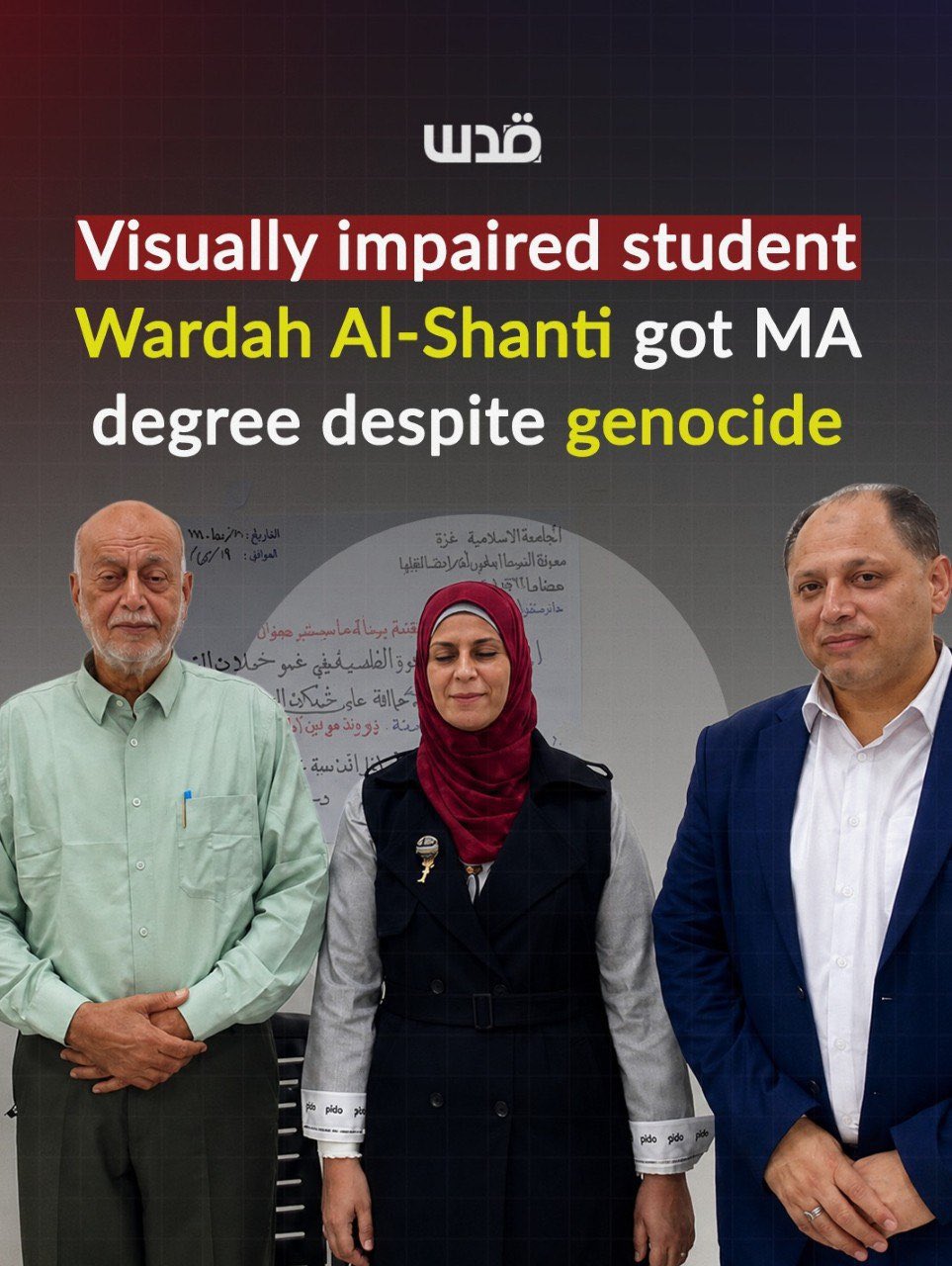
Among the most striking examples is Wardah Musa Al Shanti, a visually impaired Palestinian journalist who received a master’s degree from the Department of Journalism and Media at the Islamic University of Gaza in June 2026.
Her graduation completed an ambition she had pursued for more than a decade and under conditions that made ordinary academic work extraordinarily difficult. The university said Al Shanti completed her degree after living through exceptional circumstances in which even the most basic necessities were unavailable.
Al Shanti was born in 1992 to a Palestinian family originating from the village of Al Jiyya and grew up in the Maghazi refugee camp. According to a university profile published in 2015, she began losing her sight because of a rare retinal condition and became completely blind in April 2002, when she was ten years old.
Her father sought treatment, but the deterioration could not be stopped. Al Shanti continued her education at the Al Noor Centre for the Blind and later attended government schools, completing her secondary education with a mark of 86 per cent.
She wanted to study journalism, partly because she believed that a blind Palestinian woman had not previously completed the course she hoped to pursue. Some people around her questioned whether she could manage the demands of the profession, but she persisted and enrolled at the Islamic University to study Arabic with journalism as a minor.
During her undergraduate years, Al Shanti trained in radio presentation, produced reports for university courses and had work published in the university newspaper. She also experimented with television presenting, an experience that challenged her own doubts about whether a visual medium would be open to her.
Writing was central to her sense of purpose. She said it allowed her to carry the voices, suffering and hopes of ordinary people beyond the classroom and towards those with the power to act.
In that 2015 profile, when she was approaching the end of her undergraduate studies, Al Shanti said she hoped to remain at the university and obtain a master’s degree. Eleven years later, after Gaza’s universities had been bombed, teaching had been forced online and much of the population had been repeatedly displaced, she achieved that goal.
Her master’s thesis was titled Palestinian Public Attitudes Toward Facebook Awareness Campaigns on Disability Issues: A Field Study. It examined not only the public response to disability campaigns, but also the way media organisations and campaigners communicate questions of equality, discrimination and social inclusion.
The research found strong public support for disability awareness material on Facebook and identified video as the most effective form of presentation among those surveyed. Al Shanti recommended improving the production of short videos, digital stories, infographics and interactive content. She also called for lasting partnerships between media institutions, organisations representing people with disabilities and government bodies, together with specialist training for those responsible for designing and managing awareness campaigns.
Her achievement is significant not simply because she overcame blindness or completed advanced study during a devastating war. It also represents the persistence of Palestinian intellectual life when the physical institutions intended to sustain it have been attacked and severely damaged.
Gaza is still educating its next generation of journalists
Al Shanti’s graduation carries additional weight because journalism has become one of the most dangerous professions in Gaza.
The number of Palestinian journalists killed since October 2023 varies between monitoring organisations because each applies different definitions and verification standards, while the destruction of records, communications failures and the exclusion of foreign reporters make independent investigation exceptionally difficult.
The Committee to Protect Journalists had documented 207 Palestinian journalists and media workers killed by Israeli forces in Gaza as of its June 25, 2026 update. It recorded another Palestinian journalist killed by an armed group inside Gaza. CPJ said Israeli forces had killed more journalists than any government since the organisation began collecting data in 1992, making the conflict the deadliest it has ever recorded for the press.
CPJ has concluded that at least 75 journalists and media workers across the regional conflict were directly targeted and killed by Israeli forces in reprisal for their work, while many other suspected targeted killings remain under investigation. The Israeli military has repeatedly denied deliberately targeting journalists and has disputed the civilian status of some people included in casualty reporting.
The International Federation of Journalists uses a broader verified list compiled with the Palestinian Journalists’ Syndicate. It has documented at least 240 Palestinian journalists and media workers killed in Gaza, with 267 journalists and media workers killed across the wider war. The IFJ says about 1,300 Palestinian journalists have continued reporting from inside the territory, almost all of them displaced and many mourning relatives and colleagues.
Because Israel has largely prevented independent foreign reporters from entering Gaza, Palestinian journalists have remained the principal witnesses available to the outside world. They have worked through bombardment, hunger, bereavement, displacement, communications blackouts and the destruction of newsrooms, often using mobile telephones and partially charged equipment to document events.
Against that background, Gaza’s continued education and graduation of journalists is an extraordinary assertion of survival.
The territory’s journalism departments have tried to preserve courses through online teaching, compressed timetables and agreements allowing students to complete individual modules remotely at universities in the West Bank. Practical subjects such as photography, editing, sound engineering and television production have been much harder to maintain because laboratories, studios, equipment, electricity and reliable internet connections are unavailable.
Yet students have not simply waited for normality to return. Reporting by the Al Jazeera Media Institute found journalism and digital media students completing assignments from displacement tents, turning mobile phones into production tools and creating stories about the humanitarian conditions surrounding them.
University departments have placed students with local, regional and international media organisations as trainee correspondents. Some proved so capable that news outlets began relying upon them as sources and contributors during the war. Others entered the field before completing their final projects, discovering that the streets, hospitals, shelters and ruins of Gaza had become a brutal and dangerous training ground.
The Palestinian Journalists’ Syndicate also opened media solidarity centres in Khan Younis and Deir Al Balah, providing places for students and graduates to work, receive training and obtain psychological support. The centres hosted discussions of graduation projects after university studios and laboratories were destroyed. Emergency professional membership was offered to some graduates so they could continue reporting.
This does not replace the education they lost or reduce the danger they face. Nor should the language of resilience be used to excuse the conditions imposed upon them. Every new graduate enters a profession in which hundreds of Palestinian colleagues have been killed and where the protections normally associated with a press badge have repeatedly failed.
Nevertheless, Al Shanti’s degree and the persistence of Gaza’s journalism students represent a remarkable refusal to surrender the future. At the very moment when so many established reporters have been silenced, new Palestinian journalists are still studying, completing research, defending graduation projects and preparing to document what happens next.
Their education has become part of the same struggle visible at Al Karama School. One generation teaches beneath sheets of tarpaulin while another learns to record the history unfolding around it. Both are preserving knowledge in the face of overwhelming odds, and both insist that destruction will not be permitted to have the final word.
The danger of a stolen future
The destruction of education is one of the war’s least reversible consequences. Buildings can eventually be reconstructed, but lost years of childhood cannot be restored in the same way. Every additional month outside a stable classroom increases the risk that pupils fall further behind, leave education permanently, enter exploitative labour or carry unaddressed trauma into adulthood.
Gaza’s community schools and damaged universities are trying to prevent that future with resources that would be considered wholly inadequate almost anywhere else. Their significance lies not in their ability to replace the system that was destroyed, but in their refusal to accept that an entire generation should be abandoned.
At Al Karama, that refusal can be seen in teachers giving lessons without blackboards, parents sending children to class despite their fear, and pupils gathering beneath tarpaulins to read, count, sing and speak about their lives.
The school’s existence is an act of persistence, but it is also an indictment of the conditions that made such improvisation necessary.
Addressing her classmates, Fayad described the children of Gaza as broken by war and deprived of their schools, dreams and ambitions. Her concluding questions were simple: Do the children of Gaza not have the right to learn, to live in safety, to pursue their dreams and to sleep without fear?
Those questions reach far beyond the olive grove in Sheikh Radwan. They confront governments and international institutions with the cost of allowing Gaza’s educational emergency to continue, and with the possibility that the war may not only have destroyed the schools of the present, but stolen the future those schools were meant to build.