
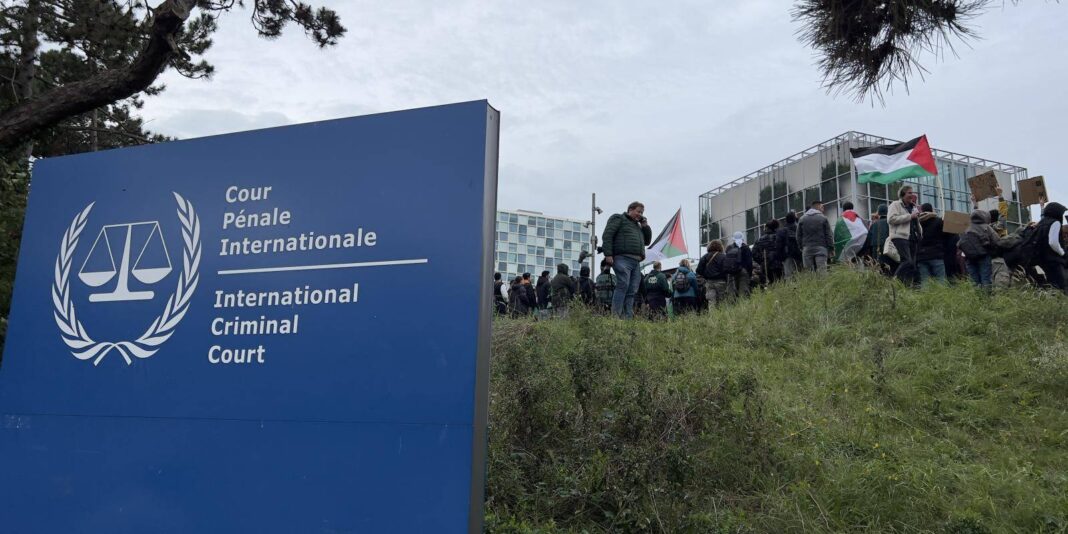

The unprecedented dismissal of the International Criminal Court’s chief prosecutor has triggered a struggle over far more than one man’s conduct. Former UN human rights official Craig Mokhiber argues that Washington’s sanctions, Israel’s campaign against its arrest warrants and mounting pressure on international institutions form part of a wider assault on the postwar legal order.
The dismissal of Karim Khan as chief prosecutor of the International Criminal Court was unprecedented, but it was not unexpected. On July 24, 2026, the Assembly of States Parties to the Rome Statute voted by secret ballot to remove the British barrister from office after a prolonged and bitter disciplinary process concerning allegations of sexual misconduct involving a junior member of his staff.
Eighty two of the court’s 125 member states supported Khan’s removal. Thirteen voted against it and others abstained or did not participate. Khan has consistently denied wrongdoing and said through his lawyer that he will challenge the lawfulness and fairness of the process. The woman at the centre of the case has maintained that she was subjected to coercive and nonconsensual sexual conduct, allegations that must be treated seriously and independently of the political battles surrounding the court. A second woman has also made allegations about Khan’s conduct earlier in his career, which he denies.
Yet the vote arrived at one of the most politically explosive moments in the ICC’s history. Khan was the prosecutor who sought arrest warrants for Israeli Prime Minister Benjamin Netanyahu and then defence minister Yoav Gallant over alleged crimes committed in Gaza. He was also operating under sanctions imposed by the United States, while Washington was publicly declaring its intention to disable the court and urging other countries to turn against it.
For Craig Mokhiber, an international human rights lawyer who served for more than three decades at the United Nations, the collision of those events cannot be ignored. Speaking to Ali Abunimah and Nora Barrows-Friedman on The Electronic Intifada livestream, Mokhiber said the removal process had to be examined alongside the sustained effort by Israel and the United States to intimidate ICC personnel and protect Israeli officials from prosecution.
His argument was not that misconduct allegations should be disregarded, nor that outsiders could know what happened between Khan and the staff member. Mokhiber acknowledged that hierarchical organisations create serious power imbalances and fertile conditions for abuse. His concern was that a disciplinary case with contested procedures unfolded inside an institution already under exceptional external attack, before being settled by a political body composed of states.
An allegation, a disputed process and a political decision
The process against Khan moved through several stages. An initial internal inquiry did not proceed after no formal complaint was made at that stage. A subsequent investigation by the UN Office of Internal Oversight Services gathered testimony and evidence, after which a panel of senior judges analysed the material and the applicable standards. The executive committee of the ICC’s governing bureau nevertheless concluded that Khan had committed serious misconduct and referred the matter to the full Assembly of States Parties.
Khan’s lawyers and supporters have argued that he was denied a fair opportunity to answer the case and that the judicial analysis did not establish misconduct under the applicable rules. The Assembly reached the opposite institutional conclusion and removed him under Article 46 of the Rome Statute. Reporting on the vote confirmed that the dismissal does not itself cancel any arrest warrant already issued by the court.
Legal opinion remains divided over how the earlier judicial analysis should be understood. Critics of the process regard the Assembly’s intervention as a political reversal of a legal finding. Other international lawyers have argued that the states were not acting as an appellate court at all: Article 46 gives them a separate responsibility to decide whether an elected official remains fit to lead the institution, closer to an impeachment judgment than a criminal conviction.
That distinction matters because two truths can coexist. The complainant’s allegations can demand a serious institutional response, while the governments voting on Khan’s future can simultaneously be subject to political pressure surrounding his work on Palestine. Treating either consideration as if it automatically extinguishes the other produces a false choice.
Mokhiber’s criticism focused on the imbalance in political energy. Many states that moved decisively against Khan have done little to execute the court’s warrants for Netanyahu and Gallant, even though states parties are generally required to cooperate with the ICC. Several Western governments have continued diplomatic, military or commercial relations with Israel while presenting themselves as defenders of international justice.
“This is a campaign of intimidation,” Mokhiber said, arguing that the message was directed not only at Khan but also at judges, deputy prosecutors, investigators, civil society groups and any future candidate for the prosecutor’s office.
The warrants at the centre of the storm
Khan applied for arrest warrants against Netanyahu and Gallant on May 20, 2024. Six months later, on November 21, a pretrial chamber rejected Israel’s jurisdictional challenges and issued the warrants. The judges said there were reasonable grounds to believe that the two men bore criminal responsibility for the war crime of starvation as a method of warfare and for crimes against humanity including murder, persecution and other inhumane acts. The ICC’s case record makes clear that these remain allegations to be tested in court, not convictions.
Israel rejects the court’s jurisdiction, denies committing the alleged crimes and says its military campaign has been directed against Hamas following the October 7, 2023 attacks. The United States, which is not a party to the Rome Statute, has also denounced the warrants as illegitimate. The ICC’s position is that it can exercise jurisdiction over alleged crimes committed in the territory of the State of Palestine, which joined the court in 2015, regardless of the nationality of a suspect.
Netanyahu celebrated Khan’s removal, but the decision did not erase the judicial orders against him and Gallant. Under the statute, warrants remain effective until the judges order otherwise. The immediate legal position is therefore unchanged, although the longer term danger lies in what the prosecution office does next. A future prosecutor could seek to withdraw charges, attempt to persuade judges to terminate the warrants or simply deprioritise the Palestine investigation until it withers through inaction.
That possibility makes the choice of Khan’s successor exceptionally important. Deputies Nazhat Shameen Khan and Mame Mandiaye Niang are running the office while the member states design an election process that is not expected to conclude before 2027. Any candidate must consider the likelihood of immediate US sanctions if the Palestine case continues.
The political pressure predated the arrest warrants themselves. Recordings reported in July 2026 showed Netanyahu and the late US senator Lindsey Graham discussing the ICC in telephone calls shortly before the 2024 US presidential election. According to reporting on the recordings, Netanyahu sought bipartisan pressure from Washington as the court considered warrants, while Graham helped enlist Democratic senators Ben Cardin and Richard Blumenthal in demanding an investigation into the allegations against Khan.
The recordings do not prove that the misconduct allegations were invented or directed by an intelligence service. The ICC’s governing body said it found no evidence that the complainant was acting for a third party, and she has publicly rejected suggestions that she was a state agent. What the material does show is that Israeli and American political figures recognised the allegations as a potential means of challenging the prosecutor while the warrants were pending.
Washington promises to dismantle the court
The broader US campaign is no longer covert or implied. In February 2025, President Donald Trump issued an executive order authorising asset freezes and entry restrictions against ICC officials and others assisting investigations of protected US or allied personnel. The order called the warrants against Netanyahu and Gallant baseless and described the court’s actions as a threat to American national security and foreign policy.
By July 2026, Secretary of State Marco Rubio had moved from punishing individuals to openly targeting the institution. He announced a government wide diplomatic campaign to “dismantle the ICC, brick by brick, if necessary,” asserting that the court posed an unacceptable threat to US sovereignty. Washington has sanctioned judges and prosecutors, including Khan, and has targeted organisations accused of helping the court’s Palestine investigation.
US officials maintain that neither Americans nor Israelis should be exposed to a tribunal their governments have not joined. Supporters of the ICC answer that territorial jurisdiction is a familiar principle of criminal law: when an alleged offence occurs on the territory of a member state, the nationality of the accused does not ordinarily remove the court’s authority. This disagreement is now being fought through financial restrictions, travel controls and pressure on states that depend on US diplomatic or economic support.
Five countries have recently begun leaving the institution. Burkina Faso, Mali and Niger initiated withdrawal procedures, followed by Venezuela and Chad. The departing governments have cited the ICC’s poor record, limited effectiveness and disproportionate focus on the Global South. Washington has encouraged the trend, while court observers warn that a widening exodus could weaken the tribunal’s resources and legitimacy. Reuters reported that US officials were considering pressure on countries to withdraw and that the court’s major supporters had offered rhetorical backing without announcing substantial protective measures.
Mokhiber argues that the Rome Statute already contains a possible answer. Article 70 gives the court jurisdiction over certain offences against the administration of justice, including corruptly influencing, intimidating or retaliating against court officials because of their duties. He contends that threats and sanctions directed at judges, prosecutors and cooperating organisations should be investigated under that provision.
Whether Article 70 could be applied to senior officials of states that never joined the court would provoke difficult questions about jurisdiction, evidence and enforcement. Mokhiber nevertheless argues that indictments could establish an official record and restrict the international movement of those accused, even if arrest were initially unlikely. Political power changes, he noted, and warrants can outlast the governments that once appeared able to ignore them.
He also called on the Netherlands, as the ICC’s host state, to protect court personnel and defend the institution’s ability to function. European governments could activate blocking measures intended to shield individuals and organisations from extraterritorial US sanctions, while groups of member states could coordinate financial, diplomatic and practical support. At the United Nations, Mokhiber proposed an emergency General Assembly session under the Uniting for Peace procedure as a way to bypass vetoes in the Security Council and mobilise wider resistance to attacks on international justice mechanisms.
These proposals would require political will that has so far been absent. European Union members have defended the ICC in statements, but people under sanctions can still face severe obstacles involving bank accounts, insurance, travel, accommodation and professional cooperation. For human rights organisations that depend on international financial systems and secure evidence sharing, those pressures can obstruct everyday work without a single courtroom order being issued.
From one prosecutor to the international legal order
Mokhiber places the ICC confrontation within a larger assault on the architecture built after the Second World War. In his account, pressure on the International Court of Justice, attacks on UN human rights experts, the defunding of humanitarian institutions and withdrawal from international bodies all serve the same objective: removing legal restraints from powerful states and their allies.
The comparison he draws is deliberately severe. Authoritarian movements have historically attacked or captured courts that could restrain executive power. What distinguishes the present campaign, he argues, is its international scale, with coercive measures exported through the global reach of the US financial system and deployed to protect Israeli impunity.
“If genocide is not a red line, there are no red lines,” Mokhiber said, using the term he has applied to Israel’s campaign in Gaza since resigning as director of the New York office of the UN High Commissioner for Human Rights in October 2023. Israel strongly rejects the genocide allegation. The International Court of Justice has issued provisional measures in the case brought by South Africa under the Genocide Convention, but those interim orders are not a final ruling on the merits.
The crisis also exposes the ICC’s longstanding credibility problem. The court has often been accused of concentrating prosecutions on weaker African states while failing to hold Western powers and their allies to the same standard. Its defenders saw the Netanyahu and Gallant warrants as evidence that this imbalance might finally be challenged. Its critics saw an illegitimate assertion of jurisdiction. Washington’s attempt to break the institution now risks confirming the suspicion that international criminal law is tolerated only when it is directed at official enemies.
The political ritual of Israel’s “right to exist”
The second part of Mokhiber’s argument moves from the machinery of prosecution to a foundational political claim. In a July 2026 essay for Mondoweiss, he challenged the demand that Palestinians and their supporters affirm Israel’s “right to exist,” describing the phrase as a political orthodoxy rather than a legal rule.
The question has acquired new urgency in Germany, where the Bundesrat advanced proposed legislation that would extend criminal penalties to certain public denials of Israel’s right to exist or calls for its elimination when the speech promotes a willingness to commit antisemitic violence or arbitrary acts. The proposal could carry a sentence of up to five years if it completes the legislative process. Germany has also incorporated responsibility for Jewish life and Israel’s security into its citizenship and constitutional debates, reflecting the country’s historical responsibility for the Holocaust.
Mokhiber’s starting point is narrower than the headline it produces. International law does not contain a general, freestanding and eternal “right to exist” belonging to states. States possess legal rights, including sovereign equality, territorial integrity and, within the limits of the UN Charter, self defence. Peoples possess the right to self determination. States themselves can dissolve, divide, merge, change constitutional form or be replaced without international law treating their previous configuration as immortal. The Soviet Union, Yugoslavia, Czechoslovakia and East Germany all disappeared, while their peoples and the rights of their populations did not.
From that premise, however, Mokhiber advances a much more contested conclusion. He argues that Israel’s creation and maintenance as a specifically Jewish state depended upon the violent displacement of Palestinians, the denial of Palestinian self determination and a continuing system of ethnic privilege. Because Palestinians inside Israel, those living under occupation and those expelled into the diaspora are not incorporated into a polity based on universal and equal suffrage, he says the state cannot claim to represent all the people entitled to political rights in historic Palestine.
In this analysis, the issue is not the physical safety or collective rights of Israeli Jews, which any lawful political order must protect. It is whether a state can claim a permanent right to preserve a preferred ethnic majority through exclusion, occupation or displacement. Mokhiber’s answer is that international law protects people, not an ethnonationalist constitutional structure.
He draws on the International Law Commission’s articles on state responsibility, which say that states must not recognise as lawful a situation created by a serious breach of a peremptory norm and must not aid in maintaining that situation. Such norms include the prohibitions of aggression, genocide, apartheid and forcible denial of self determination. The International Law Commission’s text also calls upon states to cooperate through lawful means to end a serious breach.
There is an essential legal distinction, however, between refusing to recognise an unlawful situation and denying the statehood of a UN member altogether. In its July 2024 advisory opinion, the International Court of Justice said states must not recognise as legal the situation arising from Israel’s unlawful presence in the occupied Palestinian territory and must not assist in maintaining it. The court’s ruling addressed the occupation, settlements and annexation measures; it did not order states to withdraw recognition from Israel within any final border or declare Israel’s UN membership void.
Israel was admitted to the United Nations in May 1949, and it is recognised as a state by most of the international community. Mokhiber’s call for nonrecognition and dismantlement of the existing regime is therefore an extension of legal principles into a radical political prescription, not a conclusion already adopted by the ICJ or the United Nations. His formulation is best understood as an argument for replacing an ethnically privileged state structure with a democratic order based on equal rights, Palestinian return and self determination across the whole territory.
That argument remains intensely contested. Supporters of Israel describe Jewish statehood as an expression of Jewish self determination and warn that denying it can conceal or encourage antisemitism. Palestinians answer that one people’s self determination cannot lawfully be constructed through another people’s dispossession and permanent subordination. Germany’s proposed law risks moving that dispute from politics and scholarship into criminal courts, where the state would decide which visions of Palestine’s constitutional future may be spoken aloud.
Iran and the return of force without restraint
The interview closed by widening the lens again, this time to the continuing war between the United States and Iran. A June 2026 memorandum of understanding raised hopes of a pause in hostilities and negotiations over the Strait of Hormuz and Iran’s nuclear programme, but the arrangement quickly fractured amid renewed attacks and mutual allegations of violations. US and Iranian forces subsequently exchanged missile and drone strikes across the region, including attacks involving American bases in Gulf states. Current reporting indicates that diplomatic contacts remain uncertain even as regional governments seek temporary arrangements to protect shipping.
Mokhiber characterised the initial US and Israeli attacks on Iran as aggression prohibited by the UN Charter and described Iran’s military response as lawful self defence. Washington has offered a different legal account, formally invoking Article 51 and arguing that its operations responded to attacks and continuing threats against the United States and its partners. The competing claims have not produced a common judgment from the Security Council, where the same geopolitical divisions that paralyse action over Gaza also shape the response to Iran.
Civilian harm has intensified the legal dispute. The destruction of the Shajareh Tayyebeh elementary school in Minab on February 28 killed more than 150 people, including about 120 children, according to Iranian figures cited by investigators and rights groups. Amnesty International called for accountability after evidence and preliminary reporting pointed to US responsibility, while the Pentagon’s investigation remained a central test of whether those responsible would be identified and held to account.
For Mokhiber, Iran’s ability to impose military and political costs marked the first consequential state level resistance to what he described as a wider US and Israeli regional project. He contrasted Tehran’s response with governments that had condemned violations rhetorically while continuing to accommodate American power. He also placed it beside nonstate resistance in Palestine, Lebanon and Yemen, as well as student encampments, flotillas, public demonstrations and civil society tribunals.
That framing will be rejected by those who regard Iran and allied armed groups as destabilising forces responsible for their own violations. Yet it illuminates the common thread running through Mokhiber’s analysis: international law loses meaning when it is invoked selectively, enforced against enemies and suspended for powerful allies. When courts cannot protect their own officials, warrants are ignored and military force escapes credible scrutiny, legal rules begin to look less like universal restraints than privileges allocated by power.
A court at the edge of survival
The ICC will survive Khan’s departure in a formal sense. Its judges remain in office, its investigations remain open and the warrants for Netanyahu and Gallant still stand. The more difficult question is whether the institution can continue in a meaningful form when its officials face sanctions, its members are being encouraged to leave and its next prosecutor may be punished merely for maintaining an existing case.
Khan’s removal should not be reduced to a simple morality play. Treating the vote only as proof of accountability ignores serious questions about political pressure and due process. Treating the allegations only as a conspiracy against the Palestine investigation risks erasing the complainant and reproducing the institutional abuses that international justice is supposed to confront.
The decisive test will be what happens after him. If the court investigates misconduct within its own leadership while continuing its cases without fear or favour, it may yet demonstrate that accountability is not selective. If the Palestine file is quietly abandoned and sanctions succeed in deterring the next prosecutor, the lesson received around the world will be very different.
The dispute is therefore no longer simply about Karim Khan, Benjamin Netanyahu or one set of arrest warrants. It is about whether international law can restrain powerful states when enforcement carries a cost, and whether the institutions created to judge atrocity can withstand a government that has openly promised to take them apart, brick by brick.