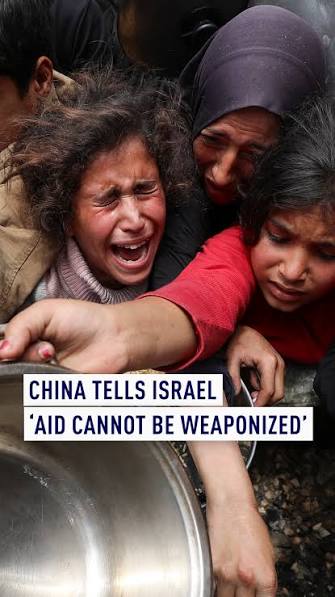
China’s Deputy Permanent Representative to the United Nations, Sun Lei, has demanded a genuine and lasting ceasefire in Gaza, an end to restrictions on humanitarian aid and irreversible action towards Palestinian statehood. His intervention continued a series of increasingly forceful Chinese statements accusing Israel of collective punishment and Washington of protecting it from accountability.
China places Gaza at the centre of the Middle East crisis
NEW YORK — China has delivered a sweeping condemnation of Israel’s conduct in Gaza, declaring that more than two million Palestinians remain trapped between death and displacement despite a ceasefire agreement reached more than nine months ago.
Addressing the United Nations Security Council on 28 July 2026, China’s Deputy Permanent Representative, Ambassador Sun Lei, rejected any attempt to treat the continuing destruction of Gaza as an unavoidable or permanent feature of Middle Eastern politics.
“Gaza is not a permanent battlefield, nor are suffering and turmoil the destiny of its people,” Sun told the Council.
His address placed Gaza and the unresolved Palestinian question at the centre of a wider regional crisis stretching from the occupied West Bank to Lebanon, Syria, the Red Sea and the Strait of Hormuz.
Although Sun also discussed Gulf security and international shipping, his first and most detailed demands concerned the Palestinian civilian population, Israeli military operations and the failure of the international community to convert a nominal ceasefire into meaningful protection.
“The suffering of civilians cannot continue, and peace and stability in Gaza must be restored,” Sun said.
“More than nine months have passed since the Gaza ceasefire agreement was reached, yet bombings, attacks, blockades and sieges have not ceased, and more than two million people remain unable to escape the threats of death and displacement.”
The speech amounted to a direct rejection of claims that the situation in Gaza had been stabilised through the ceasefire and the internationally backed transition plan endorsed by the Security Council in November 2025.
Sun said the continuing attacks, restrictions and territorial changes demonstrated that the agreement had not produced real peace.
“Lasting security can only be built on respect and mutual trust,” he said. “War and destruction will only breed hatred and confrontation.”
China called on Israel and all other parties to comply fully with the agreement and establish what Sun described as a “genuine and lasting ceasefire”.
The message was unambiguous: reducing the frequency or intensity of Israeli attacks could not be presented as peace while Palestinians continued to be killed, displaced and denied access to basic necessities.
Humanitarian access cannot be used as a weapon
Sun demanded the removal of Israeli restrictions on the entry of humanitarian supplies and defended the role of the United Nations Relief and Works Agency for Palestine Refugees, known as UNRWA.
“Israel must fulfil its obligations under international humanitarian law, lift restrictions on the entry of humanitarian supplies into Gaza, and ensure that humanitarian agencies, including the United Nations Relief and Works Agency for Palestine Refugees in the Near East, can carry out their relief operations,” he said.
China’s position directly challenged Israeli and American efforts to marginalise UNRWA and transfer humanitarian and administrative responsibilities to alternative mechanisms.
UNRWA has been one of the principal providers of food, shelter, education and medical assistance to Palestinian refugees. China has repeatedly described the agency as irreplaceable and as the backbone of humanitarian operations in Gaza.
Sun’s demands were supported by the briefing delivered to the Council by Ramiz Alakbarov, the UN Deputy Special Coordinator for the Middle East Peace Process and the organisation’s Resident and Humanitarian Coordinator.
Alakbarov had recently visited Gaza and told Council members that limited improvements in waste removal and sanitation could not conceal the continuing devastation.
He described crowded living conditions, widespread destruction, displacement and almost daily casualties resulting from Israeli military operations. Palestinian health workers and local organisations were attempting to reopen clinics, provide shelter and restore basic services, but their efforts were being overwhelmed by the scale of the damage.
The UN official said most families continued to rely on humanitarian assistance as their only lifeline. Restrictions on materials classified by Israel as having both civilian and possible military uses were preventing communities from repairing essential infrastructure or beginning recovery on the required scale.
He also reported an increase in Israeli air strikes and an expansion of the territory under Israeli military control, which had reached approximately one third of Gaza.
China’s position was that humanitarian relief should not be made dependent on political concessions or the progress of negotiations over Hamas, security arrangements or transitional administration.
That argument has become increasingly central to Beijing’s statements. Chinese officials have repeatedly warned that food, medicine, fuel, shelter materials and access to water cannot lawfully be used as instruments of pressure against a civilian population.
Israel disputes the humanitarian picture
Israel rejected much of the characterisation presented by China, the United Nations and several other delegations.
Its representative told the Council that hundreds of aid lorries were entering Gaza each day, food prices had fallen and medical capacity was improving. Israel said restrictions on certain materials remained necessary because items intended for civilian use could be appropriated by Hamas and converted to military purposes.
The Israeli delegation accused Hamas of obstructing humanitarian operations, refusing to disarm and attempting to preserve its political and military control. It argued that Hamas could play no part in the future administration of Gaza and called on the Security Council to impose sanctions on the organisation.
The United States similarly said implementation of its Gaza plan depended on the disarmament of Hamas and the transfer of authority to the National Committee for the Administration of Gaza.
Washington supported pilot reconstruction projects in southern Gaza, a new governing structure and the planned deployment of an international stabilisation force. Its representative also said UNRWA should have no future role in the territory.
China did not defend Hamas or reject the ceasefire plan in its entirety. Instead, it insisted that the treatment of civilians, the delivery of humanitarian assistance and the future of Palestinian governance could not be subordinated indefinitely to Israel’s military demands.
Sun also issued a warning about the creation of new governing mechanisms for Gaza.
“Any arrangement or new mechanism must adhere to the principle of ‘the Palestinians governing Palestine,’ respect the will of the Palestinian people, and promote rather than undermine the two State solution,” he said.
This was an important qualification of the United States backed transition process. Beijing was signalling that an externally constructed authority could not be allowed to replace Palestinian self determination, separate Gaza from the West Bank or create another indefinite period of international supervision without statehood.
China has warned about Gaza since the first days of the war
Sun’s intervention was not a new departure in Chinese policy. It was the latest in a series of statements through which Beijing has progressively accused Israel of collective punishment, violations of international humanitarian law and attempts to impose a political future on Gaza without Palestinian consent.
On 13 October 2023, less than a week after the Hamas attack on southern Israel and the beginning of Israel’s assault on Gaza, China’s then UN ambassador Zhang Jun expressed alarm over Israel’s declaration of a complete siege and its demand that the population of northern Gaza evacuate within 24 hours.
Zhang called on Israel to “stop the collective punishment of the people in Gaza” and warned that forced evacuation would artificially intensify the humanitarian disaster. He also said that neither Palestinian nor Israeli civilians should be targeted and called for diplomatic efforts to secure the release of hostages.
At a Security Council meeting on 24 October 2023, Zhang demanded an immediate ceasefire, the restoration of electricity, water and fuel, and the removal of the siege.
He told the Council that the root of the conflict lay in “the prolonged illegal occupation of Palestinian territories” and the continued denial of Palestinian statehood. China also opposed the forced displacement of Gaza’s population and demanded that Israel withdraw its evacuation order affecting the north.
On 10 November 2023, Zhang described the situation as not merely a humanitarian emergency but a “crisis of humanity”.
“A ceasefire is by no means a diplomatic statement,” he said. “It is the only hope for the people of Gaza to survive.”
China called for the immediate lifting of the siege, the opening of all available crossings, the protection of hospitals, schools, refugee camps and UN facilities, and an end to attacks on civilians.
Zhang also rejected attempts to decide Gaza’s postwar future without Palestinian involvement.
“No arrangement for Gaza can be imposed on the Palestinian people,” he said. “The future of Palestine must be and can only be decided by the Palestinian people themselves.”
The principles expressed by Sun Lei in July 2026 therefore closely followed the position China had adopted during the earliest weeks of the war: an immediate ceasefire, unrestricted humanitarian access, opposition to forced displacement, Palestinian control over Palestinian territory and a political settlement based on independent statehood.
Wang Yi called Gaza a disgrace for civilisation
China’s language became even stronger as casualties mounted during 2024.
On 7 March 2024, Chinese Foreign Minister Wang Yi described the inability of the international community to stop the humanitarian disaster as “a tragedy for humanity and a disgrace for civilisation”.
Wang said the scale of destruction in Gaza had exposed the consequences of allowing the occupation and denial of Palestinian statehood to continue unresolved.
“The historical injustice to the Palestinians must not be allowed to continue uncorrected from generation to generation,” he said.
China called for an immediate ceasefire, the delivery of humanitarian assistance, the release of detainees and the convening of a more authoritative international peace conference.
Beijing also supported Palestine’s admission as a full member of the United Nations. When the United States vetoed that application in the Security Council in April 2024, China accused Washington of obstructing an attempt to correct a longstanding historical injustice.
China subsequently backed the General Assembly resolution affirming that Palestine qualified for UN membership and called on the Security Council to reconsider the application.
The dispute over membership reflected the same imbalance identified by Sun in his July 2026 speech.
“For decades, the Palestinian Israeli situation has repeatedly fallen into turmoil because the two State solution has only been half realised,” Sun said.
“Israel achieved statehood long ago, while the State of Palestine remains far from reality.”
He added that the international community had to “step up its efforts and take irreversible actions” rather than continuing to endorse Palestinian statehood in principle while allowing the territory required for that state to be fragmented.
The Beijing Declaration and Palestinian governance
China sought to give practical effect to its position in July 2024 when it hosted talks between 14 Palestinian political organisations.
The discussions produced the Beijing Declaration on Ending Division and Strengthening Palestinian National Unity. The participating factions agreed that Gaza should remain part of a unified Palestinian territory and that Palestinian institutions should be rebuilt on a basis capable of supporting eventual statehood.
The agreement did not resolve the profound political, ideological and institutional divisions between Fatah, Hamas and the other participating groups. Nevertheless, it demonstrated China’s attempt to enter an area of diplomacy long dominated by the United States, Egypt, Qatar and European governments.
Beijing argued that Palestinian reconciliation was essential because a divided political system would make it easier for outside powers to impose separate arrangements upon Gaza and the West Bank.
China continued to defend the principle after the killing of Hamas leader Ismail Haniyeh in Tehran and, later, Yahya Sinwar in Gaza. The Chinese Foreign Ministry said changes in individual leadership did not remove the need for Palestinian unity, an immediate ceasefire and progress towards statehood.
Sun’s July 2026 warning that new governing structures must respect the will of the Palestinian people was rooted in this earlier diplomatic initiative.
China condemned the renewed Israeli offensive in 2025
When Israel resumed large scale military operations in Gaza in March 2025, China issued one of its strongest condemnations up to that point.
Ambassador Fu Cong told an emergency Security Council meeting that China was gravely concerned by the destruction of the ceasefire and “strongly condemned” the resumption of hostilities.
He accused Israel of remaining obsessed with military force and demanded an immediate end to operations and collective punishment.
China also condemned the complete interruption of humanitarian supplies and the loss of electricity to a desalination plant supplying water to civilians.
“The use of humanitarian aid as a bargaining chip is in violation of international law, especially international humanitarian law,” Fu said.
China supported the Gaza reconstruction plan prepared by Egypt and other Arab states, opposing proposals that could remove Palestinians from the territory or reconstruct Gaza without a recognised Palestinian political role.
Beijing insisted that Gaza, the West Bank and East Jerusalem were inseparable components of a future Palestinian state.
That position became more forceful during a Security Council vote on 4 June 2025, when the United States vetoed a resolution demanding an immediate and permanent ceasefire and the lifting of humanitarian restrictions.
China accused Washington of abusing its veto and shielding Israel from accountability. Fu said repeated American obstruction was a principal reason the Council had failed to stop the war.
He accused Israel of turning Gaza into “a living hell” and said the targeting of schools, hospitals, journalists and aid workers had crossed the red lines of international humanitarian law.
China also rejected the United States and Israel supported aid distribution system, arguing that it violated the principles of neutrality, impartiality and independence and had exposed civilians to deadly attacks near distribution points.
Fu asked why international law was not being enforced and why Security Council resolutions had repeatedly been prevented from producing action.
His language made explicit what Sun’s later warning about great power rivalry left implicit: Beijing regards American political and military support for Israel as a central obstacle to accountability.
A ceasefire existing alongside continuing attacks
After a new ceasefire agreement was reached in October 2025, China warned that the declaration itself would be meaningless without complete implementation.
In December 2025, Beijing announced $100 million in assistance to Palestine, intended to alleviate the humanitarian crisis and support Gaza’s recovery and reconstruction. China said it had already delivered multiple consignments of aid through the United Nations, Egypt, Jordan and other channels.
The Chinese Foreign Ministry described the Palestinian question as a test of the effectiveness and credibility of global governance.
By April 2026, Chinese officials were again warning that the ceasefire had not brought genuine security.
Fu told the Security Council that Gaza could not remain a permanent battlefield and that the Palestinian population was still being forced to live alongside death, injury and deprivation.
He said continuing Israeli attacks and an expanding military presence were hollowing out both the ceasefire and the physical basis of a future Palestinian state.
At another emergency meeting on 18 June 2026, Fu said Gaza had become trapped in the disturbing reality of “a ceasefire coexisting with low intensity attacks”.
“Death and suffering remain a daily reality for the people of Gaza,” he said.
China described the territory as an open air prison in which food, clean water, medicine, fuel and adequate shelter had become unattainable for much of the population.
Fu warned that humanitarian access must never be weaponised and said the repeated closure of crossings amounted to collective punishment.
He also condemned attacks and restrictions directed against UNRWA, noting that hundreds of the agency’s employees had been killed. China demanded that Israel facilitate the operations of UNRWA and other humanitarian organisations.
Sun Lei’s July address followed this series of warnings almost point for point. The difference was that more than nine months had now elapsed since the ceasefire, making it increasingly difficult to describe the continuing attacks and restrictions as temporary implementation problems.
Settlement expansion and impunity in the West Bank
After leading with Gaza, Sun turned to the worsening situation in the occupied West Bank.
“The international rule of law must not be undermined, and tensions in the West Bank must be brought under control,” he said.
“Settler violence in the West Bank is appalling, causing heavy civilian casualties and widespread destruction of homes.”
Sun accused Israel of accelerating settlement expansion and encroaching upon Palestinian territory despite repeated demands from the international community.
“An important reason is the lack of investigation and accountability and the persistence of impunity,” he said.
China called for the enforcement of international law and Security Council Resolution 2334, which states that Israeli settlements in the Palestinian territory occupied since 1967, including East Jerusalem, have no legal validity.
“Double standards and selective application are unacceptable,” Sun said.
“We urge Israel to immediately cease all settlement activities, take concrete measures to curb violence, and ensure serious accountability for all attacks.”
He also demanded the return of Palestinian tax revenues withheld by Israel and the removal of restrictions damaging the West Bank economy.
For China, settlement expansion and the fragmentation of Palestinian territory are inseparable from events in Gaza. Both threaten the geographical and political viability of a sovereign Palestinian state.
“Any attempt to alter the territory or demographic composition of Palestine would seriously undermine the foundation of the two State solution and must be firmly rejected,” Sun said.
China supports a fully sovereign Palestinian state based on the 1967 borders, with East Jerusalem as its capital.
Two competing explanations of the conflict
The Security Council debate demonstrated that China, the United States and Israel continue to offer fundamentally different explanations of the Middle East crisis.
The United States placed responsibility upon Iran, Hamas, Hezbollah and the Houthis. Washington argued that lasting peace required the disarmament of armed groups and the replacement of Iranian influence with internationally supported state institutions.
Israel similarly presented Hamas and Iran as the central barriers to recovery and security.
China did not deny the importance of regional armed groups, the release of hostages or safe commercial navigation. Its argument was that occupation, Palestinian dispossession, military intervention and the selective enforcement of international law could not be pushed into the background.
“The Palestinian question remains at the core of the Middle East issue and must not be ignored or marginalised,” Sun said.
“Only by achieving a comprehensive, just and lasting solution to the Palestinian question can the vicious cycle of recurring conflict in the Middle East be broken and the dawn of peace truly emerge.”
Under the American and Israeli analysis, regional stability depends primarily upon dismantling Iran’s network of allies and creating a new security order aligned with Washington.
Under China’s analysis, stability requires an end to occupation, Palestinian sovereignty, regional dialogue and the replacement of military coercion with collective security.
The Gulf, Red Sea, Lebanon and Syria
Sun applied the same principles to the renewed Gulf confrontation and disruption of shipping through the Strait of Hormuz.
He called for the implementation of the first phase memorandum of understanding reached between Iran and the United States following Pakistani mediation.
“The Memorandum of Understanding signed more than one month ago is a valuable outcome of the good offices and mediation efforts of multiple parties,” Sun said.
“It embodies the hope of the people of the Middle East for ending conflict and restoring peace and stability, and these hard won achievements should not be squandered.”
China called for negotiations to resume, for normal and secure navigation through the Strait of Hormuz to be restored and for Gulf states to pursue a collective security system.
Sun made a similar appeal concerning the Red Sea, saying that commercial vessels of every country had a right to navigate in accordance with international law. He also stressed that freedom of navigation had to be pursued alongside respect for the sovereignty and territorial integrity of states in the region.
On Lebanon, China welcomed recent de escalation but demanded a complete end to hostilities, implementation of Security Council Resolution 1701 and the withdrawal of Israeli troops.
Sun also reaffirmed Syria’s territorial integrity and described the Golan Heights as occupied Syrian territory. He called for compliance with the 1974 Agreement on Disengagement between Israeli and Syrian forces.
By addressing Gaza, the West Bank, Lebanon, Syria, the Red Sea and the Gulf within one speech, China presented the region’s conflicts as interconnected consequences of occupation, foreign intervention, insecurity and the failure to enforce international law consistently.
A warning to the great powers
Sun concluded with a statement that appeared deliberately directed at the United States and other external powers that have attempted to shape the region through military intervention, sanctions and strategic alliances.
“The Middle East belongs to the people of the Middle East,” he said.
“It should not become an arena for great power rivalry or a victim of geopolitical competition.”
China is itself a global power with major economic, energy and strategic interests across the Middle East. Its diplomacy is not detached from national interest.
However, Beijing has sought to distinguish its approach from that of Washington by emphasising mediation, commercial cooperation, national sovereignty and opposition to externally imposed regime change.
China says it will continue to support a regional security architecture based on peaceful coexistence, sovereignty, international law and a balance between development and security.
The credibility of that position will ultimately depend upon whether China can convert its statements into effective pressure for a genuine ceasefire and Palestinian statehood.
For Gaza, the immediate issue remains much more fundamental. A ceasefire that coexists with military attacks, territorial seizure, restrictions on essential supplies and continuing civilian deaths cannot offer lasting security to Palestinians or Israelis.
China’s message to the Security Council was that Gaza must no longer be treated as a territory condemned to endless cycles of destruction and reconstruction.
Its people, Sun insisted, have a political future beyond war, siege and displacement, and international diplomacy must begin from that fact.
Principal sources: Sun Lei’s official statement of 28 July 2026, the UN transcript of the Security Council meeting, China’s June 2026 Gaza statement, China’s March 2025 ceasefire statement, Wang Yi’s March 2024 remarks and China’s October 2023 Security Council intervention.