A Washington summit involving more than 60 countries has raised fears that the machinery built for the post-9/11 “war on terror” is being redirected against left-wing movements, pro-Palestinian activists and their financial supporters. The arrest of philanthropist Fergie Chambers in Spain, the British proscription of Palestine Action and the history of Western collaboration with apartheid South Africa show why the language of terrorism matters.
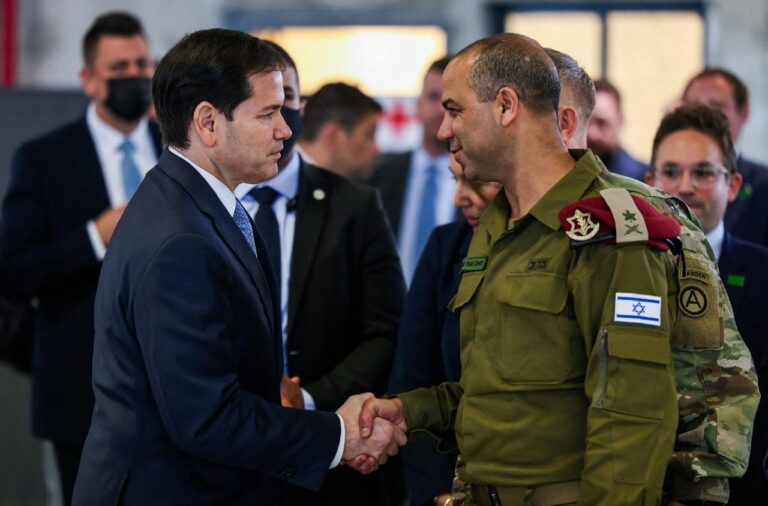
When US Secretary of State Marco Rubio addressed officials from more than 60 countries in Washington on July 16, 2026, he was not announcing a limited investigation into a named armed organisation. He was calling for a new international counterterrorism architecture directed at what the Trump administration describes as the resurgence of “far-left terror”.
The distinction is important because Rubio’s speech moved repeatedly between violent acts and entire schools of political thought. “They can call themselves anti-capitalists or anti-imperialists or communists or anarchists or Marxists,” he said, presenting these ideological labels as possible disguises for networks that threaten Western politicians, institutions and infrastructure.
Rubio argued that international cooperation had severely reduced the threat from militant Islamist organisations while leaving governments with a dangerous “blind spot” towards violence from the political left. The United States, he said, intended to fill that gap through intelligence sharing, coordinated law enforcement, border controls, financial targeting and action against online radicalisation. “We can and we must identify and map this threat and rebuild our counterterrorism architecture to defeat it,” he told the ministerial meeting, according to Reuters.
The administration presents the initiative as a necessary response to transnational political violence. Its critics see something more expansive: a framework capable of classifying protest movements, legal defence funds, humanitarian donors and anti-capitalist organisations as parts of the same international security problem.
That concern does not depend on denying that politically motivated violence can emerge from the left. It arises from the breadth of the category Rubio used, the absence of clear public thresholds separating militant violence from civil disobedience, and the extraordinary powers that follow once an individual or organisation is placed inside the counterterrorism system. Surveillance, asset restrictions, intelligence exchanges, immigration controls and extradition can begin long before a contested allegation is tested at trial.
No public evidence establishes that Rubio’s Washington summit directly caused any of the cases now alarming civil liberties campaigners. However, the arrest of an American donor in Spain only days before the meeting, and Britain’s use of terrorism legislation against supporters of a direct-action group, illustrate the kinds of cross-border powers that Rubio wants governments to coordinate more closely.
The arrest in Ibiza
On July 10, Spanish officers intercepted a vehicle carrying James “Fergie” Chambers and his family on the island of Ibiza. His wife, Stella Schnabel, said several police vehicles blocked their route and seven officers conducted an arrest that was over within minutes. Chambers was handcuffed, taken into custody and later transferred to a prison in Madrid, where he remained detained without bail at the end of July.
The operation was carried out in response to an American extradition request. US authorities accuse Chambers of international money laundering with the intention of providing material support to Hamas, which Washington has designated as a foreign terrorist organisation. Reports have also referred to riot and conspiracy charges. The indictment remained sealed, meaning that the evidence supporting the allegations had not been made public and had not been tested in court.
At the centre of the reported case is approximately $7.5 million transferred from the United States to Tunisia after Chambers left America in 2023. His family says the money financed lawful businesses and political and humanitarian work, not Hamas. Schnabel has said the US government is attempting to reinterpret the transfer as terrorism financing.
Chambers is an heir to the Cox Enterprises fortune and describes himself as a communist and anti-imperialist. After selling family stock reportedly worth about $250 million, he began financing political, community and humanitarian projects in several countries. His lawyers say he has donated more than $1 million to projects benefiting Palestinians, including food, medical care, clean water and mental health support in Gaza.
Schnabel has identified a $250,000 contribution to the Sameer Project, which supported a bakery producing free bread, and $100,000 for the Zaynab Project, which assists orphaned children with mental health care. Chambers has also financed legal representation for American activists accused of damaging property connected to Elbit Systems, the Israeli weapons manufacturer that has been a central target of Palestine Action campaigns in Britain and the United States.
Dr Ghassan Abu-Sittah, the British-Palestinian surgeon and rector of the University of Glasgow, described Chambers as a vital supporter of medical care for children wounded in Gaza. His defenders therefore see the extradition case not as a conventional terrorism prosecution but as a warning to wealthy donors who might otherwise support Palestinian humanitarian work or direct-action movements.
The US allegation is serious and cannot be dismissed merely because Chambers has made documented charitable donations. Material support laws are intended to stop money reaching armed organisations through indirect channels as well as direct transfers. Equally, the allegation cannot be treated as established fact while the indictment is sealed and the defence has not had an opportunity to challenge the evidence before an American court.
That unresolved gap has become the political heart of the case. Supporters say lawful aid is being conflated with terrorism, while US authorities maintain that the financial transfers were connected to Hamas. Veteran terrorism lawyer Stanley Cohen told The Guardian that it was the first known case in which Washington had sought the extradition of an American citizen arrested abroad for alleged support of Hamas. Writer Trevor Aaronson warned that the prosecution could deter donors from funding Palestinian organisations even when they believe the money is intended for food, medicine or education.
Spain’s role gives the case a distinctly transnational character. The Spanish High Court has been considering the American request, and if judges approve extradition, Spain’s Council of Ministers will have the final decision. Left-wing Spanish politicians have urged the government to refuse extradition if it concludes that Chambers is being pursued for his political opinions. Spain was also among the countries represented at Rubio’s counterterrorism meeting, according to reporting on the case.
The sequence does not prove coordination between the summit and the arrest, but it demonstrates how the architecture works. One government defines a financial and political activity as a terrorism offence; another government locates and detains the accused; national courts apply an extradition treaty; and a ministerial decision can ultimately determine whether the person is placed inside the prosecuting state’s prison system.
Palestine Action and the British test case
Britain offers another example of the expanding boundary between counterterrorism and political protest. Palestine Action was founded in 2020 and became known for occupying, blockading and damaging property belonging to Elbit Systems and other companies it accused of supporting Israeli military operations against Palestinians.
Its supporters describe these actions as attempts to disrupt the production and movement of weapons used against civilians. The British government says the organisation crossed the boundary from protest into terrorism by operating covertly, endorsing violent tactics and causing serious property damage. Those competing descriptions have produced one of the most consequential civil liberties cases in modern Britain.
On March 8, 2025, Palestine Action activists targeted Donald Trump’s Turnberry golf resort in Scotland after the US president proposed taking control of Gaza, relocating its Palestinian population and redeveloping the territory. Red paint was sprayed on buildings, holes were dug in the course and “Gaza is not for sale” was painted across a green. Reuters reported that the group claimed responsibility and described the damage as a response to Trump’s proposal.
Documents later placed before the High Court showed that Prime Minister Keir Starmer and Trump discussed Palestine Action during calls on March 10 and March 30. The following day, Trump wrote that Starmer had informed him about arrests and called those responsible “terrorists”, adding that he hoped they would be treated harshly. The Independent reported that the Foreign Office had advised in March that international partners generally regarded Palestine Action as activism rather than extremism or terrorism.
The calls have fuelled suspicion that Trump pressed the British government to intensify its response. They do not, on their own, prove that he caused the eventual ban. The open court record shows that the Home Office had been considering Palestine Action for proscription since December 2024, before the Turnberry incident, and that specialist British bodies had assessed the group in March 2025. The contact between Starmer and Trump nevertheless raises legitimate questions about whether diplomatic pressure influenced the pace, presentation or political atmosphere surrounding the decision.
Then Home Secretary Yvette Cooper decided on June 20, 2025, to proscribe Palestine Action under the Terrorism Act 2000. The decision was announced after activists broke into RAF Brize Norton and sprayed two military aircraft with red paint. Parliament approved the order, and the ban came into force on July 5.
Proscription transformed the legal position of people who had never damaged property and might never have met a member of the organisation. Membership, inviting support and certain public expressions of support became terrorism offences. Police began arresting demonstrators who held placards declaring: “I oppose genocide. I support Palestine Action.”
Among those detained was the Reverend Sue Parfitt, a retired Anglican priest in her eighties who had spent much of her life campaigning for peace and justice. Her arrest gave the controversy an image the government has struggled to contain: an elderly cleric carrying a sign and being processed through counterterrorism powers created to confront organisations planning mass-casualty attacks.
The scale has since become much larger. By July 30, 2026, roughly 3,000 people had been arrested for alleged expressions of support, according to Reuters. Many were elderly protesters who deliberately challenged the law by holding identical signs. Their actions forced a basic question into public view: whether expressing moral support for a banned direct-action group should expose a peaceful demonstrator to the criminal consequences of terrorism legislation.
In February 2026, the High Court ruled that the Home Secretary’s decision was unlawful. The judges did not portray Palestine Action as entirely peaceful. They found that it promoted its political cause through criminality and that a small number of actions came within the exceptionally broad statutory definition of terrorism. However, they concluded that the scale and persistence of those actions did not justify the severe interference with freedom of expression and association created by proscription. Ordinary criminal law, they noted, already allowed serious charges and heavy sentences for burglary, criminal damage and violence. The open judgment described that interference with rights to expression and association as “very significant”.
The Court of Appeal reversed that decision on June 15, holding that the Home Secretary had acted lawfully and struck a permissible balance between national security and protest rights. The ban therefore remained in force. On July 30, the Supreme Court granted Palestine Action co-founder Huda Ammori permission to appeal, ensuring that the legality and proportionality of the proscription will be examined again later in 2026.
This unresolved litigation is central to the wider international debate. The British experience shows that once a group is proscribed, counterterrorism enforcement can extend far beyond those suspected of planning violent acts. It can reach donors, speakers, placard holders, online supporters and people whose principal offence is to dispute the state’s terrorism label.
The apartheid precedent
Rubio’s demand for closer intelligence sharing carries a particular historical resonance because Western security agencies have previously defined liberation movements as terrorist threats and cooperated with governments practising systematic racial oppression. The history of apartheid South Africa does not prove that today’s counterterrorism initiative will produce the same abuses, but it demonstrates how intelligence cooperation can endanger dissidents when political labels replace independent scrutiny.
Nelson Mandela’s arrest on August 5, 1962, remains the most famous example. Former US vice-consul and CIA operative Donald Rickard later told filmmaker John Irvin that he had helped identify Mandela’s movements and pass information to the South African authorities. A separate report published in 1990 quoted a former American intelligence official as saying that senior CIA officer Paul Eckel had celebrated providing the apartheid security branch with Mandela’s clothing, route and timing.
The CIA has never publicly confirmed the account, and some documentary details remain disputed. Nevertheless, Rickard’s recorded admission added considerable weight to the long-standing allegation that American intelligence assisted the capture that began Mandela’s 27 years of imprisonment. Even after his release in 1990, his Nobel Peace Prize and his election as South Africa’s first Black president, US immigration restrictions connected to the African National Congress’s terrorism designation continued to affect Mandela and other ANC members until Congress removed them in 2008. The declassified record and the continuing dispute over the agency’s role were examined in a detailed historical investigation published by Time.
Britain has its own unresolved history. The Metropolitan Police’s Special Demonstration Squad infiltrated the Anti-Apartheid Movement and associated campaigns for years. Undercover officers attended meetings, recorded the names and views of people engaged in lawful political work, and sometimes participated in demonstrations alongside those they were monitoring. Evidence about this surveillance has been examined by the official Undercover Policing Inquiry.
Anti-apartheid campaigners have alleged that British reporting could be accessed by, or passed to, South African intelligence. The full extent of any exchange with the Bureau for State Security, known as BOSS, has not been established publicly. That distinction matters because the supplied historical record supports extensive surveillance by both states, but does not prove every claimed British-to-South African transmission or establish that British police caused each subsequent arrest or assassination.
What is beyond serious dispute is that the apartheid state conducted bombings, burglaries, surveillance and assassination operations beyond South Africa’s borders. A submission from the British Anti-Apartheid Movement archives describes an escalating campaign of covert activity in Britain and Europe, including attacks against the ANC and other liberation organisations.
On March 14, 1982, a 10-pound bomb exploded behind the ANC’s offices in Penton Street, Islington. The blast injured ANC research official Vernet Mbatha, destroyed the rear of the building and shattered windows more than 100 yards away. Oliver Tambo, the ANC president, had been expected in London for an anti-apartheid rally, and an Anti-Apartheid Movement submission to South Africa’s Truth and Reconciliation Commission said the possibility that the bomb was intended as an attempt on his life could not be excluded.
Apartheid operative Craig Williamson later admitted responsibility, according to the archive, and said the explosive had entered Britain through a South African diplomatic bag. The same period saw burglaries at the London offices of the ANC, the Pan Africanist Congress and the South West Africa People’s Organisation. Photographs, correspondence, address books, travel papers, financial records and information about liberation movement personnel were stolen and sent to South African handlers.
Ahmed Timol’s case reveals both the brutality of the apartheid security branch and the intrusiveness of British surveillance, although the evidence does not justify merging the two into a single proven operation. Timol, a teacher and underground activist who had spent time in London, was arrested at a South African roadblock in October 1971. Police claimed he jumped to his death from John Vorster Square after several days in detention. A reopened inquest ruled in 2017 that he had been tortured and murdered by police.
After his death, a small private gathering of grieving activists took place in London. An undercover British officer attended and reported on the meeting. That fact does not prove that British intelligence enabled Timol’s arrest or murder, but it exposes the priorities of a system that treated the mourning friends of a murdered anti-apartheid activist as subjects for secret police reporting.
Ruth First’s story carries an even more direct connection to the international reach of apartheid intelligence. The journalist, academic and anti-apartheid organiser lived in exile in Britain before moving to Mozambique. A former BOSS operative said that she had been kept under close surveillance in London and that a substantial file on her existed in Pretoria. On August 17, 1982, she was killed by a letter bomb delivered to her office at Eduardo Mondlane University in Maputo. Williamson later admitted responsibility and received amnesty from South Africa’s Truth and Reconciliation Commission.
Dulcie September had also worked with the Anti-Apartheid Movement in London before becoming the ANC’s chief representative in France. On March 29, 1988, she was shot five times outside the ANC office in Paris. Her murder remains legally unresolved, and the perpetrators have never been conclusively identified, as the Nelson Mandela Foundation noted in 2025. Investigators, campaigners and members of her family have long suspected connections to apartheid intelligence, sanctions busting and secret arms dealings, but claims that a particular British intelligence file guided the assassins have not been proven.
These qualifications do not weaken the historical warning. They make it more precise. Western governments monitored anti-apartheid activists as security threats while South African agents were carrying out genuine terrorist operations in European cities. The people called dangerous radicals by states were often the same people being targeted by bombs, kidnappers and assassins.
Who defines the threat?
The central question raised by Rubio’s initiative is not whether governments should cooperate to stop political violence. They already do, and a credible threat that crosses borders may require international action. The question is how “far-left terror” will be defined, who will test the evidence, and what protections will prevent an ideological campaign from swallowing lawful dissent.
The Chambers case shows how humanitarian finance can become entangled with material support law before the underlying evidence is public. The Palestine Action case shows how a terrorism designation can spread from people accused of property damage to thousands of peaceful protesters. The history of the anti-apartheid struggle shows that democracies can misidentify the defender and the aggressor, especially when intelligence alliances are shaped by strategic interests.
Rubio has said governments must map networks, share information and dismantle financial structures “brick by brick”. Such powers can disrupt organisations planning real violence, but without narrow definitions, transparent evidence and meaningful judicial review, the same tools can create a transnational system in which accusation itself produces punishment.
That is why the debate cannot be reduced to Rubio’s rhetoric or to the personal politics of those now facing prosecution. It concerns the construction of a durable international apparatus, one capable of following money across borders, exchanging political intelligence, restricting movement and converting contested activism into a national security file.
The twentieth-century campaign against apartheid offers a stark caution. Mandela was treated as a security threat, anti-apartheid meetings were infiltrated, and liberation activists were watched across borders while agents of the apartheid state planted bombs and murdered opponents abroad. Governments that now promise a new intelligence alliance against an ideologically defined enemy should be required to explain how they will ensure that history is not repeated under updated language and more powerful technology.