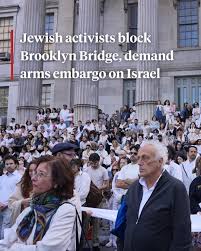
In New York, a pro-Israel parade, a progressive election campaign, an alternative synagogue and one divided family reveal how Israel’s destruction of Gaza is challenging beliefs once treated as inseparable from American Jewish life.
For generations of American Jews, support for Israel was presented not simply as a political position but as an expression of identity, history and collective survival. Israel was the refuge established after centuries of persecution, culminating in the Holocaust, and the country to which many Jewish families were taught they possessed an emotional, religious and ancestral connection.
On Fifth Avenue in New York, that understanding remains highly visible. Israeli flags fill the streets during the annual Israel Day parade, where marchers celebrate what they regard as an unbreakable relationship between Jewish identity and the Israeli state.
“America is our first home, but Israel is our second home,” one participant declared.
Yet outside the parade, and increasingly within Jewish families, political organisations, synagogues and electoral campaigns, that relationship is being questioned as never before.
Israel faces allegations of genocide over its assault on Gaza, including proceedings brought by South Africa at the International Court of Justice. The court has imposed provisional measures but has not delivered a final judgment on whether genocide has occurred. Israel emphatically rejects the allegation and maintains that its military campaign has been directed against Hamas rather than the Palestinian population. The case remains before the ICJ, while Israel has described the accusation as baseless.
For a growing number of American Jews, however, the mass death, displacement and destruction witnessed in Gaza have made unconditional support for Israel impossible. The result is not merely a political disagreement. It is a struggle over what it means to be Jewish, who has the authority to define Jewish identity and whether Judaism must remain institutionally bound to Zionism.
That conflict is explored in the Guardian documentary Why So Many American Jews Are Turning Away from Israel, reported by Matthew Cassel with Tom Silverstone and Katie Arnold. Cassel, who was raised in a Jewish family in Chicago, travelled to New York to examine how Gaza is dividing generations and transforming the community’s relationship with Israel. The documentary was published on July 28, 2026.
Two Jewish New Yorks
The documentary opens at the Israel Day parade, whose 2026 theme was “Proud Americans, Proud Zionists.” Tens of thousands gathered beneath Israeli and American flags while political leaders, community organisations and Jewish schools proceeded through Midtown Manhattan.
For participants, the parade represented Jewish survival and pride at a time of growing antisemitism. One woman wearing a shirt emblazoned with the word “Zionist” said hostility towards Israel had only strengthened her determination to identify publicly with the country.
Others dismissed the growing disillusionment among younger Jews as a product of campus conformity, misleading media coverage and algorithms designed to spread inflammatory material. One participant suggested that undergraduates were being drawn into a movement because they feared becoming isolated from their peers.
A former Israeli soldier acknowledged that Israeli policies could legitimately be criticised and that there was much requiring reform, but maintained that Israel remained a Western country attempting to conduct itself responsibly.
Cassel’s questioning exposed the distance between expressions of emotional allegiance and knowledge of Palestinian life. When one parade participant was asked to identify the West Bank and Gaza on a map, the exchange ended in confusion.
The encounter did not suggest that every marcher lacked such knowledge. It nevertheless captured a larger problem confronting institutions that have traditionally promoted an idealised Israel while giving far less attention to military occupation, settlement expansion, Palestinian displacement and the separate legal systems imposed across the occupied West Bank.
The political mood beyond the parade has changed dramatically. A February 2026 Gallup survey found that 41 per cent of Americans sympathised more with Palestinians, compared with 36 per cent who sympathised more with Israelis. The difference was not statistically significant, but it marked the first time in Gallup’s annual tracking since 2001 that Israelis no longer held the advantage.
Among Americans aged between 18 and 34, 53 per cent sympathised more with Palestinians, while only 23 per cent favoured Israelis. Even among those aged between 35 and 54, Palestinians led by 46 per cent to 28 per cent. Older Americans remained more supportive of Israel, illustrating the generational character of the transformation. Gallup described the result as a historic reversal in American sympathies.
From inherited certainty to Jewish dissent
Cassel’s investigation is partly autobiographical. More than two decades ago, while still a college student, he travelled to Israel and the occupied Palestinian territories. What he saw there challenged the version of Israel with which he had been raised.
He returned home with photographs documenting Palestinian life under occupation, expecting to discuss what he had witnessed. Instead, the photographs provoked arguments with his mother and estrangement from parts of the wider Jewish community.
At that time, mainstream Jewish institutions offered few spaces for people who wanted to remain connected to Judaism while openly opposing Israeli policies. Criticism of the occupation was frequently treated as hostility towards Israel itself, while anti-Zionism could lead to exclusion from organised Jewish life.
That institutional boundary has weakened as younger Jewish activists form organisations and congregations in which solidarity with Palestinians is presented as an expression of Jewish ethics rather than a repudiation of them.
Cara Levine, a 28-year-old New Yorker featured in the documentary, grew up in a family that supported Israel. Childhood photographs show Israeli flags forming part of the background at her Jewish nursery school. Israel was presented as a distant but benevolent homeland, woven quietly into religious education, family memory and communal identity.
Levine remembered absorbing what she described as a utopian image of the country. As she grew older and learned more about Palestinian history, the occupation and the realities of Israeli power, she began questioning what she had inherited.
Her grandparents’ survival of the Holocaust became a reason for activism rather than silence. The lesson she drew from that history was universal: “Never again means never again for anyone.”
This interpretation directly challenges those who invoke the persecution of Jews to defend Israel’s conduct. Levine argues that the memory of Jewish suffering creates an obligation to oppose the persecution of others, including when it is carried out by a state claiming to act in the name of Jewish safety.
When critics describe activists such as Levine as “self-hating Jews,” they are attempting, she said, to impose a single political definition of Jewish legitimacy. For her, there is no single correct way to be Jewish, and Zionist institutions cannot be permitted to decide who belongs to the community.
The scale of this internal dispute is reflected in a September 2025 Washington Post survey of 815 Jewish American adults. It found that 76 per cent still considered Israel’s existence vital to the long-term future of the Jewish people, while 56 per cent remained emotionally attached to the country.
At the same time, 68 per cent rated Benjamin Netanyahu’s leadership negatively, 61 per cent believed Israel had committed war crimes in Gaza and 39 per cent believed it had committed genocide. An overwhelming 94 per cent also believed Hamas had committed war crimes, demonstrating that criticism of Israel did not necessarily imply support for Hamas or indifference towards Israeli victims.
The poll found that 36 per cent had experienced family disagreements over Israel or Gaza. It captured a community that remains connected to Israel but is increasingly unwilling to give the country’s government moral immunity. The complete survey results reveal the depth and complexity of that division.
Gaza enters electoral politics
The same transformation is moving from family arguments and street demonstrations into mainstream electoral politics.
In New York, Mayor Zohran Mamdani, an outspoken critic of Israeli policy, supported former city comptroller Brad Lander’s challenge to Democratic Congressman Dan Goldman in New York’s 10th Congressional District. Lander and Goldman are both Jewish, but their positions on Gaza and American military support for Israel became one of the clearest dividing lines in the campaign.
Goldman had repeatedly backed military assistance for Israel and declined to describe Israel’s conduct as genocide. He marched near the front of the Israel Day parade and presented his attendance as a celebration of Israel’s founding.
Lander stayed away from the parade and attacked what he regarded as the Democratic establishment’s willingness to continue supplying Netanyahu’s government with weapons. He supported efforts to restrict offensive arms transfers and argued that American taxpayers possessed a direct responsibility because Washington was financing Israel’s military campaign.
The distinction mattered because Gaza was not merely another distant conflict for voters. The United States had supplied the weapons, diplomatic protection and political backing that enabled Israel to continue its operations. Lander argued that there were other atrocities in the world, but few in which American financing and military assistance were so central.
His campaign also rejected the contention that criticism of Israel was inherently antisemitic. Lander said his position was grounded in his Judaism and warned that Netanyahu’s conduct was making Jews less safe by catastrophically damaging Israel’s standing throughout the world.
Campaigners from Jews for Racial and Economic Justice accompanied Lander volunteers as they canvassed New York voters. Affordability remained a dominant concern, but conversations repeatedly returned to Gaza, American weapons and the use of public money to support overseas wars.
One young voter explained that people in Gaza and Iran wanted the same opportunities and ordinary lives as young people in New York but were instead being killed. The comment reduced an apparently remote geopolitical conflict to a straightforward recognition of shared humanity.
Another conversation demonstrated how difficult the division remains. A voter concerned about antisemitism questioned why Mamdani and Lander had declined to attend the parade. A Jewish campaigner responded by drawing a distinction between Judaism, a diverse religious, cultural and ethnic experience, and Israel, a state whose policies were open to political judgment.
“Jewish pride doesn’t equal the Israel Day parade,” the campaigner said.
That distinction is central to the emerging Jewish left. Its activists do not accept that the Israeli government represents every Jew, nor that Jews living in the United States should be held responsible for Israel’s actions. They simultaneously oppose antisemitism and reject accusations of antisemitism being used to prevent scrutiny of Israeli state violence.
The Washington Post survey showed how widely that distinction is understood. Although 95 per cent of Jewish respondents believed there was at least some antisemitism in the United States, 67 per cent said criticism of Israel’s actions in Gaza was not itself antisemitic. Forty-two per cent had avoided displaying something that could identify them publicly as Jewish, revealing that criticism of Israel exists alongside genuine fear about anti-Jewish hostility.
Lander’s argument ultimately carried electoral force. On June 23, 2026, he defeated Goldman in the Democratic primary, turning a contest between two Jewish candidates into evidence that even a heavily Jewish New York district would no longer necessarily reward unwavering support for Israel.
Israel was not the only issue in the election, which also revolved around housing costs, immigration and opposition to the Trump administration. Lander nevertheless acknowledged that it had become one of the defining questions. In his victory speech, he argued that Democratic voters were rejecting the use of American tax money to finance Netanyahu’s wars. The Associated Press described the result as part of a wider sweep by New York critics of Israel.
Building Jewish institutions around disagreement
The political rupture is also changing where and how people worship.
In Brooklyn, Congregation Kolot Chayeinu offers a Jewish community in which disagreement over Israel is not grounds for expulsion. The congregation has expanded as people search for a place where they can participate in Jewish religious life while wrestling openly with Zionism, occupation and Palestinian rights.
Levine joined Kolot because she wanted a synagogue reflecting her political and social values. Its acceptance of anti-Zionist and pro-Palestinian perspectives mattered to her, as did its egalitarian and queer-friendly character.
She had previously felt driven out of Jewish spaces because of her position on Israel. The experience demonstrated how thoroughly institutional Judaism in the United States had become entangled with Zionism. A person could observe Jewish traditions, study Jewish texts and identify strongly with Jewish ethics, yet still be told that opposition to an Israeli state policy placed them outside the community.
At Kolot, congregants gather for worship, study and meals marking the close of the Sabbath without being required to accept a single political doctrine. The synagogue does not eliminate disagreement over Israel. It provides a structure in which the disagreement can occur without determining who is entitled to remain Jewish.
This may prove one of the most significant developments documented by Cassel. Younger Jewish critics of Israel are not necessarily abandoning Judaism. Many are creating or expanding institutions in which Jewish life is separated from automatic allegiance to a state.
Their Judaism is built around ethical obligation, historical memory, social justice, religious practice and a willingness to argue. In that understanding, dissent is not a threat to the tradition but part of it.
A conflict within one family
Cassel’s final conversation is with his mother, revisiting the arguments that began after his first journey to the occupied Palestinian territories 23 years earlier.
She remembered feeling that her son’s photographs and testimony were challenging her entire belief system. The disputes became so painful that mother and son eventually established a truce under which they avoided saying the word “Israel.” That silence continued for years.
Her position has since changed. She no longer regards Israel as infallible and distinguishes between an idealised Israel and the conduct of the Israeli state. Like a difficult family member, she explained, Israel could still be loved while being criticised.
For Cassel, the change reflected not only the evolution of one woman’s thinking but the larger transformation occurring across generations. His mother grew up knowing little about Palestinians and absorbing a story centred almost entirely upon Jewish history and Israeli survival. Younger Jews now encounter images and testimony from Gaza, the West Bank and Israel instantly, without depending upon communal institutions to mediate what they see.
Those institutions consequently face an existential question. The issue is not whether politically dissident young people will continue to identify as Jewish. Many clearly will. The question is whether they will inherit the organisations, synagogues and communal structures created by their parents or be compelled to build institutions of their own.
The answer will have consequences far beyond Jewish religious life. American support for Israel has depended upon a durable political coalition combining Jewish institutions, evangelical Christians, defence interests and bipartisan congressional support. That coalition remains powerful, particularly among Republicans and older voters, but its claim to represent an unquestioned national consensus has been broken.
The shift does not mean that American Jews have collectively abandoned Israel, nor that criticism takes a single form. Some remain committed Zionists who oppose Netanyahu. Others support Israel’s existence while demanding an end to occupation and military assistance. A growing number identify as anti-Zionist and reject the principle of an ethnically defined state. Many occupy uncertain positions that cannot be reduced to loyalty or betrayal.
What unites them is a refusal to accept that Jewish identity requires silence about Palestinian suffering.
The argument once suppressed inside families and synagogues is now being fought on city streets and congressional ballots. As the devastation of Gaza forces a reckoning with the uses of history, memory and state power, the relationship between American Jews and Israel is no longer inherited without question.
It has become a struggle over what should be remembered, whose suffering counts and whether the promise of “never again” belongs to one people or to everyone.