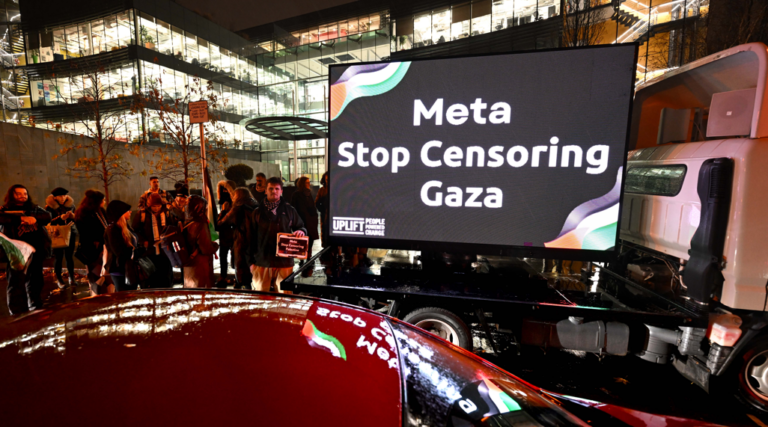
A Palestinian-led investigation has documented 3,520 cases involving removed posts, suspended accounts, blocked livestreams and concealed restrictions across Facebook and Instagram. Its findings reinforce earlier investigations by Human Rights Watch, the BBC and a human rights review commissioned by Meta itself.
For years, Palestinian journalists, news organisations and activists have described an invisible struggle taking place behind their screens. Posts documenting Israeli attacks disappeared without warning. Accounts were suspended or prevented from broadcasting live. Pages with hundreds of thousands of followers suddenly reached only a fraction of their previous audiences, frequently without any notification that a restriction had been imposed.
Because Meta’s algorithms and internal enforcement systems remain largely inaccessible to outsiders, those experiences were often dismissed as anecdotal or attributed to technical failures. A major investigation by the Palestinian digital rights organisation 7amleh, however, argues that the accumulated evidence reveals something far more systematic.
Published on June 9, 2026, The Platformicide of Palestine 2021–2025 analyses 3,520 cases submitted to 7amleh’s Palestinian Observatory for Digital Rights Violations, known as 7or. Conducted with Dr Fabio Cristiano of Utrecht University, the research examines Meta’s treatment of Palestinian and Palestine-related material on Facebook and Instagram between January 2021 and December 2025.
The report describes the resulting system as “platformicide”, meaning the structural erasure of Palestinian people, political expression and historical narratives from the digital sphere. It identifies recurring patterns involving content removal, account-level punishment, algorithmic demotion, restrictions on livestreaming and an appeals system that frequently failed to provide either explanations or remedies.
The findings were explored by Alaa Salama, audience engagement manager at +972 Magazine, in a July 30 interview with 7amleh founder and executive director Nadim Nashif. Salama’s experience managing the publication’s social media accounts placed her in a position familiar to Palestinian journalists: watching some stories travel widely while others appeared to vanish inside systems that offered no meaningful explanation.
Nashif told Salama that Palestinian content was not merely being disadvantaged by Meta’s general reduction of political material. He argued that the difference was the repeated deletion of content, crippling of accounts and removal of essential publishing functions.
“When we are speaking about Palestinian narrative, this is very different because it’s not about priority. It’s about erasure,” Nashif said in the +972 Magazine interview.
Thousands of cases reveal recurring patterns
The central importance of the new research lies in its scale and duration. Earlier investigations captured particular moments of crisis, particularly the Sheikh Jarrah protests and Gaza escalation of May 2021 or the period immediately following October 7, 2023. The 7amleh study follows reported violations across five years.
According to the full 7amleh report, Meta’s Dangerous Organizations and Individuals policy accounted for 57.2 per cent of cases in which the company’s stated justification could be identified.
The policy is intended to prevent designated organisations and individuals involved in terrorism, organised violence or serious criminal activity from maintaining a presence on Meta’s platforms. Hamas is designated under that policy, and Meta prohibits praise or substantive support for the organisation.
The difficulty is that journalism, historical discussion, criticism and human rights documentation inevitably require references to political and armed groups. Meta’s published rules permit news reporting, neutral discussion, condemnation and public-interest material, but 7amleh found the policy repeatedly being applied to journalists, media outlets and civil society organisations whose work required them to mention designated groups.
The effect, the researchers argue, is to approach Palestinian political expression primarily through a security framework. Content is treated as potentially dangerous before its journalistic, historical or civic context is properly considered.
Meta’s own account of its post-October 7 response demonstrates the scale of its automated enforcement. The company said it removed or marked as disturbing more than 795,000 pieces of Arabic and Hebrew content during the first three days after the Hamas-led attacks. Daily enforcement under the Dangerous Organizations and Individuals policy rose sevenfold compared with the previous two months. Meta nevertheless maintained that it continued to permit news reporting and neutral or condemning discussion of Hamas, according to the company’s October 2023 crisis statement.
The dispute is therefore not simply about what Meta’s written policy permits. It concerns what the company’s automated systems and human reviewers do in practice, particularly when faced with Arabic-language journalism produced during an emergency.
Punishment without explanation
Almost 70 per cent of the cases examined by 7amleh lacked a clear explanation of which Meta policy the user had allegedly violated. The organisation submitted approximately 2,800 appeals between 2021 and 2025, yet 1,363, or 48.7 per cent, received no response.
When responses did arrive, users frequently received generic messages rather than an explanation addressing the disputed material. The report also identified 273 cases in which Meta said an account was active and unrestricted even though its owner continued to experience collapsed engagement, limited visibility or inaccessible publishing functions.
This opacity is particularly significant because some of Meta’s most consequential interventions do not involve deleting a post. Content can remain technically online while being excluded from recommendations, hidden from searches or distributed to a sharply reduced audience.
Such measures are often described collectively as shadowbanning. Their concealed nature makes them exceptionally difficult to prove. A user can see that engagement has collapsed, but cannot inspect the algorithm, identify the intervention or submit a meaningful appeal when Meta denies that any restriction exists.
7amleh’s findings are supported by an independent 2024 investigation by The Markup. After analysing data from thousands of accounts and posts and conducting experiments with almost 100 Instagram accounts, the publication found that Instagram demoted non-graphic images of war, suppressed hashtags, removed captions or comments without notification and restricted users’ ability to appeal. The investigation included Palestinian journalists, international news organisations and control accounts, according to its published methodology.
From digital inconvenience to material harm
For Palestinian media organisations, visibility on Facebook and Instagram is closely connected to audience access, advertising revenue and physical safety. The consequences of an account restriction can therefore extend far beyond social media engagement figures.
A separate 7amleh report published in 2024 collected testimonies from 20 Palestinian journalists, content creators and media organisations. The Ask Jerusalem Facebook group, which had approximately 417,000 members and provided local information while supporting hundreds of businesses, reported being closed for a year during the 2021 Sheikh Jarrah protests. Its operators said the restored group continued to experience suppressed distribution and advertising losses.
Journalist Aqeel Awawdeh described changing words and inventing coded expressions to evade automated detection. That survival strategy altered the stories he was attempting to communicate. “This is how our cause is lost,” he said.
Ali Obaidat, editor-in-chief of Palgraph, reported that his Facebook and Instagram accounts had been deleted 83 times since 2017. He said livestreaming, advertising and collaboration functions remained unavailable, while content prepared for a potential audience of millions sometimes reached only hundreds of people.
These accounts are testimonies rather than independently audited performance data, but they demonstrate how opaque moderation produces self-censorship. Publishers begin avoiding historically or politically necessary terminology because they cannot predict which word, name or image might trigger a penalty against an entire account. The full testimonies can be read in 7amleh’s report, Erased and Suppressed.
In Gaza, the potential consequences are still greater. Social media has allowed residents and local journalists to document attacks, locate survivors, warn communities and preserve evidence when access for international reporters has been severely restricted. Preventing a journalist from broadcasting live, or making a local news page effectively undiscoverable, can determine whether urgent information reaches the people who need it.
Meta’s own investigation identified unequal enforcement
The claim that Arabic and Palestinian speech has been disproportionately affected is not based solely on campaigning organisations.
Following widespread complaints during the May 2021 escalation, Meta commissioned Business for Social Responsibility to conduct an independent human rights review. The resulting assessment concluded that Meta’s actions appeared to have adversely affected Palestinian users’ rights to freedom of expression, assembly, political participation and non-discrimination.
The review found greater over-enforcement of Arabic content on a per-user basis after adjusting for the population difference between Arabic and Hebrew speakers. It also found that Arabic content was proactively flagged at a significantly higher rate, partly because Meta had an Arabic hostile-speech classifier but no equivalent Hebrew classifier at the time.
Hebrew material consequently experienced greater under-enforcement, including failures to identify content that violated Meta’s rules. The investigators also warned that Meta’s Arabic classifiers might produce higher error rates for Palestinian dialects and that material might not always reach reviewers capable of understanding its linguistic context.
The Meta-commissioned assessment did not find evidence that individual employees had intentionally designed policies to harm Palestinians. That distinction is important. Structural discrimination can emerge from policy design, unequal language resources, government designations and automated systems without requiring evidence of a written instruction to censor an ethnic or national group.
Meta emphasised that finding in its official response, while acknowledging that its systems had unintentionally affected Palestinian and Arab freedom of expression. It committed to reviewing its dangerous-organisations policy, improving Arabic dialect handling and providing more specific information when content was removed.
The 7amleh research argues that the same problems persisted through 2025, despite those commitments.
The threshold was lowered for Palestinian comments
The risk of false enforcement increased dramatically after October 7, 2023, when Meta tightened its automated moderation.
Reporting by the Wall Street Journal revealed that Meta ordinarily hid potentially hostile Instagram comments when its automated system reached an 80 per cent confidence level. During the crisis, that threshold was reportedly reduced to 40 per cent across parts of the Middle East and then to 25 per cent for comments originating in the Palestinian territories.
In practical terms, a system that was only one-quarter confident that a comment violated the rules could suppress it. Meta said the temporary intervention responded to an extraordinary increase in hateful and inflammatory material. Digital rights groups warned that lowering the threshold would inevitably produce more false positives, particularly when the underlying system already struggled with Palestinian Arabic.
Human Rights Watch reached a similar conclusion after analysing 1,050 documented cases from more than 60 countries during October and November 2023. Of those cases, 1,049 concerned peaceful pro-Palestinian material that users reported as unduly removed or suppressed, while one involved pro-Israel content.
The organisation stressed that its complaint-based sample was not statistically representative of every moderation decision made by Meta. Nevertheless, it identified six recurring forms of censorship, including removed posts, disabled accounts, interaction restrictions, blocked features, exclusion from recommendations and shadowbanning. In more than 300 cases, users were unable to access a functioning appeal process. The complete findings and methodological limitations appear in Human Rights Watch’s Meta’s Broken Promises.
Independent data recorded a collapse in Palestinian reach
A BBC News Arabic investigation subsequently analysed more than 100,000 Facebook posts from 20 Palestinian news organisations. It found that audience engagement fell by 77 per cent after October 7, 2023.
During the same period, comparable engagement across 20 Israeli news pages rose by 37 per cent, while a control group of prominent Arabic-language outlets outside Palestine also recorded substantial growth. The figures could not expose every decision inside Meta’s algorithm, but they demonstrated that Palestinian outlets experienced a collapse that was not shared by other news organisations covering the same conflict.
Meta denied deliberately silencing Palestinians, telling the BBC: “Any implication that we deliberately suppress a particular voice is unequivocally false.” The company acknowledged adopting temporary policy and product measures for security reasons. The BBC investigation also obtained internal material indicating that Instagram’s moderation had been made more aggressive towards comments from Palestinian users.
The word that triggered more removals than any other
The controversy surrounding the Arabic word shaheed, commonly translated as “martyr”, illustrates how automated enforcement can flatten language and culture.
Meta previously treated the word as praise when used in connection with people it had designated under its dangerous-organisations policy. Yet shaheed can refer to people who die in war, accidents or disasters and may be used in religious, commemorative or journalistic contexts without endorsing violence.
Meta’s independent Oversight Board found that the company’s approach was “overbroad” and disproportionately restricted expression. Meta disclosed that shaheed had produced more content removals than any other word or phrase on its platforms.
In July 2024, Meta accepted the central recommendation and ended the blanket removal policy. The company now requires an additional violation, such as praise for violence, before removing content merely because it contains the word. The decision demonstrated that sustained documentation and external scrutiny can force changes to policies once presented as necessary for safety. The Oversight Board’s policy opinion explains the reasoning behind the change.
What the evidence proves, and what it does not
The 7amleh database consists of reported violations. It is not a random sample of all Facebook and Instagram posts, and Meta has not provided the independent researchers with the complete internal data needed to calculate an overall error rate or compare every Palestinian enforcement decision with every Israeli one.
The report therefore cannot, by itself, prove that Meta’s senior leadership issued a secret order to erase Palestinian speech. It does establish a substantial record of recurring harms across five years, involving the same policies, enforcement mechanisms and failures of communication.
When considered alongside Meta’s commissioned review, Human Rights Watch’s verified cases, the BBC’s engagement data, the Oversight Board’s findings and Meta’s acknowledged crisis measures, the evidence becomes difficult to dismiss as a collection of unrelated technical glitches.
The mechanism of suppression is not necessarily a single censor pressing a button. It is an interconnected system in which terrorism designations, automated classifiers, reduced confidence thresholds, inadequate dialect expertise, account-wide penalties and ineffective appeals repeatedly produce the same result: Palestinian speech becomes harder to publish, harder to find and easier to erase.
7amleh is calling for a new independent human rights audit, reform of the Dangerous Organizations and Individuals policy, enforceable protections for journalism and public-interest evidence, improved Arabic moderation and an appeals process capable of producing timely remedies.
Nashif told Salama that documentation remains essential because it prevents technology companies from treating each incident as an isolated mistake. The struggle, he argued, must now extend to regulators, courts and Meta’s shareholders.
The promise of social media was that people excluded from traditional centres of power would finally be able to document their own lives. For Palestinians, the new research suggests that the gatekeeper was never removed. It was replaced by an algorithm, an undisclosed policy and an appeals form that nearly half the time received no answer.