
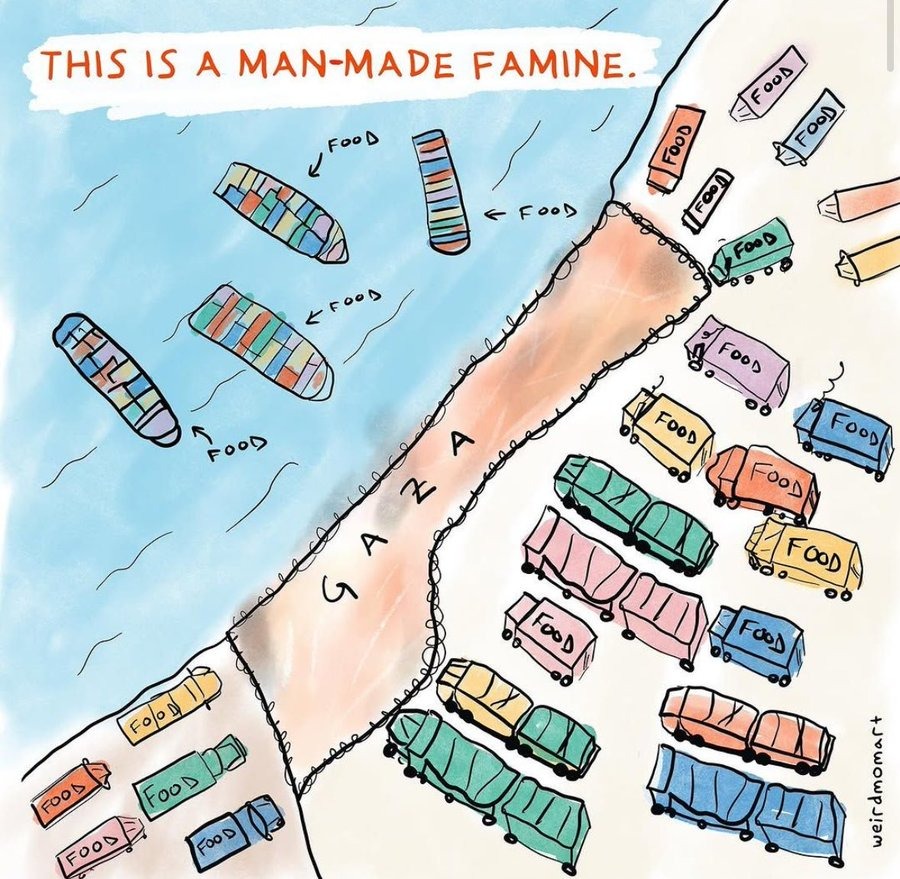

As Israel expands its military confrontation with Iran, the civilian population of Gaza is once again facing the threat of famine after Israeli authorities shut all border crossings into the enclave, halting the entry of food, fuel, medicine and humanitarian aid.
The closure of crossings into Gaza came immediately after the opening phase of Israel’s war with Iran. Israeli officials cited security concerns and the risks of operating border infrastructure during wartime conditions as justification for suspending aid deliveries.
Humanitarian agencies warn the move could rapidly trigger a new starvation crisis in a territory where more than two million people already depend almost entirely on outside assistance for survival.
Aid workers inside Gaza say the impact is already being felt.
“We will run out of food within days,” one humanitarian official warned as aid warehouses began to empty and bakeries shut down due to lack of flour and fuel.
The sudden blockade has revived memories of previous famine conditions that devastated Gaza during earlier phases of the war.
A Territory Already Pushed to the Brink
Since the start of Israel’s war in Gaza in October 2023, the enclave has experienced one of the worst humanitarian disasters in modern history.
More than 60,000 Palestinians have been killed and over 145,000 wounded during Israeli military operations, according to Gaza health authorities. Tens of thousands of the dead are women and children, and nearly the entire population has been displaced at least once.
Independent research examining indirect deaths suggests the total human toll may be significantly higher. When deaths caused by hunger, disease, untreated injuries, and the collapse of medical services are included, some analyses estimate that over 236,000 people may have died or been fatally affected by the war, representing a catastrophic share of Gaza’s pre-war population of roughly 2.3 million.
The destruction of Gaza’s infrastructure has compounded the crisis. Farms, bakeries, fishing fleets, markets, food warehouses and water systems have been destroyed or rendered inoperable. In many areas the food system has effectively collapsed.
As a result, the territory now relies almost entirely on humanitarian aid convoys to feed its population.
Previous Famine Conditions
The current crisis follows a series of famine warnings and confirmed starvation events during earlier stages of the war.
Throughout 2024 and 2025, international hunger monitoring systems repeatedly warned that Gaza had entered the highest levels of food insecurity.
At one point more than 1.8 million people—nearly the entire population—were experiencing extreme hunger, while roughly half a million people were trapped in full famine conditions, meaning they faced immediate risk of starvation.
Malnutrition surged across the enclave, particularly among children.
Hospitals reported severe wasting, skeletal body weight and signs of prolonged starvation among patients arriving at emergency wards. Doctors described children arriving with visible ribs, hair loss and dangerously weakened immune systems.
By late 2025, hundreds of Palestinians had died directly from starvation or severe malnutrition, including large numbers of children.
Medical officials reported that more than 450 people had died from hunger-related causes, among them over 150 children.
Aid groups warned that these numbers likely underestimated the true scale of famine deaths, as many people died in shelters or damaged homes without reaching hospitals.
The collapse of Gaza’s healthcare system intensified the crisis. With hospitals bombed or lacking electricity, fuel and medicine, even treatable illnesses became fatal.
Researchers studying the broader humanitarian impact concluded that indirect deaths from starvation, dehydration and disease may ultimately rival or exceed those killed by direct military violence.
Starvation as a War Crime
Legal experts and humanitarian organizations have repeatedly warned that deliberately depriving civilians of food constitutes a serious violation of international law.
Under the Geneva Conventions and their Additional Protocols, starvation of civilians as a method of warfare is explicitly prohibited. The rules of armed conflict require parties to allow the passage of humanitarian relief and forbid attacks on objects indispensable to the survival of the civilian population, including food supplies, agricultural areas and water infrastructure.
Imposing starvation on a civilian population in this way is widely regarded by legal scholars as a blatant war crime.
International law experts note that preventing humanitarian aid from reaching civilians while simultaneously destroying local food production systems can constitute the use of starvation as a weapon of war.
Human rights organizations have argued that the repeated restriction of food and aid deliveries into Gaza during the conflict raises serious legal questions about compliance with these laws.
Humanitarian workers operating in the territory say the famine conditions that developed during the war were not simply the result of conflict but of deliberate restrictions on food access.
“Starvation and malnutrition are not natural disasters,” one humanitarian report concluded. “They are the predictable outcome of blocking food and destroying food systems.”
Panic Buying and Empty Markets
Inside Gaza, the latest border closure has triggered panic buying across the enclave.
Residents rushed to markets to buy flour, rice, cooking oil and canned goods as soon as news of the blockade spread.
Prices of basic food staples have already surged dramatically, placing them beyond the reach of many families who have lost homes, jobs and savings during the war.
Many bakeries have stopped operating due to lack of flour and fuel, while aid agencies say their remaining food stocks could be exhausted within days if the crossings remain closed.
For many Gazans, the fear is not simply hunger but a return to the catastrophic conditions of the previous famine.
“You don’t forget famine,” one resident said. “When people hear the borders are closed again, everyone runs to find whatever food they can.”
Global Attention Shifts to Iran War
The renewed blockade is unfolding as international attention shifts toward the rapidly expanding war between Israel and Iran.
Analysts warn that the regional conflict risks overshadowing Gaza’s humanitarian catastrophe at precisely the moment when aid access has once again been cut off.
Humanitarian officials say the situation is dangerously fragile.
During the brief period when crossings reopened after temporary ceasefires in 2025, famine conditions eased slightly as aid convoys were able to enter the territory. But experts warned that any interruption in aid deliveries could quickly push Gaza back into catastrophic hunger.
That warning now appears to be materializing.
With border crossings closed, food convoys halted and supplies dwindling across the territory, aid agencies warn that Gaza may once again be sliding toward widespread famine—this time unfolding in the shadow of a much larger regional war.