
In the second week of the expanding U.S.–Israel war against Iran, a remarkable moment unfolded in the Middle East. Iran’s president, Masoud Pezeshkian, publicly apologised to neighbouring Arab states after Iranian missiles and drones struck targets on their territory—attacks that Tehran says were aimed not at those countries themselves but at American military assets stationed within them.
The apology was extraordinary not only because of its conciliatory tone in the midst of war, but also because of the uncomfortable truth it exposed: several Arab governments now host a vast network of American military bases that have become launch pads for attacks on Iran.
By apologising for the strikes, Tehran effectively acknowledged that Gulf monarchies were being dragged into the conflict—yet at the same time highlighted their complicity in enabling Washington’s military presence.
For critics of the region’s security architecture, the moment laid bare a strategic paradox decades in the making: Arab governments that host foreign military forces cannot easily remain neutral when those forces wage war from their territory.
“We Apologise to Our Neighbours”
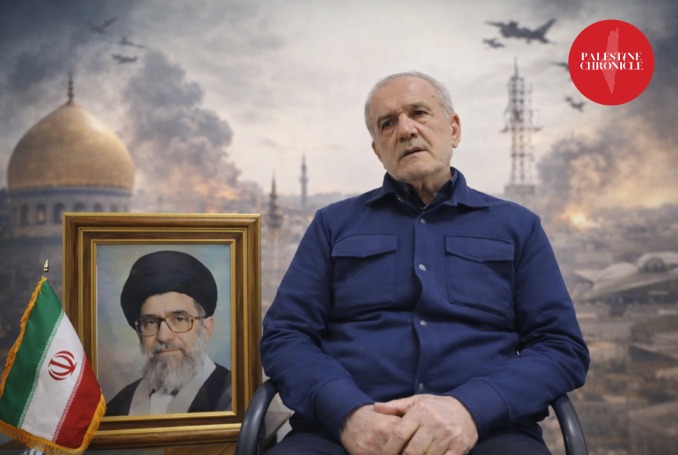
Pezeshkian delivered his remarks in a televised address broadcast across Iran at the height of the crisis. The speech attempted to strike a careful balance—rejecting American demands for surrender while reassuring neighbouring states that Tehran did not consider them enemies.
“Enemies of Iran must take their dream of the unconditional surrender of the Iranian people to their graves,” he declared. “Such a surrender will never happen.”
Yet the most striking moment came when the Iranian president turned directly to the Arab governments of the Gulf.
“At the same time, I must apologize on my own behalf and on behalf of Iran to the neighboring countries that were affected by Iran’s actions.”
“Our intention has never been to target the countries of the region. The aim of our operations has been the American bases and facilities that have been used to carry out aggression against Iran.”
Pezeshkian explained that Iran’s leadership had decided to limit further escalation with neighbouring states unless they directly participated in attacks against Iran.
“The interim leadership council agreed yesterday that no more attacks will be made on neighboring countries and no missiles will be fired unless an attack on Iran originates from those countries,” he said.
“If the countries of the region do not cooperate in attacks against Iran, they will not be targeted by the Islamic Republic.”
He also issued a direct appeal to Gulf governments not to allow their territory to be used by Washington as a staging ground for war.
“We call on the countries of the region not to allow their territories or airspace to be used by foreign powers for aggression against Iran.”
The president concluded with a warning that Iran would not capitulate under pressure.
“Iran will never submit to force or coercion. Our powerful armed forces will respond decisively to any aggression that originates from American bases or other hostile positions in the region.”
The speech was widely interpreted as both a diplomatic gesture and a strategic message: the real targets of Iranian retaliation were not Arab states themselves but the American military infrastructure embedded within them.
The Geography of American Power in the Gulf
For decades the United States has maintained a sprawling network of military installations across the Arab Gulf. Major bases exist in Qatar, Bahrain, Kuwait, the United Arab Emirates and Saudi Arabia, housing tens of thousands of American personnel and serving as command centres for U.S. military operations across the Middle East.
In Bahrain, the headquarters of the U.S. Fifth Fleet functions as a central hub for naval operations across the Persian Gulf. Qatar hosts one of the largest American air bases in the world, while Saudi Arabia and the UAE host key air defence and logistics facilities.
From Washington’s perspective these installations are pillars of regional security.
From Tehran’s perspective they are forward operating platforms for war.
Iran has long warned that in any direct confrontation with the United States these bases would become legitimate targets. The current conflict has turned that warning into reality.
Missiles and drones launched by Iran have already forced air defence systems across the Gulf into action as governments scramble to reassure their populations that they are not parties to the war.
Yet the geography of the conflict tells a different story. The presence of U.S. bases means that large swathes of the Gulf region have effectively become extensions of the battlefield.
Growing Arab Anger at Washington
As the conflict escalates, frustration and anger toward Washington have reportedly grown in several Arab capitals.
Officials in the region have complained privately that the United States launched major strikes against Iran without adequately consulting its Gulf partners—despite the fact that those attacks immediately exposed their territories to retaliation.
In effect, Arab states hosting American military infrastructure were placed on the front line of a war they neither initiated nor wanted.
The situation has triggered a scramble for diplomatic de-escalation across the region. Some Gulf governments have quietly communicated that they do not want their territory used as a staging ground for further attacks on Iran, fearing that doing so could transform their countries into primary targets.
At the same time, regional leaders have opened channels of communication with Tehran in an attempt to prevent the conflict from spreading across the Gulf.
The anger is not limited to governments. Across the wider Muslim world, protests and demonstrations have erupted condemning American involvement in the war and its continuing support for Israel.
The conflict has revived long-standing public resentment toward U.S. military interventions in the Middle East—from Iraq and Syria to the present war.
For many observers in the region, the current crisis reinforces a familiar narrative: that American military power in the Middle East often produces instability rather than security.
The Illusion of Protection
For decades Washington justified its expanding military footprint across the Arab Gulf with a simple promise: protection.
American officials repeatedly assured regional governments that hosting U.S. bases would guarantee their security against external threats. The presence of U.S. air forces, naval fleets and missile defence systems was portrayed as a shield against regional instability—particularly against Iran.
From Bahrain to Qatar, Kuwait to Saudi Arabia, Arab leaders were encouraged to believe that the American military umbrella would deter any attack on their territory.
Yet the current war has exposed a stark contradiction in that promise.
As Iranian missiles and drones began targeting American military facilities across the region, several Gulf states discovered that the U.S. security guarantee was far less reliable than advertised.
Instead of defending its partners, Washington has focused overwhelmingly on protecting Israel—diverting military resources, air defence systems and intelligence capabilities toward Israel’s defence while leaving Gulf states to intercept incoming missiles largely on their own.
For many officials and analysts in the region, the message has been unsettling.
The U.S. military presence was supposed to protect Gulf states. Yet the moment conflict erupted those same bases transformed their countries into targets.
Critics now argue that the American military infrastructure scattered across the Gulf was never designed primarily to defend Arab states at all. Rather, they say, it serves Washington’s broader strategic priorities—above all the protection of Israel and the projection of American power across the Middle East.
In this interpretation, the Gulf monarchies were encouraged to host bases that ultimately serve as launch platforms for American wars while simultaneously exposing the host nations to devastating retaliation.
The result is a growing sense across the region that the security architecture built by Washington over the past half-century has created a dangerous illusion: the promise of protection that in practice may deliver exactly the opposite.
A Region on the Edge
Iran’s apology to its neighbours may have been intended as a diplomatic gesture, but it also underscored the strategic reality now confronting the Arab world.
By hosting foreign military bases used to wage war on a neighbouring country, several Arab governments have inadvertently placed themselves directly in the line of fire.
The conflict has revealed the fragility of the regional order that has dominated the Middle East since the end of the Cold War: a system built on American military dominance, extensive basing rights, and security alliances with Gulf monarchies.
Today that system faces its most serious test in decades.
As missiles fly across the Gulf and tensions rise across multiple fronts, many in the region are beginning to question whether the American military presence they were promised as a shield has instead become a magnet for conflict.
And in that sense, Pezeshkian’s apology may have carried a deeper message—not only to Iran’s neighbours, but to the entire geopolitical order that has placed them in the crosshairs of a rapidly escalating war.