Anyone attempting to understand the current war between the United States, Israel and Iran purely through Western television news could easily come away with the impression that the conflict is unfolding almost entirely inside Iran…
Broadcast coverage across major networks has focused relentlessly on Israeli and American airstrikes, dramatic footage of explosions over Iranian cities, and confident studio commentary describing the systematic dismantling of Iranian military infrastructure. Satellite images of burning fuel depots, destroyed facilities and cratered airfields dominate the visual narrative, reinforcing the idea that Iran is absorbing overwhelming punishment while Israel and the United States conduct a technologically sophisticated campaign from a position of near total military dominance.
Yet this picture, repeated nightly across Western media, conceals a far more complicated and far more dangerous reality. Iranian missile barrages have struck locations inside Israel, American military facilities across the Middle East have been targeted, and the conflict has already expanded into a multi-front regional confrontation whose scale remains largely invisible to Western audiences. The absence of that broader picture is not simply the result of confusion in wartime reporting. It reflects a complex system of narrative management, censorship laws and digital information control that shapes what images circulate and which realities remain largely unseen.
Former British diplomat Craig Murray, who has spent extended periods reporting from Lebanon during previous phases of regional fighting, says the pattern becomes unmistakable once one begins watching how the war is discussed on mainstream television. The commentators invited onto studio panels, he argues, rarely diverge from a single overarching narrative. “They keep bringing more people into that little window on the side,” Murray observed, referring to the split-screen format common in television interviews, “and they always seem to be singing from the same hymn sheet.” The message repeated by these commentators rarely changes: Israel and the United States are striking effectively, the war is unfolding largely on their terms, and escalation by Western allies would be manageable if not desirable.
To Murray the tone of such discussions often borders on surreal. “It’s almost suggesting the UK should just get involved because it’s like a party or some sort of thing,” he said, reflecting on the casual confidence with which a major regional war is sometimes presented.
The War They Show You, and the War They Don’t
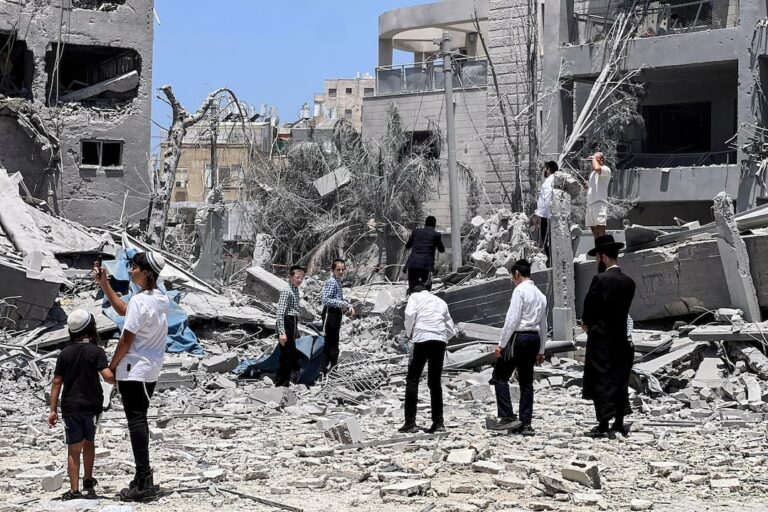
What Murray finds most revealing, however, is not what the media says but what it rarely shows. “They never ever talk about Tel Aviv being hit,” he noted, despite the fact that images of missile interceptions and impacts circulate online and through independent reporting channels. That absence produces a powerful psychological effect. Iranian destruction is shown constantly, reinforcing the impression that the country is being systematically overwhelmed, while Israeli vulnerability remains largely outside the frame. The war therefore appears visually one-sided even when the underlying military exchanges are far more complex.
Understanding why this imbalance exists requires examining one of the least discussed aspects of the conflict: Israel’s wartime censorship regime. Israel operates one of the most extensive military censorship systems among democratic states, granting authorities sweeping powers over the publication of security-related information. Journalists reporting from within Israel must submit certain categories of material to the Israeli Military Censor before publication if the content relates to missile strikes, sensitive infrastructure, intelligence operations or military installations. The official justification is straightforward — preventing adversaries from obtaining information that could improve the accuracy of future attacks.
In practice, however, these restrictions shape the global narrative of the war by limiting the visual evidence that can emerge from inside Israel itself. Foreign correspondents operating inside the country are frequently restricted from filming missile-impact locations without approval, and broadcasts from areas considered strategically sensitive may be prohibited altogether. Even footage of defensive missile interceptions can be curtailed if authorities believe it might reveal vulnerabilities in Israel’s air-defence systems.
In modern warfare, where images of destruction quickly become shorthand for strategic success or failure, such restrictions have enormous implications. When footage from one side circulates freely while footage from the other side remains constrained, the resulting narrative inevitably becomes distorted.
A Decapitation Strike That Changed the War
The consequences of this information imbalance became especially evident during one of the most dramatic developments of the war’s opening phase. On the first day of fighting, Ayatollah Ali Khamenei, Iran’s Supreme Leader for more than three decades, was killed during a wave of U.S.–Israeli airstrikes. The assassination represented one of the most consequential decapitation strikes in modern Middle Eastern history.
Western analysts initially suggested that the killing might destabilise the Iranian political system or even trigger internal collapse. Instead the opposite occurred. Within days Iran’s Assembly of Experts announced that Mojtaba Khamenei, the son of the slain leader, had been appointed as the new Supreme Leader. The transition took place while the country remained under active bombardment, transforming what was intended as a crippling blow into a moment of wartime consolidation.
For observers familiar with the history of decapitation warfare, the outcome was not entirely surprising. Leadership assassinations often strengthen hardline factions rather than weakening them, consolidating authority within security institutions and reinforcing public perceptions of national resistance. The rapid appointment of Mojtaba Khamenei therefore illustrated one of the recurring paradoxes of modern war: actions designed to destabilise an adversary can instead harden its political cohesion.
The Hidden Battlefield
While these political transformations unfolded inside Iran, the physical consequences of the conflict were becoming visible through other investigative channels. Satellite imagery analysed by open-source intelligence researchers revealed damage patterns across multiple locations in Israel following Iranian missile strikes. OSINT investigators, using geolocation techniques and commercial satellite photographs, identified structural damage near research facilities, industrial complexes and urban infrastructure.
One of the most striking incidents involved the Weizmann Institute of Science in Rehovot, a major Israeli research centre closely connected to advanced scientific and technological development. Iranian missile strikes caused extensive damage across the complex, destroying laboratories and disrupting the work of hundreds of researchers. Reports presented to Israeli lawmakers suggested that roughly ninety percent of the institute’s structures had suffered damage, with financial losses estimated in the billions of shekels.
Another strike occurred near Soroka Medical Center in Beersheba, where a missile impact damaged sections of the hospital complex and forced emergency evacuations. Yet once again the visual documentation available to the international public remained limited because filming around sensitive sites requires authorization from Israeli authorities.
These incidents illustrate how the physical impact of the war can exist largely outside the global visual narrative, visible to investigators and local residents but rarely presented to international audiences in the same way that images from Iran circulate across television screens.
The Economics of the Missile War
The regional dimension of the war has also received far less attention than the dramatic footage of airstrikes might suggest. Iranian President Masoud Pezeshkian delivered an extraordinary televised apology to neighbouring Arab states after Iranian missiles struck American military facilities located on their territory. The apology underscored an uncomfortable political reality: many of the bases used to launch attacks against Iran are situated inside Arab countries themselves.
Another rarely discussed aspect of the war concerns the brutal economics of modern air defence. Systems such as Israel’s Arrow and David’s Sling or the American Patriot interceptor cost enormous sums to operate, with each defensive missile costing hundreds of thousands or even millions of dollars. Iranian drones and missiles, by contrast, can often be produced at a fraction of that cost.
The resulting imbalance creates a form of strategic attrition in which the attacker spends relatively little while forcing the defender to expend vast resources to intercept incoming weapons. Even if most attacks are successfully intercepted, the defender may be losing the economic battle by burning through expensive interceptor stockpiles faster than they can be replenished.
The Information War
For Craig Murray the broader issue remains the extraordinary gap between the reality of the conflict and the way it is presented to Western audiences. After months spent documenting the aftermath of fighting in southern Lebanon, he estimates that roughly eighty thousand homes were destroyed across the region, leaving entire towns flattened along the border zone. Yet he says Western news organisations rarely reported from those areas.
“No Western media ever went there to report it,” he said. “I don’t think people in the West fully understand the incredible extent of bias and propaganda in what they are told about the Middle East,” Murray added. “It’s structural and it runs throughout.”
The conflict now unfolding across the region therefore cannot be understood simply as a military confrontation. It is also a struggle over narrative, visibility and perception. Missiles and drones determine which buildings are destroyed, but images determine how those events are remembered.
In an age when wars unfold in front of global audiences, controlling the visual narrative can become almost as important as controlling the battlefield itself.
Because in modern war the decisive weapon may not be the missile that destroys a building.
It may be the image that determines whether the world ever sees the destruction at all.