
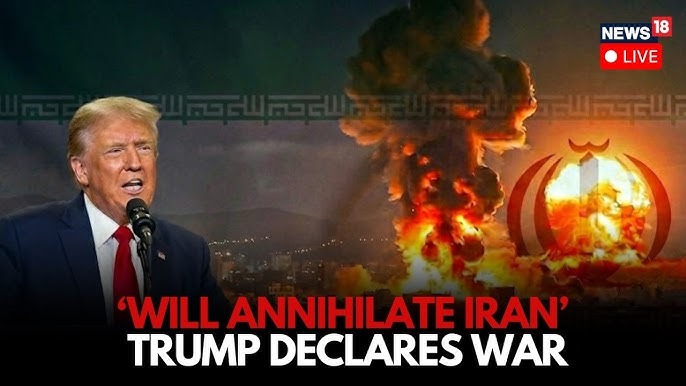

The United States and Israel have launched a sweeping military offensive against Iran, igniting a new and dangerous phase of conflict in the Middle East even as diplomatic negotiations were ongoing.
The coordinated strikes began in the early hours of Saturday, with air and missile attacks targeting what U.S. and Israeli officials described as Iranian military infrastructure, command centers, and strategic facilities. U.S. President Donald Trump confirmed that American forces were participating directly in the operation alongside Israeli units, describing the action as “major combat operations.”
On 28 February 2026, the United States, in coordination with Israel, formally announced the campaign as Operation Epic Fury — also referred to in some sources as part of a broader Israeli campaign, Operation Lion’s Roar. According to Trump, the objective was to degrade Iran’s missile systems, naval capabilities, and strategic assets, while increasing pressure on the leadership in Tehran. The assault included coordinated air and missile strikes on military and political targets across Iran.
Pentagon officials indicated that long-range bombers, carrier-based aircraft and sea-launched cruise missiles were used in the opening phase. U.S. naval assets positioned in the Arabian Sea reportedly launched precision strikes against air defense systems and missile facilities. Israeli defense sources described the campaign as potentially “multi-day,” suggesting additional waves may follow depending on Iran’s response.
The assault marks one of the most direct military confrontations between Washington and Tehran in decades — and it comes at a moment when indirect talks aimed at resolving disputes over Iran’s nuclear program were still underway through regional mediators.
The buildup to open warfare followed months of escalating tension: significant U.S. force deployments to the region, stalled negotiations over Iran’s nuclear and ballistic missile programs, and Iran’s violent crackdown on domestic unrest. Iranian officials condemned the strikes as an act of aggression carried out during active diplomacy and announced plans to seek an emergency meeting of the United Nations Security Council.
School Strike Kills Over 148 Civilians
The most shocking development emerged hours after the initial bombardment. Iranian authorities said at least 148 people were killed when a U.S.–Israeli strike hit a girls’ school in the southern city of Minab. Local officials reported that most of the victims were students, with dozens more wounded.
Images broadcast by Iranian media showed extensive structural damage to the school building as rescue workers combed through debris. The reported deaths of children have triggered widespread outrage inside Iran and across parts of the region.
Hospitals in Hormozgan province were reportedly overwhelmed as ambulances transported injured students throughout the night. Provincial officials declared a period of mourning, while state television aired scenes of funerals and vigils.
The Minab strike represents one of the deadliest single civilian incidents of the conflict’s opening phase and could dramatically shape both domestic and international responses to the campaign.
In October 2023, Israel declared war on Gaza and killed over 70,000 civilians – including over 20,000 children – predominantly on a claim that ’40 babies were beheaded by Hamas’ which was later proven to be 100% untrue – however, Israel’s opening and unprovoked attack on Iran and the number of dead schoolgirls in Minab continues to rise hour-by-hour, as more children are dug out of the rubble, and their possessions displayed for the world to see.
Iran’s Retaliation Expands the Battlefield
Within hours of the initial bombardment, Iran launched a retaliatory wave of missile and drone strikes aimed at U.S. military infrastructure across the Gulf region — a dramatic escalation that expands the battlefield well beyond Iranian territory.
Among the reported targets:
Qatar – Al Udeid Air Base
Missiles were fired toward Al Udeid Air Base outside Doha, which serves as a central hub for American air operations in the region. Qatari officials reported air defense interceptions, though explosions were heard nearby. The base hosts thousands of U.S. personnel and serves as a forward headquarters for regional operations.
United Arab Emirates – Al Dhafra Air Base
Missiles were launched toward Al Dhafra Air Base south of Abu Dhabi, a key facility supporting U.S. surveillance and combat missions. Air raid alerts were activated in the Emirati capital as defensive systems engaged incoming projectiles. One civilian fatality was reported in Abu Dhabi due to falling missile debris.
Kuwait – Ali Al Salem Air Base
Ali Al Salem Air Base, vital for logistics and regional force projection, was identified as another target. U.S. defense sources confirmed defensive systems were activated but did not disclose damage details.
Bahrain – Naval Support Activity Bahrain
Missiles were directed toward Naval Support Activity Bahrain, home to the U.S. Navy’s Fifth Fleet — the command center for American naval operations throughout the Gulf, Arabian Sea and Red Sea.
Airspace closures were implemented across Qatar, the United Arab Emirates, Kuwait and Bahrain as governments scrambled to protect civilian aviation routes.
While full damage assessments and casualty figures at U.S. facilities have not been publicly disclosed, defense officials acknowledged “multiple attempted impacts” near installations housing American personnel.
Military analysts say Iran’s missile salvos appear calibrated for sustained pressure rather than a single retaliatory demonstration. Iranian state media claimed the use of medium-range ballistic missiles and long-range drones capable of reaching targets across the Gulf and into Israel.
Missiles Over Israel
Iran’s response was not confined to Gulf installations. Waves of ballistic missiles and drones were also launched toward Israel.
Air-raid sirens sounded across Tel Aviv, Jerusalem, northern districts near Haifa, and the Negev in the south. Residents were ordered into bomb shelters as Israel’s layered air defense systems activated.
At least one civilian injury has been reported inside Israel, primarily from blast effects and falling fragments from intercepted projectiles. Interceptions were visible over central Israel, with bright mid-air flashes marking defensive engagements.
Israeli authorities implemented sweeping emergency measures: schools and workplaces closed, public gatherings banned, reservists mobilized, and hospitals moved critical patients to reinforced underground wards.
Air Defense Systems Under Strain
Israel’s defensive response relied on a multi-layered architecture:
• Iron Dome for short-range rockets and drones
• David’s Sling for medium-range ballistic threats
• Arrow 3 for high-altitude interception
Defense officials say the majority of incoming projectiles were intercepted, limiting casualties. However, sustained volleys place pressure on interceptor inventories and increase the risk of breakthrough impacts over time.
Regional security experts warn that prolonged exchanges could test both Iran’s missile stockpiles and Israel’s interceptor reserves, raising questions about sustainability if escalation continues for days or weeks.
Domestic and Political Reactions
In Washington, members of Congress from both parties called for classified briefings on the scope and legal basis of the operation. Debate quickly emerged over presidential war powers and the risk of long-term entanglement.
Crucially, the strikes were ordered by the president without prior authorization from Congress. Lawmakers are now debating whether to introduce a formal War Powers Resolution to check or restrict executive authority under the U.S. Constitution, which grants Congress the sole power to declare war.
The last time Congress formally declared war was during World War II in 1942. Since then, major U.S. military engagements — including Iraq and Afghanistan — have proceeded without formal declarations, often relying on presidential authority or Authorizations for Use of Military Force (AUMFs). The current conflict with Iran follows that modern pattern, intensifying constitutional debate over executive war powers.
In Israel, coalition leaders expressed support for the operation, framing it as a necessary preemptive strike against Iranian capabilities. Opposition figures urged caution, warning of a prolonged regional war.
Inside Iran, senior officials and commanders from the Islamic Revolutionary Guard Corps vowed further retaliation if strikes persist. Public demonstrations were reported in several cities, with crowds condemning the attacks and mourning the Minab victims.
International Alarm and Energy Shock
Global reaction was swift. Russia condemned the strikes as an “unprovoked act of armed aggression” that could destabilize the region. European Union officials called for immediate de-escalation and a return to negotiations, while governments across Asia and the Middle East weighed the risk of a broader conflict.
Oil prices surged sharply amid fears that sustained fighting could threaten shipping through the Strait of Hormuz — a critical artery for global oil exports. Shipping insurers reassessed maritime risk premiums, and commercial aviation routes were altered as regional airspace closures expanded.
Financial markets reacted with volatility as investors weighed the possibility of a prolonged regional conflict affecting global energy supply chains.
Diplomacy Collapses Into War
The timing of the offensive — launched during reported diplomatic engagement — has intensified scrutiny over the collapse of negotiations.
Iran’s leadership has vowed further retaliation if attacks continue. U.S. and Israeli officials have indicated that operations could expand depending on Tehran’s response.
The confrontation has now crossed a dangerous threshold: open, acknowledged missile fire between sovereign states, with direct U.S. participation and retaliatory strikes stretching from Iran to Israel and across Gulf states hosting American forces.
For now, the Middle East stands at the edge of a rapidly widening conflict. Whether this moment stabilizes into deterrence or spirals into a broader regional war may depend on decisions made in the coming hours — in Tehran, Jerusalem and Washington.