
New research presented today at the 2026 European Congress of Psychiatry reports that individuals with an evening chronotype, those who naturally prefer later sleep and activity times, show significantly higher rates of emotional dysregulation and affective temperaments associated with bipolar vulnerability in the general population.
With approximately one in three adults in the UK (and similar proportions elsewhere in Europe) identifying as ‘night owls’, this study adds important evidence that evening chronotype is associated with greater vulnerability to bipolar-related mood patterns.[1],[2],[3]
Researchers collected data from 2,031 adults recruited from COVID‑19 vaccination centres and points of care across Italy. Participants completed validated questionnaires assessing the participants’ circadian rhythm or chronotype (rMEQ), affective temperament (Brief‑TEMPS‑M), emotion regulation (DERS), and subthreshold bipolar features (MDQ and HCL‑32‑R2). In this sample, 22.8% were evening chronotype, 22.2% morning type and 55.0% neutral.
Key findings include:
- Individuals with an evening chronotype reported significantly higher levels of depressive, anxious, irritable and cyclothymic temperament traits.
- The evening chronotype group also showed greater emotional dysregulation compared with morning and neutral types.
- Higher ‘eveningness’ scores were strongly correlated with both affective temperament measures and emotional‑regulation difficulties.
- Evening chronotypes recorded significantly higher scores on both the MDQ and HCL‑32‑R2, suggesting increased vulnerability to subthreshold bipolar disorder.
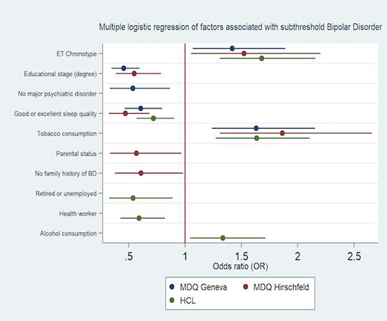
- In multivariate analyses, only evening chronotype and tobacco use predicted subthreshold bipolar features.
- Good or excellent sleep quality emerged as a protective factor on both MDQ and HCL-32-R2 scales.
Lead author G. Pontoni, Italian Army National Recruitment and Selection Center, said:
“Our findings strongly support a link between the evening chronotype and affective temperaments associated with bipolar vulnerability. Individuals with later sleep-wake rhythms are more likely to experience emotional dysregulation and subthreshold bipolar features, even in the general population.”
Professor Andrea Fiorillo, President of the European Psychiatric Association, commented: “These results underline the relevance of chronotype when assessing mood symptoms and emotion-regulation difficulties. Considering sleep–wake preferences alongside standard clinical evaluation may help clinicians better characterise risk and tailor follow-up where appropriate.”
The European Congress of Psychiatry takes place from 28 – 31 March 2026 in Prague, Czech Republic and represents Europe’s largest congress dedicated to psychiatry, with over 4,200 attendees from over 105 countries worldwide: epa-congress.org.
CHRONOTYPE AND SUBTHRESHOLD BIPOLAR DISORDER: EMOTIONAL DYSREGULATION AND AFFECTIVE TEMPERAMENTS IN THE ITALIAN GENERAL POPULATION [EPP379]
G. Pontoni 1,*, S. Caiolo 2,3, A. Miola 3,4, A. Sarzetto 5, F. Sambataro 3,4
1 Psychophysiological Selection Office, Psychiatry Section, Italian Army National Recruitment and Selection Center, Foligno (PG)
2 Psychiatry Section, Military Department of Forensic Medicine
3 University of Padova, Padova, Italy
4 Department of Neuroscience (DNS), Padua Neuroscience Center , University of Padova, Padova
5 Vita-Salute San Raffaele University, Milano, Italy
Introduction: Growing evidence supports an association between chronotype and mental health. In particular, the evening chronotype (ET) has been associated with increased vulnerability to bipolar disorder (BD).
Objectives: This study aimed to estimate the prevalence of the different chronotypes in the general population, confirm the association between ET and subthreshold BD, clarify whether chronotype is associated with BD-related psychopathological dimensions and identify factors associated with subthreshold BD in the general population.
Methods: A self-administered questionnaire including the reduced Morningness Eveningness Questionnaire (rMEQ), Brief-TEMPS-M, Difficulties in Emotion Regulation Scale (DERS), MDQ Mood disorder Questionnaire (MDQ) and Hypomania Check List-32, second revision (HCL-32-R2) scales was distributed to individuals attending of different Covid 19 vaccination centers and Covid-19 points of care.
Results: A total of 2031 participants from the general population were enrolled. Overall, 22.8% of subjects had an evening chronotype (ET), 22.2% had a morning type (MT), and 55.0% displayed neither chronotype (NT). Significantly higher scores for depressive, anxious, irritable and cyclothymic affective temperament, along with a significant emotional dysregulation, were found in subjects with ET chronotype compared with MT and NT groups. The rMEQ score was significantly correlated with both the Brief-Temps M and the DERS scores. ET chronotypes exhibited significantly higher scores on both the MDQ and HCL-32-R2 scales, and a significant correlation was found between such scales and the rMEQ. ET chronotype and tobacco consumption were the only two factors, among those in Image 1, predicting subthreshold BD on both MDQ (Geneva and Hirschfeld scores) and HCL-32-R2 scales through a multivariate logistic regression model. In the same model, a good or excellent sleep quality was found to be a significant protector from subthreshold BP on both MDQ and HCL-32-R2 scales.
Conclusions: Our findings strongly support an association between the ET chronotype and specific affective temperaments. Moreover, individuals with an evening chronotype are more likely to exhibit significant emotional dysregulation and an increased vulnerability to BD.
Disclosure of Interest: None Declared.
With active individual members in as many as 100+ countries and 47 National Psychiatric Association Members who represent more than 80,000 European psychiatrists, the European Psychiatric Association is the main association representing psychiatry in Europe. The EPA’s activities address the interests of psychiatrists in academia, research and practice throughout all stages of career development. The EPA deals with psychiatry and its related disciplines and focuses on the improvement of care for the mentally ill as well as on the development of professional excellence. More information: https://www.europsy.net/
References:
[1] Xie, H., Xi, Z., Wen, S., Zhang, R., Liu, Y., Zheng, J., Feng, H., Wu, D., & Li, Y. (2025). Associations between chronotype, genetic susceptibility and risk of colorectal cancer in UK Biobank. Journal of Epidemiology and Global Health, 15(1), 57. https://doi.org/10.1007/s44197-025-00399-6
[2] Kobayashi Frisk, M., Hedner, J., Grote, L., Ekblom, Ö., Arvidsson, D., Bergström, G., Börjesson, M., & Zou, D. (2022). Eveningness is associated with sedentary behavior and increased 10‑year risk of cardiovascular disease: The SCAPIS pilot cohort. Scientific Reports, 12(1), 8203. https://doi.org/10.1038/s41598-022-12267-5
[3] Jones, S.E. et al. (2019) ‘Genome-wide association analyses of chronotype in 697,828 individuals provides insights into circadian rhythms’, Nature Communications, 10(1). Available at: https://doi.org/10.1038/s41467-018-08259-7.