
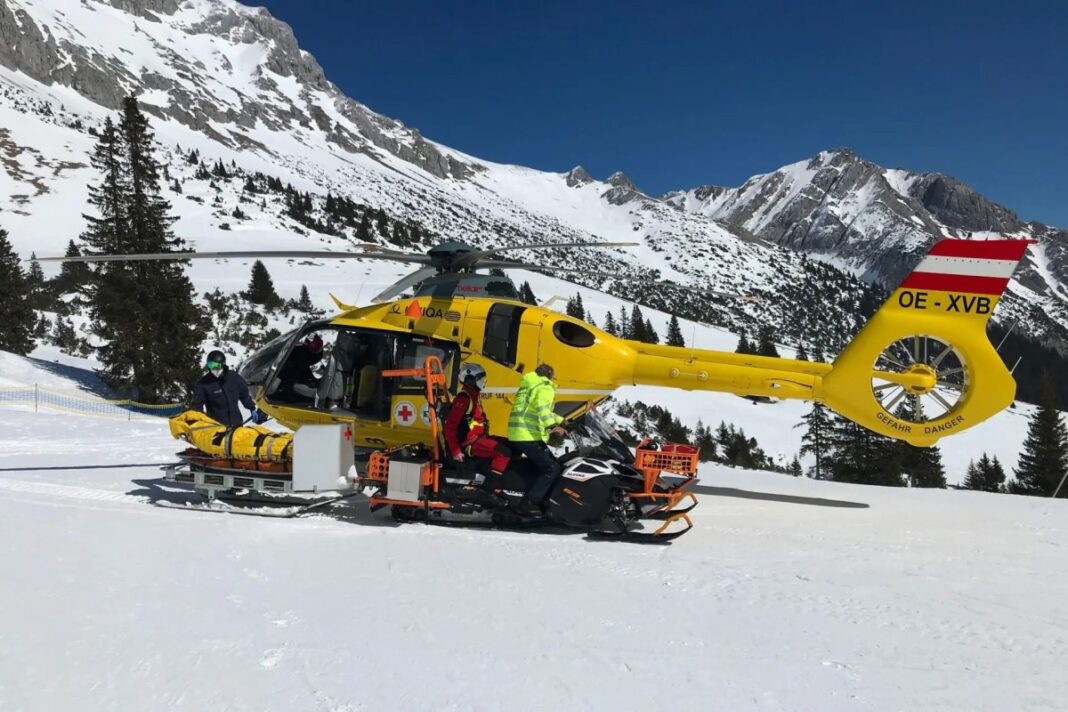

Authorities in the Austrian state of Tyrol recorded more than 30 avalanches on Wednesday 18 February, marking one of the most concentrated surges of avalanche activity this winter. The spike occurred during sustained Level 4 (“high”) avalanche warnings across western Austria and followed weeks of instability affecting the broader Alpine region due to persistent weak snow layers, heavy snowfall and wind-driven slabs.
In the Navis Valley in the Tux Alps, a 44-year-old German ski tourer was killed during a descent near Geier peak (2,857 m). A slab avalanche released beneath the group as they were returning from their ascent. His companion was partially buried but managed to free himself and alert rescuers. Despite rapid helicopter response, the 44-year-old died at the scene.
Near Fiss in the Landeck district – close to the St Anton and Lech ski arena – a 71-year-old Dutch holidaymaker was killed when a large avalanche was triggered in unsecured terrain. He was completely buried. Two companions, aged 41 and 34, survived but required medical treatment, with one airlifted to hospital in Zams.
In neighbouring Vorarlberg, a separate avalanche in the Sonnenkopf ski area resulted in another fatality, demonstrating that instability extended beyond Tyrol itself, all this week.
Earlier incidents in Tyrol in February reflect the broader danger gripping Austria’s mountains. On 16 February 2026, two 37-year-old Austrian snowboarders died after being buried by an avalanche on the open shoulder of the Stubai Glacier near the Dresdner Hut and the Gamsgarten valley station. Their transceiver signals were located by rescuers using drones before their bodies were recovered; emergency doctors confirmed their deaths late in the evening.
On 17 February 2026, an 18-year-old Austrian freerider died in an off-piste accident at the St. Anton am Arlberg resort when he fell into deep fresh snow, became stuck head-first, and could not free himself. Despite a risky rope rescue by an emergency helicopter crew and rapid medical response, he succumbed to his injuries after being taken to hospital in Zams.
Avalanche danger has also resulted in serious injuries. On 15 February 2026, a 19-year-old Swedish alpinist was partially buried by a slide near St. Anton am Arlberg and was airlifted to hospital; further details about his condition were not fully disclosed.
The crisis extends beyond Tyrol. On 15 February 2026, near Courmayeur in Italy’s Aosta Valley close to the Mont Blanc massif, an off-trail avalanche in the Couloir Vesses area killed two skiers and injured a third. Helicopters and avalanche rescue dogs were deployed to reach the victims.
Between 13 and 17 February 2026, multiple avalanches in the French Alps — including near Val d’Isère and Valloire — resulted in at least five fatalities, many involving off-piste skiing despite elevated warnings.
On 9 February 2026, Italian Alpine rescue authorities reported that at least 11 people had died in avalanche incidents during the preceding seven days. Fatalities were recorded in Lombardy, Trentino and South Tyrol, including near the Marmolada glacier. Officials described the period as one of the deadliest short spans for avalanche victims in recent years.
The mid-February surge followed a deadly January across Austria. On 17 January 2026, a cluster of avalanches struck within hours. In Pongau (Salzburg province), a solo off-piste skier was killed. At Finsterkopf in the Großarltal region, an avalanche hit a group of seven ski tourers ascending the slope; four members died. In Pusterwald (Styria), three Czech ski tourers were killed in a separate avalanche on the same day. Two of the victims at Großarl were long-serving mountain rescuers, a loss that deeply affected the alpine rescue community.
On 15 January 2026, a skier was killed in an avalanche near Ischgl in Tyrol while travelling beyond secured slopes. On 13 January 2026, a 13-year-old Czech skier died after being buried while skiing off-piste near Bad Gastein. On 11 January 2026, a skier was killed near Weerberg in Tyrol when heavy snowfall overloaded weak layers within the snowpack.
Avalanche forecasters across Austria, Italy, Switzerland and France have identified consistent structural causes throughout January and February: repeated heavy snowfall, strong winds forming wind slabs, deep persistent weak layers beneath newer snow, and temperature fluctuations weakening bonding between layers. These conditions have created slopes that often appeared stable but could fail under minimal additional load.
Large areas of Tyrol and western Austria remained at Level 4 (high) avalanche danger for extended periods throughout January and February, with occasional localized spikes toward Level 5 after major storms.
From 11 January through 18 February 2026, the Alps have experienced a sustained sequence of avalanche fatalities across Austria, Italy, France and Switzerland — a winter marked not by isolated accidents but by prolonged structural instability in the mountain snowpack that continues to endanger winter sports enthusiasts and backcountry travellers alike.