
In late December 2025, as Iran’s economy buckled under renewed sanctions pressure and isolated local protests began to surface, an extraordinary message appeared not from Tehran but from Washington.
Mike Pompeo, the former US secretary of state and CIA director, posted a New Year greeting on X addressed not only to Iranians protesting economic hardship, but explicitly to Israel’s intelligence service.
“Happy New Year to every Iranian in the streets,” he wrote. “Also to every Mossad agent walking beside them.”
At the time of the post, unrest remained fragmented and limited in scale, with no confirmed nationwide mobilisation and no unified political programme. Pompeo’s message therefore read less like a response to a mass uprising than a public signal — one that assumed the presence of foreign intelligence networks operating inside Iranian demonstrations before such claims had been independently substantiated.
When protests expanded in early January 2026 amid accelerating currency collapse and rising prices, Iranian officials seized on the remark as evidence that foreign intelligence services had anticipated, and possibly embedded themselves within, the unrest from an early stage.
Iran’s foreign minister Abbas Araghchi accused the United States and Israel of effectively admitting involvement in destabilising the country. “We have many documents and pieces of evidence,” he said, charging that Washington and Tel Aviv were sponsoring what he described as violent and subversive activity under the cover of protest.
Pompeo’s remark did not stand alone. It came after months of escalating confrontation between Israel and Iran, and just months after Israeli prime minister Benjamin Netanyahu had delivered a direct televised appeal to the Iranian people urging them to overthrow their government.
“The time has come for you to unite around your flag and your historic legacy by standing up for your freedom from an evil and oppressive regime,” Netanyahu said in June 2025. “Israel’s fight is not with you. Our fight is with our common enemy: a murderous regime that both oppresses you and impoverishes you.”
The phrase “impoverishes you” carried a political sleight of hand.
Iran’s economic collapse did not begin with street protests or domestic mismanagement. It began with international financial warfare.
After the United States abandoned the nuclear agreement in 2018 and reimposed sanctions, Iran’s oil exports were slashed, its banks were severed from the global financial system, and foreign firms were threatened with punishment for continuing to trade. When sanctions were briefly eased, growth returned. When Washington reinstated “maximum pressure,” the economy imploded again.
This was not a side-effect. It was the strategy.
By late 2025 Iran had been deliberately denied the dollars needed to defend its currency. Oil was sold through shadow networks at deep discounts. Banking channels were blocked. Foreign reserves were frozen. This was not market failure but currency warfare: a policy designed to collapse the rial, drive inflation, and convert economic pain into political pressure.
The result was catastrophic. The rial crashed. Import prices surged. Wages evaporated. Living standards collapsed almost overnight.
The International Monetary Fund has repeatedly found that even limited sanctions relief would sharply reduce inflation and stabilise growth. Ordinary Iranians are not poor because they built centrifuges. They are poor because the world’s dominant financial power chose to make enrichment economically lethal.
And here lies the central hypocrisy.
Iran is a signatory to the Nuclear Non-Proliferation Treaty. It submits to international inspections. Israel does not.
Israel is widely believed to possess a substantial nuclear arsenal. It maintains deliberate opacity, has never signed the NPT, and keeps its main weapons complex at Dimona outside full international inspection. The global non-proliferation regime that Iran is forced to live inside is one Israel stands outside by design.
That asymmetry was locked in during the Cold War. When President John F. Kennedy demanded inspections of Dimona in 1963, warning Israel that US support could be jeopardised without transparency, it was the last serious attempt by Washington to bring Israel’s nuclear programme into daylight. Kennedy was killed five months later. The pressure vanished. Israel’s arsenal matured in silence.
By the 1970s Israel’s nuclear story was already surrounded by unresolved shadows. Hundreds of pounds of highly enriched uranium disappeared from the NUMEC facility in the United States, sparking decades of suspicion that material had been diverted to Israel. The issue was never conclusively resolved. At the same time Israel entered into deep military and nuclear cooperation with apartheid-era South Africa, a relationship that culminated in the still-disputed 1979 Vela “double flash” over the southern oceans, widely suspected by scientists and intelligence analysts to have been an undeclared nuclear test.
This is the nuclear world Israel built: outside treaties, outside inspections, protected by Western power.
For more than two decades Western policy in the Middle East has followed a clear pattern. No independent regional power is allowed to grow strong enough to challenge US or Israeli dominance.
Iraq was dismantled through invasion and occupation.
Syria was shattered through proxy war and sanctions.
Lebanon was financially strangled.
Yemen was bombed and blockaded.
Each, in its own way, was reduced to permanent weakness.
Iran remains the exception.
It retains industrial capacity, energy independence, regional alliances and military reach. It has not collapsed into dependency. That resilience makes it a thorn in the side of a regional order designed to keep Israel militarily unchallenged and the Middle East strategically fragmented.
By the mid-2020s Iran had become a strategic pillar of a rising multipolar bloc led by China and Russia. It joined the Shanghai Cooperation Organisation, deepened military cooperation with Moscow, expanded energy trade with Beijing, and became a full member of BRICS, the alliance constructing financial infrastructure designed to bypass the dollar, Western banks and the sanctions system itself.
For Washington this was intolerable.
Sanctions on Iran were never only about nuclear compliance. They were about preventing Iran from becoming a pivot state in a non-Western economic and security order.
Israel’s nuclear weapons sit safely inside the dollar system.
Iran’s nuclear capability sits inside a bloc designed to escape it.
That is the real red line.
When protests spread across Iran in late December 2025 and early January 2026 amid collapsing living standards and a sanctions-driven currency crisis, Western leaders did not merely comment. They intervened rhetorically.
Donald Trump urged Iranians to “KEEP PROTESTING” and promised that “HELP IS ON ITS WAY.” Netanyahu had already called for regime change. Pompeo had publicly asserted Mossad’s presence.
Iran’s own recent history casts those interventions into sharp relief.
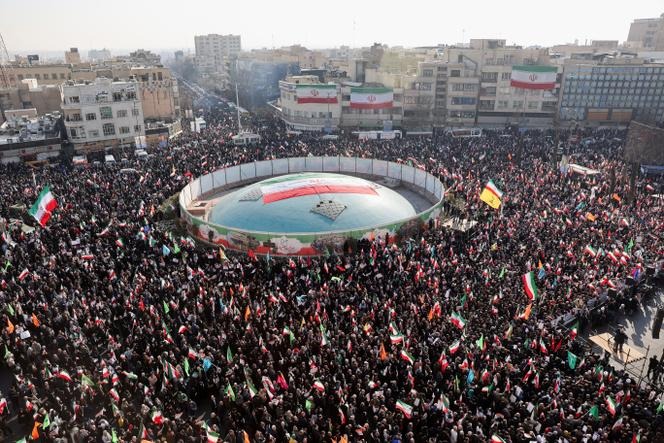
When foreign powers assassinated senior Iranian figures — most notably after the US killing of Qasem Soleimani in January 2020, the Israeli assassination of nuclear scientist Mohsen Fakhrizadeh in November 2020, and repeated Israeli strikes killing Iranian officers in Syria — millions of Iranians poured into the streets. But they did not demand regime change. They marched in mourning, anger and national defiance against foreign attack.
Those demonstrations were vast, emotional and overwhelmingly non-violent.
By contrast, movements framed as regime-change protests have emerged only when economic collapse, sanctions pressure, information warfare and foreign political signalling converge. That pattern lies at the heart of Tehran’s claim that January 2026 was not simply domestic anger but a crisis catalysed from outside.
The shadow war that preceded those protests had already spilled into the open.
In January 2024 Israel assassinated senior Hamas political leader Saleh al-Arouri in Beirut. His killing triggered one of the largest mass mobilisations in Lebanon since the 2006 war. Ismail Haniyeh travelled to Beirut to address tens of thousands of mourners gathered in a stadium in the southern suburbs, turning the funeral into a regional rally against Israel’s expanding campaign of targeted killings.
Across Iran, Iraq, Yemen and Gaza, huge solidarity marches followed for Palestinian and Iranian figures killed by Israeli and US strikes. These were not regime-change demonstrations. They were sovereignty demonstrations — expressions of resistance to what much of the region saw as a campaign of decapitation warfare aimed at destroying every independent centre of power.
Israel has long accompanied such moments with air-power theatre. In Gaza, southern Lebanon and Beirut, Israeli fighter jets have repeatedly flown low over dense civilian areas and mass gatherings, generating sonic booms that terrify crowds and remind entire populations that no public space is beyond reach.
This too is part of the information war.
Tehran responded to the January 2026 unrest with force and then with a digital siege.
On January 8 Iran shut down the internet nationwide. Around ninety percent of connectivity vanished. Messaging apps, banks, media and family contact were severed from the outside world.
A thin line was supposed to remain. Starlink satellite terminals, smuggled into the country, had been widely presented in Western commentary as the unstoppable workaround — the uncensorable layer floating above state control.
It did not hold.
Iran deliberately interfered with Starlink reception during the shutdown. Terminals meant to bypass domestic control stopped working reliably at scale. The network marketed as sitting beyond state reach became noisy, uneven and in many places unusable.
The move was not simply about hiding images. It also degraded external coordination. Intelligence contact requires reliable channels. Influence operations need live data. Once the state concluded that foreign-linked activity was operating through open access, it stopped treating a foreign-controlled satellite network as neutral and started treating it as a vulnerability.
Iran justified the crackdown by citing armed cells, weapons seizures, explosives and foreign links, including Israeli involvement. Those claims are contested, but the practical outcome was clear. Satellite internet marketed as uncensorable was rendered unreliable when a state decided access itself was part of the battlefield.
A belief system collapsed in real time.
Blackouts were supposed to be obsolete. Technology was meant to route around them. Truth was meant to leak.
It did not.
When connectivity becomes politically decisive, it is treated like any other critical infrastructure. It gets mapped. It gets targeted. It gets denied. Neutrality does not survive contact with power.
This does not make protest disappear. It makes it slower, more local, more dangerous and less legible to outside audiences. Absence of footage is not proof that nothing happened. Presence of footage is not proof of scale or legitimacy. What vanished was certainty.
This was not merely a protest movement. It was a domestic eruption inside a pressure chamber built by sanctions, regime-change rhetoric, covert operations and a nuclear double standard that has endured since the Cold War.
Iran’s uprising is real. So is its suffering.
But it is unfolding inside a shadow war that began long before the first stone was thrown — a war over who is allowed sovereignty, technology and power in a world no longer willing to remain American-dominated.
And the rules of that war were not written in Tehran.
They were written in Washington, and enforced in Tel Aviv.