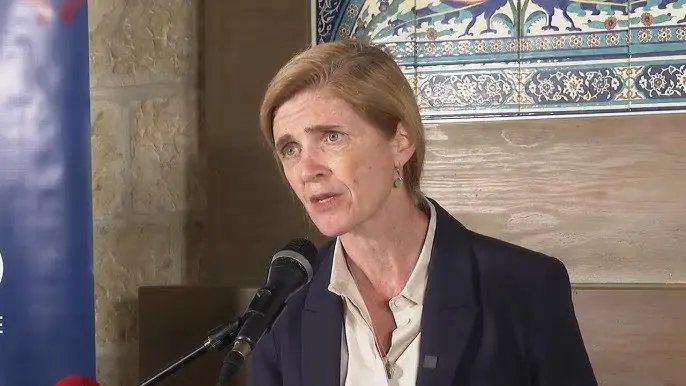

Political commentator Tucker Carlson has accused former USAID Administrator Samantha Power of failing to uphold the principles that made her one of the world’s most influential advocates against genocide, arguing that she remained in the Biden administration despite what he described as a genocide unfolding in Gaza.
In a recent monologue, Carlson framed his criticism around the lessons of the 1994 Rwanda genocide, which claimed the lives of hundreds of thousands of Tutsis during a 100-day campaign of ethnic slaughter.
“Something horrible, in fact genocide, can happen. The world can know it’s happening and allow it to happen. That’s the lesson,” Carlson said.
He argued that governments, aid agencies and international institutions were aware of the killings while they were taking place but largely failed to intervene.
According to Carlson, one of the people most deeply influenced by Rwanda was Samantha Power, then a young Harvard Law student who would later become one of the most prominent voices in the world on genocide prevention.
In 2002, Power published A Problem from Hell: America and the Age of Genocide, a Pulitzer Prize-winning book examining repeated failures by the United States and other governments to intervene against mass atrocities.
Carlson summarized the central question that drove Power’s work.
“How can a genocide take place within living memory of the Second World War and the civilized world does nothing about it?” he asked.
According to Carlson, Power’s answer was clear.
“The world cannot allow genocide to happen again. If people find out this is happening, they have to act. That’s the mark of civilization.”
He noted that Power argued the United States had a moral obligation to intervene when genocide was underway.
“The United States, she wrote, has a moral obligation to intervene with force if it determines that a genocide is underway,” Carlson said. “What’s the point of having the world’s largest military if you can’t at least try to prevent a genocide?”
Power’s career subsequently took her to the highest levels of American foreign policy. She served as an adviser to President Barack Obama, became U.S. Ambassador to the United Nations, participated in atrocity prevention initiatives and later returned to government under President Joe Biden as Administrator of the U.S. Agency for International Development while holding a seat on the National Security Council.
For Carlson, the Gaza war represented the ultimate test of the principles Power spent decades advocating.
“Well, it just so happens that during her time there, the thing that she warned about, wrote about, actually happened,” Carlson said. “Another genocide.”
Following the October 7, 2023 Hamas attacks on Israel, Israel launched a military campaign in Gaza that has resulted in tens of thousands of deaths and widespread destruction. Human rights organizations, legal scholars and some governments have accused Israel of committing genocide or other grave violations of international law. Israel rejects those allegations, arguing that it is acting in self-defense against Hamas following the October 7 attacks that killed approximately 1,200 people and resulted in hundreds of hostages being taken into Gaza.
Carlson argued that Israeli leaders openly signaled their intentions during the earliest stages of the conflict.
He pointed specifically to comments by Israeli Prime Minister Benjamin Netanyahu invoking the biblical story of Amalek.
“When Benjamin Netanyahu describes the Palestinians as Amalek twice in the first month of the Gaza operation, you don’t need to guess what the point of this is,” Carlson said. “The point is to destroy every man, woman and child in Gaza.”
Carlson also cited remarks by then Israeli Defence Minister Yoav Gallant, who announced a complete siege on Gaza in October 2023.
“No electricity, no food will be allowed in. We are fighting human animals,” Gallant said at the time.
Carlson argued that such statements should have triggered the same alarm bells that Power spent much of her career warning about.
“The genocide lady did nothing to stop genocide after writing a book scolding the rest of us for doing nothing to stop genocide,” Carlson said.
“What she did not say was, ‘You’re absolutely right. I wrote a book saying the civilized world can’t allow genocide to happen and then I allowed it to happen.’ But that’s exactly what she did.”
Yet Power’s own public statements paint a more nuanced picture than Carlson’s portrayal suggests.
Far from remaining silent about Gaza, Power repeatedly warned about the humanitarian catastrophe unfolding inside the enclave and became one of the most outspoken members of the Biden administration regarding civilian suffering.
In January 2024, after being confronted by USAID staff who accused the administration of enabling atrocities, Power described the situation in Gaza as “devastating” and noted that more than 25,000 civilians had already been killed.
She stressed that humanitarian assistance reaching Gaza remained inadequate and called for substantially more aid while also emphasizing the significance of Hamas’s October 7 attack.
“We have to make sure that an attack like October 7 never happens again,” Power said.
By April 2024, Power became one of the highest-ranking U.S. officials to publicly acknowledge famine conditions in northern Gaza.
“There is famine in areas of northern Gaza,” she told lawmakers during congressional testimony, citing severe food insecurity and alarming levels of child malnutrition.
Later that month she again sounded the alarm.
“People are facing famine-like conditions,” she said, arguing that humanitarian deliveries remained far below what was necessary to sustain the population.
Power’s criticism of Israel’s military operation became more pointed during the assault on Rafah.
In May 2024 she warned that Israeli actions were causing “catastrophic consequences” for civilians and highlighted the collapse of basic services across Gaza.
She noted that approximately 95 percent of Gaza’s population lacked access to clean water and that much of the healthcare system had ceased functioning.
One year after the conflict began, Power publicly reflected on the human toll.
“We mourn the tens of thousands of Palestinian civilians killed,” she said while calling for greater humanitarian access and acknowledging the suffering experienced by Israeli, Palestinian and Lebanese civilians.
Nevertheless, those statements failed to satisfy many critics.
The criticism directed at Power stems not from a perceived silence about Palestinian suffering but from what opponents see as a contradiction between her words and her actions.
Critics argue that while she repeatedly described humanitarian conditions in Gaza as catastrophic, she remained within an administration that continued supplying military aid and diplomatic support to Israel throughout the conflict.
Some former USAID officials publicly urged her to resign, arguing that remaining in office undermined the principles she championed in A Problem from Hell.
Power has rejected that criticism, maintaining that remaining inside government allowed her to advocate for expanded humanitarian assistance, increased civilian protections and policy changes that could reduce suffering.
She has consistently acknowledged mass civilian casualties, famine risks and humanitarian devastation in Gaza. However, she stopped short of accusing Israel of genocide or calling for an unconditional end to U.S. military support for Israel.
That position has placed her in an increasingly difficult middle ground.
To supporters of Israel, some of her public comments have appeared overly critical of the military campaign. To critics of the Biden administration, her refusal to directly challenge U.S. support for Israel represents a profound departure from the principles that made her famous.
For Carlson, however, the issue extends far beyond one individual.
“Everybody knew from the first week after October 7th that Israel planned to commit genocide,” he claimed.
Whether one agrees with Carlson’s assessment or not, the debate surrounding Samantha Power has become a wider argument about consistency, moral responsibility and the application of humanitarian principles when allegations of genocide involve a close ally of the United States.
More than two decades after Power asked why the world failed to stop the slaughter in Rwanda, supporters and critics alike continue to debate whether the lessons she drew from that tragedy have been applied equally to Gaza.