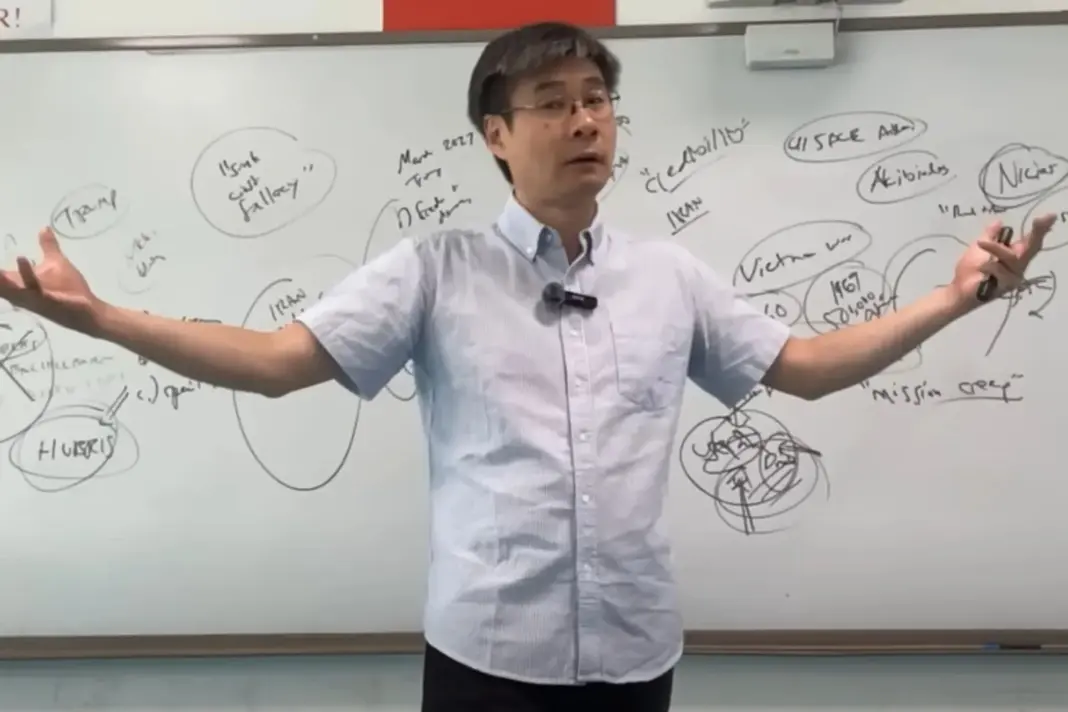

A controversial commentator whose sweeping forecasts on war, empire and civilizational decline have gained traction across alternative media is now claiming that the confrontation between the United States, Israel and Iran is not simply another Middle Eastern crisis, but the beginning of a far larger rupture in world affairs. In a lengthy and often incendiary interview, Professor Jiang Sha Quinn argued that the current hostilities should be understood not as an isolated confrontation, but as the opening stage of a conflict that could redraw power relations across the Middle East, destabilize global energy markets, expose the fragility of Gulf monarchies and accelerate the breakdown of the international order that has dominated since the end of the Cold War.
Jiang’s remarks are dramatic, highly speculative and in many places deeply controversial. Yet they are also striking because they combine several strands of contemporary geopolitical anxiety that are already circulating widely: the fear that the U.S. can no longer control the world it once dominated, the belief that Israel’s regional strategy is becoming more openly expansionist, the suspicion that Gulf states are less stable than their wealth suggests, and the growing sense that a major war in the Persian Gulf would not remain confined to the region for long. His analysis moves well beyond conventional military forecasting into a broader interpretation of imperial decline, global supply chains and ideological conflict, which helps explain why it has resonated so strongly with audiences seeking grand explanations for an increasingly chaotic world.
Why Jiang says Iran is different
At the core of Jiang’s argument is the insistence that Iran cannot be understood in the same way as earlier American targets such as Iraq or Afghanistan. Those wars, in his view, created a false sense of Western military invincibility because they were fought against states that had already been hollowed out by sanctions, isolation, internal fractures or overwhelming technological inferiority. Iran, by contrast, is a large, cohesive and historically self-conscious state with a population of around 90 million, substantial missile capabilities, hardened underground military infrastructure and a political culture that has spent decades preparing for siege, infiltration and confrontation. That difference, he argues, changes everything.
“This is not Iraq or Afghanistan,” Jiang said during the interview. “Iran is a completely different situation in terms of population, territory and military capability.”
For Jiang, that distinction is not a detail but the central fact of the conflict. In his telling, the current war remains, for now, largely an air war. The United States and Israel retain air superiority and can strike Iranian targets at will, while attempting to keep their own casualties relatively low. So long as the fighting remains at that level, he suggests, Washington and its allies still have the option of de-escalation, however politically difficult that may be. But the introduction of ground forces would, in his view, mark an irreversible transition into a much wider and more dangerous phase.
The turning point: a ground invasion
He pointed to rumors circulating online that the U.S. 82nd Airborne Division had halted training exercises and received deployment orders, though he acknowledged those claims were unconfirmed. Even so, he treated the possibility as a sign of the direction in which the crisis could move.
“If ground troops enter Iran,” he said, “that will be a massive escalation. At that point the war cannot easily be reversed.”
That prediction forms the spine of Jiang’s wider thesis. He believes the real turning point in the conflict will not be another air strike, another exchange of missiles or another round of rhetorical escalation, but the moment Washington decides that aerial bombardment and covert warfare are insufficient and that troops must be put on the ground. In his view, once that line is crossed, the war ceases to be a punishing campaign and becomes a consuming one. Casualties rise, political calculations harden, outside powers begin adjusting their own positions and the logic of escalation takes over.
From regional war to wider shockwaves
From there, Jiang argues, the consequences would quickly spread beyond Iran itself. A ground war, he says, would not remain a bilateral fight between Washington and Tehran. It would pull in surrounding states directly or indirectly, transform the Gulf into a contested military theatre and place enormous pressure on governments whose economies depend on uninterrupted energy flows and shipping lanes. The Gulf Cooperation Council states, long shielded by wealth and U.S. military patronage, would suddenly find themselves at the center of a war they cannot fully control and may not be able to survive in their current form.
Hormuz and the global economy
His reasoning here is tied closely to geography. Any major war involving Iran immediately raises the question of the Strait of Hormuz, the narrow but indispensable passage through which a significant share of the world’s oil and gas exports moves. In Jiang’s view, that chokepoint is not simply one strategic asset among many. It is the hinge on which the global economy could swing from fragile stability into severe disruption.
“If the Strait of Hormuz remains closed because of the war,” he said, “the entire global economy will be affected.”
That is not an outlandish point in itself; mainstream analysts have long warned that a major confrontation in the Gulf could send energy prices soaring and trigger economic shockwaves well beyond the Middle East. What makes Jiang’s commentary distinctive is the way he extends that logic into a far more expansive theory of global realignment. He argues that countries in East Asia, especially those heavily dependent on imported fuel, would not be able to remain passive spectators if Gulf shipping were severely disrupted. Japan, South Korea, China, India and others all rely to differing degrees on the flow of energy through the region, and prolonged instability would force them to rethink long-held assumptions about security, supply and diplomatic alignment.
Why East Asia figures in his scenario
Japan figures especially prominently in his analysis. Jiang claimed that Japanese officials have already expressed alarm at the vulnerability of the country’s oil supplies and suggested that a sustained closure or partial shutdown of Gulf routes would create intense pressure inside Tokyo to respond in some form. That response, he argued, might not necessarily be military at first, but it would almost certainly be strategic.
“Japan receives about 75 percent of its oil through that route,” he said. “If it remains blocked, there will be enormous pressure on governments in Asia to intervene.”
Linking Iran to the Ukraine war
From there, Jiang broadens the frame even further. In his telling, the war over Iran cannot be separated from the war in Ukraine, because both are expressions of a deeper struggle over global trade, energy control and the future structure of world power. His interpretation is that Russia’s war in Ukraine has already reshaped the strategic environment by challenging Western power in Europe, disrupting food and energy networks and forcing the United States to seek new ways to maintain leverage over allies and adversaries alike. If Russia can weaken Europe by constraining energy and grain flows, then, in his view, control over the Middle East becomes even more crucial for Washington.
“The Middle East becomes crucial in that situation,” he said. “If the United States can control energy supplies there, it retains influence over global trade.”
Iran, in this worldview, is not merely another adversarial state but a central pivot between the Gulf, Central Asia, Russia, South Asia and China. Its survival as an independent power complicates any attempt by Washington to dominate Eurasian trade routes or to contain a possible long-term bloc linking Russia, Iran and China. That line of thinking is not unique to Jiang; variants of it have circulated for years in both Western and non-Western geopolitical writing. But Jiang pushes it further by describing the war as a struggle of life and death for American imperial power itself. In his formulation, Washington is not intervening because it is strong and confident, but because it is anxious, overextended and increasingly desperate to prevent the erosion of its global primacy.
The “Greater Israel” argument
That interpretation feeds directly into one of the most contentious themes in the interview: the question of Israeli regional ambition and the recurring political discourse around the idea of “Greater Israel.” Jiang presented this concept not as a fringe slogan but as a structuring idea behind Israeli strategic behavior, claiming that Israeli elites increasingly view the current period of regional instability as an opportunity to weaken surrounding states and establish a new hierarchy of power centered on Jerusalem.
He argued that, in its most expansive reading, the concept envisions Israeli influence extending from the Nile to the Euphrates and ultimately reaching into the affairs of Egypt, Saudi Arabia, Turkey and beyond. He linked this reading to remarks attributed to former Israeli Prime Minister Naftali Bennett suggesting that Turkey could emerge as the next strategic rival after Iran. In Jiang’s account, the war against Iran is therefore not an endpoint but one phase in a much longer process aimed at neutralizing any state capable of contesting Israeli supremacy in the region.
Such claims are, of course, highly disputed. Many scholars would reject the notion that Israeli policy can be accurately reduced to a master plan for territorial domination of the entire region, while others argue that “Greater Israel” is often invoked too loosely in political commentary and propaganda. Even so, the concept remains powerful in regional discourse because it expresses a widely held fear that Israeli military campaigns, normalization deals and strategic alignments are all part of a broader project to reorder the Middle East on terms favorable to Israeli power. Jiang’s interview gives that interpretation one of its most maximalist contemporary expressions.
The fragility of the Gulf monarchies
A related and more grounded strand of his analysis concerns the vulnerability of the Gulf monarchies themselves. Here, Jiang shifts from ideology to infrastructure. Saudi Arabia, the United Arab Emirates, Bahrain, Qatar and Kuwait are often presented in global media as islands of wealth, luxury and stability, their glittering skylines standing as symbols of successful adaptation to globalization. Jiang argues that this image conceals a profound structural weakness. Many of these states rely on desalination for water, imported labor for much of their workforce, imported food for basic sustenance and U.S. military protection for strategic security. In a prolonged regional war, he suggests, those dependencies become liabilities.
“Much of the infrastructure that sustains these countries can be disrupted relatively easily,” he said.
His point is that the Gulf states are rich, but that wealth does not automatically make them resilient. A missile or drone campaign targeting energy sites, desalination plants, ports or bases could rapidly expose how much of daily life in those states depends on fragile systems. Bahrain, in his telling, is especially vulnerable because of its sectarian makeup and the presence of the U.S. Fifth Fleet. Saudi Arabia, despite its enormous military spending, remains exposed through oil infrastructure, water dependency and the vast logistical requirements of sustaining cities built in extreme environments. The UAE, meanwhile, is vulnerable not just materially but reputationally: its role as a hub for finance, tourism and expatriate life depends on the perception of peace and safety. A serious war punctures that perception overnight.
Rethinking the value of U.S. bases
Jiang uses this point to challenge the longstanding assumption that American military bases guarantee Gulf security. In his account, those bases are not primarily there to defend the populations of Gulf states, but to secure ruling elites and integrate the region into a wider U.S.-led financial and strategic order. That arrangement functioned well so long as the U.S. could credibly deter adversaries and the region remained relatively insulated from large-scale interstate war. But once the bases themselves become targets and once their presence invites retaliation rather than prevents it, the bargain begins to look much less attractive. For Jiang, this realization is one of the hidden political consequences of the present war: elites and publics in the Arab Gulf may increasingly ask whether American protection is in fact the source of their danger.
The limits of American military power
He also devotes considerable attention to what he sees as the limits of American military power. His argument is not that the U.S. lacks formidable weapons or global reach, but that the wars it has fought for decades have not prepared it for a direct, high-intensity confrontation with a state like Iran. In his view, many of the wars that shaped the post-1991 American self-image were not symmetric tests of military skill, but technologically one-sided campaigns against opponents already crippled by sanctions, poor air defenses, internal disunity or strategic isolation. Iran, by contrast, has spent years designing a defense posture meant precisely to absorb punishment, retaliate asymmetrically and exploit the political sensitivity of Western casualties.
“The American military hasn’t fought a war like this in decades,” he said.
From that perspective, the effectiveness of Western air defense systems becomes a crucial issue. Jiang argues that Iran’s missile and drone arsenal, even if not deployed at its maximum capacity, has already shown how costly and imperfect modern defense shields can be under sustained assault. He described Iranian strategy as one of attrition and saturation, forcing adversaries to expend enormous resources intercepting relatively cheaper projectiles while keeping their own civilian and economic infrastructure under pressure. He suggested that this dynamic could expose weaknesses not only in Israeli systems like Iron Dome and Arrow, but also in broader U.S.-backed regional defense architecture.
Many military analysts would push back against some of Jiang’s conclusions here, noting that the United States still possesses overwhelming conventional superiority, vast logistical capabilities and the ability to escalate across multiple domains. Still, his broader argument taps into a real and growing debate about whether advanced Western militaries, designed around extraordinary expense and technological complexity, are optimally structured for prolonged conflict against adversaries using massed drones, missiles, proxies and hardened underground networks.
The proxy question
Another major issue raised in the interview is the use of proxies. Jiang argues that if Washington seeks to avoid the political cost of sending a large ground force directly into Iran, it may look again to regional armed groups operating near Iran’s borders. Kurdish factions, separatist movements and militants based around frontier zones could all be seen as potential assets. Yet Jiang believes the utility of such proxies is often overstated. The Kurds, he notes, have a long and bitter history of being encouraged by outside powers and then abandoned. Azerbaijan, despite speculation in some media spaces, would take enormous risks by entering such a war openly. Other groups may be willing to accept money, weapons or political promises, but far less willing to become expendable cannon fodder in a campaign whose endgame they do not control.
“The Kurds remember what happened in the past,” he said. “They know how these conflicts can end.”
Here again, Jiang mixes practical observation with sweeping inference. He is surely right that proxy warfare has limits and that groups with historical memory do not simply volunteer for destruction because outside powers ask them to. But he also folds that point into a wider argument that the search for proxies itself reveals weakness: if Washington is exploring irregular partners and deniable channels, it is because the costs of direct intervention are already too high to contemplate comfortably.
From geopolitics to ideology and apocalypse
What gives Jiang’s commentary its distinctive tone, however, is that he does not stop at conventional geopolitical explanation. As the interview unfolds, he increasingly frames the war in ideological, civilizational and even spiritual terms. He suggests that conventional analysis centered on oil, military advantage or state interest no longer fully explains why wars continue long after they appear strategically irrational. He points to the persistence of the Ukraine war, despite immense human cost, as evidence that older realist frameworks are no longer sufficient. In their place, he proposes a darker explanation: that political and military elites are operating according to narratives of destiny, apocalypse and sacred purpose that ordinary policy analysis cannot easily capture.
This is where the interview becomes most provocative and most difficult to assess. Jiang speaks repeatedly of eschatology, of actors who believe history is moving toward a divinely ordained climax and of political decisions made not to secure limited material gains but to bring about a particular world-historical transformation. He invokes Christian Zionism, the symbolism of Jerusalem and fears surrounding holy sites such as Al-Aqsa Mosque, suggesting that what appears irrational in material terms may appear coherent to people acting within an apocalyptic framework.
Whether one accepts any of that or not, it is clear that Jiang’s audience finds in this language a way of making sense of events that otherwise seem both catastrophic and strangely unmoored from ordinary political logic. Wars that do not end, demands that appear impossible to meet, escalations that seem to serve no obvious public interest, and elites who persist in policies rejected by majorities at home all feed the suspicion that something deeper and less visible is at work.
The hidden structure of power
Toward the end of the interview, Jiang leans fully into that interpretation. He argues that the visible contest between nation states may itself be a kind of surface drama, while the true structures of power lie elsewhere, in transnational networks of capital, security institutions and opaque elite systems that operate above or beyond democratic accountability. He invokes Plato’s allegory of the cave to describe a world in which publics see only shadows projected before them while the real mechanisms of power remain hidden behind the stage.