UK Government Wants to Control Which News Reaches British Citizens Online
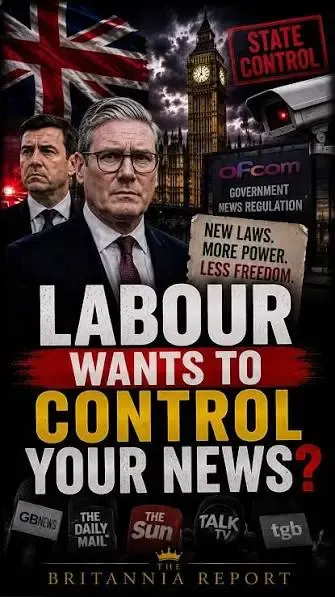
Buried in a green paper about the future of television is a proposal for the state to help decide which news is prominent online. Broadcasters have welcomed the idea. Independent journalists say it hands ministers a power they should never hold. What almost no one can yet answer is how the government means to define 'trustworthy'.
On the morning of 23 June, with the prime minister's resignation less than a day old and the Labour Party already turning to the question of his successor, the Department for Culture, Media and Sport published a document that appeared to have nothing to do with the leadership crisis and everything to do with the country's information future. 'Watch this Space: A new strategic direction for UK media' runs to a great many pages, most of them taken up with the slow retirement of the terrestrial aerial and the migration of British broadcasting onto the internet. Its middle chapters, though, contain a proposal that has provoked a sharper reaction than anything about switchover timetables. The government wants a hand in deciding which news is prominent when people search and scroll on YouTube, Facebook, TikTok and the rest.
The mechanism is prominence. News from the public service broadcasters – the BBC, ITV, STV, Channel 4, S4C and Channel 5 – along with what the paper calls 'other trustworthy providers', would be made easier to find and more likely to appear near the top when people search for news. The purpose, as the department frames it, is to blunt the spread of mis- and disinformation, 'particularly during times of social unrest or crisis'. Ministers reach here, as they now habitually do, for the summer of 2024, when false claims about the Southport killings outran the facts and were followed by riots, attempts to burn down hotels housing asylum seekers and attacks on mosques.
This is not a modest ambition, and the case against it is not that disinformation does no harm. It is that the paper proposes to sort the news into the trustworthy and everything else without yet saying who does the sorting, by what test, or under whose supervision. That unresolved question – what counts as trustworthy, and who decides – is where the argument has settled.
The case for
The ground the government is standing on is real enough. Ofcom's most recent figures, cited in the paper, show that social media is now the main source of news for three-quarters of people aged 16 to 24, and that more than half of all adults use it for news to some degree. Last month the Reuters Institute reported that, for the first time, social media and video platforms have overtaken publishers as a source of news worldwide. The channels through which most people now learn what is happening are ranked by algorithms whose workings are disclosed to no one, and no public-interest obligation attaches to any of it. Supporters of the paper point out that television has carried prominence rules for years – public service channels are guaranteed a place near the top of the electronic programme guide – and argue that carrying a version of the same principle onto the platforms where audiences have actually gone is continuity rather than novelty.
That argument has takers well beyond Whitehall. Carolyn McCall, ITV's chief executive, welcomed the paper as a way of keeping trusted, well-made content within reach as habits change. Azzurra Moores, of the think tank Demos, backed extending prominence duties to the platforms as a way of shoring up democratic resilience, while making an observation that cuts both ways: at present there are no rules and no transparency governing how the platforms rank what appears in a feed. That absence is the government's argument for stepping in. It is also, as critics are quick to note, the argument for caution about what a state role in the ranking would look like if it arrived with no guarantee of transparency of its own.
There is a further point in the government's favour, and a good deal of the alarm has skated past it. For now, the plan is to ask, not to compel. The DCMS minister Ian Murray told reporters that the department intends to invite YouTube, Meta and the other platforms to make the changes voluntarily, and would turn to regulation and legislation only if they refused. The paper consults on options that run from a voluntary code at one end to a statutory regime at the other. It is not a law waiting to be signed.
The case against
Among the most prominent of these critics is Owen Jones, the writer and broadcaster who has built something close to a one-man newsroom: more than 800,000 subscribers on YouTube, over a million followers on X, and a video operation that routinely reaches larger audiences than many of the legacy outlets he scrutinises. That reach has not gone unnoticed inside government. Jones has written that a subject access request to Labour Together returned a 42-page internal dossier in which, he says, he was described as 'very dangerous', in material fretting about the growing reach of independent left-wing video. Labour Together was at that point run by Morgan McSweeney, who had taken the group over in 2017 and built it into the organising hub of the campaign to defeat Jeremy Corbyn and the Labour left. Only afterwards did he run Sir Keir Starmer's 2024 election campaign and become his chief of staff, a post he held until resigning in early 2026. The assessment, on Jones's account, came from the strategist who would go on to reshape the governing party and run its Downing Street operation – hardly reassuring background for a proposal that would now let the state weight the visibility of independent voices like his.
His objection to the green paper is mechanical before it is political. Promoting one source necessarily pushes another down; nothing need be deleted for a voice to be turned so low that it is no longer heard. For an independent publisher whose survival depends on the reach a platform grants and the revenue that follows it, that is a material threat in a way it simply is not for the BBC, whose funding owes nothing to its position in anyone's feed. Jones has told his subscribers, more than once, that he could 'disappear' from their feeds even if they have chosen to follow him.
Beneath the mechanics is the objection of principle: that the power to stamp one outlet trustworthy and withhold the mark from another is a power the state should not hold, because whoever wields it is making editorial judgements with the authority of government behind them. Jones presses the point using the BBC itself, pointing to his own investigation for Drop Site News – built, he says, on interviews with BBC journalists and on statistical analysis of the corporation's output – which argued that its coverage of Gaza leaned systematically towards Israeli framing. One need not accept that particular charge to see the difficulty it exposes. 'Trustworthy' is not a fact sitting in the world waiting to be read off. It is a judgement, and a contested one, even when the outlet in question is the country's flagship broadcaster.
The unease is not confined to the left, nor to Jones. The News Media Association, which speaks for national and regional publishers, has welcomed the direction of travel but pressed the government hard on the same definitional point, warning that a test drawn too tightly around the public service broadcasters would thin the range of trusted voices available to readers rather than widen it. The Council of Europe's standards for schemes of this kind ask that they rest on clear and objective criteria, that they be run at arm's length from ministers rather than by them, that they leave editorial independence intact, and that they protect a plurality of independent, local and investigative outlets. A state-administered register of the trustworthy would have to work hard to satisfy any of those tests, and the paper as it stands does not explain how it would.
Then there is the element that has unsettled people most, which is the suggestion that prominence might be dialled up during moments of 'social unrest or crisis'. The worry is straightforward. Those are precisely the moments – an election, a war, a wave of protest, a public-health emergency – at which a government has the strongest motive to quiet its critics, and at which established outlets have most often fallen into step with the official account. A tool built to raise trusted voices in a crisis is, seen from another angle, a tool for lowering inconvenient ones at exactly the point where scrutiny matters most.
Where the alarm outruns the text
For a reader trying to work out how frightened to be, it helps to separate what the paper says from what it has been taken to say, because several of the loudest fears are, on the document's own wording, overstated.
The regime is not, yet, compulsory: the first move is a request to the platforms, with legislation held back as a threat rather than deployed as a fact. Nor is the likely definition of a trustworthy source obviously built to shut independents out. The starting point ministers have named is the 'recognised news publisher' test already written into the Online Safety Act of 2023, and its conditions – that an outlet's main business is producing news, made by a range of people and subject to editorial control; that it operates as a business, which may be a non-profit; that it answers to a standards code; and that it keeps a UK address – are conditions that a great many smaller and independent publishers already meet. A lone individual with a camera and a channel might struggle with the requirements for a range of contributors and a standards code, so the definition cuts in more than one direction; but it is not a machine for confining the label to the BBC and a handful of national titles. Ministers have, if anything, gone the other way in public. Murray raised the possibility that YouTube might itself 'become a PSM in terms of some of its content', and that the question might turn on the content produced rather than the type of organisation producing it – a formulation that, taken at face value, would usher individual creators through the door rather than lock them out. And the trade body for the newspaper industry is lobbying to widen eligibility, not to narrow it.
Even the sharpest single figure in the wider argument needs handling with care. Critics who point to the fourteen-year sentences hanging over supporters of the proscribed group Palestine Action are describing a real provision, but a narrow one. The fourteen-year maximum attaches to the offence of inviting or expressing support for a proscribed organisation, under section 12 of the Terrorism Act; the great majority of those arrested for holding placards have been dealt with under section 13, for displaying an article, which carries up to six months. The distance between 'fourteen years for a placard' and the law as written is the sort of thing a careful case cannot afford to blur.
A wider pattern
Set against those caveats, though, is the company the proposal keeps. It is not the government's only recent move over what people can see online. The age-verification regime brought in under the Online Safety Act in July 2025, presented as a way to keep children away from pornography, required sites hosting adult content – along with platforms such as X and Reddit – to confirm that users are over eighteen, and prompted a surge in downloads of virtual private networks, which disguise a user's location and let them browse as though abroad. Downloads of one VPN jumped by more than 1,800 per cent on the weekend the rules took effect. The response from parts of Westminster has been to move against the workaround itself: the children's commissioner for England, Dame Rachel de Souza, has called the VPN 'loophole' one that must be closed, and peers have tabled amendments that would force VPNs to carry the same age checks. The government says VPNs are legal and that it has no plans to ban them; digital-rights groups, among them the Electronic Frontier Foundation, argue that bolting age verification onto VPNs would work less as child protection than as a control on what information people in Britain can reach. Set beside the prominence plan and Powell's move on election-period content, it is a government reaching for several levers over the online sphere at once.
The unease runs wider still, into a period in which control of the feed has become an openly contested prize. In September 2025, at Israel's consulate in New York, Benjamin Netanyahu told a gathering of American influencers that social media was now 'the most important weapon' for holding Israel's support in the United States, and singled out the American-brokered takeover of TikTok as 'the most important purchase going on right now'. 'TikTok,' he added. 'Number one.' He was speaking days after a United Nations commission of inquiry concluded that Israel had committed genocide in Gaza – a finding Israel rejects as false – and as polling showed young Americans, many of whom follow the war through TikTok, turning sharply against it. Closer to home, the investigative outlet Declassified reported that senior editors at the BBC, the Guardian and the Financial Times had held private meetings with a former Israeli military chief of staff accompanying Israel's ambassador to London – meetings the outlets described as routine engagement with journalists who cover the region, and which critics read as an attempt to shape the reporting of a war whose coverage was already the subject of sustained complaint.
It is against that backdrop that critics, Jones among them, place the green paper: as one more instrument for deciding what reaches an audience, at a moment when governments and states are visibly fighting over what appears on a screen. The paper's defenders would reject the association out of hand, and they have a case. It is a domestic measure aimed at disinformation, tied to no foreign government and to no single conflict; making trusted news easier to find is not the same as suppressing anything; and the comparison flattens the difference between a consultation document and an overseas propaganda drive. Yet the force of the objection does not finally rest on the comparison holding in every particular. It rests on the machinery – a permanent state hand in what surfaces and what sinks – and on the uses to which such machinery has lately been put elsewhere.
The vacuum it landed in
None of this is happening in settled political weather, and the timing is much of the story. The paper appeared the morning after Sir Keir Starmer announced that he would stand down as prime minister once Labour had chosen a successor, following a battering in May's local elections. Andy Burnham, the former mayor of Manchester, has since taken a Commons seat and is widely reckoned the frontrunner to replace him. A proposal to give government a hand in ranking the news is therefore being floated by an administration that does not know who will be leading it by the autumn, which sharpens rather than settles the questions about how far it will be pushed, and by whom.
It is not the only such proposal in the air. Lucy Powell, Labour's deputy leader and a Burnham ally, spent a run of broadcast interviews in early July pressing for amendments to the Representation of the People Bill that would extend to social media, during election campaigns, some of the rules that already bind broadcasters – the balance requirements and the polling-day restrictions that make up what used to be called purdah. Her argument is that election law was written for a world of television bulletins and has not caught up with feeds shaped by algorithms nobody can see. That the loudest objections to her proposal have come from the right, while the loudest objections to the prominence plan have come from the left, is a useful reminder that disquiet about the state reaching into what people may see online belongs to no single part of the political spectrum.
The precedent that critics of both proposals keep returning to is Palestine Action. Proscribed in July 2025 after activists damaged aircraft at an RAF base, at a cost put at some £7m, it became the first direct-action protest group to be treated in law as a terrorist organisation. More than 2,200 people have since been arrested for expressing support, many of them elderly, a good number of them retired professionals and veterans holding signs; a founding member is challenging the ban in the courts. Whatever one makes of the group's tactics, the sequence is the one that worries people about any broadly drawn new power: an instrument introduced for one stated purpose being turned, once it exists, to uses its architects insisted were never intended.
Before the end of August
The consultation on 'Watch this Space' runs for ten weeks and closes at 23.59 on 31 August, after which the department will draw up firm positions – in effect, a white paper – and set a date for the television switchover. The prominence proposal will stand or fall on the detail the paper leaves open, and above all on the meaning eventually poured into that one word. Drawn one way, around clear criteria, arm's-length administration and a genuinely broad idea of who publishes news, a prominence regime could raise the standing of good journalism without the state deciding whose journalism counts. Drawn another way, it becomes a register of the officially approved, maintained by whoever happens to hold the department and inherited intact by whoever holds it next. The argument worth having is not whether disinformation is a problem – it plainly is – but whether the answer to it should run through Whitehall at all. The window to say so closes on 31 August.