The $730 Million Confession: Israel's Record Propaganda Budget Signals Panic
On Tuesday, 5 May 2026, Tzipi Hotovely walked into the Prime Minister's Office to take up her new post as head of Israel's National Public Diplomacy Directorate. Her appointment had been approved unanimously by Benjamin Netanyahu's cabinet nine days earlier, on 26 April, filling a post that had sat without a permanent head since May 2024 – through the assault on Gaza, the war in Lebanon and the war in Iran.
The choice was extraordinary. For five years, Hotovely served as Israel's ambassador in London, and in that time became one of the most reviled foreign envoys in modern British diplomatic memory. She is the diplomat who described the Nakba, the 1948 expulsion of some 750,000 Palestinians, as "a very strong and very popular Arab lie". She is the diplomat who declared on British television, ten days into the Israeli blockade of Gaza, that there was "no humanitarian crisis". She is the diplomat who told Piers Morgan in May 2025 that Israel was "allowed to attack hospitals", and whose official complaint to the BBC succeeded in pulling a documentary on the children of Gaza off air. A public petition demanding her expulsion from the United Kingdom amassed nearly 200,000 verified signatures. Declassified UK described her as "the leading apologist and cheerleader for genocide on British soil".
Through nearly two years of an assault that has killed more than 70,000 Palestinians – the majority of them women and children – Hotovely made the rounds of BBC, Sky News and ITV studios denying that any war crimes were taking place. This is the figure Israel has now placed in charge of repairing its image abroad.
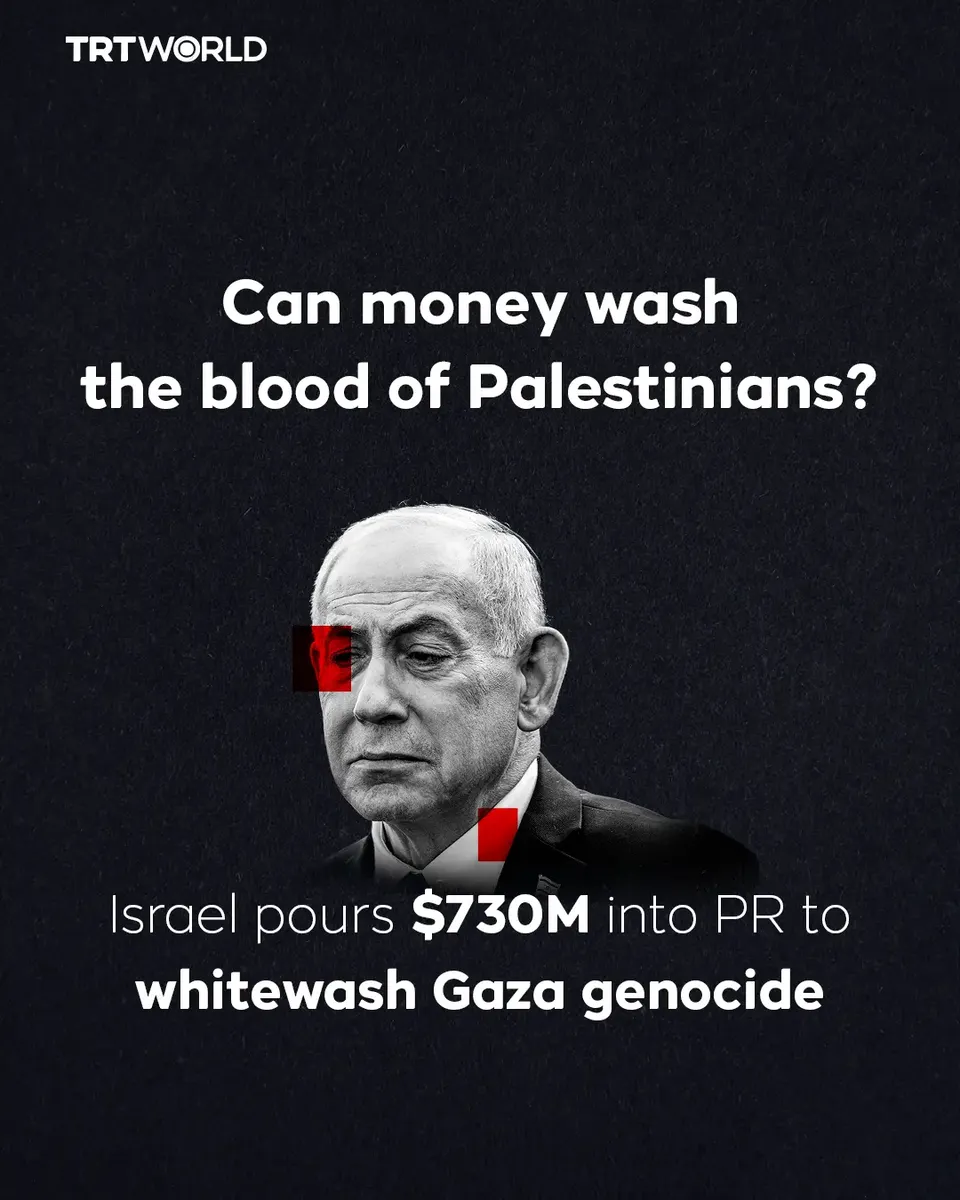
She inherits a record budget. Buried in a Knesset budget document last December was a line item unremarkable except for its sheer scale: 2.35 billion shekels. Nearly three-quarters of a billion dollars. And with it, an admission that Israel's foreign minister never intended to make so plainly.
For decades, Israel has called its public diplomacy work hasbara – a Hebrew word that translates politely to "explanation". What Foreign Minister Gideon Sa'ar proposed, and what Finance Minister Bezalel Smotrich signed off on for the 2026 budget, is something else entirely: an emergency-scale information war budget that nearly quintuples last year's spending, and stands at roughly twenty times what Israel allocated before October 7, 2023.
"This should be treated like investing in jets, bombs and missile interceptors," Sa'ar said as the budget moved through the Knesset, arguing that public diplomacy had become an "existential issue".
That a nuclear-armed state with one of the world's most advanced air defence systems now ranks Instagram ads alongside the Iron Dome – with a Nakba denier in charge of the operation – is not, as Sa'ar would have it, a sign of strategic evolution. It is a confession of catastrophic failure.
The Receipts
The previous, smaller budget bought Israel a great deal. Just not what it was hoping for.
A joint Eurovision News investigation – working with Spanish broadcaster RTVE alongside German, Austrian and Belgian public broadcasters – found that Israel's state-run advertising agency Lapam ran more than 4,000 social media ads between January and early September of last year. Half were targeted at international audiences. A separate $50 million digital ad buy, approved by Israel's Exemption Committee in June 2025, was earmarked for Google, YouTube, X and the platforms Outbrain and Teads – with the largest tranche, roughly $45 million, going directly to Google and its Display & Video 360 platform.
A central purpose of those ad buys: pushing back on famine reporting from Gaza. Lapam, which reports directly to Prime Minister Benjamin Netanyahu's office, ran dozens of promotions on YouTube and elsewhere showing what it framed as bustling Gaza markets, contradicting the Integrated Food Security Phase Classification's formal famine declaration. One AI-narrated video carried a closing line in multiple European languages: "There is food in Gaza. Any other claim is a lie." It accumulated more than six million views on its own. Across the broader campaign, videos depicting Gaza markets and restaurants amassed over 30 million paid-for views between August and early September alone.
Then there is the Brad Parscale contract. In September 2025, the Israeli Foreign Ministry – via the German subsidiary of advertising giant Havas Media – signed a $6 million agreement with Clock Tower X LLC, a firm run by Donald Trump's 2016 digital architect and 2020 campaign manager. By December the contract had been expanded to $9 million, with reported monthly billings of $1.5 million. The deliverables: 50 million digital impressions per month, 80 per cent of content tailored to Generation Z, "narrative messaging" integration with the conservative Salem Media Network, and – most striking – the construction of websites and content specifically designed to "deliver GPT framing results in GPT conversations". A foreign election strategist on retainer not just to manage the perception of a foreign war, but to reshape what artificial intelligence systems tell users about it.
Subsequent FARA filings revealed at least eleven separate brands operating under the Clock Tower X umbrella – PaxPoint, Allies for Peace, Cognitura, FactSignal, Justorium and others – each disclosing in its footer that its material is distributed on behalf of the State of Israel, while presenting itself publicly as independent civic content.
Then there is the Esther Project: a paid influencer network coordinated through Bridges Partners LLC, a newly registered firm operating out of a Capitol Hill rowhouse. The contract value runs up to $900,000, covering between 14 and 18 US-based social media influencers paid an estimated $7,000 per post. Public Citizen and the Quincy Institute's Democratizing Foreign Policy programme have since filed a formal complaint with the US Department of Justice, alleging that the influencers are operating as unregistered agents of a foreign government in violation of the Foreign Agents Registration Act – the same legal framework used against Russian and Chinese influence operations. As of writing, not one of those influencers has publicly disclosed their work for Israel.
Around $40 million from the 2025 budget went on flying in roughly 400 foreign delegations – more than 5,000 individual participants in total, according to the Foreign Ministry – under an initiative explicitly titled "Airbridge to Israel". Lawmakers, pastors, influencers, university presidents, academics, all hosted on carefully curated itineraries and dispatched home as unpaid ambassadors. A separate $4.1 million programme targeted evangelical churches in the United States.
In an average pre-war year, the Foreign Ministry brought 25 such delegations.
What the Money Didn't Buy
The old budget ran across the major Western advertising networks. It placed thousands of ads. It hosted hundreds of delegations. It produced a sub-industry of sympathetic influencer content.
And yet, Pew Research Center surveyed 3,507 American adults between 23 and 29 March 2026, weeks into the US–Israeli war on Iran. The findings: 60 per cent of US adults now hold an unfavourable view of Israel, up seven points in a single year and nearly twenty points since 2022. Only 37 per cent hold a favourable one. The share with a "very unfavourable" view, 28 per cent, has nearly tripled since before the Gaza war began.
Among Democrats and Democratic-leaning independents, the unfavourable figure stands at 80 per cent.
Among Republicans aged 18 to 49 – the demographic the pro-Israel lobby has spent decades cultivating through evangelical networks and AIPAC – 57 per cent now hold a negative view of Israel. A clear majority of the party's under-50 base. Among men under 50 specifically, Israel's net favourability has collapsed from –3 in 2022 to –47 today: the same demographic that voted overwhelmingly for Donald Trump in 2024.
Confidence in Netanyahu personally is even worse. Just 27 per cent of Americans say they trust him to do the right thing on world affairs. Among American Jews – ostensibly Israel's natural constituency – 56 per cent say they have little or no confidence in him.
Congress is now reflecting this collapse in public sentiment. In April, 40 of 47 Senate Democrats voted to block a $295 million sale of Caterpillar bulldozers to Israel. Thirty-six voted to block a separate sale of 1,000-pound bombs. It was the strongest congressional rebuke of US military aid to Israel on record.
The previous PR budget did not stop any of this. It happened anyway.
The Experts' Verdict
Nicholas Cull, the University of Southern California public diplomacy scholar, has put it bluntly: money cannot overcome wrong policy.
Ilan Manor, another scholar of public diplomacy, has gone further. The deeper problem, he argues, is that people no longer believe the state. And credibility cannot be purchased; it can only be earned, by changing the policies that destroyed it.
Eitan Gilboa, a veteran Israeli scholar of strategic communication, has been blunt: "This is the worst crisis in Israel's image abroad," he has said in commentary widely circulated since the start of the Gaza war, arguing that Israel is "losing a generation" of Americans who will go on to become the journalists, academics and political leaders of the next decades.
What makes Gilboa's verdict particularly damning is that he has been warning of this trajectory for almost twenty years. His 2006 paper in Israel Affairs, "Public Diplomacy: The Missing Component in Israel's Foreign Policy", already documented that Israel was being portrayed in non-American media as a violator of human rights and international law, that European polling was deeply negative, and that international NGOs and parts of the UN system had begun framing Israel as an "apartheid state". The paper called for a far more aggressive public diplomacy strategy and was effectively shelved. By June 2021, addressing the Middle East Forum, Gilboa was describing US college campuses as "a terrible place" for any Jewish student unwilling to distance themselves from Israel, and openly calling for "information warfare" against the narratives accumulating against the country. By November 2023, six weeks into the Gaza war, he was on i24News warning that Israel's communications failure had become acute.
The diagnosis was not new. The warnings were on record. What is new is the price tag now attached to ignoring them.
Even from inside the Israeli foreign policy establishment, the message is similar. Rotem Landau, a former senior Foreign Ministry adviser, called the 2026 allocation "a long overdue course correction" but warned that structural failures would swallow the money. "Israel's narrative has no single strategic owner," she wrote, noting that messaging responsibility is scattered across the Foreign Ministry, the Prime Minister's Office, the Diaspora Affairs Ministry, the Government Press Office and the IDF.
These are not activists. They are experts in the very field Israel is now throwing three-quarters of a billion dollars at. And they are unanimous: the problem is not the marketing. The problem is the product.
The War Economy
This money is coming from an economy that can barely afford it.
The Bank of Israel reported a 3.4 per cent GDP shortfall at the end of 2025, with a cumulative shortfall since October 7, 2023, of 8.5 per cent. The 2026 budget deficit is projected at 5.3 per cent of GDP, with debt-to-GDP at around 70.5 per cent – well above the median for similarly-rated countries. In March 2026 Fitch maintained Israel's "A" rating but kept the negative outlook, citing continued public debt growth and "war-related tail risks" including potential further escalation in Lebanon and Iran.
This is not a state with money to burn. It is a state pulling fiscal levers it cannot afford to pull, throwing hundreds of millions at reputation management while its economy contracts and its credit rating sits on a warning.
The Road Not Taken
The alternative routes were always visible. Israel could have changed what it was doing. It could have stopped the destruction in Gaza. It could have de-escalated with Lebanon and Iran. It could have engaged seriously with the genocide allegations before the International Court of Justice rather than dismissing them.
Every one of those roads runs through Benjamin Netanyahu. And Netanyahu cannot afford to take any of them.
A ceasefire would collapse his coalition the moment Smotrich and Itamar Ben-Gvir – his far-right partners – walked out. An end to the war would remove the emergency framing that has kept his corruption trial moving in slow motion. Engagement with the Hague would mean engaging with the fact that the case names him personally.
The prime minister's political survival, his coalition and his liberty are all currently held together by the continuation of the very policies that are tanking Israel's global standing.
So the policies stay. The war continues. And the bill for the reputational damage gets paid in advertising.
The Panic Bell
The 2026 budget includes a dedicated public diplomacy unit inside the Foreign Ministry – a permanent infrastructure for hasbara, headed by a director on parallel rank to the head of the political division. It funds a media monitoring operation that tracks 250 outlets and processes 10,000 Israel-related items every single day. Seven items per minute, monitored, categorised and routed for response.
That is not a marketing budget. That is a state at war with information itself.
"You only spend at this level when you've already lost the argument," says one Western diplomatic observer who has tracked Israeli hasbara for years, speaking on condition of anonymity to discuss sensitive budget matters. "You only set up a permanent unit, a war room, an AI contract, an influencer network and a quintupled annual spend when the normal tools have all failed and the only response left is volume."
Sa'ar called public diplomacy an existential issue. He was telling the truth – just not the truth he meant to tell. The existential question is not how to convince the world. It is whether a state can continue doing what Israel is doing while the world watches, and survive the watching.
Israel has bet $730 million that it can. The polling, the receipts, the experts and the world's own eyes suggest the bet was already lost.
The budget just put a price tag on the loss.