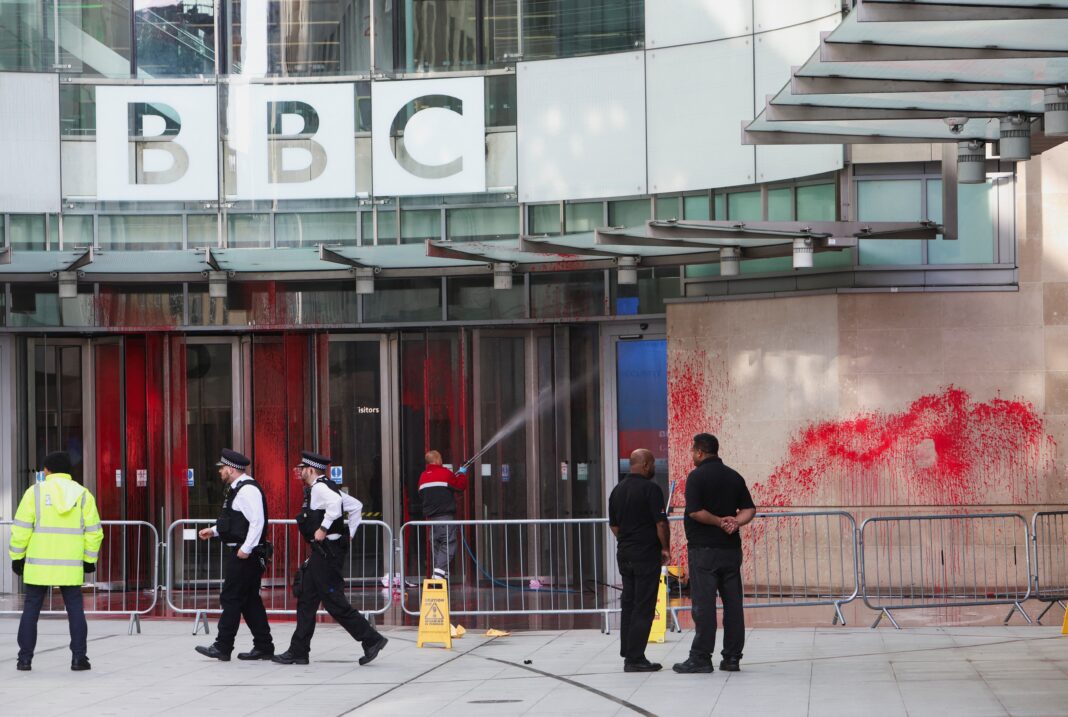

The BBC has been thrown into turmoil. Its leadership has resigned following the leak of a memo—authored by Michael Prescott, a former Sunday Times political correspondent turned corporate lobbyist, and published via the right-wing Daily Telegraph. Prescott was presented as an independent analyst reviewing BBC editorial conduct. In reality, the document he produced has triggered one of the most contentious disputes over media accuracy and accountability in years.
Much early coverage focused on Prescott’s criticism of a problematic edit in a Panorama documentary about Donald Trump’s speech during the January 6 Capitol insurrection. Trump, he wrote, had been misrepresented. Even those critical of the film accept the edit was flawed. But the most explosive part of the memo was not about Trump at all—it was about Israel, Gaza, and the BBC’s coverage of what genocide scholars, the UN, humanitarian agencies, and even many Israeli legal experts have identified as a genocide.
Prescott’s claim was stark: the BBC, he argued, had shown anti-Israel bias.
For millions of viewers familiar with the BBC’s reporting, the allegation bordered on surreal. For media analysts, statisticians, and human rights researchers who have scrutinised the BBC’s output since October 2023, it was simply false.
To unpack the memo’s claims and the deeper failures in BBC coverage, journalist Owen Jones spoke with Krishma Patel, a former BBC journalist and presenter whose forensic documentation of the corporation’s reporting has become essential reading for media scholars and the wider public. What follows is an examination—through Patel’s expertise—of the memo, the BBC’s actual record, and the political effort now underway to invert reality itself.
A Memo Built on “Methodologically Flawed” Claims
Prescott’s analysis, Patel explains, mixes selective criticism with sweeping distortions. His primary tactic is to use a legitimate critique—the misleading Trump edit—as a gateway to smuggle in unsubstantiated claims that the BBC has been biased against Israel.
“That’s the purpose of this dossier,” she says, quoting media editor Ben De Pear, formerly of Channel 4 News. “To smuggle in the distortion that the BBC’s coverage has been anti-Israel.”
Prescott’s core method involves comparing BBC Arabic output with the BBC English-language website—the latter being the most visited news site on earth. But this comparison, Patel stresses, is not only non-sensical, it is designed to produce a predetermined conclusion.
“He’s not comparing BBC Arabic content to BBC editorial guidelines,” she notes. “He’s comparing it to the English website—which has often been the worst offender in its Gaza coverage.”
Over two years, BBC English output routinely:
- omitted Israel from headlines even when Israel was the perpetrator;
- framed Palestinian deaths primarily through the lens of Israeli military statements;
- positioned Israeli official claims as authoritative while treating Palestinian information as suspect.
Comparing any service to this skewed baseline inevitably produces the illusion of “bias” in the wrong direction.
The Statistical Reality: A BBC Tilted Heavily Toward Israel
The Center for Media Monitoring conducted a forensic study of more than 35,000 BBC content items. Their findings are devastating:
- Presenters amplified Israeli perspectives 11 times more often than Palestinian perspectives.
- Israeli deaths received 33 times more coverage per fatality than Palestinian deaths.
- Emotive language (“slaughter,” “massacre,” “atrocity”) was used overwhelmingly for Israeli victims—
70% of emotive terms referred to Israeli victims, while Palestinian victims were described with vague, distancing language. - Only one Palestinian voice was interviewed across an entire period of coverage, compared to over 2,300 Israeli voices and perspectives.
This is not bias against Israel. It is structural and quantifiable bias in favour of Israel.
Patel warns that Prescott’s memo, by ignoring such data, risks being used to codify falsehoods into parliamentary debate and media policy.
The Death Toll: Gaslighting on a Mass Scale
One of the memo’s most widely circulated claims concerns Gaza’s death toll. Prescott alleges that the BBC “gave unjustifiable weight” to official figures—specifically, the statistic that 70% of Palestinian deaths were women and children.
But Patel explains the reality:
- The UN did not revise down the total death toll.
- It updated the proportion of identified bodies—because thousands were unidentifiable due to Israel’s systematic destruction of hospitals, morgues, and emergency services.
- The UN explicitly reaffirmed the accuracy of Gaza’s Health Ministry numbers, long relied on by:
- aid organisations,
- international agencies,
- and even Israel itself.
Moreover, Israeli military documents leaked to Israeli journalists (Local Call and +972 Magazine) show that over 80% of Palestinians killed were civilians.
And independent modelling by The Economist suggested that by May 2024:
- 110,000 Palestinians may have been killed by Israeli violence—
more than double the official figure at the time.
Far from exaggeration, the official Gaza toll is widely considered a severe underestimate.
Meanwhile, as Patel notes, Prescott fails to mention that Israel itself revised its October 7 death toll down—from 1,400 to around 1,200—yet BBC coverage routinely stated the higher figure without attribution, while always attaching the qualifier “Hamas-run health ministry” to Palestinian statistics.
The double standard is unmistakable.
Mass Graves, Hospitals, and Evidence Israel Tried to Erase
One of the memo’s most disturbing distortions concerns the discovery of bodies at Nasser Hospital and Al-Shifa Hospital. Prescott argues that the “most likely explanation” is that Palestinians buried bodies before Israel’s ground invasion.
This claim is contradicted by:
- a UN Commission of Inquiry report (2024),
- forensic testimonies from those who exhumed bodies,
- and investigations from the Palestinian Centre for Human Rights.
Bodies were found:
- with hands tied behind their backs,
- stripped of clothing,
- showing signs of execution,
- among the elderly, women, and wounded patients.
Witnesses described summary executions carried out by Israeli forces, alongside the abandonment of patients who were left to die without care.
Prescott’s narrative erases all of this.
Hospitals as “Hamas Bases”: A Repeatedly Debunked Myth
Prescott argues that the BBC should have highlighted Israeli claims that hospitals were used as Hamas command centers. In practice, BBC journalists already repeated these claims heavily.
But Patel notes that journalists are obligated to assess source credibility—and Israeli claims about hospitals have repeatedly been disproven.
Israel produced CGI videos depicting vast terror headquarters beneath Al-Shifa Hospital. No such facility was ever found.
The UN Human Rights Office, after reviewing multiple hospital attacks, concluded in December 2024:
Israel has failed to provide evidence supporting its allegations in all but two cases, and in many instances publicly available information contradicts Israeli claims.
Channel 4’s Gaza Medics documentary—rejected by the BBC—showed Israeli forces following an identical pattern at hospital after hospital: make an allegation; secure media coverage; launch an assault; fail to produce evidence.
This pattern is central to understanding how Israel justified its operations—and how British media amplified these narratives with minimal scrutiny.
UK Lawyers for Israel vs. 600 Legal Experts: False Balance as Disinformation
One of Prescott’s “case studies” claims the BBC gave too much coverage to a letter signed by 600 British legal specialists warning the government that arms sales to Israel breached international law. He argues the BBC should have given equal weight to a letter from UK Lawyers for Israel—a highly partisan pressure group.
This, Patel points out, is absurd.
UKLFI is known for:
- pressuring institutions to suppress Palestinian voices,
- including successfully removing artwork by Gazan children from a London hospital,
- and advancing explicitly pro-Israel lobbying goals.
To equate this with the consensus of hundreds of legal experts, including former judges and war-crimes prosecutors, is an extraordinary distortion—yet indicative of the memo’s broader strategy.
The ICJ Genocide Case: How the BBC Used One Judge to Rewrite Policy
Prescott criticises BBC references to the International Court of Justice’s finding of a “plausible risk of genocide,” arguing the language was misleading.
But legal scholars—such as Professor Janina Dill of Oxford—explain that the phrasing accurately reflects the ruling. There is no “plausible risk” unless genocide is a plausible threat.
And crucially, the BBC quietly rewrote its editorial guidance after interviewing a single ICJ judge, Joan Donoghue—who herself later left the court. Other ICJ judges issued far more urgent warnings, including Judge Yasef, who said:
“Every red light is flashing.”
Yet it was Donoghue’s framing alone that the BBC incorporated into its policy.
Patel recalls receiving the internal email announcing this shift—an extraordinary moment when one judge’s media interview reshaped BBC practice, without seeking broader expert consensus.
The Core Failure: Humanizing Israelis, Dehumanizing Palestinians
Between the statistical analysis, editorial decisions, and linguistic framing, a consistent pattern emerges.
Israeli victims were:
- named,
- profiled,
- shown with families,
- described in emotionally rich language.
Palestinian victims were:
- anonymised,
- reported only as numbers,
- described with hedging terms (“say,” “claim,” “report”),
- depicted without context, story, or identity.
Patel describes the psychological effect:
“This muddied, abstract language gives the audience permission to disengage their empathy. It says: we’re not sure this happened, so you don’t need to care.”
Meanwhile, Israeli suffering was presented with clarity and certainty, activating immediate emotional response.
The outcome, Patel argues, is a vast public “empathy gap”—one that only alternative media, Palestinian journalists, and international outlets have begun to close.
The Gaslighting Campaign
The leaked memo, Patel concludes, is the culmination of a two-year effort to invert reality:
- A genocide widely recognised by experts is reframed as a matter of disputed interpretation.
- A broadcaster criticised for pro-Israel bias is accused of being anti-Israel.
- Palestinian deaths are questioned while Israeli statements are treated as authoritative.
- Evidence of war crimes—from mass graves to hospital attacks—is minimised or ignored.
“It is the ultimate gaslighting,” she says.
The danger now is that Prescott’s claims—methodologically hollow but politically useful—will be used by MPs, committees, and lobby groups to pressure the BBC even further away from accurate reporting.
A Public Seeking Truth in the Dark
Despite the failures of mainstream media, public opinion has shifted dramatically. Polls in the UK and US show large majorities believe Israel has committed war crimes, and in many cases genocide.
But people had to look elsewhere for the truth.
“They had to go searching,” Jones notes. “And that is deeply disturbing when the truth was obvious from the beginning.”
The BBC’s crisis is therefore not just organisational—it is existential. A generation of young journalists, Patel says, now tell her they no longer wish to work for the BBC. They want to work in media that does not distort reality for political convenience.
Alternative media is growing, she says—but the stakes could not be higher.