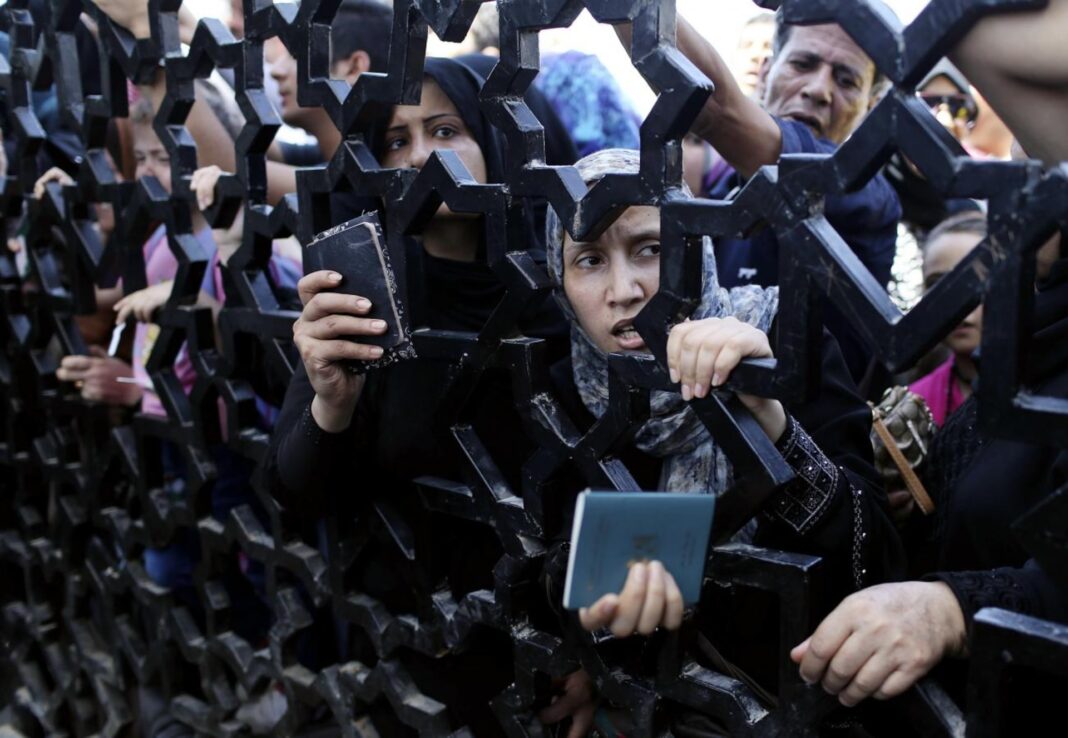

In the dim hours before dawn on 14 November 2025, a chartered South African aircraft descended quietly onto the runway of Johannesburg’s O.R. Tambo International Airport. There were no press advisories, no diplomatic escorts, no indication that anything unusual was about to unfold. But inside the aircraft were 153 Palestinians from Gaza—men, women, infants, teenagers, elderly people, and at least one pregnant woman—exhausted, frightened, and visibly shaken by a journey few yet understand.
They had come from a place where the destruction has been so total that entire neighbourhoods no longer exist, where war has lasted two years, and where civilians have been trapped for months under siege. And yet now, inexplicably, they were here—on a South African runway, aboard a plane no one had expected.
What followed was a humanitarian crisis unfolding in real time, not in Gaza but in the heart of Johannesburg.
For more than twelve hours, the passengers were kept inside the aircraft, prevented from disembarking by the Border Management Authority (BMA). The cabin grew stifling. Children cried from hunger and dehydration. Adults fainted. A pregnant woman’s condition deteriorated.
Gift of the Givers, South Africa’s largest humanitarian NGO, rushed urgently to the scene with food and water. BMA officials refused to deliver it. Even the pilots pleaded. The answer remained no.
The footage of children screaming through sealed windows has already ricocheted around the world. But the deeper story—the hidden machinery that brought these people here—remains largely obscured, shrouded in unanswered questions, state secrecy, and the opaque dealings of a little-known organisation that calls itself Al-Majd Europe.
South Africa is now trying to understand how it became the terminal point of a flight that no one authorised, carrying refugees from one of the world’s deadliest wars.
As President Cyril Ramaphosa said the next day:
“These are people from Gaza who somehow mysteriously were put on a plane that passed by Nairobi and came here.”
The mystery behind that “somehow” has now opened into one of the most politically volatile episodes of the Gaza war far from Gaza itself—touching international law, forced displacement, covert state policy, and what many now fear may be a developing pipeline of population removal.
An Aircraft With No Clear Point of Origin
The first anomaly was the paperwork.
The passengers carried travel documents—but none of them bore exit stamps. Not from Israel. Not from the Palestinian Authority. Not from Egypt. Not from any border agency on earth.
And yet, Gaza—surrounded by Israeli military control, drones, surveillance towers and fenced checkpoints—had somehow been breached.
Multiple passengers recounted an identical sequence:
- They were contacted—some online, some through intermediaries—by a group calling itself Al-Majd or Al-Majd Europe, promising to evacuate them from Gaza for a fee.
- They were told to gather in southern Gaza or near Rafah.
- Buses arrived—marked only by handlers claiming to represent Al-Majd.
- These buses transported them directly through the Kerem Shalom / Karem Abu Salem crossing into Israel.
- From there, they were escorted to Ramon Airport, near Eilat.
- They boarded a chartered aircraft—operated by Global Airways, a South African carrier.
- The plane routed through Nairobi, Kenya.
- Its final stop: Johannesburg.
The Palestinian embassy in Pretoria issued a furious statement:
“An unregistered and misleading organisation exploited our people’s tragic humanitarian conditions, deceived families, collected money from them, and facilitated their travel in an irregular and irresponsible manner.”
Families told journalists they paid between $1,400 and $5,000 per person to Al-Majd—an astronomical sum for people living in a collapsed economy where food is scarce and cash nearly impossible to access.
Israel’s military liaison office, COGAT, offered only a foggy explanation: that Palestinians left Gaza “with the approval of a third country.” But South Africa insists it provided no such approval.
So where was that approval supposedly obtained?
And who authorised the movement of these Palestinians across one of the world’s most militarised borders?
Al-Majd Europe: A Humanitarian Group That Exists Mostly on Paper
It didn’t take long for investigators—and journalists—to look into the group at the centre of this story.
On its website, Al-Majd Europe claims:
- It is a German humanitarian organisation founded in 2010.
- It specialises in “evacuations from conflict zones.”
- It has offices in East Jerusalem.
But none of this is true.
Haaretz, digging into the corporate trail, found the following:
- Al-Majd Europe is not registered in Germany.
- It is not registered in East Jerusalem.
- Its website domain was created only in February 2025—not 2010.
- Its “impact stories” include stolen photographs taken from unrelated news articles.
- Its supposed Jerusalem office does not exist.
But the most troubling discovery was this:
Al-Majd Europe appears to be linked to a tiny Estonian company called Talent Globus OÜ.
In Estonia’s public business registry:
- Talent Globus was incorporated in July 2024.
- It has a share capital of €301.
- The company has one director, one shareholder, one employee:
Tomer Janar Lind
Israeli–Estonian businessman
Sole owner of Talent Globus OÜ
Talent Globus’s website previously openly advertised:
“Voluntary emigration from Gaza to third countries.”
The language is identical to that used by Al-Majd Europe.
And then Haaretz discovered something more alarming:
Israel’s Voluntary Emigration Bureau, a unit created inside its Defence Ministry in 2025, referred Al-Majd/Talent Globus to the IDF to help coordinate departures.
This was not a rogue private operation at all.
It was part of an official Israeli state programme—one that international lawyers warn could amount to forced displacement, a crime under international law.
A Humanitarian Nightmare on South African Soil
Back on the runway in Johannesburg, none of this was yet known.
All anyone understood was that 153 Palestinians—terrified and exhausted—were trapped inside a plane without food or water, after having just escaped one of the most violent warzones on earth.
Dr Imtiaz Sooliman, the founder of Gift of the Givers—an organisation trusted across South Africa—arrived personally.
What he saw shocked him.
Children screaming. Babies crying. Adults fainting. A pregnant woman close to collapse. No air conditioning. No food. No water.
And officials refusing to let aid in.
Sooliman later said:
“This seems to be a coordinated effort from Israel to carry out a process of ethnic cleansing.”
He demanded a formal investigation into Home Affairs and the BMA, calling the treatment “inhumane,” “disgraceful,” and “a humiliation inflicted on Palestinians fleeing genocide.”
To Sooliman, the pattern was unmistakable:
“Gaza is being destroyed, and people are being moved. This flight is not a coincidence.”
Ramaphosa Intervenes
President Ramaphosa, upon being informed, acted swiftly:
“We cannot turn them back… Even though they do not have the necessary documents, these are people from a war-torn country.”
Yet he too sensed something was wrong:
“It does seem like they were being flushed out.”
South Africa has now launched an extensive inquiry, involving:
- Intelligence services
- Home Affairs
- The Presidency
- The Border Management Authority
Their mandate is to determine:
- How the Palestinians crossed through Israeli-controlled territory
- Who authorised their movement
- Who paid Al-Majd and where the funds went
- Whether South Africa was the intended destination or a waypoint
- Whether Al-Majd is part of a larger, systematic displacement operation
Voices from the Plane: Stories of Survival
For the passengers, the complexity of geopolitics means little. Their stories are simple, devastating, and deeply human.
One father told South Africa’s eNCA:
“We have survived a war of two years. Death every day. We are lucky to be here.”
Others said they thought they were being taken back when officials refused to let them disembark.
Inside the cabin:
- Children sobbed uncontrollably.
- Several people fainted.
- Passengers begged for water.
- A pregnant woman came close to collapse.
When they were finally allowed to enter South Africa, 23 passengers immediately continued to other destinations—Canada, Australia, Malaysia—suggesting that this was not merely an evacuation, but part of a multi-stage migration pipeline.
A Pattern Emerges
This was not the first such flight.
- On 28 October, another charter transported 176 Palestinians out of Gaza using the same method.
- Earlier flights carried Palestinians to Indonesia, Malaysia, Kenya, and Budapest, often through Ramon Airport.
- All involved Al-Majd Europe or intermediaries linked to it.
- All required payments of thousands of dollars.
- None were coordinated with Palestinian authorities.
The Palestinian Authority called groups like Al-Majd:
“Agents of displacement” and “merchants of blood.”
Now, with the Haaretz findings, these warnings appear prophetic.
The Genocide Case: South Africa Becomes a Frontline
The timing is extraordinary.
South Africa is the lead nation in the International Court of Justice case accusing Israel of genocide in Gaza.
Forced displacement is one of the acts that constitute genocide under the Convention.
Now South Africa finds itself receiving the very civilians who may be the subjects of that displacement:
- Out of Gaza
- Via Israeli-controlled routes
- Through a Defence Ministry “emigration” bureau
- Organised by a shell organisation
- Deposited onto South African soil
If this is part of a wider policy, it strengthens Pretoria’s legal case—and raises the stakes profoundly.
Forced Displacement or Humanitarian Escape?
Israel insists that only voluntary evacuees leave Gaza, with third-country approval.
But what does consent mean when:
- your home has been bombed?
- your neighbourhood has been flattened?
- your children are starving?
- the only way out requires paying $5,000?
- your “humanitarian” rescuers turn out to be unregistered entities linked to defence ministries?
International lawyers are clear:
Consent under siege is not consent.
Paid escape during genocide is not voluntary migration.
And when the organising entity is functionally a shell company tied into a government bureau devoted to “voluntary emigration,” the implications go far beyond bureaucracy.
As one South African legal expert put it:
“If these flights are being used to quietly depopulate Gaza, then we are witnessing an element of ethnic cleansing in real time.”
What Really Happened? South Africa Needs Answers
What happened on 14 November was not a logistical mistake.
It was a fragment of a much larger story—one that crosses continents, governments, private intermediaries, and a shattered people desperate for survival.
South Africa must now determine:
- Was this a humanitarian escape sabotaged by bureaucracy?
- Or was it a link in a deliberately obscured programme of forced displacement, engineered under the fog of war?
- Why South Africa?
- Who profited?
- Who gave the permissions?
- And how many more flights are already in motion?
The answers matter—not only for the 130 Palestinians now living in South Africa, but for the entire population of Gaza, whose fate hangs in the balance as war, starvation, and displacement converge.
Because this flight was not only about immigration rules or paperwork.
It may be a glimpse into how a people are being quietly removed from their homeland—one plane at a time.