Israel’s War Machine Demands Billions More as Economy Buckles Under Permanent Mobilization
Israel’s most senior military leaders have privately warned the finance ministry that the army is no longer prepared for new wars without an immediate and significant budget infusion. The admission lands awkwardly alongside claims of two active ceasefires and follows a year in which defense spending surged to nearly 9% of GDP — the highest share since 1967.
On paper, officials frame this as “budget strain.” In reality, it resembles fiscal trench warfare: hospitals trimmed, education cut, and social services squeezed to fund continued combat. Behind the official language is a simpler truth — a war machine that consumes crisis now demands more fuel to survive.
The Bottomless Defense Budget
The numbers are staggering. The Knesset approved an additional 30.8 billion shekels (around $9 billion) for defense this year, lifting the national budget to 787 billion shekels. Treasury officials concede that is still insufficient. Another 42 billion shekels is penciled in for 2025–26 merely to replenish exhausted munition stockpiles.
Since 2023, Israel has borrowed roughly 190 billion shekels to sustain its multi-front operations — in Gaza, Lebanon, Syria, the Red Sea, and beyond. The legal deficit ceiling was raised to 5.2% of GDP just to keep the Treasury signing checks.
Generals are quietly admitting what politicians won’t: Israel planned for a short war, not a two-year grind of regional escalation. But each new front is also a new rationale for funding — and for power.
“War Currency” and the Rise of a Gig-Economy Army
Dr. Shir Hever, an economist and political scientist born in Jerusalem and now based in Germany, calls the current situation “a new form of currency.”
Hever studies Israel’s political economy, apartheid policy, and the arms trade. Formerly the coordinator of the BDS military embargo campaign, he is managing director of the Alliance for Justice Between Israelis and Palestinians and author of The Privatization of Israeli Security (Pluto Press, 2017). He renounced his Israeli citizenship in protest.
In a recent discussion, Hever explained how Israel is solving an acute manpower crisis: by printing financial incentives for reservists.
Traditionally, reservists are paid their normal civilian wage when called up. Now, however, the military offers 29,000 shekels per month (roughly $9,000) — more than twice Israel’s average wage and five times the minimum wage. Officers distribute these “reserve tokens” at their own discretion. Desperate units are recruiting via WhatsApp, offering bonuses and inflated time-credit to lure tank drivers, mechanics, and infantry.
“I see how this turns Israel into a mercenary army,” Hever notes. “You have soldiers wandering from one unit to another like gig-economy contractors. They’ve abandoned civilian jobs. It’s more lucrative to fight than to work.”
Some officers have used these reserve tokens as payment to butcher shops for meat — a practice almost unheard of in modern militaries.
The result: cafés, courier services, and restaurants across Israel are short-staffed. Young men who once waited tables are paid to drive tanks.
A Competing Currency — and Inflationary Risk
Hever warns that reserve tokens behave like a parallel currency, reminiscent of the hyperinflation crisis that struck Israel in the early 1980s. Back then, manipulated stock prices and speculative loans overheated the economy until the banking system collapsed.
“This is very dangerous,” he cautions. “The central bank loses control when competing currencies appear.”
Inflation is already creeping upward. Costs of living are climbing. And none of this “income” produces anything: reservists are not building infrastructure — they are destroying it.
Israel’s only sustainable method of financing this war-currency economy is deeper debt.
Growth Without Growth
Despite sluggish growth — roughly 1% — administration spokespeople insist the economy remains healthy. But that growth comes largely from the government spending money it borrowed.
Private investment is falling. Consumer demand is flat. Exports are shrinking. Tourism has collapsed. And shipping through Eilat has dried up under Houthi threat.
Israel’s tech sector — its crown jewel — is being hollowed out by mobilization fatigue. You cannot develop cloud infrastructure when your engineers are rotating through armored units.
Credit Downgrades and Cracks in Confidence
Ratings agencies are sounding alarms:
- Fitch cut Israel’s rating and shifted it to negative.
- Moody’s downgraded to BA1 — junk-adjacent territory.
Hever says Western financial media have contributed to the illusion of stability by refusing to report the depth of the crisis.
“Normally, mismanagement like this causes immediate bankruptcy,” he says. “Israel avoids that only because investors cannot read Hebrew and English-language papers simply don’t tell them.”
That protection is beginning to fail. The United Nations recently expanded its blacklist of companies complicit in settlement activity. Pension funds are accelerating divestment.
And Israeli households have quietly moved more than 50% of their savings abroad, as domestic confidence evaporates.
Austerity in Camouflage
The finance ministry is cutting all civilian departments by 3% to fund new military demands. That means:
- fewer hospital beds,
- fewer teachers,
- delayed university terms,
- eroding welfare systems.
Queues in emergency rooms grow longer. University semesters open late because faculty are on reserve duty. Some schools cannot fully staff classrooms.
These austerity measures have political camouflage: they are described as security priorities.
Permanent Emergency as Political Oxygen
Prime Minister Benjamin Netanyahu’s coalition survives through continuous escalation. Each confrontation:
- restarts emergency powers,
- postpones corruption trials,
- prevents coalition fractures,
- and justifies more debt.
When Gaza quieted, operations intensified in Lebanon. When Lebanon cooled, strikes widened across Syria and the Red Sea. June’s exchange with Iran reset the wartime narrative again.
Peace would expose the books.
An Economy Addicted to Conflict
Hever argues that this is now structural.
“The crisis is getting worse. Those Israelis willing to look reality in the face are packing their bags and leaving. They are voting with their feet.”
Israel’s state apparatus appears trapped in circular logic:
- War demands money.
- Money demands war.
- Peace threatens collapse.
Meanwhile, the very aid that props up Israel’s arsenal must be spent on U.S. systems, weakening local industry. The more Washington “helps,” the less sovereign Israel’s economy becomes.
When Killing Becomes a Budget Line
Inside this system, violence becomes an accounting category. Each strike is evidence the machine still turns. Gaza’s ruins become deterrence. Lebanon’s devastation becomes a security dividend.
The cruelty is no longer exceptional. It is structural.
A State Exhausted by Arithmetic
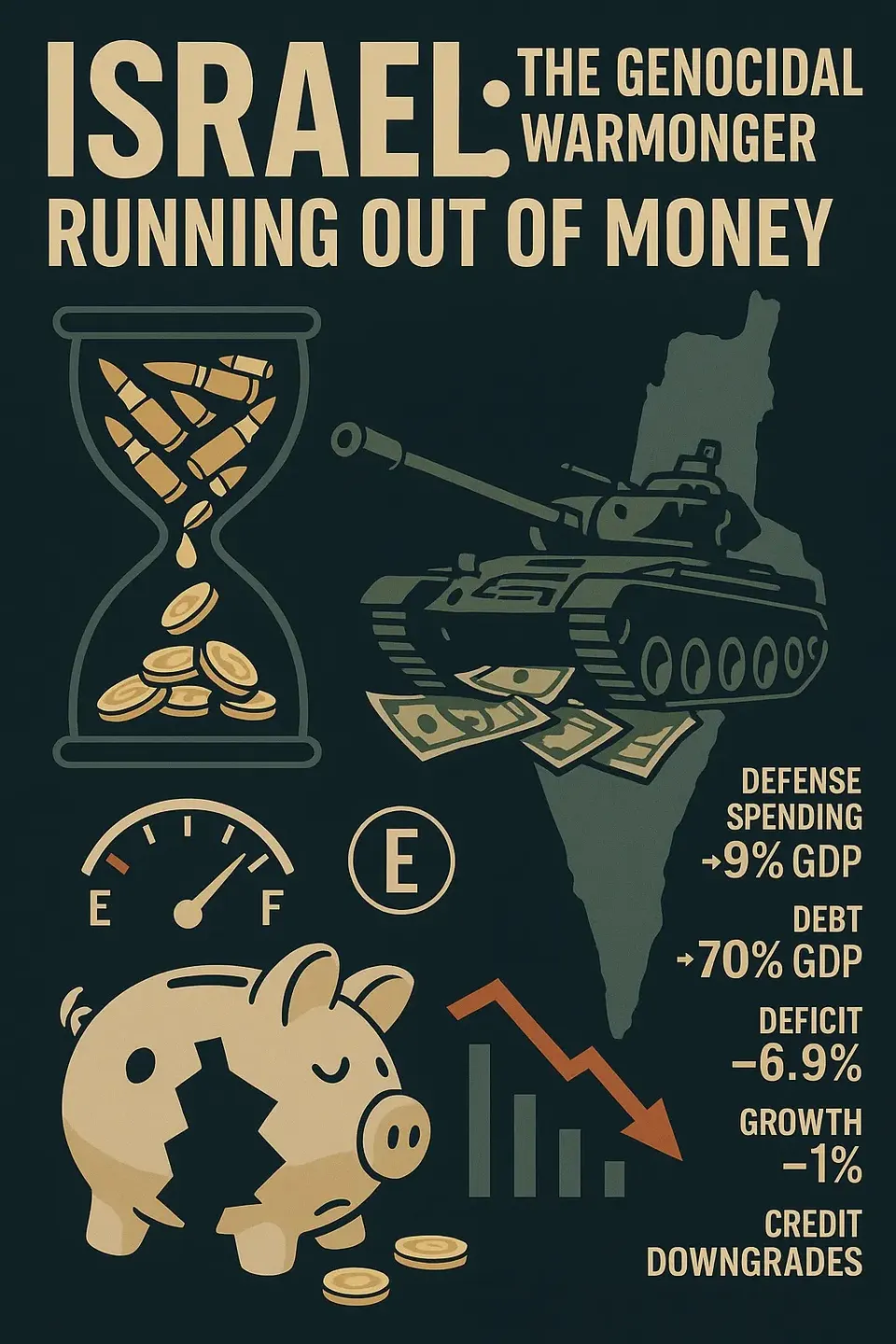
The vital signs are unmistakable:
- Defense spending at 8–9% of GDP
- Debt near 70%
- Deficit at 6.9%
- Growth at 1%
- Credit downgrades
- Capital flight
- 46,000 businesses shuttered
Israel can still fight, but it cannot afford to stop — and cannot afford to continue.
War has become both a political life-support system and an economic subsidy. Ending the emergency would reveal how hollow the civilian economy has become.
The numbers are writing the obituary now. You cannot run a high-tech economy and a forever war. One of them dies first. The only question remaining is whether Israel’s leadership chooses arithmetic — or inertia — before the collapse chooses for them.