Gaza’s Journalists Under Fire: Israel's Al-Shifa Hospital Massacre and the Hind Rajab Foundation’s Pursuit of Justice
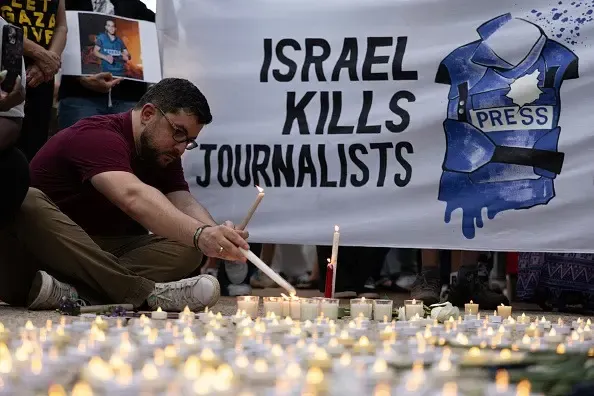
In one of the most brazen assaults yet on the press in Gaza, Israeli forces on Sunday carried out a precision strike on a journalists’ tent just outside the main gate of Al-Shifa Hospital, one of the last functioning reporting sites in northern Gaza. The attack, which survivors described as “surgical,” killed six members of the press and a civilian, and came just hours after an earlier airstrike in Gaza’s Zaytoun neighborhood killed seven children.
The victims at Al-Shifa included some of Gaza’s most prominent and relied-upon reporters:
- Anas al-Sharif, 28, Al Jazeera Arabic correspondent
- Mohammed Qreiqeh, Al Jazeera journalist
- Ibrahim Zaher, Al Jazeera cameraman
- Mohammed Noufal, Al Jazeera cameraman
- Moamen Aliwa, Al Jazeera journalist
- Mohammed al-Khaldi, Sahat Media Platform journalist
- Saad Jundiya, Palestinian civilian present at the time
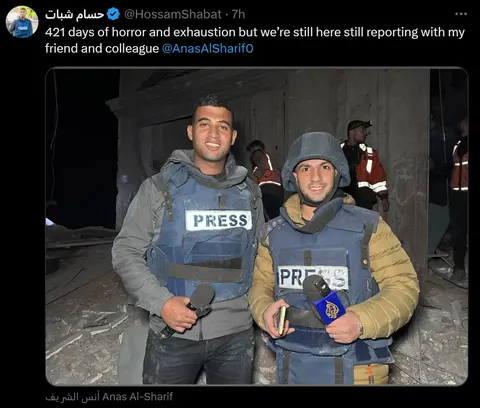
Al-Sharif had reported from Gaza’s front lines since the first days of the war, armed only with a camera and a press vest. Minutes before the missile struck, he was filming fresh bombardments shaking the streets around Al-Shifa.
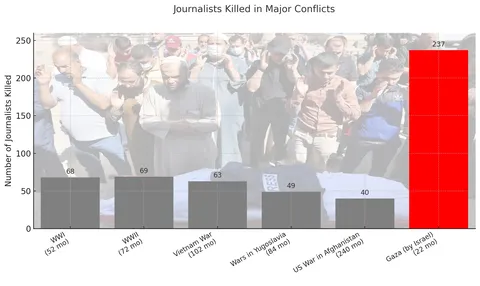
The Israeli military later admitted the strike was deliberate. Their justification was the same line used to defend more than 220 other journalist killings since October 2023 — that the victims were “terrorists in press vests.”
The Smear Before the Strike
The missile was only the final act. For nearly two years, Col. Avichay Adraee, Israel’s Arabic-language military spokesperson, had used social media to accuse Al-Sharif of being a Hamas operative. He mocked his emotional on-air reporting, called his tears “crocodile tears,” and framed his coverage as propaganda.
This smear-and-kill playbook is familiar. Before their assassinations, journalists like Hamza Wael al-Dahdouh, Ismail al-Ghoul, and Hussam Shabat were publicly branded “terrorists” by Israeli officials. Days or weeks later, they were killed in precision strikes, often while wearing clearly marked “PRESS” gear or in vehicles identified as press transport.
Al-Sharif knew his name was on the list. On July 23, 2025, just 18 days before his killing, he recorded a direct appeal to the international press and human rights organizations after another wave of threats from Adraee:
“I really don’t know… what this guy wants from me. He wants me to stop covering the news. He wants me to stop covering the massacres. Despite that, I will continue until my last breath. Whether he threatens me or wants to bomb me, the mission will continue until the last breath. God willing. We are not afraid.”
A Will Written in Advance
In April 2025, days after Israel killed his colleague Hussam Shabat in a targeted drone strike, Al-Sharif wrote a will to be published upon his death:
“If these words reach you, know that Israel has succeeded in killing me and silencing my voice… I entrust you with Palestine… my daughter Shem, my son Salah, my beloved mother, my wife Um Salah Bayan. If I die, I die steadfast upon my principles.”
On August 10, those words became reality.
Hind Rajab: The Girl Behind the Foundation’s Name
The Hind Rajab Foundation (HRF) — co-filer of the ICC case on Al-Sharif’s killing — is named for a five-year-old Palestinian girl whose fate encapsulates the cruelty of Israel’s Gaza campaign.
In January 2024, as her family tried to flee Tel al-Hawa, their car was targeted by an Israeli tank. Hind survived the initial attack, trapped in the blood-soaked vehicle among the bodies of her relatives, and called emergency services. Her pleas, broadcast worldwide, begged for rescue.
After hours of negotiations, an ambulance was sent — only for Israeli forces to obliterate it before reaching her. Hind was killed in the blast, along with the paramedics. UN experts later described the case as a war crime. For HRF’s founders, Hind’s death was the point of no return: the foundation would pursue legal accountability for such crimes, from murdered children to murdered journalists.
The Hunt for Anas al-Sharif’s Killers
On August 12, 2025, HRF and the Palestinian Center for Human Rights (PCHR) filed a joint Article 15 Communication to the International Criminal Court (ICC). The submission targets the military and political chain of command behind Al-Sharif’s killing and places it in the context of a systematic policy of eliminating Gaza’s press corps.
PCHR’s contribution brought detailed case files on other assassinated journalists: Hussam Shabat, Ismail al-Ghoul, Ahmed al-Louh, Hamza Wael al-Dahdouh, Samer Abu Daqa, and others — all killed after being smeared as “terrorists.”
HRF’s investigation reconstructed the strike on Al-Sharif, tracing it from the moment a drone camera locked onto his position to the instant the missile hit. Using operational pattern analysis, signals intelligence, and military expertise, HRF identified the chain of command:
- Lt.-Gen. Eyal Zamir – IDF Chief of General Staff
- Maj.-Gen. Tomer Bar – Commander, Israeli Air Force
- Maj.-Gen. Yaniv Asor – Southern Command Commander
- Brig.-Gen. Yossi Sariel – Former Commander, Unit 8200 (signals intelligence)
- General A. – Current Commander, Unit 8200
- Palmachim Airbase Commander – undisclosed
- “Black Snake” Squadron Commander – undisclosed
- Col. Avichay Adraee – IDF Spokesperson’s Unit, Arab Media Division
At the political summit sits Benjamin Netanyahu, Prime Minister, accused of presiding over — and encouraging — a strategy to eliminate journalists as part of Israel’s genocidal assault on Gaza.
A War on Witnesses
The HRF–PCHR dossier argues that in Gaza, the killing of journalists is not collateral damage but a deliberate method of warfare:
- Label journalists as terrorists without evidence.
- Smear them publicly to dehumanize and prepare public opinion.
- Eliminate them in targeted strikes, often on clearly marked press positions.
With foreign reporters barred from Gaza, local journalists are the last line of independent witness. Silencing them is strategic: without them, the war’s other crimes are hidden from the world.
From Evidence to Action
The ICC submission accuses the named figures of:
- War crimes under Article 8(2)(a)(i) of the Rome Statute (willful killing)
- Genocide under Article 6(a) of the Rome Statute (as part of a campaign to destroy the Palestinian people and erase their chroniclers)
The filing makes three urgent demands:
- Issue arrest warrants for the military officials named.
- Expand Netanyahu’s arrest warrant to include crimes against journalists.
- Formally incorporate all 220+ journalist killings into the ICC’s Palestine investigation.
Beyond The Hague
HRF stresses this is not symbolic litigation. It is tracking suspects, mapping their movements, and preparing to prosecute in any country with universal jurisdiction over war crimes and genocide. The foundation set a precedent in July 2025 when two Israeli soldiers visiting Belgium were arrested and interrogated for Gaza war crimes — the first such arrests abroad. Though later released, the case remains open and was referred to the ICC.
HRF Chairman Dyab Abou Jahjah:
“The assassination of Anas al-Sharif was so blunt, so arrogant, and so drenched in contempt for human life, truth, the legal order, and humanity itself, that it cannot and will not be allowed to pass into silence.”
The Message to the ICC
The HRF–PCHR case insists the court already has jurisdiction, the evidence, and the legal basis. What is missing is action. To delay is not neutrality, the submission says — it is complicity. Killing journalists is not a footnote to war; it is the method by which every other war crime is concealed.
Anas al-Sharif understood that better than most. His last prepared words still echo online:
“If these words of mine reach you, know that Israel has succeeded in killing me and silencing my voice.”
The case now before the ICC ensures that voice — and the voices of hundreds of other silenced reporters — will rise again, in court filings, in arrest warrants, and in the historical record. They will testify not just to the courage of those who bore witness, but to the obligation of the world to defend them.
The Journalists Named in the HRF–PCHR ICC Submission
The joint Article 15 communication to the ICC is more than a list of names — it is a catalogue of Gaza’s most dedicated reporters, each of whom paid the ultimate price for documenting Israel’s assault.
Anas al-Sharif – Al Jazeera Arabic Correspondent, Gaza City
Age: 28 — Killed: August 10, 2025, in the Al-Shifa Hospital courtyard strike. Known for his calm, measured delivery under fire and his determined coverage of Gaza’s starvation crisis. Directly threatened by Avichay Adraee weeks before his death. Left a will entrusting the world with his children, wife, and Palestine itself.
Mohammed Qreiqeh – Al Jazeera Journalist
Killed alongside al-Sharif on August 10. Specialized in documenting the immediate aftermath of bombardments and interviewing survivors before their stories could be lost.
Ibrahim Zaher – Al Jazeera Cameraman
Killed August 10. Captured some of Al Jazeera’s most iconic footage from Gaza, often filming under direct fire.
Mohammed Noufal – Al Jazeera Cameraman
Killed August 10. Filmed the now-viral clip of al-Sharif vowing to continue reporting “until my last breath.”
Moamen Aliwa – Al Jazeera Journalist
Killed August 10. Focused on the impact of the war on Gaza’s schools and universities. Died while reporting on the siege of Al-Shifa.
Mohammed al-Khaldi – Sahat Media Platform Journalist
Killed August 10. Embedded with displaced families in northern Gaza. His last work documented disease outbreaks in shelters.
Samer Abu Daqa – Al Jazeera Cameraman
Killed December 15, 2023, in Khan Younis. Bled to death after rescue crews were prevented from reaching him.
Hamza Wael al-Dahdouh – Al Jazeera Cameraman
Killed January 7, 2024, in Rafah. Son of Al Jazeera bureau chief Wael al-Dahdouh. Targeted while wearing press gear.
Ismail al-Ghoul – Al Jazeera Correspondent
Killed April 2024 in a strike on his press convoy. Targeted after an online smear campaign.
Hussam Shabat – Freelance Journalist
Killed April 2025 in a targeted drone strike. His death prompted al-Sharif to write his will.
Ahmed al-Louh – Freelance Journalist and Photographer
Killed in late 2024 in a “double tap” strike aimed at rescuers.
A Symbol That Binds the Case Together
Hind Rajab’s final hours — a terrified five-year-old begging for rescue while surrounded by the bodies of her family, only to be killed when the ambulance came — are more than a tragedy. They are the purest distillation of the policy that the Hind Rajab Foundation now fights in court: to erase witnesses, silence testimony, and make the truth itself a casualty. From a child’s desperate phone call in Tel al-Hawa to the last broadcast of Anas al-Sharif outside Al-Shifa, the pattern is the same. It is why the ICC case is not just about justice for one journalist or one little girl, but about defending the very possibility that the world can know, and remember, what happened in Gaza — before those who fear the truth succeed in erasing it forever.